
Statistics Canada's Job Numbers Are Noisier Than the Headlines Suggest
Monthly employment changes carry confidence intervals wide enough to swallow most reported moves.
By Élise Galarneau3 min readTranslation: human
本文目前仅提供英文版本。
Sample size
~100,000
Households surveyed
Confidence interval
Tens of thousands
Monthly change
Better series
Hours worked
Leads headcount
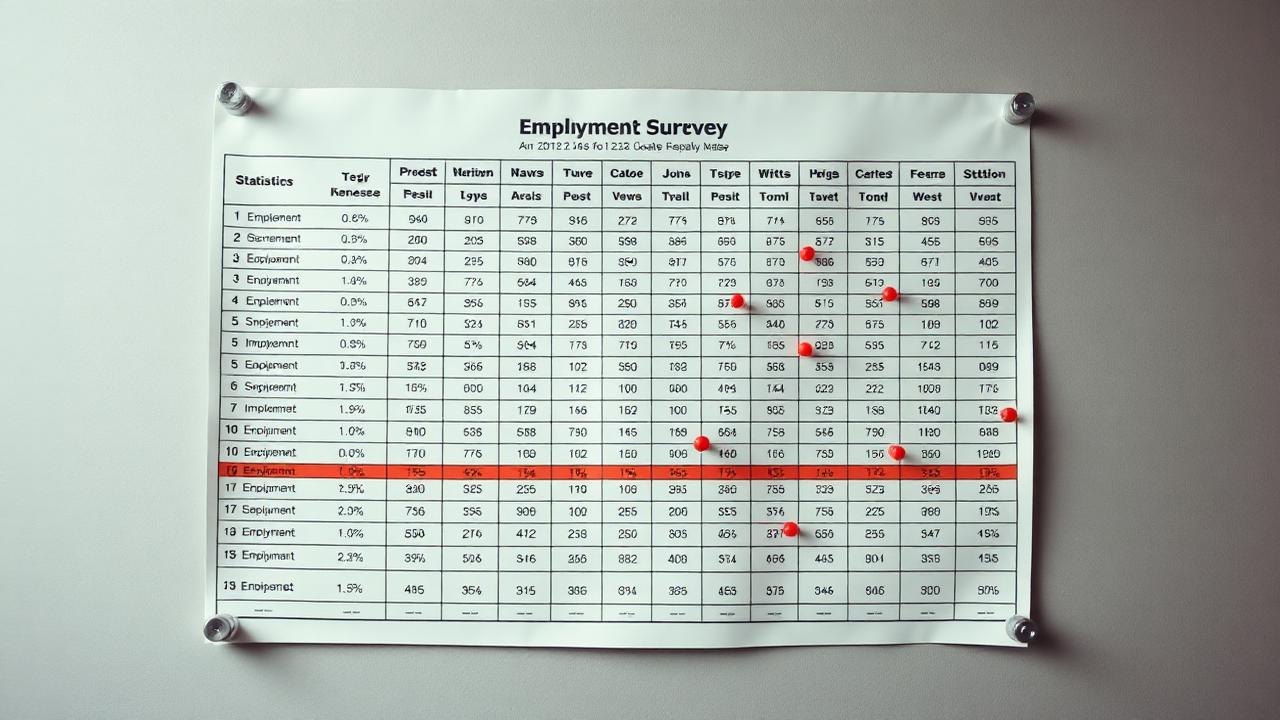
The Labour Force Survey reports a monthly change in employment that markets treat as precise, moving currency and rate expectations on a single figure. The survey's own documentation puts a confidence interval around that number wide enough to include zero in most months, meaning the headline change is frequently not statistically distinguishable from no change at all. Understanding why the number is noisier than the reaction it generates is a matter of understanding how the survey is constructed, not a criticism of Statistics Canada's methodology.
The statistics
The Labour Force Survey samples roughly one hundred thousand individuals across the country each month, a substantial sample by survey standards but still a sample, not a census, and every sample carries sampling error. Statistics Canada publishes a ninety-five per cent confidence interval on the monthly employment change, and that interval routinely spans tens of thousands of jobs in either direction around the reported figure. A headline gain that falls inside that band cannot be distinguished, statistically, from no change in employment at all, even though markets and commentary routinely treat it as a definitive data point. This is not a flaw unique to the Canadian survey; it is an inherent feature of any survey-based employment estimate, and it means that a single month's reported number should be treated as one noisy observation rather than a standalone signal.
Why the market reaction outruns the signal
Employment data is scheduled, widely watched and directly tied to central bank policy expectations, which creates strong incentives for market participants to react quickly regardless of how reliable any single print actually is. The reaction is genuine and moves rates, currency and equity pricing in the short run, even when the underlying number carries little statistical information. This is a case where understanding the mechanics of the release is more useful than either ignoring the data or overreacting to it: a trader positioned around the release needs to know the reaction will happen, while an investor assessing the state of the labour market needs to discount any single month heavily.
What to read instead
Three-month moving averages smooth over the sampling noise inherent in any one month and give a more reliable read on the underlying trend in employment. The participation rate — the share of the working-age population employed or actively looking for work — captures dynamics that a simple headcount change misses, including discouraged workers leaving the labour force, which can make an unemployment rate look better than the underlying trend actually is. Hours worked, a separate series within the same release, tends to lead headcount changes, because employers typically adjust the hours of existing staff before they adjust headcount in either direction. Wage growth, reported with its own separate methodology, adds information about labour market tightness that a change in the number of people employed does not capture on its own.
Revisions compound the noise
Beyond the confidence interval on any given month, the Labour Force Survey estimates are also subject to revision as additional data and seasonal adjustment factors are incorporated, meaning the figure reported in real time is not necessarily the figure that stands once later data has been folded in. A reader relying heavily on a single month's initial estimate is relying on a number that may look different in retrospect once revisions are applied, which reinforces the case for weighting trend measures over any single release.
Putting the release in context
None of this means the Labour Force Survey is unreliable as a measure of the labour market over time; averaged across several months, it is one of the more informative economic series available. The issue is specifically the practice of treating a single month's change as a precise, standalone data point worth an immediate and large market reaction, when the survey's own published confidence interval says otherwise.
What to watch
Track the three-month moving average of employment change rather than the single-month figure, the participation rate alongside the unemployment rate, hours worked as a leading indicator, wage growth for signs of labour market tightness, and subsequent revisions to prior months' reported figures.
披露声明
Information only. Not investment advice. The Maple Markets does not hold positions in securities discussed.
接着阅读
英文版: Statistics Canada's Job Numbers Are Noisier Than the Headlines Suggest
 Mining & EnergyVault Strategic在内华达州:四个月专注于一处钨矿项目2026年7月3日,Vault Strategic Mining放弃另外两项钨矿期权,集中力量开发War Bond。War Bond位于内华达州西部,是1950年代曾经产钨的矿山。此后公司公布了地表采样结果,完成了73.6测线公里的磁法航测,完成150万加元配售,并启动首份NI 43-101技术报告。公司尚未给出报告日期;截至2026年11月30日的六个月财务报表是下一份计划提交的文件。Daniel Okoye · November 4, 2026 · 7 min
 Mining & EnergyQIMC规划横跨三省、总长126.5公里的地震勘探Quebec Innovative Materials已完成新斯科舍省Cumberland县63.7测线公里的地震数据采集。其土壤气、氦、重力和磁法工作以及DDH-26-05钻孔的气体事件都位于同一测网内,目前正在卡尔加里处理。公司还计划与相同承包商在魁北克完成36公里、在安大略完成26.8公里,已完成和计划的覆盖范围合计约126.5测线公里。截至2026年6月30日,公司持有现金1,410万加元。Priya Sandhu · November 3, 2026 · 7 min
 TechnologyReklaim连续第三个季度盈利,股价上涨45%Reklaim Ltd.于2026年11月3日公布,截至9月30日的季度营收同比增长近两倍,达到316万加元,净利润127万加元,为连续第三个盈利季度。该股在多伦多创业板收于C$0.40,上涨45%,成交193万股。公司当季回购510万股;前一天,公司提议允许C$500,000可转换债券的持有人按现行C$0.105的价格提前转股,此事尚待多伦多创业板批准。Marc Belzile · November 3, 2026 · 6 min
订阅 Maple Morning Debrief
前一交易日收盘、隔夜行情,以及开盘前值得关注的要点 —— 美东时间早上 6 点前送达您的邮箱。免费,一键退订。
Follow and ask
Get more of our Canadian market coverage in Google Top Stories.
资料来源与参考 (3)
引用本文分析
Please attribute The Maple Markets and link to the original page.
Élise Galarneau (June 12, 2026). Statistics Canada's Job Numbers Are Noisier Than the Headlines Suggest. The Maple Markets. https://themaplemarkets.ca/zh-hans/newsroom/statistics-canada-s-job-numbers-are-noisier-than-the-headlines-suggesthttps://themaplemarkets.ca/zh-hans/newsroom/statistics-canada-s-job-numbers-are-noisier-than-the-headlines-suggest