
The Canada–U.S. Rate Gap Is a Signal, Not a Loonie Forecast
A policy differential is a starting condition. Currencies price entire economies.
The Bank of Canada's target sits well below the federal-funds range. That is factual. The conclusion that the loonie must therefore weaken is not.
By Élise Galarneau2 min read
本文目前仅提供英文版本。
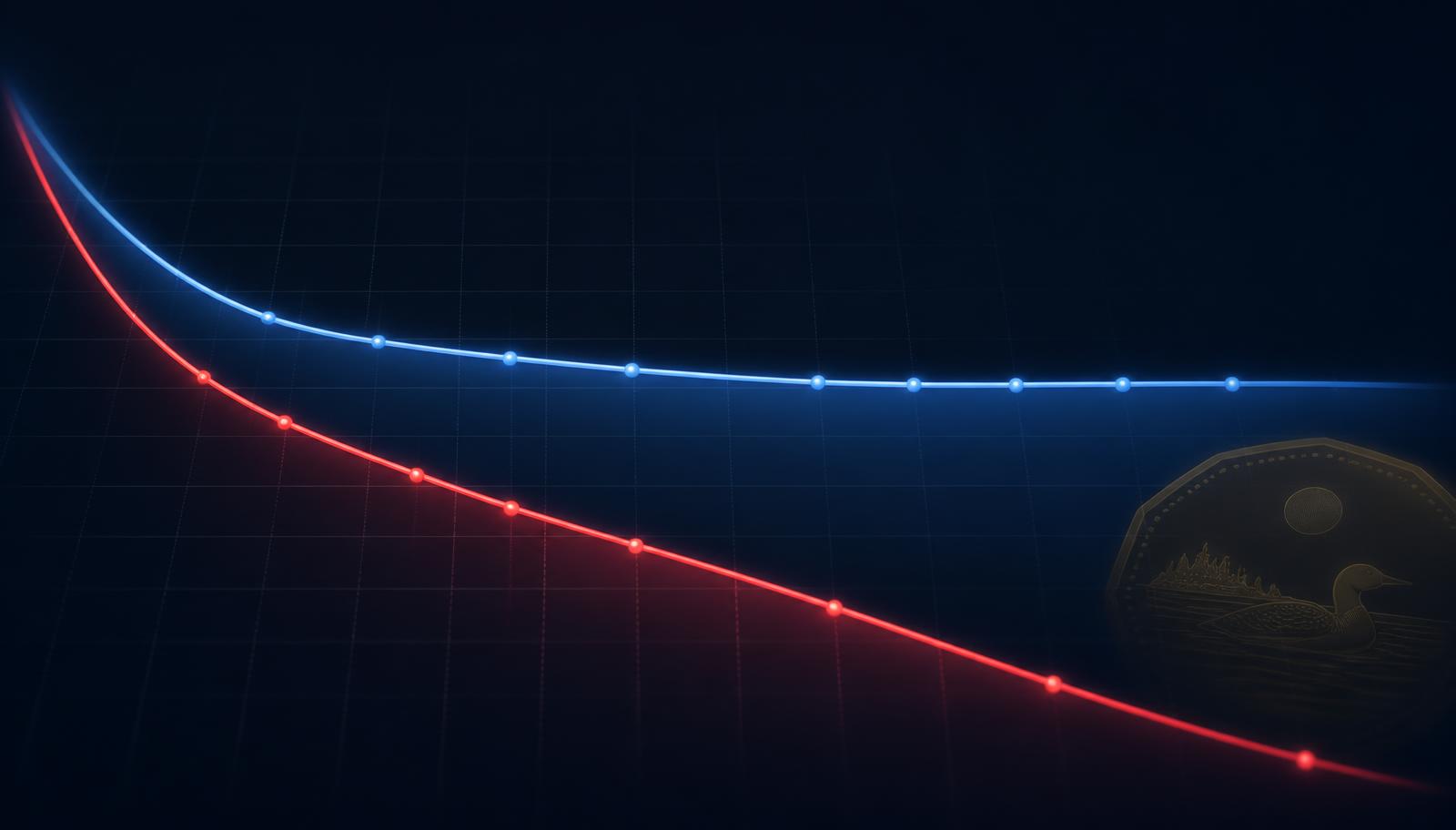
It is tempting to turn the Canadian dollar into a one-variable trade.
The Bank of Canada rate is lower than the Federal Reserve's rate. Therefore, the argument goes, investors should prefer U.S.-dollar assets and the Canadian dollar should weaken.
The first statement is currently factual. The second is not automatic.
The starting condition
The Bank of Canada held its overnight target at 2.25% on July 15, 2026. The Federal Reserve subsequently maintained a federal-funds target range of 3.50%–3.75% on July 29. That places the U.S. policy rate roughly 125–150 basis points above Canada's, depending on the point in the Fed range used for comparison.
The differential matters because capital has an opportunity cost. All else equal, a higher short-term U.S. yield can make U.S.-dollar assets comparatively attractive.
"All else equal" is doing considerable work.
Currencies are relative prices for entire economies. Rate expectations matter, but so do trade flows, commodity income, growth, fiscal policy, inflation, risk appetite and — most importantly — expectations about where policy is headed rather than where it is.
Both central banks are uncertain
Canada currently provides a useful example. Statistics Canada reported real GDP growth of 0.8% in the second quarter of 2026, a July unemployment rate of 6.4% and CPI inflation of 3.0% year over year in July. The Bank of Canada's July outlook described the economy as weak but showing signs of improvement, while projecting growth to pick up and inflation to move back toward roughly 2%, subject to elevated uncertainty.
The Federal Reserve's July decision revealed its own uncertainty. Nine FOMC members voted to hold the funds rate at 3.50%–3.75%, while three preferred a 25-basis-point increase. The minutes described inflation as elevated relative to the 2% objective.
The question that actually matters
Today's differential should be read as a starting condition, not a forecast. The more useful question is what the market is likely to believe about the differential six or twelve months from now.
If Canadian growth accelerates and the Bank of Canada becomes less dovish while the Fed eventually eases, the expected gap can narrow before either central bank moves. If Canadian activity deteriorates or trade shocks force the Bank to ease further while U.S. inflation proves persistent, the expected gap can widen.
The currency typically reacts to the changing expectation before the decisions arrive.
Two decisions, not one
Canadian investors converting large amounts of capital into U.S. dollars should separate two decisions that are frequently combined by accident.
The first is an asset decision: is the U.S. security attractive?
The second is a currency decision: is the investor comfortable owning the USD exposure, and over what horizon?
A Canadian investor can be correct about a U.S. equity and wrong about the currency, or the reverse. Hedged and unhedged versions of the same ETF exist precisely because these are separable choices.
The rate differential is valuable information. It is not a complete investment thesis.
Policy rates cited reflect the most recent decisions as of publication; the framework is unchanged by subsequent meetings.
披露声明
As of the publication date, the author, editor, publisher, their immediate households and affiliated entities do not own positions in the securities discussed. The Maple Markets received no compensation from any company, its officers, investor-relations providers or financiers in connection with this article. Figures are drawn from public filings and official statistical releases as of the date shown and are not restated for later disclosure. Worked examples labelled illustrative use assumed inputs to show a method, not a forecast. This article is informational only and is not investment, legal, accounting or tax advice.
接着阅读
英文版: The Canada–U.S. Rate Gap Is a Signal, Not a Loonie Forecast
 Mining & EnergyVault Strategic在内华达州:四个月专注于一处钨矿项目2026年7月3日,Vault Strategic Mining放弃另外两项钨矿期权,集中力量开发War Bond。War Bond位于内华达州西部,是1950年代曾经产钨的矿山。此后公司公布了地表采样结果,完成了73.6测线公里的磁法航测,完成150万加元配售,并启动首份NI 43-101技术报告。公司尚未给出报告日期;截至2026年11月30日的六个月财务报表是下一份计划提交的文件。Daniel Okoye · November 4, 2026 · 7 min
 Mining & EnergyQIMC规划横跨三省、总长126.5公里的地震勘探Quebec Innovative Materials已完成新斯科舍省Cumberland县63.7测线公里的地震数据采集。其土壤气、氦、重力和磁法工作以及DDH-26-05钻孔的气体事件都位于同一测网内,目前正在卡尔加里处理。公司还计划与相同承包商在魁北克完成36公里、在安大略完成26.8公里,已完成和计划的覆盖范围合计约126.5测线公里。截至2026年6月30日,公司持有现金1,410万加元。Priya Sandhu · November 3, 2026 · 7 min
 TechnologyReklaim连续第三个季度盈利,股价上涨45%Reklaim Ltd.于2026年11月3日公布,截至9月30日的季度营收同比增长近两倍,达到316万加元,净利润127万加元,为连续第三个盈利季度。该股在多伦多创业板收于C$0.40,上涨45%,成交193万股。公司当季回购510万股;前一天,公司提议允许C$500,000可转换债券的持有人按现行C$0.105的价格提前转股,此事尚待多伦多创业板批准。Marc Belzile · November 3, 2026 · 6 min
订阅 Maple Morning Debrief
前一交易日收盘、隔夜行情,以及开盘前值得关注的要点 —— 美东时间早上 6 点前送达您的邮箱。免费,一键退订。
Follow and ask
Get more of our Canadian market coverage in Google Top Stories.
资料来源与参考 (3)
- Bank of Canada — July 2026 policy decision and Monetary Policy Report
- Federal Reserve — July 2026 FOMC statement and minutes
- Statistics Canada — current economic indicators
引用本文分析
Please attribute The Maple Markets and link to the original page.
Élise Galarneau (September 4, 2026). The Canada–U.S. Rate Gap Is a Signal, Not a Loonie Forecast. The Maple Markets. https://themaplemarkets.ca/zh-hans/newsroom/canada-us-rate-gap-is-a-signal-not-a-loonie-forecasthttps://themaplemarkets.ca/zh-hans/newsroom/canada-us-rate-gap-is-a-signal-not-a-loonie-forecast