
The Canada–U.S. Rate Gap Is a Signal, Not a Loonie Forecast
A policy differential is a starting condition. Currencies price entire economies.
The Bank of Canada's target sits well below the federal-funds range. That is factual. The conclusion that the loonie must therefore weaken is not.
By Élise Galarneau2 min read
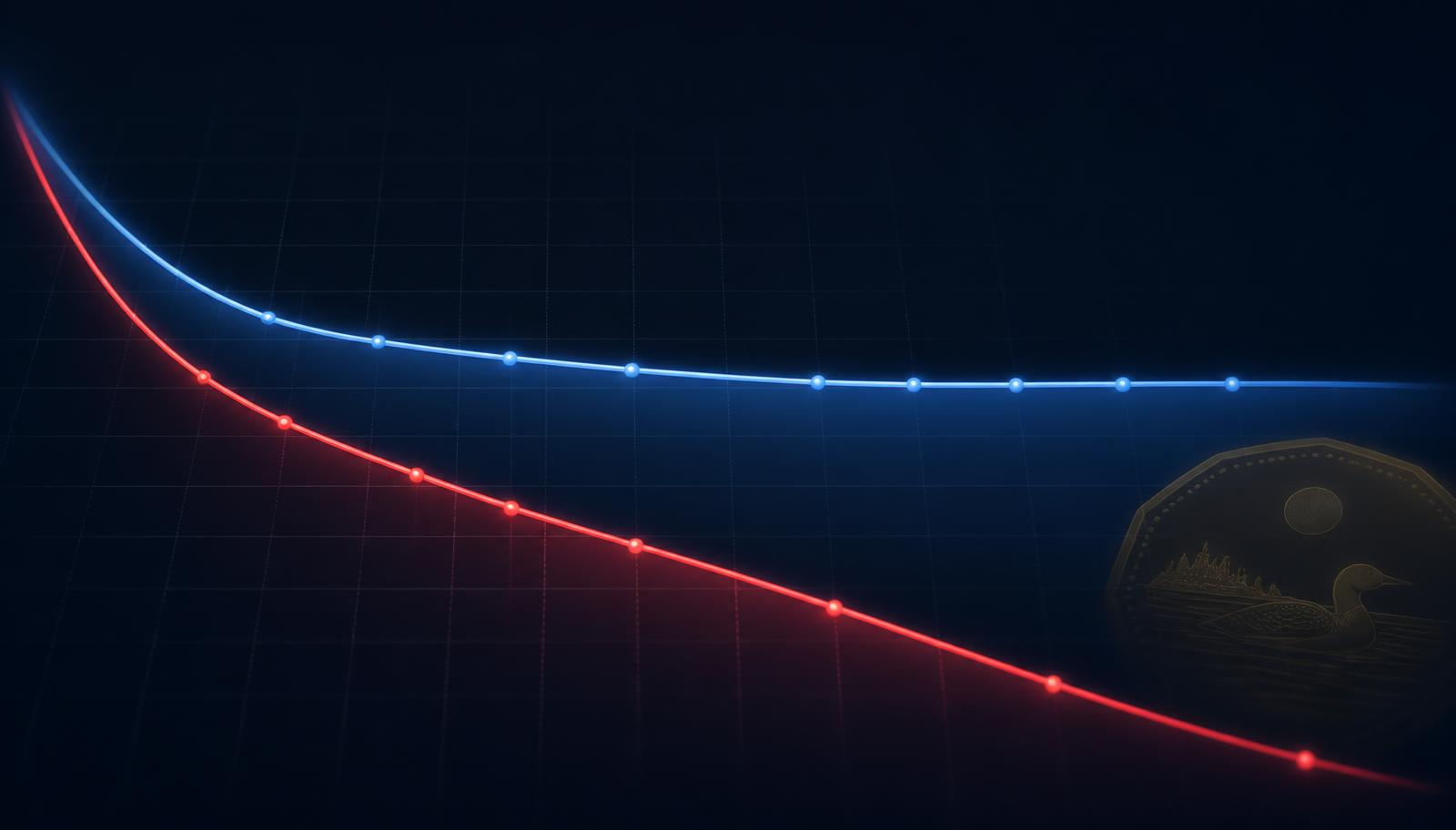
It is tempting to turn the Canadian dollar into a one-variable trade.
The Bank of Canada rate is lower than the Federal Reserve's rate. Therefore, the argument goes, investors should prefer U.S.-dollar assets and the Canadian dollar should weaken.
The first statement is currently factual. The second is not automatic.
The starting condition
The Bank of Canada held its overnight target at 2.25% on July 15, 2026. The Federal Reserve subsequently maintained a federal-funds target range of 3.50%–3.75% on July 29. That places the U.S. policy rate roughly 125–150 basis points above Canada's, depending on the point in the Fed range used for comparison.
The differential matters because capital has an opportunity cost. All else equal, a higher short-term U.S. yield can make U.S.-dollar assets comparatively attractive.
"All else equal" is doing considerable work.
Currencies are relative prices for entire economies. Rate expectations matter, but so do trade flows, commodity income, growth, fiscal policy, inflation, risk appetite and — most importantly — expectations about where policy is headed rather than where it is.
Both central banks are uncertain
Canada currently provides a useful example. Statistics Canada reported real GDP growth of 0.8% in the second quarter of 2026, a July unemployment rate of 6.4% and CPI inflation of 3.0% year over year in July. The Bank of Canada's July outlook described the economy as weak but showing signs of improvement, while projecting growth to pick up and inflation to move back toward roughly 2%, subject to elevated uncertainty.
The Federal Reserve's July decision revealed its own uncertainty. Nine FOMC members voted to hold the funds rate at 3.50%–3.75%, while three preferred a 25-basis-point increase. The minutes described inflation as elevated relative to the 2% objective.
The question that actually matters
Today's differential should be read as a starting condition, not a forecast. The more useful question is what the market is likely to believe about the differential six or twelve months from now.
If Canadian growth accelerates and the Bank of Canada becomes less dovish while the Fed eventually eases, the expected gap can narrow before either central bank moves. If Canadian activity deteriorates or trade shocks force the Bank to ease further while U.S. inflation proves persistent, the expected gap can widen.
The currency typically reacts to the changing expectation before the decisions arrive.
Two decisions, not one
Canadian investors converting large amounts of capital into U.S. dollars should separate two decisions that are frequently combined by accident.
The first is an asset decision: is the U.S. security attractive?
The second is a currency decision: is the investor comfortable owning the USD exposure, and over what horizon?
A Canadian investor can be correct about a U.S. equity and wrong about the currency, or the reverse. Hedged and unhedged versions of the same ETF exist precisely because these are separable choices.
The rate differential is valuable information. It is not a complete investment thesis.
Policy rates cited reflect the most recent decisions as of publication; the framework is unchanged by subsequent meetings.
Weiterlesen
Also in English: The Canada–U.S. Rate Gap Is a Signal, Not a Loonie Forecast
 EconomyVier in Kanada notierte Unternehmen meldeten diese Woche Staatsgeld, und keiner der Beträge war BargeldZwischen dem 15. und dem 18. September 2026 meldeten Conifex Timber, Global Atomic, First Phosphate und Bitterroot Resources jeweils, dass eine Regierung Geld hinter sie gestellt hat: bis zu C$30 Millionen, US$414.2 Millionen, US$212.5 Millionen und bis zu US$5.22 Millionen. Vier Meldungen, vier Instrumente, und keines davon ist eine Überweisung. Was ein Darlehensvertrag, eine bedingte Zusage, eine Exportkredit-Unterstützungserklärung und eine Kostenteilungszusage jeweils verpflichten, und was zutreffen muss, bevor das Geld ankommt.Marc Belzile · 19. September 2026 · 10 min
 EconomyVier Dinge, die ein kanadischer Bergbaukonzern über ein Bohrloch sagen kann, und was jedes davon wert istEin kanadisches Explorationsunternehmen ohne Laborwerte legte am 9. September 2026 um 93.8 Prozent zu. Ein Unternehmen, das Laborwerte veröffentlichte, verlor am Tag darauf 35 Prozent. Die kanadische Bergbau-Offenlegung kennt vier getrennte Nachweisstufen, und die meiste Verwirrung in einer Bohrergebnis-Woche entsteht, wenn sie als eine behandelt werden.Priya Sandhu · 13. September 2026 · 8 min
 EconomyVier der stärksten Kursverluste an der Börse Toronto in dieser Woche waren Fonds, und drei davon hielten eine einzige AktieAm 9. September 2026 waren vier der zehn größten Kursverluste an der Börse Toronto börsengehandelte Fonds. Drei davon halten nichts außer Shopify und fielen am selben Tag um 27.83, 14.97 und 14.90 Prozent, bezogen auf dasselbe Unternehmen. Ein vierter, ein Anleihefonds mit fester Fälligkeit, hatte fünf Sitzungen zuvor auf 2,000 Units einen Kursgewinn von 38.59 Prozent gedruckt und gab ihn vollständig wieder ab. Hier steht, was jede dieser Zahlen tatsächlich gemessen hat und wo der Anbieter die Zahl veröffentlicht, die kein Kurs ist.Marc Belzile · 12. September 2026 · 6 min
Den Maple Morning Debrief erhalten
Der gestrige Schluss, die Nacht und worauf Sie vor der Eröffnung achten sollten — bis 6 Uhr ET in Ihrem Postfach. Kostenlos, Abmeldung mit einem Klick.
Folgen und fragen
Mehr von unserer Berichterstattung zu den kanadischen Märkten in Google Top Stories.
Offenlegung
As of the publication date, the author, editor, publisher, their immediate households and affiliated entities do not own positions in the securities discussed. The Maple Markets received no compensation from any company, its officers, investor-relations providers or financiers in connection with this article. Figures are drawn from public filings and official statistical releases as of the date shown and are not restated for later disclosure. Worked examples labelled illustrative use assumed inputs to show a method, not a forecast. This article is informational only and is not investment, legal, accounting or tax advice. Lesen Sie den finanziellen Haftungsausschluss.
Quellen und Verweise (3)
- Bank of Canada — July 2026 policy decision and Monetary Policy Report
- Federal Reserve — July 2026 FOMC statement and minutes
- Statistics Canada — current economic indicators
Diese Analyse zitieren
Bitte The Maple Markets nennen und auf die Originalseite verlinken.
Élise Galarneau (4. September 2026). The Canada–U.S. Rate Gap Is a Signal, Not a Loonie Forecast. The Maple Markets. https://themaplemarkets.ca/de/newsroom/canada-us-rate-gap-is-a-signal-not-a-loonie-forecasthttps://themaplemarkets.ca/de/newsroom/canada-us-rate-gap-is-a-signal-not-a-loonie-forecast