
Canadian Grocery Margins: Pricing Power Under Political Scrutiny
Gross margin, private label mix and the difference between food and everything else in the basket
Canadian grocers earn thin margins on food and better margins on everything else in the store. The public debate conflates the two, and so do a lot of investors.
By Hannah Kuan3 min read
本文目前仅提供英文版本。
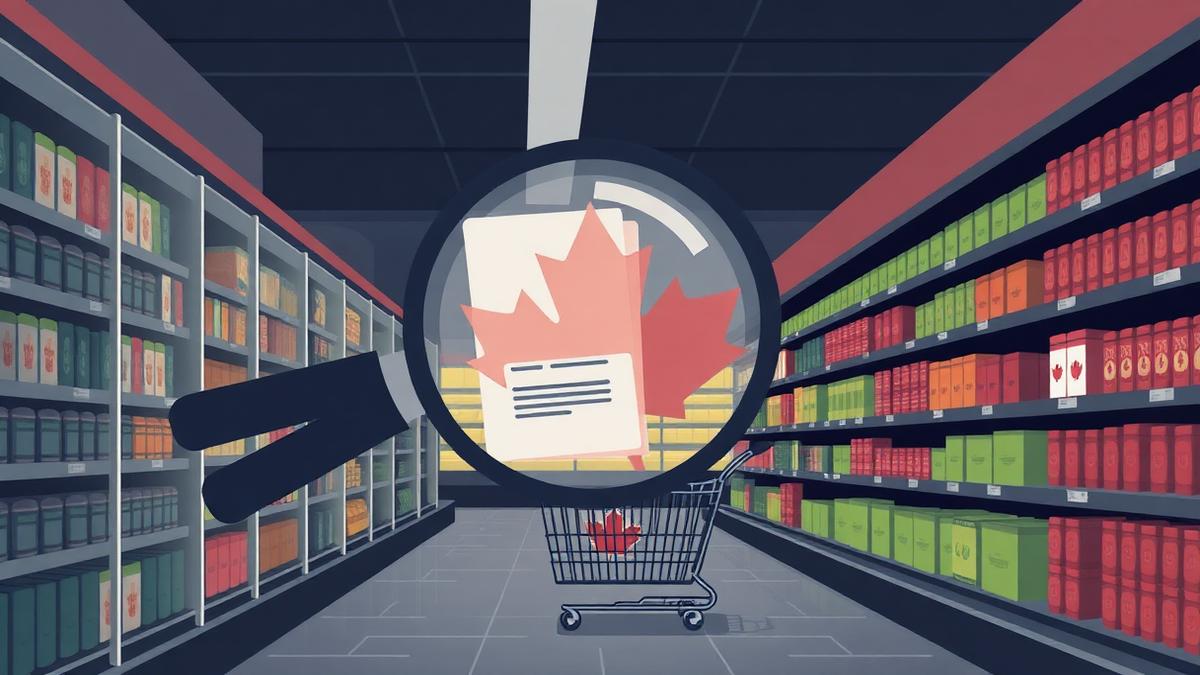
Canadian grocery is a concentrated industry, politically exposed, and consistently misunderstood in public discussion. The claim that grocers profiteered during food inflation and the claim that grocery is a razor-thin margin business are both supported by selectively chosen numbers. The reconciliation is mix.
The margin structure
A large Canadian grocery retailer's net margin is typically in the low single digits — often around 3-4% of revenue. That figure is accurate and is the number the industry cites.
Gross margin tells a different story, because it is not uniform across the store:
- Centre-store packaged food and fresh carry the thinnest gross margins. Competition is direct and price comparison is easy.
- Private label carries materially higher gross margin than the equivalent national brand, because the retailer captures the brand margin.
- Pharmacy operates on prescription reimbursement economics, with front-store retail attached at higher margin.
- General merchandise, health and beauty, and apparel carry the highest gross margins in the store.
- Financial services, loyalty programme monetisation and retail media — advertising sold to suppliers for placement in-store and in apps — carry very high margins and have grown rapidly.
So a grocer can report expanding gross margin during a period of food inflation without raising food margins at all, if the mix shifted toward pharmacy, general merchandise, private label or retail media. Segment disclosure allows this to be partially unpicked, and the honest reading requires doing so before drawing a conclusion in either direction.
What food inflation does mechanically
When food costs rise and a retailer passes through the cost at a constant percentage margin, gross profit dollars rise while gross margin percentage stays flat. Revenue rises; profit rises; the margin ratio does not move. This is not price gouging, and it is also not nothing — it is real dollar profit growth generated by inflation.
Where the debate has substance is in the timing asymmetry: costs pass through to shelf quickly on the way up and more slowly on the way down. This is observable in the gap between Statistics Canada's industrial product price index for food manufacturing and the food component of CPI. A widening gap during disinflation is the evidence-based version of the argument.
Private label is the strategic variable
Private label penetration rises during periods of consumer stress, as shoppers trade down. For the retailer this is favourable: the trade-down retains the customer and improves gross margin per unit even as the ticket price falls.
The metrics to watch:
- Private label penetration, disclosed qualitatively or as a percentage by most Canadian grocers.
- Same-store sales split between ticket and traffic. Rising ticket with falling traffic is inflation without volume. Rising traffic with flat ticket is genuine share gain.
- Tonnage or unit volume growth, where disclosed — the cleanest read on real demand.
The regulatory overhang
Canadian grocery faces sustained political attention: parliamentary hearings, a grocery code of conduct governing retailer-supplier relations, and Competition Bureau study of the sector's concentration. The realistic risks to model are not dramatic:
- Code of conduct compliance limits certain fees charged to suppliers, modestly compressing a real profit source.
- Merger review effectively forecloses further consolidation among the largest players, capping one growth path.
- Reputational pressure on pricing during inflationary episodes, which has produced voluntary price-freeze commitments — a real constraint on pass-through during the period it applies.
Outright price regulation of Canadian grocery has not been seriously advanced, and modelling it as the base case is not supported by the policy record. Modelling continued scrutiny, higher compliance cost and constrained M&A is.
The analytical checklist
- Segment revenue and profit: food retail versus pharmacy versus other.
- Gross margin by segment, tracked over eight quarters rather than year over year.
- Same-store sales decomposed into traffic and ticket.
- Private label penetration trend.
- Retail media and loyalty revenue, where separately disclosed — small in revenue, disproportionate in profit.
- Capital allocation: store renovation capex, buyback pace, and whether square footage is growing or being converted to discount banners.
Discount banner conversion is the quiet indicator worth ending on. When a grocer converts conventional stores to its discount format, it is forecasting the Canadian consumer more explicitly than any management commentary will.
披露声明
As of the publication date, the author, editor, publisher, their immediate households and affiliated entities do not own positions in the securities discussed. The Maple Markets received no compensation from any company, its officers, investor-relations providers or financiers in connection with this article. Figures are drawn from public filings as of the date shown and are not restated for later disclosure. Worked examples labelled illustrative use assumed inputs to show a method, not a forecast. This article is informational only and is not investment, legal, accounting or tax advice.
接着阅读
英文版: Canadian Grocery Margins: Pricing Power Under Political Scrutiny
 Mining & EnergyVault Strategic在内华达州:四个月专注于一处钨矿项目2026年7月3日,Vault Strategic Mining放弃另外两项钨矿期权,集中力量开发War Bond。War Bond位于内华达州西部,是1950年代曾经产钨的矿山。此后公司公布了地表采样结果,完成了73.6测线公里的磁法航测,完成150万加元配售,并启动首份NI 43-101技术报告。公司尚未给出报告日期;截至2026年11月30日的六个月财务报表是下一份计划提交的文件。Daniel Okoye · November 4, 2026 · 7 min
 Mining & EnergyQIMC规划横跨三省、总长126.5公里的地震勘探Quebec Innovative Materials已完成新斯科舍省Cumberland县63.7测线公里的地震数据采集。其土壤气、氦、重力和磁法工作以及DDH-26-05钻孔的气体事件都位于同一测网内,目前正在卡尔加里处理。公司还计划与相同承包商在魁北克完成36公里、在安大略完成26.8公里,已完成和计划的覆盖范围合计约126.5测线公里。截至2026年6月30日,公司持有现金1,410万加元。Priya Sandhu · November 3, 2026 · 7 min
 TechnologyReklaim连续第三个季度盈利,股价上涨45%Reklaim Ltd.于2026年11月3日公布,截至9月30日的季度营收同比增长近两倍,达到316万加元,净利润127万加元,为连续第三个盈利季度。该股在多伦多创业板收于C$0.40,上涨45%,成交193万股。公司当季回购510万股;前一天,公司提议允许C$500,000可转换债券的持有人按现行C$0.105的价格提前转股,此事尚待多伦多创业板批准。Marc Belzile · November 3, 2026 · 6 min
Follow this story
Follow L, MRU — the next Maple piece on these companies, plus the Maple Morning Debrief before the open.
Follow and ask
Get more of our Canadian market coverage in Google Top Stories.
资料来源与参考 (3)
引用本文分析
Please attribute The Maple Markets and link to the original page.
Hannah Kuan (August 31, 2026). Canadian Grocery Margins: Pricing Power Under Political Scrutiny. The Maple Markets. https://themaplemarkets.ca/zh-hans/newsroom/canadian-grocery-margins-pricing-power-versus-scrutinyhttps://themaplemarkets.ca/zh-hans/newsroom/canadian-grocery-margins-pricing-power-versus-scrutiny