
Hydro-Québec's Export Capacity and the Northeast Power Market
Interties to the United States turn Québec's hydro surplus into export revenue, when transmission exists.
By Marc Belzile4 min readTranslation: human
本文目前仅提供英文版本。
Price spread
Export above domestic
Regulated rate gap
Bottleneck
Transmission permits
Multi-jurisdiction
Competing demand
Domestic industry
Load rationing
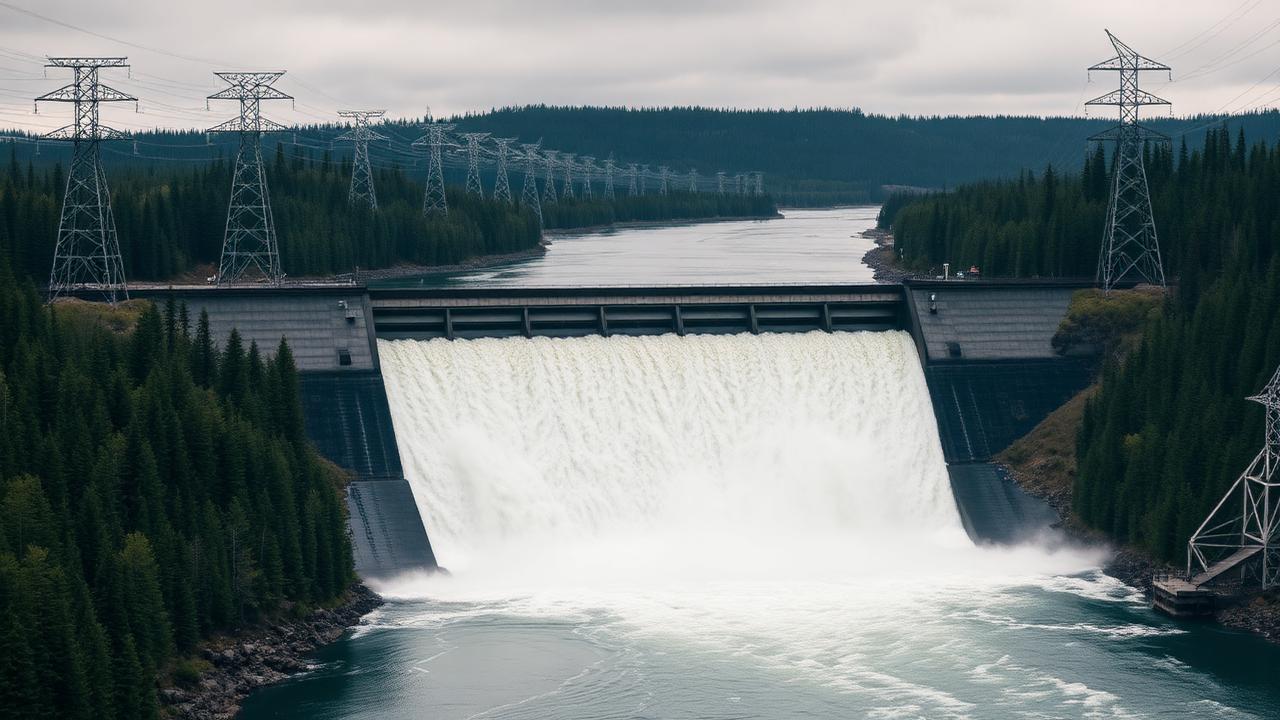
Québec's hydroelectric surplus has long been an export asset, but converting it into revenue depends entirely on transmission capacity into the constrained northeastern American market. The underlying resource — large-scale, low-carbon, dispatchable hydroelectric generation — is not in question. What determines how much of it actually becomes export revenue is a set of infrastructure and policy constraints that are easy to overlook when the conversation focuses only on generating capacity.
The economics
Northeastern states pay substantially more per megawatt-hour than Québec's regulated domestic rate, and increasingly require low-carbon supply to meet legislated targets. That spread is the export opportunity. Québec's domestic electricity rate is set through a regulated process designed around affordability and industrial competitiveness for its own residents and businesses, while northeastern American markets price electricity through wholesale mechanisms that reflect the marginal cost of generation, often set by natural gas plants at peak demand. Layered on top of that price spread is a policy dimension: several northeastern states have legislated clean-energy targets that make Québec's hydroelectric output specifically valuable, not just as a source of electrons but as a source of electrons that count toward decarbonization commitments. That combination — a persistent price differential plus a regulatory preference for the type of generation Québec can supply — is what makes export contracts economically attractive on both sides of the border, provided the electricity can physically get there.
Transmission is the bottleneck
New interties face permitting processes in multiple jurisdictions and litigation from competing generators. Projects have been delayed or cancelled after years of development, which is the primary risk to any export forecast. Building a new high-voltage transmission line crossing international and often multiple state or provincial jurisdictions requires approvals from each regulatory body along the route, and each approval process can be contested by parties with a competing interest, including regional generators who would rather see demand met by in-market supply than by imports. This is not a hypothetical risk; the history of northeastern transmission proposals includes projects that spent years in development and permitting before being cancelled or substantially redesigned. For investors and policymakers evaluating export revenue projections, the transmission approval pipeline is a more reliable indicator of near-term export capacity than the underlying generation surplus, because the surplus can exist for years without a physical path to market.
The domestic tension
Industrial electrification and data-centre demand within Québec compete for the same electrons. The province has begun rationing new large-load connections, which caps how much surplus is genuinely available for export. This creates a structural tension in how the province allocates its hydroelectric output: export contracts typically carry attractive pricing and support the case for further generation investment, but domestic industrial development, including energy-intensive sectors the province is actively trying to attract, competes directly for the same supply. When new large-load connections are rationed or delayed to preserve capacity, that decision implicitly reallocates supply between export and domestic uses, and the criteria used to make that allocation — economic development priorities, existing contractual commitments, or grid reliability considerations — shape how much surplus genuinely exists at any given time, independent of the province's total generating capacity.
How to evaluate export capacity claims
Because of this domestic tension, headline figures about Québec's hydroelectric surplus should be read alongside data on committed large-load connections and export contract volumes, rather than treated as an available balance simply waiting for transmission to be built. A surplus that looks substantial on a total-generation basis can be considerably smaller once existing domestic commitments and near-term industrial demand growth are subtracted, and it is this net figure, not the gross generating capacity, that ultimately determines the realistic scale of new export revenue.
The regional competitive picture
Québec is not the only source of low-carbon power competing for access to northeastern transmission capacity and clean-energy procurement contracts; offshore wind, other Canadian provinces, and in-region renewable development are also seeking the same limited transmission corridors and the same state-level procurement processes. This means transmission capacity, once built, does not automatically flow to Québec exports by default, and the competitive positioning of Québec's hydroelectric supply relative to these alternatives depends on price, reliability and the pace at which each competing source can actually deliver.
What to watch
The clearest indicators of whether export capacity will materialize are the status of specific intertie projects working through permitting and litigation, the pace at which Québec approves or rations new domestic large-load connections, and whether northeastern states continue to tighten clean-energy procurement requirements in ways that favour hydroelectric imports specifically. Any of these three factors could move faster or slower than currently expected, and each one independently determines how much of the underlying surplus actually becomes exportable revenue.
披露声明
Information only. Not investment advice. The Maple Markets does not hold positions in securities discussed.
接着阅读
英文版: Hydro-Québec's Export Capacity and the Northeast Power Market
 Mining & EnergyVault Strategic在内华达州:四个月专注于一处钨矿项目2026年7月3日,Vault Strategic Mining放弃另外两项钨矿期权,集中力量开发War Bond。War Bond位于内华达州西部,是1950年代曾经产钨的矿山。此后公司公布了地表采样结果,完成了73.6测线公里的磁法航测,完成150万加元配售,并启动首份NI 43-101技术报告。公司尚未给出报告日期;截至2026年11月30日的六个月财务报表是下一份计划提交的文件。Daniel Okoye · November 4, 2026 · 7 min
 Mining & EnergyQIMC规划横跨三省、总长126.5公里的地震勘探Quebec Innovative Materials已完成新斯科舍省Cumberland县63.7测线公里的地震数据采集。其土壤气、氦、重力和磁法工作以及DDH-26-05钻孔的气体事件都位于同一测网内,目前正在卡尔加里处理。公司还计划与相同承包商在魁北克完成36公里、在安大略完成26.8公里,已完成和计划的覆盖范围合计约126.5测线公里。截至2026年6月30日,公司持有现金1,410万加元。Priya Sandhu · November 3, 2026 · 7 min
 TechnologyReklaim连续第三个季度盈利,股价上涨45%Reklaim Ltd.于2026年11月3日公布,截至9月30日的季度营收同比增长近两倍,达到316万加元,净利润127万加元,为连续第三个盈利季度。该股在多伦多创业板收于C$0.40,上涨45%,成交193万股。公司当季回购510万股;前一天,公司提议允许C$500,000可转换债券的持有人按现行C$0.105的价格提前转股,此事尚待多伦多创业板批准。Marc Belzile · November 3, 2026 · 6 min
订阅 Maple Morning Debrief
前一交易日收盘、隔夜行情,以及开盘前值得关注的要点 —— 美东时间早上 6 点前送达您的邮箱。免费,一键退订。
Follow and ask
Get more of our Canadian market coverage in Google Top Stories.
资料来源与参考 (3)
引用本文分析
Please attribute The Maple Markets and link to the original page.
Marc Belzile (July 15, 2026). Hydro-Québec's Export Capacity and the Northeast Power Market. The Maple Markets. https://themaplemarkets.ca/zh-hans/newsroom/hydro-quebec-s-export-capacity-and-the-northeast-power-markethttps://themaplemarkets.ca/zh-hans/newsroom/hydro-quebec-s-export-capacity-and-the-northeast-power-market