
Conifex Has a Federal Loan of Up to C$30 Million and a Market Value of C$5.1 Million
The shares closed up 38.9 per cent at twelve and a half cents on 18 September, and the loan behind the move is secured on everything the company owns.
Conifex Timber Inc. (TSX: CFF) said on 18 September 2026 that it had received a Large Enterprise Tariff Loan of up to C$30 million from the Government of Canada, on a seven-year term secured by substantially all of its property. The shares closed at C$0.125, up 38.9 per cent. At 30 June 2026 the company held C$1.3 million of unrestricted cash against C$101.8 million of debt and a going-concern warning.
By Marc Belzile7 min read
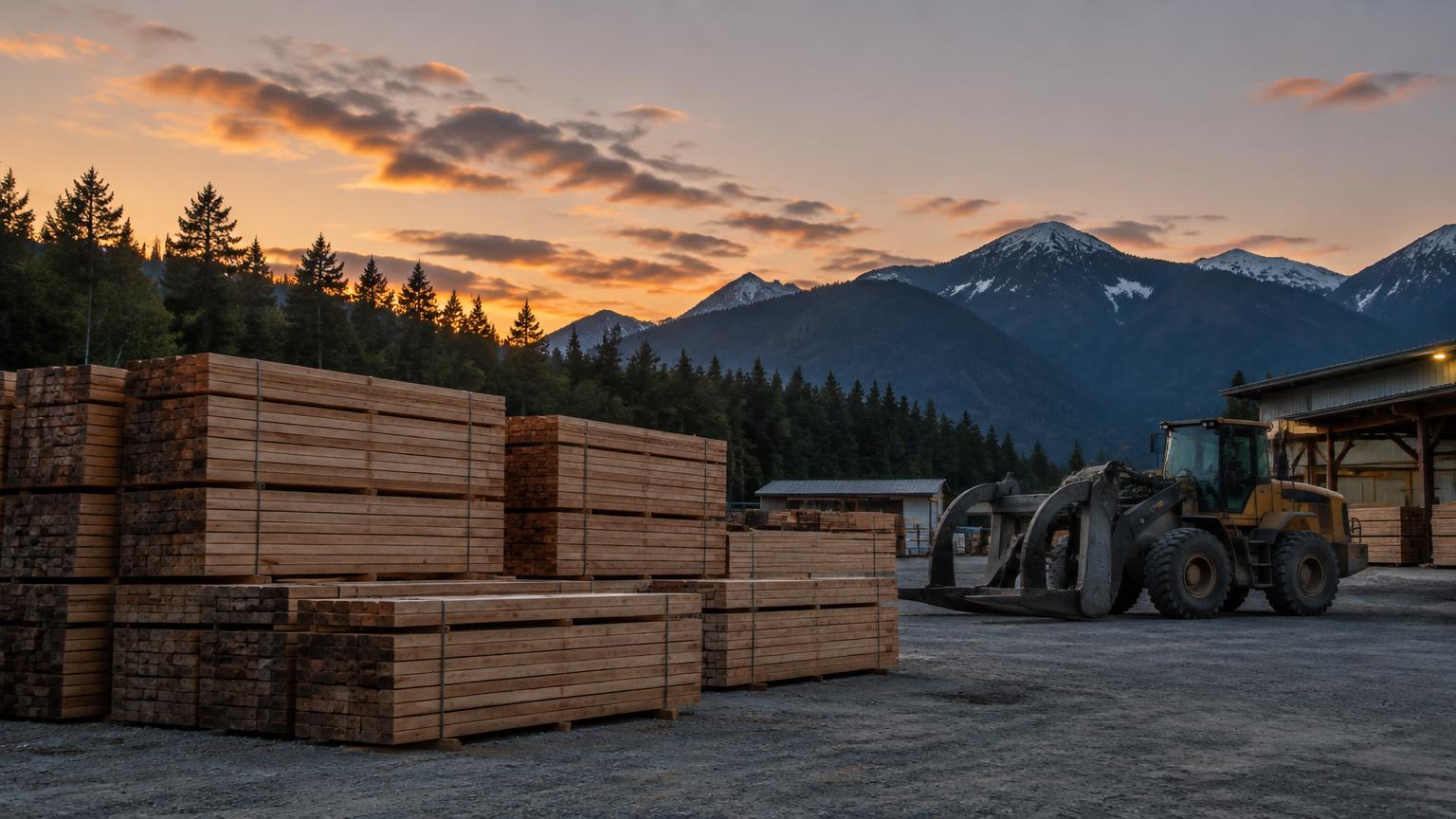
Large Enterprise Tariff Loan from the Government of Canada
Up to C$30 million
seven-year term, market-based rate, secured by substantially all property, ranking equally with or behind existing secured lenders; company release, 18 September 2026
closing price on 18 September 2026
C$0.125
up 3.5 cents or 38.889 per cent, 392,081 shares on the Toronto exchange against a 74,842 thirty-day average, C$0.115 VWAP; TMX Money, official close
market value at that close
C$5.1 million
40.77 million shares outstanding; TMX Money and QuoteMedia, 18 September 2026
unrestricted cash against total debt at 30 June 2026
C$1.3 million / C$101.8 million
with a stated material uncertainty over going concern; second-quarter release, 14 August 2026
PenderFund warrants newly issued or extended to 17 January 2031
5,904,000 warrants at C$0.50
about 14.5 per cent of shares outstanding; the federal lender's warrants are additional and unquantified; company release, 18 September 2026
Conifex Timber Inc. told the market on 18 September 2026 that it had been granted a loan of up to C$30 million by the Government of Canada under the Large Enterprise Tariff Loan facility. Trading in the shares was halted by Canada's market regulator that morning and resumed shortly afterwards.
By the close the shares stood at C$0.125, up 3.5 cents or 38.889 per cent on the day, on 392,081 shares traded on the Toronto exchange against a thirty-day average of 74,842, with consolidated Canadian volume of 727,060 shares and a volume-weighted average price of C$0.115. Those are the official exchange figures carried by TMX Money, last updated at 4.15 p.m. Eastern on 18 September 2026. At that price, and on 40.77 million shares outstanding, the whole company is worth about C$5.1 million.
Two different things are being reported as one, and they are worth separating before anything else. The first is that a government agreed to advance money to a British Columbia lumber producer during a tariff war. The second is the shape of what was actually agreed, which is a secured, seven-year loan roughly six times the size of the borrower's entire equity value, priced partly in warrants whose terms have not been set.
What the facility is, and what qualifying for it says about the applicant
The Large Enterprise Tariff Loan facility is run by the Canada Development Investment Corporation through its subsidiary, the Canada Enterprise Emergency Funding Corporation, and exists to lend to large Canadian businesses whose liquidity has been damaged by tariffs and countermeasures when ordinary market financing is not available to them.
Its published tests are specific. An applicant should have roughly C$150 million or more in annual Canadian revenue, must attest that it was solvent as at 31 December 2024 and viable before tariffs hit, and must not have filed for protection under the Companies' Creditors Arrangement Act. The programme targets companies facing a liquidity shortfall of up to 36 months after other sources of capital have been exhausted.
That last clause deserves to be read twice. Access to this facility is not a compliment. It is a finding, by a federal lender of last resort, that the applicant has run out of alternatives.
The terms Conifex disclosed
The company's own release sets out four elements. The facility provides additional liquidity of up to C$30 million. It bears what the release calls a market-based interest rate. It runs for seven years and is secured by substantially all of Conifex's property, with portions ranking either equally with, or behind, the company's existing secured lenders. And it comes with warrants.
A warrant is a right to buy a new share at a fixed price before a fixed date. Warrants cost the lender nothing to hold and cost existing shareholders something if they are exercised, because the new shares dilute everyone else's proportion of the company.
Two of the three warrant items are quantified. Conifex has agreed to issue PenderFund up to a further 1,584,000 warrants exercisable at C$0.50 each until 17 January 2031, and to extend the expiry of PenderFund's existing 4,320,000 warrants by one year to the same date. Together that is 5,904,000 warrants, equal to about 14.5 per cent of the shares now outstanding, struck at four times Friday's closing price.
The third item is not quantified. The release states that warrants will be issued to the federal lender in connection with the facility, and that the number, exercise price, term and other material terms will be set out in definitive documentation still to be entered into. All of it remains subject to Toronto Stock Exchange approval.
The release adds one further item: the company's existing lumber lender has agreed to reimburse Conifex up to C$11.0 million for capital spending intended to improve operating performance and earnings at the Mackenzie mill.
The loan is certain, the price of it is not
- A facility of up to C$30 million exists in principle. The company has announced it, named the lender and stated the term, the ranking and the security. This is the firmest item on the list.
- The company met a federal test that requires an attestation of pre-tariff viability and evidence that other capital has been exhausted. The programme's criteria are public. Conifex's application is not, so what the company told the lender about its own runway is not on the record.
- Dilution is coming, and part of it is already measurable. The 5,904,000 PenderFund warrants at C$0.50 are stated. They are worth nothing to their holder at C$0.125 and everything to existing shareholders if the price recovers past the strike.
- Dilution is coming, and part of it is not yet measurable. The federal warrants have no number, no price and no term. Until the definitive documents are filed, the cost of this money to shareholders cannot be calculated, only bounded below.
- The company intends to restore two shifts at Mackenzie. An intention stated in a release, conditional on financing and operating conditions, is not a production schedule.
- Nothing in the release addresses the going-concern qualification. The loan changes the liquidity position. Whether it resolves the doubt is a question for the auditors and the next set of statements, and the release does not claim otherwise.
The balance sheet the loan is landing on
Conifex reported its second quarter on 14 August 2026. The company lost C$9.5 million, or 23 cents a share, on a negative EBITDA of C$6.3 million. It produced 14.1 million board feet of lumber, which it stated was 23 per cent of annualised capacity, and shipped 23.6 million board feet. Unrestricted cash was C$1.3 million.
Debt stood at C$101.8 million: a C$46.1 million power term loan, a C$34.4 million Pender term loan, a C$19.0 million loan from the Business Development Bank of Canada, and C$2.4 million of leases. Market data services carry total liabilities of about C$168.83 million, a wider figure that includes items beyond borrowings and is secondary data, not verified against the filed statements.
In the same release the company stated that it recognises there is material uncertainty that may cast significant doubt on its ability to continue as a going concern, and that the temporary curtailment at its Mackenzie sawmill had continued beyond the roughly seven-week period originally announced.
The tariff arithmetic behind all of this is public and dated. Conifex reported a combined softwood lumber duty rate of 25.18 per cent, made up of 10.66 per cent anti-dumping and 14.52 per cent countervailing duty, and cumulative deposits paid of US$49.4 million.
Why 38.9 per cent is a smaller number than it sounds
At twelve and a half cents, the entire day's gain was three and a half cents a share. The stock traded between 9.5 cents and 12.5 cents, and the 52-week range runs from 5.5 cents to 28.5 cents. A percentage move calculated from a base of nine cents flatters itself; the same three and a half cents on a five-dollar share would be a rounding error.
What the move did do is restore about C$1.4 million of market value to a company that has just been lent up to twenty times that sum by the federal government, against security over substantially all of its assets. The equity is the thinnest slice of this capital structure, and it is the slice that moved.
None of which makes the loan bad news for Conifex. A seven-year facility is a long runway compared with the alternatives available to a company with C$1.3 million of cash, and reimbursement of up to C$11.0 million of Mackenzie capital spending by an existing lender is real money aimed at the specific problem, which is a mill that cannot run profitably at current lumber prices. The company will get to try.
The terms on which it gets to try are the part still to be filed. Until the federal warrant documentation and the exchange's approval are on the record, the price of Friday's good news is a number nobody outside the negotiation can calculate.
Transparency note. This is an independent due-diligence analysis and editorial opinion piece produced by The Maple Markets editorial desk. It is not sponsored, promoted or commissioned, and no compensation of any kind has been received from Conifex Timber Inc. (TSX: CFF) or any party acting on their behalf. The analysis is based on public disclosure available as of the publish date; every figure is attributed to its primary source. The Maple Markets and its authors may hold positions in securities mentioned; nothing here is a recommendation to buy, sell or hold any security, and readers should not treat it as investment advice. Past disclosure does not guarantee future results. Policies: Editorial Standards · Financial Disclaimer.
Read next
Auch auf Deutsch: Conifex hat ein Bundesdarlehen von bis zu C$30 Millionen und eine Marktkapitalisierung von C$5.1 Millionen
 Canadian MarketsPlanet Ventures Fell to Five Cents Two Days Before a Consolidation That Changes NothingPlanet Ventures Inc. (CSE: PXI) fell 16.7 per cent on 16 September 2026, to C$0.05, on roughly 37 times average volume and with no announcement that day. Behind the move sit a rights offering that issued 152,244,604 shares at a penny on 1 September, a five-for-one consolidation effective 18 September, and a year of disclosed investments smaller than the disclosed investor-awareness budget.Marc Belzile · September 17, 2026 · 7 min
 Mining and ResourcesCoyote Copper's Arizona Drill Permits Started a 30-Day Clock on 17.5 Million WarrantsCoyote Copper Mines Inc. (TSXV: CCMM) received Phase 1 drill permits for its wholly owned Copper Springs project in Arizona on 15 September 2026 and, in the same release, gave notice accelerating 17,501,296 warrants to a 15 October expiry. Exercise brings in C$3,143,386.58 and adds about 13 per cent to the share count. The shares closed down 33.33 per cent at C$0.44 on 281,072 shares, 1.57 times their 30-day average.Priya Sandhu · September 16, 2026 · 6 min
 EconomyWhy a Canadian Explorer Can Sell New Shares Above Its Own Market Price, and Who Pays for ThatJunior exploration was the busiest corner of the Canadian market this week, and almost none of it is paid for out of revenue. It is paid for by placements, and those placements are priced two different ways at once: flow-through shares above the market, ordinary units below it. The difference is a tax deduction the Canada Revenue Agency lets an exploration company hand to the buyer. Here is what that deduction is worth in dollars, why the calendar pushes the cheques into the autumn, and what each kind of financing does to the share count.Élise Galarneau · September 12, 2026 · 8 min
Follow this story
Follow CFF.TO — the next Maple piece on this company, plus the Maple Morning Debrief before the open.
Follow and ask
Get more of our Canadian market coverage in Google Top Stories.
Opinion
This article expresses the author's personal views, is separate from news reporting and is not investment advice.
Disclosure
**Transparency note.** This is an independent due-diligence analysis and editorial opinion piece produced by The Maple Markets editorial desk. It is not sponsored, promoted or commissioned, and no compensation of any kind has been received from Conifex Timber Inc. (TSX: CFF) or any party acting on their behalf. The analysis is based on public disclosure available as of the publish date; every figure is attributed to its primary source. The Maple Markets and its authors may hold positions in securities mentioned; nothing here is a recommendation to buy, sell or hold any security, and readers should not treat it as investment advice. Past disclosure does not guarantee future results. Policies: [Editorial Standards](https://themaplemarkets.ca/en/policies/editorial-standards) · [Financial Disclaimer](https://themaplemarkets.ca/en/policies/financial-disclaimer). See the Financial Disclaimer.
Sources and references (4)
- Conifex Receives Large Enterprise Tariff Loan, 18 September 2026
- Conifex Announces Second Quarter 2026 Results, 14 August 2026
- Canada Enterprise Emergency Funding Corporation, Large Enterprise Tariff Loan facility overview
- TMX Money quote and official close for Conifex Timber Inc. (TSX: CFF), 18 September 2026
Cite this analysis
Please attribute The Maple Markets and link to the original page.
Marc Belzile (September 18, 2026). Conifex Has a Federal Loan of Up to C$30 Million and a Market Value of C$5.1 Million. The Maple Markets. https://themaplemarkets.ca/en/newsroom/conifex-timber-a-c-5-million-company-rose-38-9-per-cent-on-4-7-timeshttps://themaplemarkets.ca/en/newsroom/conifex-timber-a-c-5-million-company-rose-38-9-per-cent-on-4-7-times