
Toroparu, Costed: Aris Mining Prices a Guyana Gold Mine at US$1 Billion
The prefeasibility study gives Aris its first mineral reserve at Toroparu, 5.9 million ounces, and a construction decision targeted for early 2027 that depends on a Guyanese mining licence and a financing plan.
Aris Mining's prefeasibility study for Toroparu, released on 12 November 2026, sets out a 29-year gold mine in Guyana with an initial funding requirement of US$1,005 million, 5.9 million ounces of reserves and an after-tax value of US$2.8 billion at US$3,600 gold. A construction decision is targeted for early 2027, subject to the mining licence.
By Daniel Okoye7 min read
Proven and probable reserves
5.9 million oz gold (200.2 Mt at 0.92 g/t)
effective November 12, 2026, at US$1,950/oz; Aris Mining PFS release.
Initial funding requirement
US$1,005 million
construction capital, contingency and working capital, less the US$138 million Wheaton stream; PFS release, November 12, 2026.
After-tax NPV (5%) / IRR
US$2.8 billion / 31.5%
base case US$3,600/oz gold; US$1.8 billion and 24.3% at US$3,000; PFS release, November 12, 2026.
Life-of-mine AISC
US$1,494/oz
after silver and copper credits; projection from the PFS, November 12, 2026.
Cash and net debt
US$419.0 million cash, US$46.5 million net debt
at September 30, 2026; Q3 2026 MD&A dated November 4, 2026.
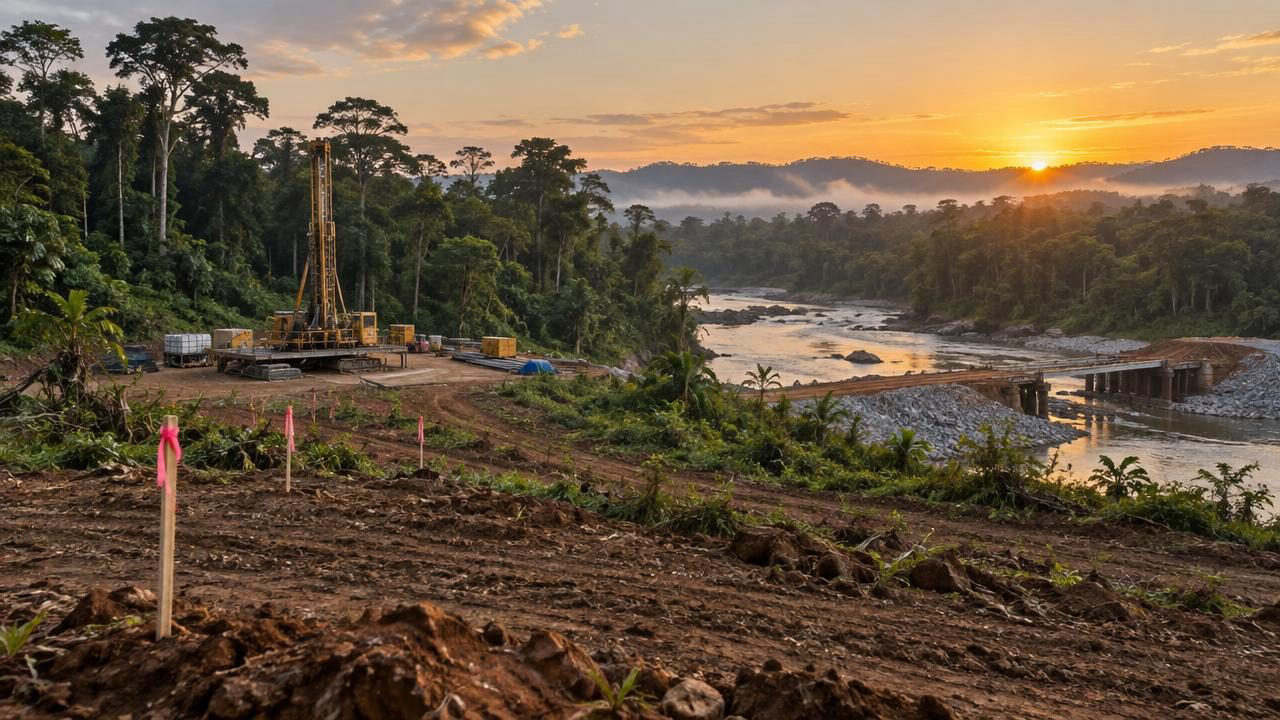
Aris Mining now has a costed design for its third gold mine. The prefeasibility study for Toroparu in Guyana describes a long-life open-pit operation and puts the cost of building it at about US$1 billion.
A prefeasibility study is the second of the three engineering studies a miner usually completes before it builds: detailed enough to convert part of a deposit into reserves, short of the final feasibility work that lenders tend to require. For Aris, the study released on November 12, 2026 carries a specific weight. It contains the company's first mineral reserve at Toroparu, and the company has named early 2027 as the target for a construction decision.
Toroparu now has reserves, and the study says how much
A mineral reserve is the part of a deposit a qualified person has shown can be mined at a profit under a specific mine plan and price. A resource is the larger estimate of what is in the ground. The difference matters because reserves are what a mine plan, and a lender, rely on.
The company reported proven and probable reserves of 5.9 million ounces, effective November 12, 2026, in 200.2 million tonnes grading 0.92 grams per tonne gold. The pits that define those reserves were designed at a gold price of US$1,950 an ounce. That is well below the prices used to value the project, so the reserve is defined at a price well below recent levels.
The higher-grade core is concentrated. About 5.1 million of those ounces sit in material above 0.50 grams per tonne, averaging 1.18 grams per tonne. The rest is lower-grade ore the plan processes later.
The resource grew too. Measured and indicated resources rose to 9.3 million ounces, which Aris says is 74 per cent more than in its 2025 preliminary economic assessment. The release does not give the processed head grade or the metallurgical recovery; both are in the NI 43-101 technical report, dated and filed on November 12.
A 29-year mine with its best years first
The plan is a 7.0 million tonne a year processing plant fed by open pits, with mining over 21 years and processing over 29. Construction is scheduled at 32 months.
Production would be front-loaded. According to the study, output would average 291,000 ounces a year over the first five years and 258,000 a year while the main pit runs. It then falls to about 103,000 ounces a year as the plant works through stockpiled lower-grade material.
Across the full life the average is 195,000 ounces a year, for 5.6 million ounces in total, with silver and copper as by-products.
All-in sustaining cost is the industry's standard measure of what it costs to keep a mine producing, including sustaining capital, per ounce sold. The study puts it at US$1,494 an ounce over the life of the mine, after credits for silver and copper. Every figure in this section is a projection from the study, not a result.
For scale, Aris guided to 300,000 to 350,000 ounces for all of 2026 across its Colombian operations and said in its third-quarter release of November 4 that it was targeting the lower end. Toroparu's first five years alone, at 291,000 ounces a year, would be close to the low end of that 2026 guidance.
What the gold price does to the value
Net present value is the study's estimate of the project's future cash flows in present-day money; Aris discounts them at 5 per cent a year. The internal rate of return is the annual return that would make that value zero. The base case uses US$3,600 gold, with sensitivities either side.
| Gold price (US$/oz) | After-tax NPV at 5% | After-tax IRR | Payback |
|---|---|---|---|
| 3,000 | US$1.8 billion | 24.3% | 2.7 years |
| 3,600 (base case) | US$2.8 billion | 31.5% | 2.2 years |
| 4,200 | US$3.8 billion | 37.8% | 1.9 years |
Source: Aris Mining release, November 12, 2026. Silver at US$50 an ounce and copper at US$5.00 a pound in the base case.
The table matters this week because gold has been the subject of the trading. Aris shares closed at C$18.99 on November 18, down 6.96 per cent on the day as gold miners fell across the sector, per end-of-day data read at 16:58 ET on TMX Money.
Much of the discussion around the stock has turned on how low gold could go. The study's lowest published case is US$3,000, and at that price the project still returns 24.3 per cent after tax on the company's figures.
Aris has not published a case below US$3,000. Estimates of Aris's cash generation at US$2,500 gold posted on retail investor boards on November 18, 2026 are the posters' own arithmetic.
For comparison, Aris realized an average of US$4,205 an ounce in the third quarter.
The money is the next hurdle
The November 12, 2026 study puts the initial funding requirement at US$1,005 million, built from US$1,017 million of construction capital plus contingency and working capital, less US$138 million that Wheaton Precious Metals may elect to provide under its precious metals purchase agreement for Toroparu, a stream.
A stream is an upfront payment from a financier in exchange for a share of a mine's future metal at a fixed, low price. The Wheaton payment is available only if Wheaton elects to take it up after a full development plan, and the two companies said they are exploring amendments to fit the agreement to the new project design.
Set against the balance sheet, the build is large. At September 30, 2026 Aris held US$419.0 million in cash and net debt of US$46.5 million, according to its third-quarter MD&A dated November 4, 2026. The company says it has sufficient cash resources to meet its financial obligations. The MD&A does not describe how Toroparu would be funded, and it reports no equity financing or at-the-market program in 2026.
Some of the answer is the existing business. In the three months to September 30, 2026, Aris reported US$69.8 million of cash from operations after sustaining capital and taxes, and spent US$120.6 million on growth and expansion, mostly at Segovia and Marmato. The MD&A reports free cash flow after that spending of negative US$50.8 million for the quarter ended September 30, 2026. Once the Marmato plant, due to pour first gold in December 2026, and the Segovia expansion are built, the growth bill falls and more of the operating cash is free. How much of the study's US$1,005 million comes from that cash, from debt, from the stream or from new shares has not been set out by the company, which targets its construction decision for early 2027.
At 206.7 million shares outstanding at the MD&A date and C$18.99 a share, the market valued Aris at about C$3.9 billion on November 18.
The steps between a study and a mine
Toroparu has climbed several rungs and has several to go. In order:
- A defined deposit. Done: 9.3 million ounces of measured and indicated resources, effective November 12, 2026.
- A reserve and a mine plan. Done with this study: 5.9 million ounces of proven and probable reserves.
- A filed technical report. Done: the NI 43-101 report was filed on SEDAR+ and EDGAR on November 12.
- A large-scale mining licence. Applied for in August 2026 and under review by the Government of Guyana.
- Infrastructure on site. Under way: the Puruni River bridge is expected to be complete by December 2026, according to the MD&A.
- A construction decision. Targeted for early 2027, subject to the licence and other approvals.
- A funding package. The Wheaton stream is the only named component so far.
- Production. About 32 months after construction starts, on the study's schedule.
The company itself frames the risk this way. Its release says the longer-term objective of about one million ounces a year carries no assurance and depends on permits and construction decisions at both Soto Norte, its Colombian project, and Toroparu.
Where Toroparu fits in Aris's plan
The near-term growth is in Colombia. Aris says the Segovia and Marmato expansions should take annual output to about 500,000 ounces once both are ramped up, with steady-state rates of about 300,000 ounces at Segovia and 200,000 at Marmato. Marmato's new plant is expected to reach full capacity by the end of 2027, according to the third-quarter release.
Toroparu is the next layer after that. The company's own documents set out the path: about 500,000 ounces from the Colombian expansions, and about one million as a longer-term objective that needs both Toroparu and Soto Norte. The 500,000 is a target for operations under construction. The million rests on two projects that have no construction decision.
The study also revises the earlier picture. The 2025 preliminary economic assessment, which included inferred resources, contemplated about 235,000 ounces a year on average at a US$3,000 base case. The prefeasibility study's life-of-mine average is lower at 195,000 ounces, over a longer plan, with a richer first five years at 291,000. The two studies use different price decks and different levels of engineering, so the averages are not like for like.
Chair and chief executive Neil Woodyer called Toroparu the company's "next major growth project" in the November 12 release. The study gives that ambition its first reserve and its first engineering-grade cost. A licence decision in Georgetown is the next thing on the company's own timetable.
Disclosure
Transparency note. This is an independent due-diligence analysis and editorial opinion piece produced by The Maple Markets editorial desk. It is not sponsored, promoted or commissioned, and no compensation of any kind has been received from Aris Mining Corporation (TSX: ARIS), Wheaton Precious Metals Corp. (TSX: WPM) or any party acting on their behalf. The analysis is based on public disclosure available as of the publish date; every figure is attributed to its primary source. Neither The Maple Markets nor the author holds a position in the securities mentioned; nothing here is a recommendation to buy, sell or hold any security, and readers should not treat it as investment advice. Past disclosure does not guarantee future results. Policies: Editorial Standards · Financial Disclaimer.
Read next
Auch auf Deutsch: Toroparu, durchgerechnet: Aris Mining beziffert eine Goldmine in Guyana auf US$1 Milliarde
 Mining & EnergyRecord Mill Rates Give G Mining US$80 Million of Free Cash FlowG Mining Ventures produced 44,960 ounces of gold at Tocantinzinho in the third quarter of 2026, with record mining and milling rates, and US$80.0 million of free cash flow. All-in sustaining costs of US$1,591 an ounce sat above the 2026 range, which the company expects to meet after a stronger fourth quarter. Oko in Guyana is 57 per cent spent against its US$973 million budget, with first gold targeted for the second half of 2027.Élise Galarneau · November 13, 2026 · 7 min
 Mining & EnergyLundin Gold Drills 124 Grams per Tonne Beside Its Fruta del Norte MineLundin Gold reported new drill results on October 26, 2026 from FDNS, FDN East and Bonza Sur, three deposits beside its Fruta del Norte mine in Ecuador, and started conversion drilling at FDN East. The holes add detail to deposits already partly in the company's reserves, at a mine that produced a record 153,736 ounces in the third quarter. Third-quarter financial results follow on November 4.Élise Galarneau · October 28, 2026 · 7 min
 Mining & EnergyEric Sprott Exercises Metalsource Mining Warrants for C$1.38 MillionEric Sprott exercised 4,387,158 Metalsource Mining warrants for C$1,379,863.20, the company announced on November 18. The company plans to use the cash for exploration at Silver Hill and Byrd-Pilot in North Carolina and for working capital. Two rigs are working there, and 24 holes were awaiting assays in October.Priya Sandhu · November 19, 2026 · 7 min
Follow this story
Follow ARIS.TO — the next Maple piece on this company, plus the Maple Morning Debrief before the open.
Follow and ask
Get more of our Canadian market coverage in Google Top Stories.
Sources and references (3)
- Aris Mining: Positive PFS results for the Toroparu Gold Project, news release, November 12, 2026 (Form 6-K, EDGAR)
- Aris Mining: Q3 2026 results, news release, November 4, 2026 (Form 6-K, EDGAR)
- Aris Mining: Management's discussion and analysis for the three and nine months ended September 30, 2026, dated November 4, 2026 (EDGAR)
Cite this analysis
Please attribute The Maple Markets and link to the original page.
Daniel Okoye (November 19, 2026). Toroparu, Costed: Aris Mining Prices a Guyana Gold Mine at US$1 Billion. The Maple Markets. https://themaplemarkets.ca/en/newsroom/aris-mining-reported-preliminary-feasibility-study-results-for-itshttps://themaplemarkets.ca/en/newsroom/aris-mining-reported-preliminary-feasibility-study-results-for-its