
B2Gold Drills 10.9 Grams a Tonne at a New Goose Zone
The interval comes from a single exploration hole at a zone B2Gold has named Tattuk, the width is core length rather than true width, and the zone sits in no mineral resource estimate.
B2Gold reported drill results from the Back River gold district in Nunavut on 28 September 2026, including 10.94 grams of gold per tonne over 9.95 metres from a single hole at a newly named zone called Tattuk, about 150 metres down plunge from Nuvuyak. The same release reaffirmed Goose mine guidance of 170,000 to 200,000 ounces of gold for 2026 and contained no production, grade, recovery or cost figures for the quarter.
By Daniel Okoye8 min read
Tattuk discovery interval
10.94 g/t gold over 9.95 m from 1,195.90 m
hole 26GSE750Z2, core length not true width, capped 10.54 g/t; release of 28 September 2026.
Goose 2026 guidance
170,000 to 200,000 oz gold
reaffirmed, not changed, in the 28 September 2026 release; no quarterly production, grade, recovery or cost figure was given.
Fixed plant throughput
3,200 tpd from October 2026, 4,000 tpd targeted in H1 2027
second phase involves a crushing plant outage of up to 10 weeks; release of 28 September 2026.
Consolidated 2026 guidance
820,000 to 920,000 oz gold; AISC US$2,370 to US$2,550/oz sold
narrowed and lowered respectively in the Q2 2026 release of 6 August 2026.
Goose probable reserve
10.9 Mt at 6.79 g/t for 2.38 Moz gold
effective 31 December 2025; Tattuk is not included in it.
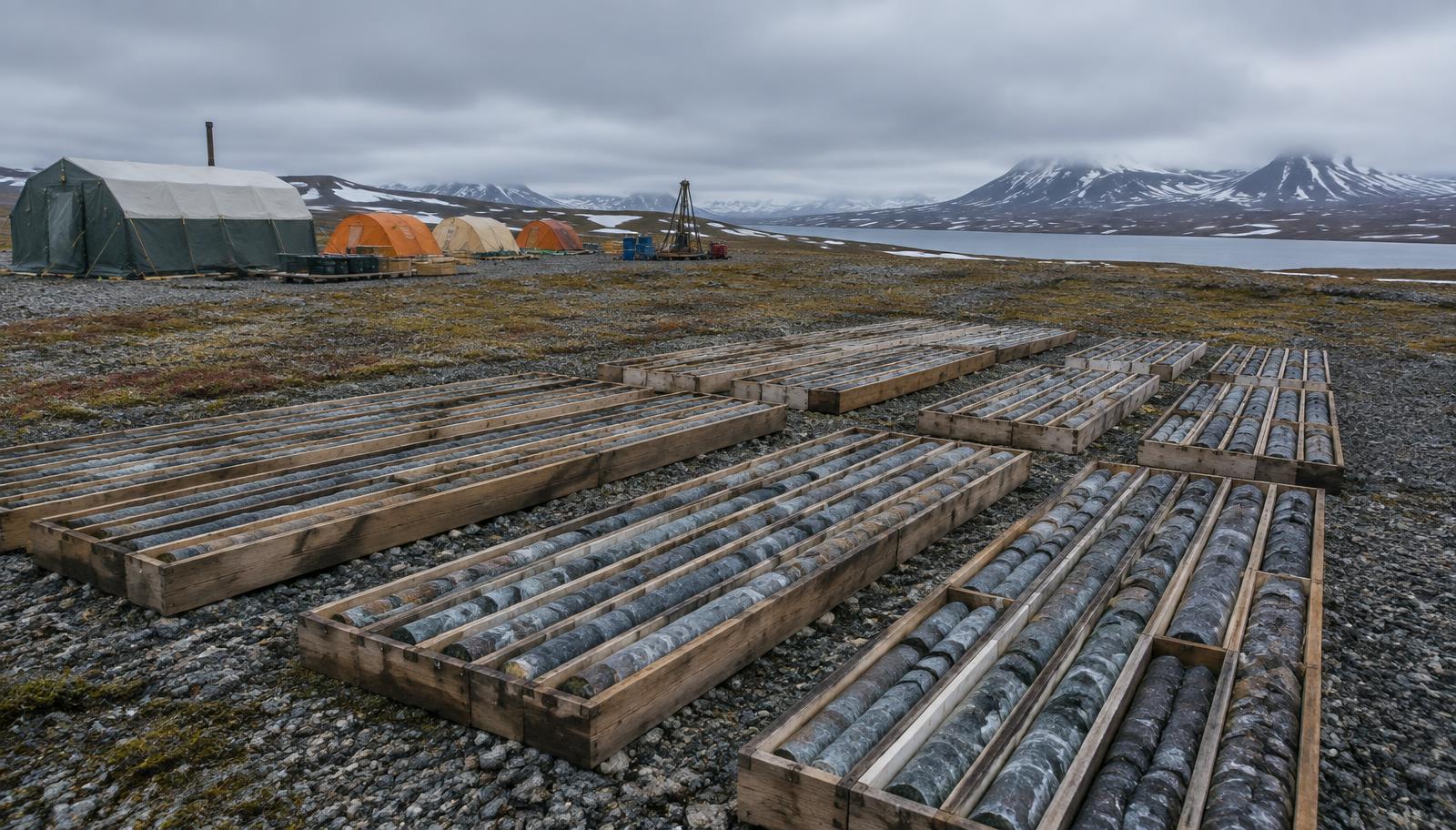
One drill hole at the Goose mine in Nunavut has put a new name on B2Gold Corp.'s map of the Back River gold district. The company calls the zone Tattuk, and reported it in a release issued on 28 September 2026 that also carried an operations update for Goose and drill results from three other areas.
The release states the result in one sentence: "Drill hole 26GSE750Z2 returned 10.94 g/t gold over 9.95 m from 1,195.90 m (Tattuk zone exploration hole)." It then places it: "This new discovery, named Tattuk, is approximately 150 m down plunge from Nuvuyak and presents a new opportunity for future resource additions."
A named zone is not a counted ounce
Down plunge means further along the direction a mineralised body dips into the ground, so Tattuk is an extension of the same structural trend that hosts Nuvuyak rather than a separate discovery in new country rock. The release places Tattuk outside every current mineral resource estimate, and the company's own wording, "future resource additions", confirms that the ounces there are prospective rather than counted.
Two qualifications in the release govern how the number should be read, and both are the company's own. The first concerns width. The release states that "Composite intervals represent core length, not true width, and were calculated using a 3.0 g/t gold cut-off grade and may include up to 2.0 m of internal dilution." Core length is the distance measured along the drill hole. True width is the thickness of the mineralised zone measured perpendicular to it, which is the number that matters for tonnage, and it is always the shorter of the two unless the hole happens to cut the zone at a right angle. The release says true width is undetermined. Any tonnage a person builds off 9.95 metres is therefore building off an upper bound.
The second concerns the grade itself. B2Gold reports intervals twice, uncapped and capped, with assays capped at 50 grams per tonne. For the Tattuk hole the difference is small, 10.94 grams uncapped against 10.54 capped. Elsewhere in the same release it is not small at all, which is the more useful disclosure.
The capping tells you where the gold is concentrated
| Hole | Zone | Interval (m) | Uncapped (g/t Au) | Capped (g/t Au) |
|---|---|---|---|---|
| 26GSE749Z2 | Llama | 21.23 | 19.12 | 15.44 |
| 26GSE749 | Llama | 4.65 | 44.61 | 32.15 |
| 26GSE748Z1B | Llama | 3.53 | 44.03 | 31.06 |
| 26GSE746Z2 | Llama | 10.60 | 21.72 | 16.79 |
| 26GSE750Z2 | Tattuk | 9.95 | 10.94 | 10.54 |
| 26GRL239 | George, Locale 1 | 9.40 | 26.49 | 18.62 |
| 26GRL232Z1 | George, Locale 1 | 3.65 | 29.58 | 29.58 |
Capping replaces individual assay results above a threshold with the threshold value, because in a coarse gold system one or two extreme samples can carry an interval that the surrounding rock does not support. The gap between the two columns therefore measures how much of an interval's grade rests on a handful of assays.
At hole 26GSE749 the capped grade is 28 per cent below the uncapped grade, so a substantial part of that 44.61 grams sits in very little rock. At 26GRL232Z1 the two figures are identical, meaning no assay in that interval exceeded the cap. The second result is the more durable of the two even though its headline number is lower.
The volume of work behind the release is as much a part of it as the qualifications. According to the release, B2Gold drilled 28 holes and 7,255 metres at Llama, 16 holes and 6,951 metres at Nuvuyak within Goose Main, and 15 infill holes at Locale 1 in the George claims group, where a 4.0 gram cut-off was applied rather than 3.0. Samples were prepared at the ALS laboratory in Yellowknife and analysed at ALS in North Vancouver, by fire assay and atomic absorption spectrometry on a 50 gram subsample, with a gravimetric finish above 3,000 parts per billion and umpire checks at Bureau Veritas Minerals in Vancouver. Quality control, the company stated, includes "the systematic insertion of blanks and standards into the core sample strings."
Andrew Brown, P.Geo., vice president, exploration, is named in the release as the qualified person for exploration and mineral resource matters, and Peter D. Montano, P.Eng., vice president, operations and project development, for operations.
That body of work establishes something positive and specific: Llama is a repeatable high-grade system rather than a single lucky interval. Four separate holes reported there returned capped grades between 15.44 and 32.15 grams per tonne over widths from 3.53 to 21.23 metres, and Locale 1 was drilled as infill, which is the stage at which a company is filling in known mineralisation rather than searching for it. Against that, Tattuk is one hole. Both statements come from the same release.
It is a properly documented exploration release. It is not a resource update, and the company neither announced one nor gave a date for one.
An operations update that contains no operating results
The other half of the release is the part that carries the mine rather than the exploration story, and it is thinner than the heading suggests. It reports capacity and capital. Mobile crushing has exceeded an average of 3,000 tonnes of ore per day since mid-August 2026. The fixed plant is expected to reach 3,200 tonnes per day from October 2026 under a first phase of upgrades, and a second phase scheduled for the first half of 2027 targets a design throughput of 4,000 tonnes per day, during which the fixed crushing plant is expected to be down for up to 10 weeks. The mobile plant cost approximately US$16 million and the first phase of upgrades US$11 million, in a company that reports in US dollars.
What the release does not contain is any figure for ounces produced, head grade, recovery, cash operating cost or all-in sustaining cost at Goose for the quarter or the year to date. Guidance was reaffirmed rather than changed: "Goose Mine is on track to achieve annual production guidance of 170,000 to 200,000 ounces of gold in 2026." On the shape of the year, the company said third-quarter production would be broadly in line with first-quarter levels and that the fourth quarter is expected to be the strongest of the year.
Read together, those two statements put the weight of a 170,000 to 200,000 ounce year on its final quarter, with a disclosed crusher outage of up to 10 weeks arriving in the first half of the year after. That is a schedule with one narrow point in it, and the release gives no interim production figure against which to check how much room is left.
The consolidated figures, and what the cost spread is made of
Group guidance published with second-quarter results on 6 August 2026 puts 2026 consolidated gold production at 820,000 to 920,000 ounces, narrowed from an earlier 820,000 to 970,000 ounce range. Cash operating costs were left unchanged at US$1,155 to US$1,280 per ounce produced, and all-in sustaining costs were lowered to US$2,370 to US$2,550 per ounce sold from US$2,400 to US$2,580.
The distance between those two ranges is the important one. All-in sustaining cost is roughly double the cash operating cost, and the difference is capital: sustaining capital, exploration and corporate costs that cash operating cost excludes by definition. For a company mid-build in Nunavut that spread is expected. It also means the cash cost figure on its own describes very little about whether an ounce from Goose pays for itself this year.
B2Gold reported cash and cash equivalents of US$287 million at 30 June 2026, with an US$800 million revolving credit facility fully undrawn at that date, US$75 million repaid during the quarter and US$95 million drawn in early August 2026. Those balance-sheet figures come from the company's own quarterly release; the interim statements filed since were not available when this was written, so they are reported rather than statement-verified numbers.
Against that, Goose held a probable mineral reserve of 10.9 million tonnes grading 6.79 grams of gold per tonne for 2.38 million ounces, effective 31 December 2025. The company also published indicated resources of 17.56 million tonnes at 7.45 grams for 4.21 million ounces and inferred resources of 13.50 million tonnes at 8.05 grams for 3.49 million ounces across the Goose and George claims. B2Gold's summary does not state whether the indicated figure is inclusive of the reserve, so the two cannot be added together here.
One session of relative strength is one session
Goose and Back River landed on a day the gold complex sold off, and B2Gold fell less than its peers. Secondary market data for the 28 September 2026 session, 15-minute delayed and not verified against exchange records, showed B2Gold down 2.46 per cent against Eldorado Gold down 4.28 per cent, Agnico Eagle Mines down 4.61 per cent, Equinox Gold down 4.51 per cent, Alamos Gold down 4.32 per cent and Seabridge Gold down 4.43 per cent. The five-name average is 4.43 per cent, so B2Gold outperformed it by 1.97 percentage points.
That difference was set on 0.63 times the stock's thirty-day average volume. Fewer shares than usual therefore produced the gap, over one session, on a day when the entire sector moved together for reasons unrelated to Nunavut. A single session of relative performance on below-average volume is a weak observation, and it is the one piece of Monday's picture that carries no document behind it.
The company has said what comes next in the ground: 2027 drilling aimed at the LX Gap at Llama and follow-up on Tattuk. It has not said when the next mineral resource estimate for Back River will be published, and that is the document in which Tattuk either becomes ounces or does not.
Goose has a new name on its map and the same reserve it carried in December. Both of those will stay true until a resource estimate says otherwise, and B2Gold has not given a date for one.
Transparency note
Transparency note. This is an independent due-diligence analysis and editorial opinion piece produced by The Maple Markets editorial desk. It is not sponsored, promoted or commissioned, and no compensation of any kind has been received from B2Gold Corp. (TSX: BTO), Eldorado Gold Corporation (TSX: ELD), Agnico Eagle Mines Limited (TSX: AEM), Equinox Gold Corp. (TSX: EQX), Alamos Gold Inc. (TSX: AGI), Seabridge Gold Inc. (TSX: SEA) or any party acting on their behalf. The analysis is based on public disclosure available as of the publish date; every figure is attributed to its primary source. The Maple Markets and its authors may hold positions in securities mentioned; nothing here is a recommendation to buy, sell or hold any security, and readers should not treat it as investment advice. Past disclosure does not guarantee future results. Policies: Editorial Standards · Financial Disclaimer.
Read next
 Mining and ResourcesAya Gold and Silver Drills 593 g/t Silver Equivalent Over 15.2 Metres With 14 Rigs Turning at BoumadineAya Gold & Silver Inc. (TSX: AYA; NASDAQ: AYA) reported high-grade drill results from Boumadine in Morocco on September 22, 2026, including 593 g/t silver equivalent over 15.2 metres and 392 g/t over 24.3 metres. The company says the holes confirm strong high-grade continuity along the Main Trend. Behind the intercepts sits the larger number: 145,719 metres drilled at Boumadine this year, 38.6 per cent of a 360,000-metre infill programme, with 14 drills turning and an updated feasibility study expected next year. Shares closed at a record C$42.68, up 6.1 per cent.Élise Galarneau · September 23, 2026 · 8 min
 Mining and ResourcesA 141.5-Metre Gold Intercept, 1.29 Million Indicated Ounces and No Economic Study at Sitka GoldSitka Gold Corp. (TSXV: SIG) reported 141.5 metres at 1.93 g/t gold at Blackjack on 21 September 2026 and closed at C$1.07, up 7.0 per cent on 2.3 times average volume. Taken in order, the filings behind it describe a Yukon project with 1.29 million Indicated and 3.83 million Inferred ounces, a five per cent royalty granted last month, C$30.6 million of flow-through money that must be spent by 31 December 2026, and no economic study of any kind.Daniel Okoye · September 22, 2026 · 9 min
 Mining and ResourcesBanyan Gold Joins the GDXJ With 8.6 Million Ounces and No Economic Study of ThemBanyan Gold Corp. (TSXV: BYN) said on 14 September 2026 that it joins the index behind the VanEck Junior Gold Miners ETF on 21 September. Its AurMac project in the Yukon holds 3.639 million indicated ounces and 4.985 million inferred ounces of gold. There is no preliminary economic assessment yet. At Tuesday's close the market valued the company at about C$98 for every ounce in the ground, or C$233 for each indicated ounce.Élise Galarneau · September 15, 2026 · 6 min
Follow this story
Follow BTO.TO — the next Maple piece on this company, plus the Maple Morning Debrief before the open.
Follow and ask
Get more of our Canadian market coverage in Google Top Stories.
Opinion
This article expresses the author's personal views, is separate from news reporting and is not investment advice.
Disclosure
**Transparency note.** This is an independent due-diligence analysis and editorial opinion piece produced by The Maple Markets editorial desk. It is not sponsored, promoted or commissioned, and no compensation of any kind has been received from B2Gold Corp. (TSX: BTO), Eldorado Gold Corporation (TSX: ELD), Agnico Eagle Mines Limited (TSX: AEM), Equinox Gold Corp. (TSX: EQX), Alamos Gold Inc. (TSX: AGI), Seabridge Gold Inc. (TSX: SEA) or any party acting on their behalf. The analysis is based on public disclosure available as of the publish date; every figure is attributed to its primary source. The Maple Markets and its authors may hold positions in securities mentioned; nothing here is a recommendation to buy, sell or hold any security, and readers should not treat it as investment advice. Past disclosure does not guarantee future results. Policies: [Editorial Standards](https://themaplemarkets.ca/en/policies/editorial-standards) · [Financial Disclaimer](https://themaplemarkets.ca/en/policies/financial-disclaimer). See the Financial Disclaimer.
Sources and references (4)
- B2Gold Provides Operations Update for the Goose Mine and Announces Drill Results at the Back River Gold District, 28 September 2026
- B2Gold Q2 2026 results and updated 2026 guidance, 6 August 2026
- B2Gold mineral reserves and resources, effective 31 December 2025
- B2Gold 2025 Back River exploration update, 25 March 2026
Cite this analysis
Please attribute The Maple Markets and link to the original page.
Daniel Okoye (September 29, 2026). B2Gold Drills 10.9 Grams a Tonne at a New Goose Zone. The Maple Markets. https://themaplemarkets.ca/en/newsroom/b2gold-relative-strength-is-not-a-result-b2gold-s-goose-update-and-backhttps://themaplemarkets.ca/en/newsroom/b2gold-relative-strength-is-not-a-result-b2gold-s-goose-update-and-back