
Global Atomic Priced C$50 Million of Stock at C$0.50, and the Shares Closed Below It
A conditional US$414.2 million loan approval, a 74 per cent cost increase and a discounted equity raise arrived inside eight days, and the market settled on the last of the three.
Global Atomic Corporation, the Toronto-listed developer of the Dasa uranium mine in Niger, priced 100 million units at C$0.50 on 23 September 2026 for C$50 million of gross proceeds. The shares fell 16.04 per cent to C$0.445, below the issue price, on 9.79 million shares on the Toronto exchange. The raise follows a 74 per cent increase in the project's direct cost estimate disclosed on 18 September and a conditional loan approval on 16 September that carries five unmet conditions.
By Daniel Okoye10 min read
Close, 2026-09-23
C$0.445, down 16.04 per cent
9,787,155 shares on the Toronto exchange and 17,711,883 across all Canadian venues; market value C$218.2 million on 490,282,186 shares; 15-minute delayed secondary market data.
Unit offering
100,000,000 units at C$0.50 for C$50 million gross
one share plus half a warrant at C$0.70 for 36 months, 15 per cent over-allotment, Red Cloud sole underwriter, closing on or about 2026-10-01; dilution of 20.4 per cent, or 23.5 per cent fully exercised.
Project cost
US$777.6 million total, direct costs US$653.0 million
up 74 per cent on the 2024 feasibility study's US$375.6 million; US$228.5 million invested to 2026-06-30; commissioning in H2 2028; no updated technical report filed at this cost.
DFC facility
up to US$414.2 million, conditional
US$397.4 million term loan plus a US$16.8 million cost-overrun facility, announced 2026-09-16, subject to five named conditions including an export route and a mining permit extension; US$152.7 million of equity still required.
Listings
TSX GLO, FSE G12, WKN A2JAQL, ISIN CA37957M1068, OTCQX GLATF
Deutsche Börse and Tradegate instrument pages; the Frankfurt line closed at EUR 0.2895 on 372,544 shares on 2026-09-23.
Global Atomic Corporation sold new shares on Wednesday at a price the market then declined to pay. By the close its stock was worth less than the buyers of that offering had just agreed to hand over.
The price was C$0.50 a unit, for 100 million units and C$50 million of gross proceeds, announced on 23 September 2026. Toronto marked the stock down 16.04 per cent to C$0.445 from a previous close of C$0.53, on 9,787,155 shares on the exchange and 17,711,883 across all Canadian venues, against a thirty-day average near 2.3 million. Half that volume would still have made it the heaviest selling since the announcement; double it and the print reads as a liquidation rather than a repricing. Market value at the close was C$218.2 million on 490,282,186 shares, per exchange data read after the close and delayed 15 minutes.
A discount to a price that was already stale
The offering was launched on 22 September as an overnight marketed deal, with Red Cloud Securities as sole underwriter and bookrunner and no price attached. The company said only that "final pricing of the Units, the exercise price and term of the Warrants and the determination of the number of Units to be sold and gross proceeds of the Offering will be determined in the context of the market."
Each unit carries one common share and half of one warrant exercisable at C$0.70 for 36 months. There is an over-allotment option for up to 15 per cent more units, and closing is expected on or about 1 October 2026. Proceeds are described as "an initial step to satisfy the Company's remaining contribution to fund the Dasa Project."
Measure C$0.50 against two reference points. On 16 September the shares closed at C$0.71 after rising 44.9 per cent on news of a conditional United States loan approval. Against that, the issue price is a discount of roughly 30 per cent. Against the 22 September close of C$0.53, it is a discount of about 6 per cent. Twice the discount would have implied an issue near C$0.36 and a far larger share count for the same money; half of it would have implied roughly C$0.62 and a deal the book did not support.
On the share count, 100 million new shares against 490,282,186 outstanding is dilution of 20.4 per cent, rising to 23.5 per cent if the over-allotment is exercised in full. Half that would be a routine top-up. Double it would put existing holders below half the company in a single transaction. There are also 50 million warrants at C$0.70 created here, or 57.5 million with the over-allotment, which become shares only if the price recovers above that level.
The cost estimate moved 74 per cent and the filed study did not
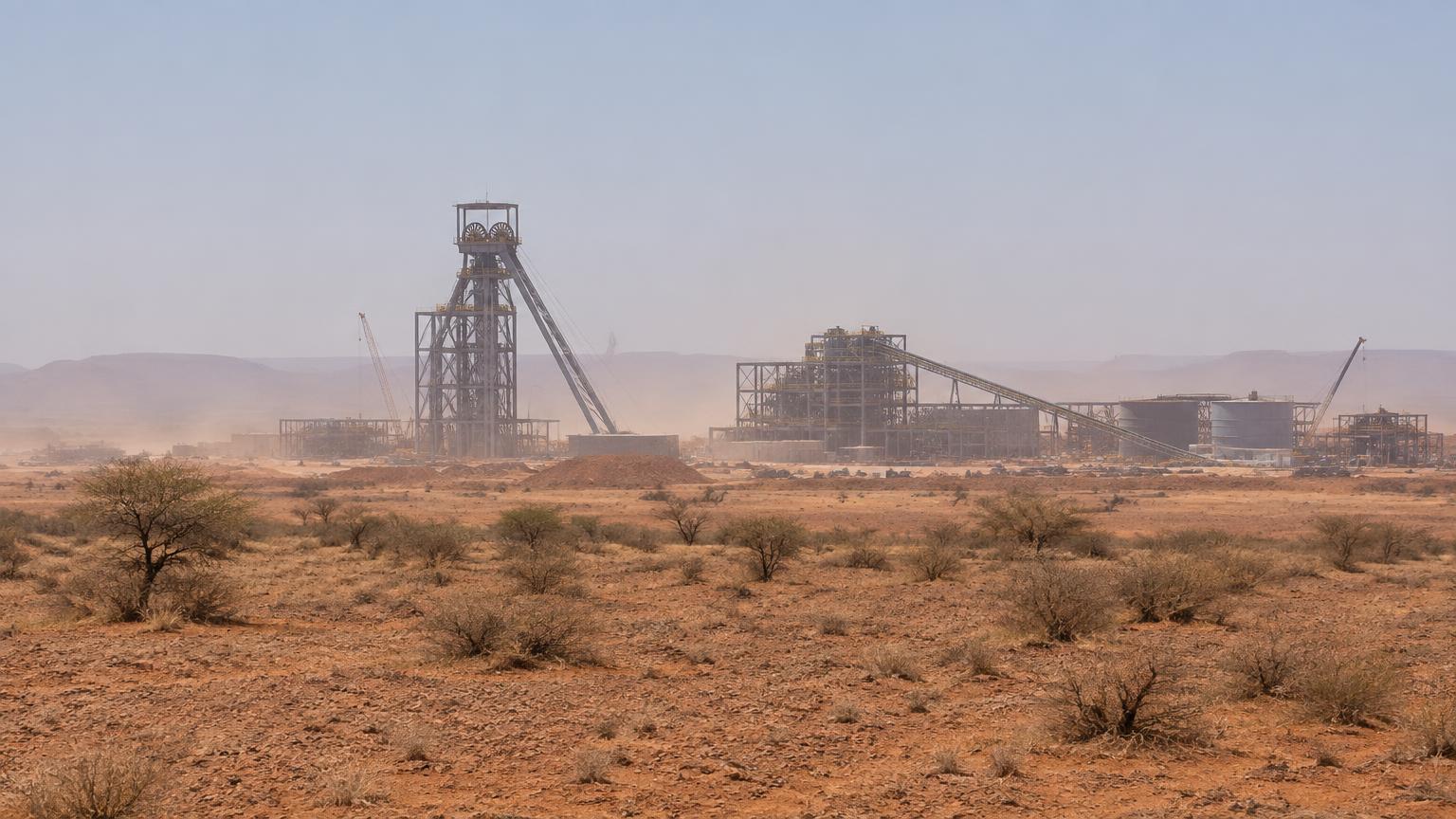
Two days before the offering launched, on 18 September, the company restated what Dasa will cost. Direct project costs are now estimated at US$653.0 million against US$375.6 million in the 2024 feasibility study, an increase of 74 per cent. Total project costs to commissioning, including financing costs and contingency, are put at US$777.6 million. Of that, US$228.5 million had been invested by 30 June 2026.
The line items are worth reading individually because they are not uniformly worse. Construction rose 352 per cent, from US$26.5 million to US$119.6 million. Site and Niamey costs rose 136 per cent. Mining rose 40 per cent. Contingency fell 53 per cent, to US$17.3 million, which is the one item that moves the wrong way in a re-estimate: a smaller contingency on a larger budget means less room for the next surprise. Had contingency doubled instead, it would signal an engineer pricing in uncertainty. Halving it signals confidence the cost work does not otherwise support.
Completion has moved with the cost. Construction is now to finish in the first half of 2028 and commissioning in the second half, against an original target of end-2025. The company attributes the slip to "political developments in Niger" delaying funding and construction.
The disclosure gap here matters more than any single figure. The only filed technical report for Dasa is the feasibility study with an effective date of 28 February 2024, which shows pre-production capital of US$308 million, total life-of-mine capital of US$647 million, an after-tax net present value of US$917 million at an 8 per cent discount rate and an after-tax internal rate of return of 57 per cent, all at an assumed uranium price of US$75 per pound.
No updated technical report has been filed at the new cost estimate, and no revised net present value or rate of return has been published. Chief executive Stephen Roman said on 18 September that "despite the increase in capital costs … the Dasa Project is financially robust, due to its high grade and excellent metallurgical characteristics." That is the company's assessment. It is not a filed number.
One input has moved in the company's favour. It cites current term pricing of US$97 per pound of uranium oxide, 29 per cent above the study's US$75 assumption. At half the study price the project would not be financeable at any capital cost; at double it, the cost increase would barely register. At US$97 it offsets some but not all of a 74 per cent rise in direct costs, and only a restated study can say how much.
US$414.2 million that cannot be drawn yet
The approval that lifted the shares 44.9 per cent on 16 September came from the United States International Development Finance Corporation, not from the Export-Import Bank: up to US$414.2 million, structured as a US$397.4 million term loan and a US$16.8 million cost-overrun facility. On a total project cost of US$777.6 million, that is a little over half. Half the facility would leave a hole no equity market is likely to fill; double it would exceed the entire remaining budget.
The company's own wording on what has been approved is precise. "Entry into the DFC Facility and any disbursement thereunder is subject to several material conditions and resolution of other key transaction parameters, and no assurances can be given that these matters will be resolved in a timely matter or at all." The conditions are named. They are: "identifying a viable route to export yellowcake (U3O8) from the project site"; "extending the Project Mining Convention and the Mining Permit on satisfactory terms to harmonize with the tenor of the DFC Facility"; "receiving satisfactory assurances regarding governmental approvals for loan repayments"; "negotiating a satisfactory direct agreement with the government of Niger"; and settling the loan documentation itself. Warrants to the lender are contemplated on terms not yet set.
Two of those conditions sit oddly beside the company's own description of Dasa as "the fully permitted, large, high-grade Dasa Deposit," permitted in 2020 and mined since 2022. A permit whose term has to be extended to match a loan's tenor is a permit that currently expires sooner than the loan, and the expiry date is not disclosed in any company document located. Nor is an export route settled, four years after mining began. Dasa is held through SOMIDA, owned 80 per cent by Global Atomic and 20 per cent by the Republic of Niger, which took a 10 per cent free carried interest and subscribed for another 10 per cent.
After the DFC facility, the company says US$152.7 million of equity is still required before it can draw the term loan. This offering raises C$50 million. Even before any currency conversion, that is a fraction of the stated requirement, which is why the company called it an initial step rather than the step.
Deliveries promised for 2026 from a plant commissioning in 2028
Global Atomic has four uranium sales agreements, none with a named counterparty. As last described in the 13 August 2026 management discussion, three are with North American utilities for "between 6.9 and 8.8 million pounds U3O8 over 6 years beginning in 2026," and one is with a Europe-based utility for "260,000 pounds U3O8 per year for three years beginning in 2026."
Every one of those contracts specifies deliveries starting in 2026. Commissioning is now scheduled for the second half of 2028. The company has not disclosed whether the agreements have been amended, deferred or remain in force as written, and the aggregate volume has been stated three different ways across disclosures: 9.5 million pounds in March 2024, 8.8 million pounds over seven years in February 2025, and the 6.9 to 8.8 million pound range this August. Pricing is described for one agreement only, as "priced close to current term market prices escalating each year."
Niger has already left Europe's uranium supply
The idea that Dasa sits inside a Niger-to-Europe supply question is worth checking against what European utilities actually bought. The Euratom Supply Agency's annual report for 2025, published 9 July 2026, records EU utilities purchasing 14,678 tonnes of uranium in 147 deliveries. Niger supplied 33 tonnes of it, or 0.23 per cent. Canada supplied 36.68 per cent, Kazakhstan 20.31 per cent and Russia 15.98 per cent. Doubling Niger's share would still leave it below Malawi's and South Africa's combined; halving it would round to zero.
That collapse has a documented cause. Orano confirmed in December 2024 that it had lost operational control of SOMAÏR, and in June 2025 stated that Niger had announced its "intent to appropriate" the joint venture, which Orano called "a further step in the military authorities' ongoing strategy to expell Orano from Niger." An ICSID arbitral tribunal ordered Niger on 23 September 2025 to refrain from selling SOMAÏR-produced uranium; Orano said in November 2025 that a shipment had gone anyway, "in breach" of that decision.
None of that is a forecast about Dasa, which is a separate asset held under a separate convention with a state shareholder. It is the operating environment a lender is pricing when it makes a direct agreement with the government of Niger a condition of disbursement.
The grade is why this is still a project at all
Dasa's probable mineral reserve is 8.047 million tonnes at 4,113 parts per million uranium oxide, containing 73.0 million pounds, with 68.1 million pounds recovered over a 23 to 24 year life at a steady-state metallurgical recovery of 94.15 per cent. Halve that grade and the project is a marginal heap-leach story at best; double it and there is nothing comparable outside Athabasca.
Set that beside other developers at a similar stage. Deep Yellow's Tumas reserve in Namibia sits at 345 parts per million, roughly a twelfth of Dasa's grade, with initial capital near US$372 million; Bannerman's Etango is of a similar order at US$353 million. Those studies were costed in 2023 and 2024, so the capital comparison is between cost bases struck at different times.
For anyone holding the security outside Canada, it trades on the Frankfurt Stock Exchange as G12, with WKN A2JAQL and ISIN CA37957M1068, and on OTCQX as GLATF. The Frankfurt line moved less than Toronto and on a fraction of the volume: Tradegate's order book shows EUR 0.2895 at the close on 23 September 2026, down 12.93 per cent on 372,544 shares, against 17.7 million shares in Canada. Price discovery is in Toronto.
What would turn this around is specific and datable. If the offering closes on 1 October and an export route and a permit extension follow before the loan documentation, the markdown was the cost of a financing rather than a verdict on the asset. If the equity gap is closed by another discounted raise, existing holders will have funded the cost increase twice. At 30 June 2026 the company held C$29,993,336 of cash against total liabilities of C$28,149,346 and a working capital surplus of C$8.4 million: enough to run a head office, nowhere near enough to build a mine.
Equity issued at C$0.88 in February and C$0.50 in September is the clearest single measure of what eight months did to this project.
Transparency note
Transparency note. This is an independent due-diligence analysis and editorial opinion piece produced by The Maple Markets editorial desk. It is not sponsored, promoted or commissioned, and no compensation of any kind has been received from Global Atomic Corporation (TSX: GLO), Orano SA, Deep Yellow Limited (ASX: DYL), Bannerman Energy Ltd (ASX: BMN) or any party acting on their behalf. The analysis is based on public disclosure available as of the publish date; every figure is attributed to its primary source. The Maple Markets and its authors may hold positions in securities mentioned; nothing here is a recommendation to buy, sell or hold any security, and readers should not treat it as investment advice. Past disclosure does not guarantee future results. Policies: Editorial Standards · Financial Disclaimer.
Read next
Auch auf Deutsch: Global Atomic platzierte Aktien für C$50 Millionen zu C$0.50, und der Kurs schloss darunter
 Mining and ResourcesGlobal Atomic Has a US$414.2 Million Approval From Washington and Five Conditions Before It DrawsGlobal Atomic Corporation (TSX: GLO) was halted on 16 September 2026 and announced that the board of the U.S. International Development Finance Corporation had approved a debt facility of up to US$414.2 million for the Dasa uranium project in Niger. The shares closed at C$0.71, up 44.9 per cent on more than seven times average volume. The facility exceeds the US$327.9 million still budgeted for construction, and five conditions stand between approval and a drawdown.Daniel Okoye · September 17, 2026 · 7 min
 Mining and ResourcesHemlo Mining Drills 89.9 g/t Gold 50 Metres From a Working Stope, and Changes Its True-Width EstimateHemlo Mining Corp. (TSX: HMMC) reported 89.89 g/t gold over 3.0 metres of core length in hole 6702608 at South-Rim on September 10, 2026, from a zone 50 to 150 metres from active C-Zone mining. The release also revises the estimated true-thickness conversion to 65 to 90 per cent of downhole length, from 30 to 70 per cent in the May 14, 2026 release on the same zone, without stating why. South-Rim carries no resource, no reserve and no economics.Priya Sandhu · September 11, 2026 · 9 min
 Mining and ResourcesThe Title Changed, the Drill File Did Not: Reading F3 Uranium's (TSXV: FUU, FSE: GL7) 10 Per Cent DayF3 Uranium Corp. (TSXV: FUU, FSE: GL7) closed at C$0.16 on September 4, 2026, up 10.34 per cent on 1.84 times its average volume, the first session after a 5:00 p.m. release naming president Raymond Ashley as VP Exploration in place of Sam Hartmann. The release changed who signs the technical disclosure and nothing in the drill file. Ranked from the top, the filed record is 11.8 million lb U3O8 indicated at the JR Zone, one assayed Tetra Zone hole, C$21.4 million of cash at March 31, a C$15 million Denison debenture and an unused shareholder authority to consolidate at up to 40-for-1.Daniel Okoye · September 7, 2026 · 8 min
Follow this story
Follow GLO.TO — the next Maple piece on this company, plus the Maple Morning Debrief before the open.
Follow and ask
Get more of our Canadian market coverage in Google Top Stories.
Opinion
This article expresses the author's personal views, is separate from news reporting and is not investment advice.
Disclosure
**Transparency note.** This is an independent due-diligence analysis and editorial opinion piece produced by The Maple Markets editorial desk. It is not sponsored, promoted or commissioned, and no compensation of any kind has been received from Global Atomic Corporation (TSX: GLO), Orano SA, Deep Yellow Limited (ASX: DYL), Bannerman Energy Ltd (ASX: BMN) or any party acting on their behalf. The analysis is based on public disclosure available as of the publish date; every figure is attributed to its primary source. The Maple Markets and its authors may hold positions in securities mentioned; nothing here is a recommendation to buy, sell or hold any security, and readers should not treat it as investment advice. Past disclosure does not guarantee future results. Policies: [Editorial Standards](https://themaplemarkets.ca/en/policies/editorial-standards) · [Financial Disclaimer](https://themaplemarkets.ca/en/policies/financial-disclaimer). See the Financial Disclaimer.
Sources and references (14)
- Global Atomic, "Announces C$50 Million Public Offering of Units", 23 September 2026
- Global Atomic, "Announces Proposed Public Offering of Units", 22 September 2026
- Global Atomic, "Updates Dasa Uranium Project Cost Estimates", 18 September 2026
- Global Atomic, "Dasa Uranium Project Financing Update", 16 September 2026
- Dasa Uranium Project Feasibility Study, NI 43-101 technical report, effective 28 February 2024
- Global Atomic, management discussion and analysis for the quarter ended 30 June 2026, dated 13 August 2026
- Global Atomic, condensed interim consolidated financial statements, 30 June 2026
- Euratom Supply Agency, Annual Report 2025, published 9 July 2026
- Orano, "Orano opposes nationalization plans of SOMAÏR in Niger", June 2025
- Orano, "Orano condemns illegal shipment of uranium stored at the SOMAIR site", November 2025
- TMX Money quote page, Global Atomic Corporation, read after the close 23 September 2026
- Tradegate order book, ISIN CA37957M1068
- Deep Yellow, Tumas project economics
- Bannerman Energy, Etango project economics
Cite this analysis
Please attribute The Maple Markets and link to the original page.
Daniel Okoye (September 24, 2026). Global Atomic Priced C$50 Million of Stock at C$0.50, and the Shares Closed Below It. The Maple Markets. https://themaplemarkets.ca/en/newsroom/global-atomic-sixteen-per-cent-off-on-3-6-times-volume-global-atomic-shttps://themaplemarkets.ca/en/newsroom/global-atomic-sixteen-per-cent-off-on-3-6-times-volume-global-atomic-s