
How Snowline Gold Lined Up C$220 Million for a Valley Mine Decision
Snowline closed the third quarter with C$220.4 million in cash after an August raise it sized to reach a potential construction decision, and its prefeasibility study for the Valley gold deposit is due by the first quarter of 2027.
Snowline Gold rose on November 27 with its September 30 statements showing C$220.4 million in cash and no debt, after a C$172.6 million August offering the company sized to its projected costs through engineering and permitting. The Valley prefeasibility study is on track for the first quarter of 2027, followed by a Yukon permitting submission planned for early 2028; build financing is a later step the company has said will be needed.
By Daniel Okoye7 min read
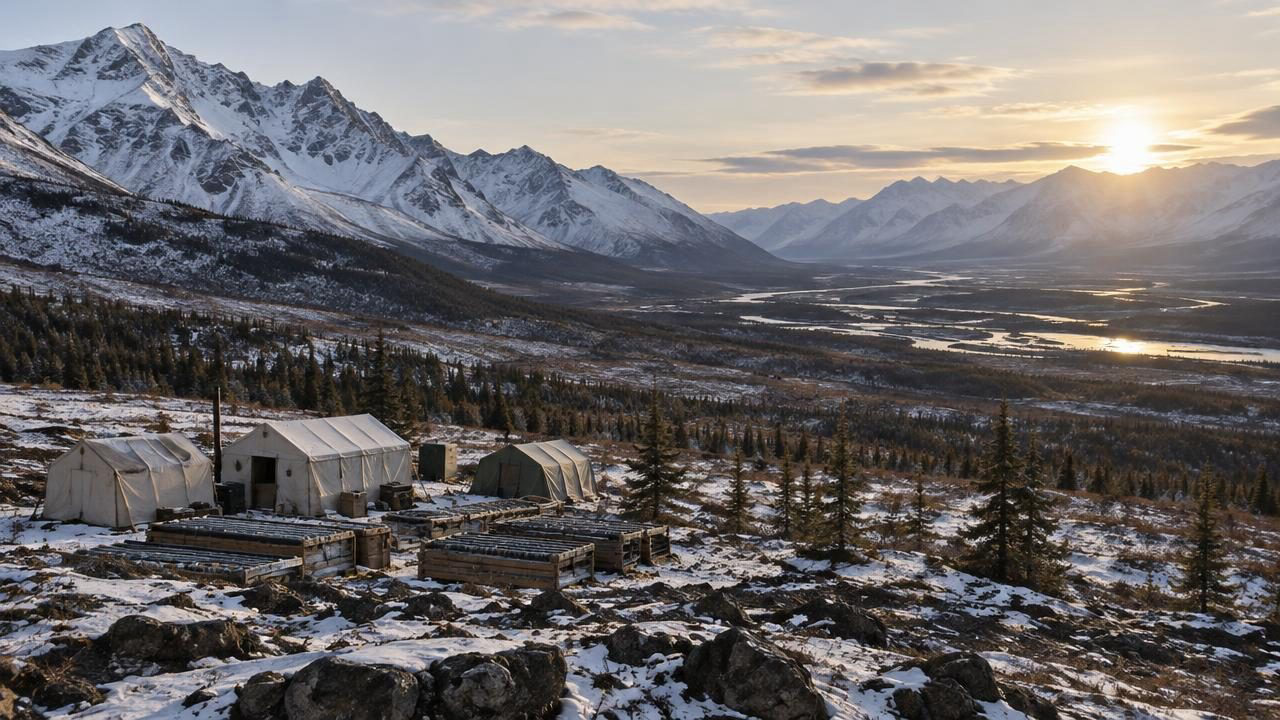
Cash at September 30, 2026
C$220.4 million
C$220,367,000 in the condensed interim statements approved November 13, 2026; up from C$104.1 million at December 31, 2025.
August 2026 bought deal
C$172.6 million
11,902,500 shares at C$14.50, closed August 12, 2026; B2Gold kept its 9.9 per cent, per the company's release.
Valley resource
7.94 million ounces
measured and indicated at 1.21 g/t gold, plus 0.89 million ounces inferred, technical report dated August 27, 2025.
Initial capital in the 2025 PEA
C$1.685 billion
preliminary economic assessment at US$2,150 gold; post-tax NPV5% of C$3.367 billion, repeated in the Q3 2026 MD&A.
Close on November 27, 2026
C$12.47
up 7.04 per cent from C$11.65 on consolidated volume of 487,041 shares, per end-of-day data read at 16:58 ET from TMX Money (QuoteMedia).
Snowline Gold has already raised the money it says will carry Valley to a decision on building a mine. The company reported C$220.4 million in cash and cash equivalents at September 30, 2026, in interim statements its board approved on November 13, and the money is already earmarked for one job: carrying the Valley gold deposit through engineering and permitting to the point where a board can decide whether to build.
The shares closed at C$12.47 on the Toronto Stock Exchange on November 27, up 7.04 per cent, per end-of-day data read at 16:58 ET from TMX Money. Consolidated volume across Canadian venues was 487,041 shares.
No company release accompanied the day; Snowline's most recent announcement remains its drill update of November 18.
The raise was sized to a decision, and the company said so
When Snowline closed the bought deal on August 12, 2026, selling 11,902,500 common shares at C$14.50 each for C$172.6 million, chief executive Scott Berdahl said in the release that "the scale of the raise is informed by our projected costs through engineering and permitting to a potential construction decision."
A bought deal is a financing in which a syndicate of investment banks agrees to buy the whole issue at a fixed price before selling it on, which moves the placement risk from the company to the banks. BMO Capital Markets led this one with CIBC World Markets, and the underwriters were paid a 4.0 per cent cash commission, or 2.0 per cent on a list of subscribers named by the company, according to the closing release.
B2Gold Corp., the existing strategic shareholder, took part in the offering to keep its 9.9 per cent interest, the company said in the same release.
The September 30 statements show what the money did to the balance sheet. Working capital, the gap between current assets and current liabilities, is the cleanest single measure of what an explorer has to spend.
| Item, from the condensed interim statements | September 30, 2026 | December 31, 2025 |
|---|---|---|
| Cash and cash equivalents | C$220.4 million | C$104.1 million |
| Working capital | C$214.2 million | C$101.0 million |
| Total liabilities | C$11.7 million | C$8.1 million |
The statements carry no borrowings.
Note 2 to the statements gives the company's own view: "Based on its current cash resources and planned expenditures, the Company expects to have sufficient liquidity to fund its planned exploration activities and corporate expenditures for at least the next twelve months." The same note adds that once a development decision is made, "expenditures will increase significantly, and additional financing will be required."
What the money is buying between now and 2028
Snowline's September 9 update said its prefeasibility study for Valley "remains on track for delivery by Q1 2027," and the November 18 release repeated that timing. A prefeasibility study is the second of the three standard engineering studies a mining project goes through; it is detailed enough to let a company declare mineral reserves, the portion of a resource shown to be economically mineable, which a preliminary assessment cannot do.
The September update listed the design choices the study is testing. Mill throughput may rise above the 25,000 tonnes a day assumed in the 2025 economic assessment. Liquefied natural gas is being studied as the main fuel in place of diesel, because power is the largest operating cost in that assessment. Tailings sites closer to the mine, where waste rock and tailings could be stored together, are being compared with the original site served by an 18-kilometre pipeline.
Alongside the study, the company plans to submit a project description to the Yukon Environmental and Socio-economic Assessment Board, known as YESAB, together with the study, to begin a pre-submission engagement. The company describes pre-submission engagement as a newer, early-stage step meant to align First Nations, regulators and communities before formal assessment, per its September 9 release. Snowline said on September 9 that it then intends to file the project proposal that starts YESAB's screening and assessment "in early 2028."
Exploration and evaluation expenses were C$56.7 million in the nine months to September 30, 2026, the statements show, and cash used in operations over the same nine months was C$51.5 million.
On Maple's arithmetic, at the nine-month rate of operating cash use the balance at September 30, 2026, would last a little over three years; exploration and evaluation expense was C$31.0 million in the third quarter alone, and the company's own statement covers the next twelve months. The company described 2026 as its largest field campaign to date, and spending in 2027 and 2028 will follow the study's design choices.
Valley is the asset; the drill bit is still adding to it
Valley, on Snowline's wholly owned Rogue Project in central Yukon, holds a measured and indicated mineral resource of 7.94 million ounces of gold at 1.21 grams per tonne, plus 0.89 million ounces in the lower-confidence inferred category, according to the technical report dated August 27, 2025. A mineral resource is an estimate of gold in the ground with a reasonable prospect of being mined; it is not a reserve and has not been shown to be economic.
The 2025 preliminary economic assessment set out what a mine might look like. Using a fixed gold price of US$2,150 an ounce, it estimated a post-tax net present value of C$3.367 billion against initial capital of C$1.685 billion, figures the third-quarter MD&A repeats. Gold traded at US$3,643.03 an ounce in the U.S. session of November 27, 2026, per USAGOLD's daily market report. That value is the mine's projected after-tax cash flow, discounted back to today. The assessment uses inferred resources, and Snowline's September 9 project update states that "there is no certainty that the results of the PEA will be realized."
The November 18 release added to the picture without changing the study. An infill hole returned 450.2 metres averaging 1.47 grams per tonne gold from surface at Valley, which the company said outperformed its resource block model at that spot.
At Duke, 12 kilometres southeast, one hole returned 65.8 metres at 1.03 grams per tonne, in a breccia the company describes as a new style of gold system for the Rogue Project. A breccia is rock that has been shattered and re-cemented by mineral-bearing fluid.
Berdahl was explicit about where those results go. They "will inform future mineral resource estimates and studies," he said in the release, but "will not be incorporated into the company's upcoming Pre-Feasibility Study." Maple's piece of November 18 read those holes in detail, and nothing filed since changes those figures. Full assays for one Duke hole were still pending as of the November 18 release.
People and shares since the summer
The board changed in October. On October 26, 2026, Snowline appointed Randy Smallwood as an independent director. He co-founded Wheaton Precious Metals and was its president and chief executive from 2011 to March 2026, and before that he was project manager at the Golden Bear mine in northern British Columbia from 1995 to 2000, the release states. Craig Hart remains chair, per the same release.
Snowline had 188,576,760 common shares outstanding at September 30, 2026.
The MD&A gives 188,654,260 shares and 6,484,300 stock options outstanding as of its date, a share count higher than the quarter-end figure because of option exercises and share-unit settlements after September 30. The statements list no warrants.
Since then, the subsequent-events note records 40,000 options exercised for C$179,000 and small unit grants to a director and an employee. No financing has been announced since August 12.
Snowline has announced no build financing and no new partner. The company has set out the order of work as the prefeasibility study, followed by the YESAB filings.
Where the shares sit after the day
Market value is the share count times the price. At C$12.47, the 188,654,260 shares in the MD&A give a market value of about C$2.35 billion, against cash of C$220.4 million at September 30, 2026. The quote and volume are secondary market data from TMX Money and were not checked against exchange filings.
Snowline has said it has the money for at least the next twelve months, that the study is on track for the first quarter of 2027, and that a much larger financing will be needed only after a decision to build.
Snowline's next dated step is the Valley prefeasibility study, which the company says is on track for delivery by the first quarter of 2027 and is the stage at which mineral reserves can be declared.
Disclosure
Transparency note. This is an independent due-diligence analysis and editorial opinion piece produced by The Maple Markets editorial desk. It is not sponsored, promoted or commissioned, and no compensation of any kind has been received from Snowline Gold Corp. (TSX: SGD), B2Gold Corp. (TSX: BTO), Wheaton Precious Metals Corp. (TSX: WPM) or any party acting on their behalf. The analysis is based on public disclosure available as of the publish date; every figure is attributed to its primary source. Neither The Maple Markets nor the author holds a position in the securities mentioned; nothing here is a recommendation to buy, sell or hold any security, and readers should not treat it as investment advice. Past disclosure does not guarantee future results. Policies: Editorial Standards · Financial Disclaimer.
Read next
Auch auf Deutsch: Wie Snowline Gold C$220 Millionen für eine Bauentscheidung bei Valley beschafft hat
 Mining & EnergySnowline Drills a New Gold System at Duke, and Valley Returns 450 MetresSnowline Gold reported on November 18, 2026 that hole DUK-26-004 at its Duke target cut 65.8 metres of 1.03 grams per tonne gold, about 12 kilometres from the Valley deposit, and that Valley hole V-26-165 returned 1.47 grams per tonne over 450.2 metres from surface. The Valley prefeasibility study remains on schedule for the first quarter of 2027.Daniel Okoye · November 18, 2026 · 7 min
 Mining & EnergyEquinox Gold's Costs in a Falling Gold Market: US$2,091 an OunceEquinox Gold reported record revenue of US$1.05 billion for the third quarter of 2026, at an all-in sustaining cost of US$2,091 per ounce sold and a realised gold price of US$4,157. Gold has since fallen to about US$3,870. The company's own cost measures show how much margin a lower price leaves, and which costs those measures leave out.Priya Sandhu · November 26, 2026 · 6 min
 Mining & Energy32 Metres of Gold Between Banyan's Airstrip and Powerline Deposits at AurMacBanyan Gold has extended gold into the ground between two of its AurMac deposits in Yukon. On November 23, 2026 it reported that hole AX-26-910 intersected 32.2 metres at 1.67 grams of gold per tonne, including 1.5 metres at 31.30 grams. The result arrived after the data cut-off for the company's preliminary economic assessment, which Banyan said in July it expected in the fourth quarter of 2026. Seven drills were still turning, with more than 69,000 metres completed.Élise Galarneau · November 25, 2026 · 7 min
Follow this story
Follow SGD.TO — the next Maple piece on this company, plus the Maple Morning Debrief before the open.
Follow and ask
Get more of our Canadian market coverage in Google Top Stories.
Sources and references (9)
- Snowline Gold, condensed interim consolidated financial statements for the three and nine months ended September 30, 2026
- Snowline Gold, management's discussion and analysis for the period ended September 30, 2026
- Snowline completes C$172.6 million bought deal public offering, August 12, 2026
- Snowline Gold announces inclusion into multiple equity indices and provides project updates, September 9, 2026
- Snowline expands new gold system at its Duke target and reports 1.47 g/t gold over 450.2 m at Valley, November 18, 2026
- Snowline Gold appoints Randy Smallwood to board of directors, October 26, 2026
- TMX Money quote page, SGD
- The Maple Markets, Snowline's Duke and Valley results, November 18, 2026
- USAGOLD, daily precious metals market report, November 27, 2026
Cite this analysis
Please attribute The Maple Markets and link to the original page.
Daniel Okoye (November 27, 2026). How Snowline Gold Lined Up C$220 Million for a Valley Mine Decision. The Maple Markets. https://themaplemarkets.ca/en/newsroom/snowline-gold-rose-7-38-percent-to-c-12-51-on-0-71-times-average-volumehttps://themaplemarkets.ca/en/newsroom/snowline-gold-rose-7-38-percent-to-c-12-51-on-0-71-times-average-volume