
First Lithium's Winter Brine Sampling Returns Up to 348 mg/L Lithium at Ascotan
Sixty shallow auger holes sampled in August add a winter season to First Lithium's brine work in northern Chile.
First Lithium Minerals sampled brine from 60 shallow holes at Salar de Ascotan in August 2026. Lithium ranged from 34 to 348 mg/L, strongest in the southern sector. The company plans a 1,500-metre drill program in the first half of 2027.
By Priya Sandhu7 min read
Dieser Artikel ist derzeit nur auf Englisch verfügbar.
Winter lithium range
34 to 348 mg/L
60 shallow brine samples taken in August 2026; mean 137 mg/L; release of November 5, 2026.
Southern sector
197 to 348 mg/L lithium
the main winter anomaly; release of November 5, 2026.
Summer peak
1,299.5 mg/L lithium
March 2026 campaign, 20 samples; release of June 9, 2026.
Planned drilling
1,500 metres, est. US$3.0 million
expected to start in the first half of 2027, subject to capital and permits; release of November 5, 2026 and MD&A of July 10, 2026.
Frankfurt listing
X28 / WKN A3DQXP / ISIN CA32072L1094
Deutsche Börse instrument page, read November 5, 2026.
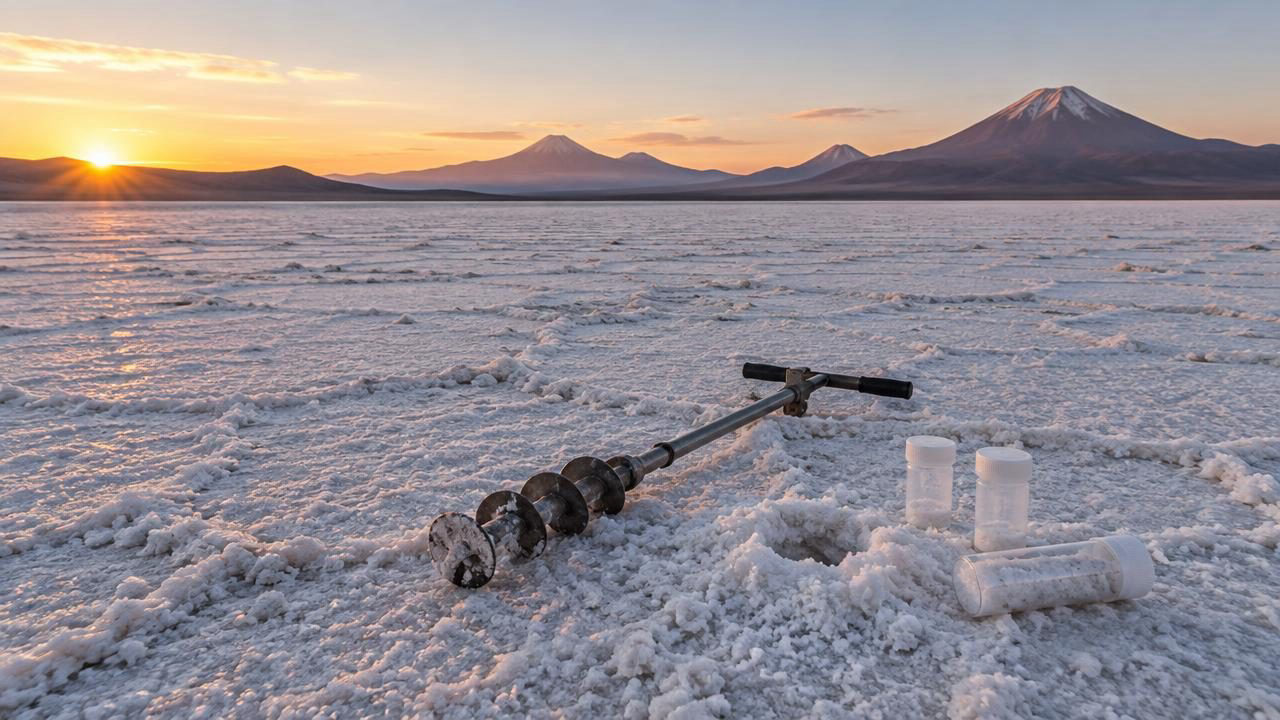
First Lithium's field crew completed sixty hand-auger holes in the crust of the Salar de Ascotan this August. Each hole stopped about a metre and a half down and gave up a bottle of salty water.
First Lithium Minerals Corp. reported the results this week. Lithium in those winter samples ranged from 34 to 348 milligrams per litre, with a mean of 137 mg/L.
The strongest values sat in the southern sector of the concessions, between 197 and 348 mg/L.
The release says the sampling method was chosen to keep the winter results directly comparable with the company's earlier analyses. The two campaigns give First Lithium a seasonal picture of the shallow brine. They also mark where its planned drill program would go first.
A salar keeps its lithium in water
Ascotan is a salar, a high-altitude salt flat in Chile's Antofagasta Region. The release places it about 150 kilometres from Calama. First Lithium holds about 6,400 hectares of exploration concessions there.
In a salar, lithium is not dug out of rock. It is dissolved in brine, the salty water held between grains of sediment. Producers pump that brine to the surface and concentrate it. A figure in milligrams per litre is therefore a concentration: how much lithium a litre of that water carries.
A concentration measures grade in a sample. Drilling and pumping tests measure how much brine sits underground and how fast it flows. Ascotan has no resource estimate today. The samples are also shallow: a 1.5-metre auger hole reaches the top of the brine table, where the sediment turns wet. Deeper brine can differ in grade and in chemistry.
Two seasons, read side by side
The winter program was the second sampling season at Ascotan this year. The first ran in March 2026, the southern summer. First Lithium reported it on June 9, 2026.
The two campaigns used the same method but different hole counts. They should be read side by side, never averaged together.
| Campaign | Samples with brine | Lithium range (mg/L) | Lithium mean (mg/L) | Source |
|---|---|---|---|---|
| March 2026 (summer) | 20 of 40 holes | 93.5 to 1,299.5 | 417.4 | Release, June 9, 2026 |
| August 2026 (winter) | 60 | 34 to 348 | 137 | Release, November 5, 2026 |
The summer program returned the higher peak. In March, 20 of the 40 holes reached the brine table. The June 9 release says the other 20 did not because of permeability conditions. Three of the 20 samples exceeded 1,000 mg/L.
The winter mean of 137 mg/L sits below the summer mean of 417.4 mg/L. The winter program took 60 samples against 20 in March, per the two releases. The November 5 release points to a southern anomaly in the new data.
Seasonal change matters in a salar. As a general pattern, rain and snowmelt dilute shallow brine and dry-season sun concentrates it again. Rob Saltsman, president and chief executive officer, addressed that directly in the November 5 release.
He said winter brings less evaporation and "climatic conditions dilute the near-surface brine." Even so, the program "confirmed robust lithium presence."
Two campaigns five months apart give the company a sense of that range. Neither one alone would.
Magnesium, the number processors watch
Lithium is one figure among several. The winter assays also report magnesium and potassium, along with boron, calcium and sodium.
Magnesium matters most after lithium. It behaves chemically like lithium and has to be separated out. The more magnesium a brine carries for each unit of lithium, the harder and costlier that separation tends to be.
The industry tracks this as the magnesium-to-lithium ratio. The winter samples had a median ratio of 13.0, within a range of 12.4 to 25.7.
The March release cited ratios of roughly 8 to 10 in its strongest group of holes, SAL-16 to SAL-20. That March figure covers five holes, while the winter median covers all 60 samples, so the two are not like-for-like.
The market for the end product sets the stakes. Trading Economics quoted Chinese lithium carbonate at CNY 92,850 a tonne on November 4, 2026. That price is context for why grade and magnesium matter, not a value for Ascotan.
Potassium is a possible by-product of brine operations. The winter samples carried a mean of 2,660 mg/L potassium. Boron stayed below 1 mg/L throughout.
Aldo Moreno Salinas, First Lithium's vice-president of exploration, reviewed the technical content as the qualified person. A qualified person is the professional who takes responsibility for technical disclosure under Canada's mining-disclosure rule, National Instrument 43-101.
From auger to drill rig
The sampling program is the foundation for what comes next. The company expects to start a 1,500-metre drilling program at Ascotan in the first half of 2027.
A drill hole goes far deeper than an auger. It can show how thick the brine-bearing sediments are and what the brine carries at depth. A pumping test in a finished hole shows how readily it flows. A resource estimate would rest on those measurements.
The July 10, 2026 interim management's discussion and analysis put the program's estimated cost at US$3.0 million. The November 5 release says the timing depends on access to capital. It also depends on government permits and licences, and on agreements with local communities.
"The Ascotan project continues to deliver," Saltsman said in the release.
He said the results "reinforce our belief" that conductive zones found by geophysics "could be associated with lithium brine mineralization." The company is "looking forward to advance the project to the resource delineation stage," he added.
The money behind the program
First Lithium has raised money twice since mid-year. On July 22, 2026 it closed a first tranche of C$1,781,948, per the company's release that day. That was C$1,121,400 under LIFE and C$660,548 by private placement, for 15,844,982 units.
On October 29, 2026 it closed a second tranche, headlined at gross proceeds of C$1,442,144. The release gives C$597,345 under the listed issuer financing exemption and C$844,840 by private placement. Those two parts add to C$1,442,185, above the headline total by C$41.
The listed issuer financing exemption, known as LIFE, lets a listed company sell shares to the public without a full prospectus.
The second tranche issued 12,320,469 units. Of those, 2,173,333 were flow-through units at C$0.15 and the rest were units at C$0.11. Each unit came with half a warrant, exercisable at C$0.18 for three years.
A flow-through share passes the company's Canadian exploration tax deductions to the buyer, who pays a premium for them.
The release lists use of proceeds as exploration, general corporate purposes and working capital. The CSE listing page showed 124,545,737 shares outstanding on November 5, 2026. The July 10 MD&A gave 96,380,286. The July 22 closing issued 15,844,982 units and the October 29 closing 12,320,469. Per the releases, those account for the difference.
The most recent filed statements are the interim accounts for the second quarter. At June 30, 2026 they show cash of C$396,772 and a working-capital deficit of C$165,695. Both tranches closed after that balance-sheet date, so neither is in those figures.
The two raises together come to about C$3.2 million gross. The MD&A states that there is no assurance new capital will become available. The next quarterly statements, for September 30, 2026, will be the first to show the July tranche.
The shares and the Frankfurt line
First Lithium shares closed at C$0.10 on the CSE on November 5, up 25.00 per cent on 10,000 shares traded.
Those figures are per end-of-day data read at 16:20 ET on November 5, 2026, from the exchange's listing page.
The company is also quoted in Frankfurt under the symbol X28.
Deutsche Börse lists it with WKN A3DQXP and ISIN CA32072L1094. The November 5 release also names the FSE symbol.
A board that changed this autumn
Rob Saltsman is president and chief executive officer, per the November 5 release. Deepak Varshney joined the board on October 27, 2026, succeeding Ernest Mast, who stays on as an advisor.
The CSE listing page names Claude Ayache as chief financial officer.
Where Ascotan stands now
Two seasons of shallow sampling have mapped lithium-bearing brine across the Ascotan concessions. The southern sector stands out in the winter data. The March program found its highest values in holes SAL-16 to SAL-20.
The company says it aims to advance Ascotan to the resource delineation stage. First Lithium has raised about C$3.2 million since July. It plans 1,500 metres of drilling at Ascotan in the first half of 2027.
Offenlegung
Transparency note. This is an independent due-diligence analysis and editorial opinion piece produced by The Maple Markets editorial desk. It is not sponsored, promoted or commissioned, and no compensation of any kind has been received from First Lithium Minerals Corp. (CSE: FLM) or any party acting on their behalf. The analysis is based on public disclosure available as of the publish date; every figure is attributed to its primary source. The Maple Markets and its authors may hold positions in securities mentioned; nothing here is a recommendation to buy, sell or hold any security, and readers should not treat it as investment advice. Past disclosure does not guarantee future results. Policies: Editorial Standards · Financial Disclaimer.
Weiterlesen
Also in English: First Lithium's Winter Brine Sampling Returns Up to 348 mg/L Lithium at Ascotan
 Mining & EnergyC$1.44 Millionen eingeworben: First Lithium schließt die zweite LIFE-Tranche abFirst Lithium Minerals hat am 29. Oktober 2026 die zweite Tranche seines LIFE-Angebots und eine parallele Privatplatzierung mit einem Bruttoerlös von C$1,442,144 abgeschlossen. Nach Angaben des Unternehmens fließt das Geld in Explorationsbohrungen und Soleproben bei seinem Lithiumprojekt Ascotan in Chile, in Flow-through-Exploration bei seinem Goldprojekt Lidstone in Ontario und in das Betriebskapital. Ausgegeben wurden 12,320,469 Aktien, rund 9.9 Prozent des vergrößerten Unternehmens.Priya Sandhu · 2. November 2026 · 7 min
 Mining & EnergyUranium One holt einen Explorationsgeologen mit 14 Jahren Erfahrung für die erste Athabasca-SaisonUranium One Mining hat am 23. Oktober 2026 den Geologen Adrian Huerta Ruiz aus Saskatoon verpflichtet, um die erste Feldsaison im Athabasca-Becken zu planen, wo das Unternehmen die Claims Nucleon und Quark hält und den Erwerb von Pasfield Lake vereinbart hat. Zum 30. Juni 2026 hielt das Unternehmen C$2.87 Millionen an Barmitteln, davon rund C$1.55 Millionen für kanadische Exploration gebunden.Daniel Okoye · 27. Oktober 2026 · 6 min
 Mining & EnergyUranium One geht mit C$2.9 Millionen Barmitteln und vier Meilensteinen in die nächste ExplorationsphaseUranium One Mining Corp. (CSE: UUU) meldete in den am 31. August eingereichten Zwischenabschlüssen Barmittel von C$2,868,144 zum 30. Juni 2026 und geht mit vier anstehenden Meilensteinen in die letzten Monate des Jahres 2026: der regulatorischen Annahme der Übernahme von Foghorn und Pasfield Lake, den ersten Explorationsergebnissen von Nucleon im Athabasca-Becken, einer Hauptversammlung am 30. November und dem Einsatz von C$1,535,001 an Flow-Through-Mitteln für die Exploration. Die Aktie schloss am 21. Oktober 2026 unverändert bei C$0.18.Élise Galarneau · 22. Oktober 2026 · 13 min
Dieser Geschichte folgen
FLM.CN folgen – der nächste Maple-Beitrag zu diesem Unternehmen, dazu der Maple Morning Debrief vor Handelsbeginn.
Folgen und fragen
Mehr von unserer Berichterstattung zu den kanadischen Märkten in Google Top Stories.
Quellen und Verweise (10)
- First Lithium Reports Winter Sedimentary Brine Geochemistry Results at Its Salar de Ascotan Project (Newsfile, November 5, 2026)
- First Lithium Reports up to 1,300 mg/L Lithium in Brine Samples at Ascotan Project (Newsfile, June 9, 2026)
- First Lithium Minerals Announces Closing of First Tranche of LIFE Offering and Private Placement (Newsfile, July 22, 2026)
- First Lithium Minerals Announces Closing of Second Tranche of LIFE Offering and Private Placement (Newsfile, October 29, 2026)
- First Lithium Appoints New Director (Newsfile, October 27, 2026)
- Management's discussion and analysis for the period ended June 30, 2026 (First Lithium, dated July 10, 2026)
- First Lithium Minerals listing page (Canadian Securities Exchange)
- First Lithium Minerals instrument page (Deutsche Börse)
- Lithium carbonate price (Trading Economics, read November 5, 2026)
- C$1.44 Million Raised as First Lithium Closes Its Second LIFE Tranche (The Maple Markets, October 30, 2026)
Diese Analyse zitieren
Bitte The Maple Markets nennen und auf die Originalseite verlinken.
Priya Sandhu (6. November 2026). First Lithium's Winter Brine Sampling Returns Up to 348 mg/L Lithium at Ascotan. The Maple Markets. https://themaplemarkets.ca/de/newsroom/first-lithium-minerals-reported-winter-sedimentary-brine-geochemistryhttps://themaplemarkets.ca/de/newsroom/first-lithium-minerals-reported-winter-sedimentary-brine-geochemistry