
The Number Is Not the Discovery: How to Read a Natural-Hydrogen Result
Concentration is a compositional measurement. Commerciality is a reservoir-performance question.
QIMC reported 27.8% hydrogen at Bennett Hill; MAX Power reported 28.6% at Lawson. The headline percentages look interchangeable. The measurements behind them are at different stages of proof.
By Marc Belzile5 min read
Dieser Artikel ist derzeit nur auf Englisch verfügbar.

A natural-hydrogen exploration headline can look deceptively simple. A company reports hydrogen at 10%, 20% or almost 30%, investors compare that percentage with another discovery, and the larger number appears to win.
Subsurface energy projects do not work that way.
The developing Canadian natural-hydrogen sector now provides an unusually useful illustration. Québec Innovative Materials Corp. (CSE: QIMC) reported a company-record 27.8% H₂ measurement at approximately 374 metres in DDH-26-05 at Bennett Hill, Nova Scotia. MAX Power Mining Corp. (CSE: MAXX) previously reported hydrogen of up to 28.6% at its Lawson discovery in Saskatchewan. On headline concentration alone, the figures appear nearly identical.
They are not equivalent measurements.
Two numbers, two stages of proof
QIMC describes its Bennett Hill data as preliminary field readings from IsoJar mud-gas headspace samples collected during drilling and measured using an EAGLE II analyzer. Its August 25 update says the 308–377-metre interval included multiple replicate measurements and that its statistics count individual replicates. An earlier methodology disclosure states explicitly that preliminary field readings remain subject to laboratory confirmation.
That does not make the readings unimportant. On the contrary, repetition may be more interesting than any individual peak. Below 300 metres in DDH-26-05, QIMC reported elevated hydrogen at several depths, including peaks of 23.7%, 15.8%, 19.1% and 27.8%. It also reported elevated measurements in the upper part of the hole, including 23.5% near 170 metres, and drilling observations that management interprets as consistent with free gas near 164 metres.
The appropriate inference is that QIMC is accumulating evidence for a hydrogen-bearing geological system at Bennett Hill. The inappropriate inference would be that a 27.8% headspace measurement establishes a 27.8%-hydrogen commercial reservoir.
MAX Power's Lawson evidence sits at a different stage. Its 28.6% result was reported from gas recovered in sealed core tubes and analyzed by AGAT. More materially, the company subsequently reported that an eight-metre fractured interval was perforated and gas flowed through casing to surface. Flow-test samples analyzed by AGAT, Corelab and PTRC returned H₂ concentrations between 16.80% and 19.07%.
That is a stronger level of validation because it begins to answer a different question. A drilling sample asks, broadly, is hydrogen present here? A completed-interval flow test begins to ask can the formation deliver hydrogen into a well?
Even that is not the final question.
What actually determines commerciality
A commercially useful gas accumulation depends on pressure, permeability, connected volume, decline behaviour, production rate, gas composition, well cost, processing requirements, infrastructure and the ability to reproduce the result across enough wells to support development. MAX Power itself has framed additional drilling and reservoir work as necessary to evaluate commercial deliverability.
This is also why depth must be interpreted carefully. QIMC's high readings at roughly 170 and 374 metres are substantially shallower than the Lawson intervals under evaluation. If a shallow system eventually demonstrates adequate pressure, connectivity and sustained rates, lower drilling depth could become an important economic variable. But depth alone cannot substitute for those measurements. A shallow non-productive accumulation is not inherently superior to a deeper productive reservoir.
Faults require similar caution. QIMC reports hydrogen measurements associated with faulted, brecciated and sheared rocks, and says drilling experienced loss of return water in portions of that structural zone. Management interprets those observations as consistent with enhanced permeability. Geologically the concept is reasonable: USGS research on hydrogen systems explicitly treats migration pathways, reservoirs, traps and seals as separate components of a subsurface accumulation. But a migration pathway is not automatically a reservoir. A permeable structure may help gas move; it may also allow gas to escape. QIMC's own risk disclosure warns that drilling-water losses may not represent permeability relevant to hydrogen production.
An evidence ladder for early-stage hydrogen
The market needs a better vocabulary than "hit" or "miss." One workable hierarchy:
- Surface or soil-gas anomaly.
- Hydrogen detected in drilling gas.
- Independently analyzed contained gas from sealed samples.
- Flow from a completed, isolated interval.
- Sustained flow with formation-pressure measurement.
- Reservoir definition and demonstrated connectivity between wells.
- Independent resource assessment.
- Commercial production.
This is not a formal regulatory classification. It is a way to prevent evidence from one stage being mistaken for proof of the next.
The caution is warranted by the state of the science. The U.S. Geological Survey says limited data from known accumulations currently prevent a quantitative assessment of overall geologic-hydrogen resource potential. A 2026 peer-reviewed study of natural-hydrogen flow observations concluded that measured flows in most studied settings remain well below the levels the authors associate with modelled commercial projects. Neither finding is a project-specific verdict on Bennett Hill or Lawson. Both reinforce why actual flow data matters more than composition.
The next QIMC headline may not be a percentage
It may be a formation pressure. A sustained rate. An independently analyzed flowing-gas sample. Or evidence that two wells are communicating with the same connected system.
Those measurements are less visually dramatic than "27.8% hydrogen." From a research perspective they are considerably more important.
Scorecard
| Question | QIMC Bennett Hill | MAXX Lawson |
|---|---|---|
| Hydrogen detected in drilling | Yes, issuer-reported | Yes, issuer-reported |
| Peak reported concentration | 27.8%, preliminary IsoJar headspace | 28.6%, sealed-core laboratory sample |
| Independent lab confirmation of headline peak | Not established in cited disclosure | Reported via AGAT |
| Flow from a completed interval | Not reported | Reported through casing |
| Independent analysis of flowing gas | Not applicable yet | 16.80%–19.07% across three laboratories |
| Sustained rate, pressure, connectivity | Not reported | Not established |
| Resource estimate | None | None |
What would change the reading
The constructive case at Bennett Hill strengthens if QIMC produces controlled gas flow from an isolated interval, independently analyzed gas composition, meaningful formation pressure, sustained rates, and evidence of repeatability across holes. It weakens if laboratory confirmation materially diverges from field measurements, if completed intervals fail to flow, if pressure is inadequate, or if subsequent drilling fails to establish continuity. QIMC's own disclosures acknowledge that current exploration observations may not translate into sustained deliverability or economic quantities.
At Lawson, the case advances with sustained-rate and pressure-decline data across multiple wells, and stalls if flow proves short-lived or non-repeatable.
A note on language
Words carry evidentiary weight. Reported means the issuer disclosed it. Measured should identify the method. Interprets is appropriate for a geological model. Indicates fits evidence that supports without establishing. Demonstrated should be reserved for data that directly answers the question being asked.
"QIMC reported a preliminary 27.8% H₂ headspace measurement at 374 metres" is a defensible sentence. "QIMC proved a 27.8% hydrogen reservoir" is not. The same discipline applies in the other direction: MAX Power reported through-casing flow and independent laboratory analyses; it has not proved Lawson is commercial.
Neither company is served by the market grading it on the wrong evidence.
Offenlegung
As of the publication date, the author, editor, publisher, their immediate households and affiliated entities do not own positions in the securities discussed. The Maple Markets received no compensation from any company, its officers, investor-relations providers or financiers in connection with this article. Figures are drawn from public filings and official statistical releases as of the date shown and are not restated for later disclosure. Worked examples labelled illustrative use assumed inputs to show a method, not a forecast. This article is informational only and is not investment, legal, accounting or tax advice.
Weiterlesen
Also in English: The Number Is Not the Discovery: How to Read a Natural-Hydrogen Result
 Mining & Energy99% der neuen Bodengas-Stationen von QIMC in Nova Scotia zeigen nasses thermogenes GasQuebec Innovative Materials meldete am 26. Oktober 2026, dass 145 von 147 neuen Bodengas-Stationen in Cumberland County, Nova Scotia, eine nasse thermogene Gassignatur zeigten, nach 86 Prozent in der am 6. Oktober gemeldeten Serie. Eine vier Kilometer lange Linie blieb durchgehend anomal und lieferte sieben der zehn höchsten Heliumwerte. Die neuen Linien liegen innerhalb der seismischen Messung über 63.7 Linienkilometer, die derzeit in Calgary verarbeitet wird, und das Unternehmen hielt zum 30. Juni 2026 C$14.1 Millionen an Barmitteln.Priya Sandhu · 27. Oktober 2026 · 7 min
 Mining & Energy26.8 Kilometer neue Seismik tragen die Wasserstoffsuche von QIMC nach OntarioQuebec Innovative Materials hat Line 5 hinzugefügt, ein 26.8 Kilometer langes seismisches Profil über die Ontario-Seite des Témiscamingue-Grabens, gelegt dorthin, wo die Bodengas-Wasserstoffwerte des Unternehmens in Ontario am höchsten sind. Nach einer Platzierung im April hielt das Unternehmen am 30. Juni 2026 liquide Mittel von C$14.13 Millionen, und die Tests an der Bohrung DDH-26-05 in Nova Scotia gehen weiter.Élise Galarneau · 21. Oktober 2026 · 8 min
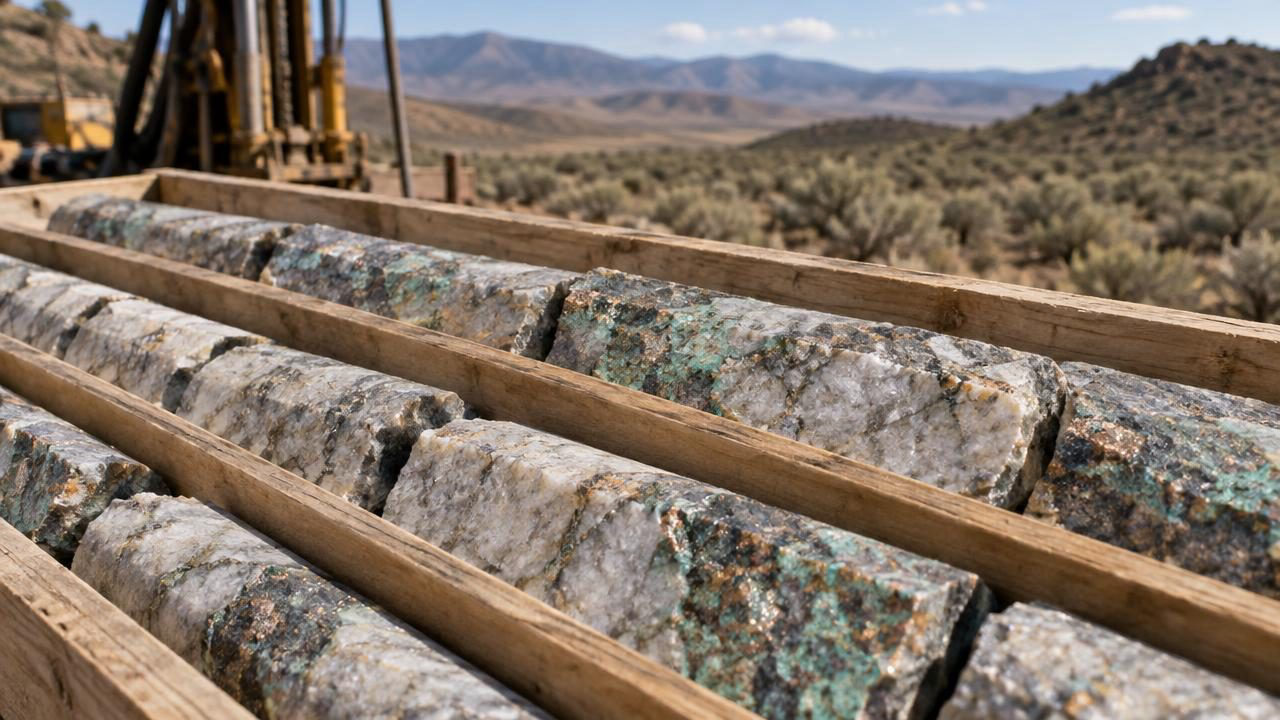 GesponsertMining & EnergyCopper One trifft im ersten Bohrloch von Phase 2 bei Majuba Hill auf visuell identifiziertes gediegenes KupferCopper One Resources hat das erste Bohrloch seines Phase-2-Programms bei Majuba Hill in Nevada abgeschlossen, eine Woche nachdem das Unternehmen den Beginn der Bohrungen gemeldet hatte. Bohrloch MHB-39 reichte 210 Fuß tiefer als geplant, um anhaltender Verkieselung zu folgen, und traf auf visuell identifizierte Kupferoxide bei 820 Fuß und gediegenes Kupfer bei 1,090 Fuß, innerhalb des oxidischen und angereicherten Bereichs des Unternehmens. Die ehemals produzierende Mine weist rund 95,000 Fuß an Bohrungen auf, das Betriebskapital lag nach Angabe des Unternehmens am 14. Oktober bei C$19.1 Millionen, und Analyseergebnisse werden die Gehalte bestimmen.Daryl Frètu Von · 2. November 2026 · 10 min
Dieser Geschichte folgen
QIMC.CN, MAXX.CN folgen – der nächste Maple-Beitrag zu diesen Unternehmen, dazu der Maple Morning Debrief vor Handelsbeginn.
Folgen und fragen
Mehr von unserer Berichterstattung zu den kanadischen Märkten in Google Top Stories.
Quellen und Verweise (5)
- Québec Innovative Materials Corp. — DDH-26-05 results and methodology disclosure (August 11 and August 25, 2026)
- MAX Power Mining Corp. — Lawson technical confirmation and flow-test results (January 16, 2026)
- U.S. Geological Survey — geologic hydrogen systems research
- Scientific Reports (2026) — analysis of measured natural-hydrogen flow rates
- SEDAR+ issuer filings
Diese Analyse zitieren
Bitte The Maple Markets nennen und auf die Originalseite verlinken.
Marc Belzile (30. August 2026). The Number Is Not the Discovery: How to Read a Natural-Hydrogen Result. The Maple Markets. https://themaplemarkets.ca/de/newsroom/reading-a-natural-hydrogen-result-concentration-versus-deliverabilityhttps://themaplemarkets.ca/de/newsroom/reading-a-natural-hydrogen-result-concentration-versus-deliverability