
The Number Is Not the Discovery: How to Read a Natural-Hydrogen Result
Concentration is a compositional measurement. Commerciality is a reservoir-performance question.
QIMC reported 27.8% hydrogen at Bennett Hill; MAX Power reported 28.6% at Lawson. The headline percentages look interchangeable. The measurements behind them are at different stages of proof.
By Marc Belzile5 min read

A natural-hydrogen exploration headline can look deceptively simple. A company reports hydrogen at 10%, 20% or almost 30%, investors compare that percentage with another discovery, and the larger number appears to win.
Subsurface energy projects do not work that way.
The developing Canadian natural-hydrogen sector now provides an unusually useful illustration. Québec Innovative Materials Corp. (CSE: QIMC) reported a company-record 27.8% H₂ measurement at approximately 374 metres in DDH-26-05 at Bennett Hill, Nova Scotia. MAX Power Mining Corp. (CSE: MAXX) previously reported hydrogen of up to 28.6% at its Lawson discovery in Saskatchewan. On headline concentration alone, the figures appear nearly identical.
They are not equivalent measurements.
Two numbers, two stages of proof
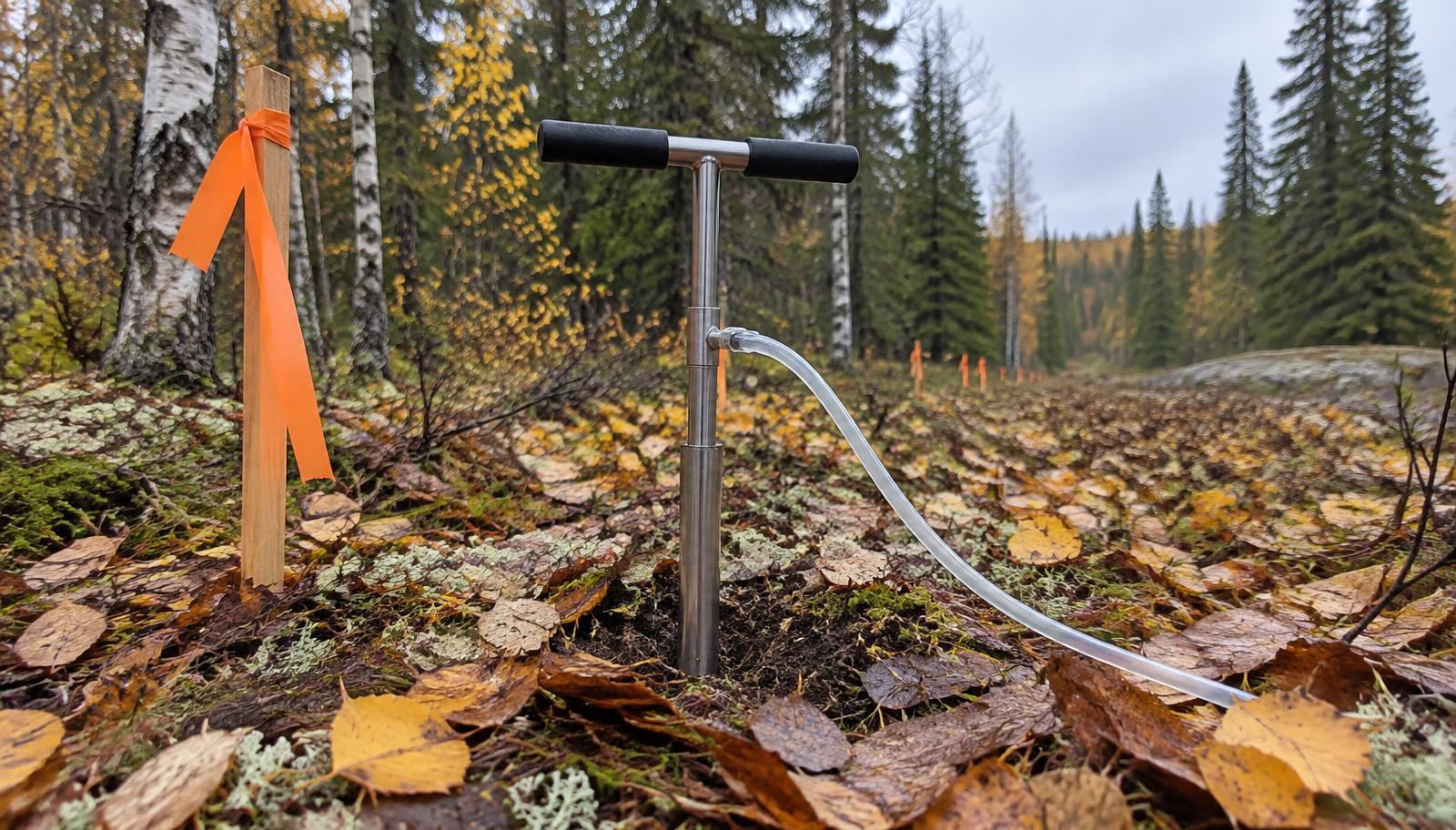
QIMC describes its Bennett Hill data as preliminary field readings from IsoJar mud-gas headspace samples collected during drilling and measured using an EAGLE II analyzer. Its August 25 update says the 308–377-metre interval included multiple replicate measurements and that its statistics count individual replicates. An earlier methodology disclosure states explicitly that preliminary field readings remain subject to laboratory confirmation.
That does not make the readings unimportant. On the contrary, repetition may be more interesting than any individual peak. Below 300 metres in DDH-26-05, QIMC reported elevated hydrogen at several depths, including peaks of 23.7%, 15.8%, 19.1% and 27.8%. It also reported elevated measurements in the upper part of the hole, including 23.5% near 170 metres, and drilling observations that management interprets as consistent with free gas near 164 metres.
The appropriate inference is that QIMC is accumulating evidence for a hydrogen-bearing geological system at Bennett Hill. The inappropriate inference would be that a 27.8% headspace measurement establishes a 27.8%-hydrogen commercial reservoir.
MAX Power's Lawson evidence sits at a different stage. Its 28.6% result was reported from gas recovered in sealed core tubes and analyzed by AGAT. More materially, the company subsequently reported that an eight-metre fractured interval was perforated and gas flowed through casing to surface. Flow-test samples analyzed by AGAT, Corelab and PTRC returned H₂ concentrations between 16.80% and 19.07%.
That is a stronger level of validation because it begins to answer a different question. A drilling sample asks, broadly, is hydrogen present here? A completed-interval flow test begins to ask can the formation deliver hydrogen into a well?
Even that is not the final question.
What actually determines commerciality
A commercially useful gas accumulation depends on pressure, permeability, connected volume, decline behaviour, production rate, gas composition, well cost, processing requirements, infrastructure and the ability to reproduce the result across enough wells to support development. MAX Power itself has framed additional drilling and reservoir work as necessary to evaluate commercial deliverability.
This is also why depth must be interpreted carefully. QIMC's high readings at roughly 170 and 374 metres are substantially shallower than the Lawson intervals under evaluation. If a shallow system eventually demonstrates adequate pressure, connectivity and sustained rates, lower drilling depth could become an important economic variable. But depth alone cannot substitute for those measurements. A shallow non-productive accumulation is not inherently superior to a deeper productive reservoir.
Faults require similar caution. QIMC reports hydrogen measurements associated with faulted, brecciated and sheared rocks, and says drilling experienced loss of return water in portions of that structural zone. Management interprets those observations as consistent with enhanced permeability. Geologically the concept is reasonable: USGS research on hydrogen systems explicitly treats migration pathways, reservoirs, traps and seals as separate components of a subsurface accumulation. But a migration pathway is not automatically a reservoir. A permeable structure may help gas move; it may also allow gas to escape. QIMC's own risk disclosure warns that drilling-water losses may not represent permeability relevant to hydrogen production.
An evidence ladder for early-stage hydrogen
The market needs a better vocabulary than "hit" or "miss." One workable hierarchy:
- Surface or soil-gas anomaly.
- Hydrogen detected in drilling gas.
- Independently analyzed contained gas from sealed samples.
- Flow from a completed, isolated interval.
- Sustained flow with formation-pressure measurement.
- Reservoir definition and demonstrated connectivity between wells.
- Independent resource assessment.
- Commercial production.
This is not a formal regulatory classification. It is a way to prevent evidence from one stage being mistaken for proof of the next.
The caution is warranted by the state of the science. The U.S. Geological Survey says limited data from known accumulations currently prevent a quantitative assessment of overall geologic-hydrogen resource potential. A 2026 peer-reviewed study of natural-hydrogen flow observations concluded that measured flows in most studied settings remain well below the levels the authors associate with modelled commercial projects. Neither finding is a project-specific verdict on Bennett Hill or Lawson. Both reinforce why actual flow data matters more than composition.
The next QIMC headline may not be a percentage
It may be a formation pressure. A sustained rate. An independently analyzed flowing-gas sample. Or evidence that two wells are communicating with the same connected system.
Those measurements are less visually dramatic than "27.8% hydrogen." From a research perspective they are considerably more important.
Scorecard
| Question | QIMC Bennett Hill | MAXX Lawson |
|---|---|---|
| Hydrogen detected in drilling | Yes, issuer-reported | Yes, issuer-reported |
| Peak reported concentration | 27.8%, preliminary IsoJar headspace | 28.6%, sealed-core laboratory sample |
| Independent lab confirmation of headline peak | Not established in cited disclosure | Reported via AGAT |
| Flow from a completed interval | Not reported | Reported through casing |
| Independent analysis of flowing gas | Not applicable yet | 16.80%–19.07% across three laboratories |
| Sustained rate, pressure, connectivity | Not reported | Not established |
| Resource estimate | None | None |
What would change the reading
The constructive case at Bennett Hill strengthens if QIMC produces controlled gas flow from an isolated interval, independently analyzed gas composition, meaningful formation pressure, sustained rates, and evidence of repeatability across holes. It weakens if laboratory confirmation materially diverges from field measurements, if completed intervals fail to flow, if pressure is inadequate, or if subsequent drilling fails to establish continuity. QIMC's own disclosures acknowledge that current exploration observations may not translate into sustained deliverability or economic quantities.
At Lawson, the case advances with sustained-rate and pressure-decline data across multiple wells, and stalls if flow proves short-lived or non-repeatable.
A note on language
Words carry evidentiary weight. Reported means the issuer disclosed it. Measured should identify the method. Interprets is appropriate for a geological model. Indicates fits evidence that supports without establishing. Demonstrated should be reserved for data that directly answers the question being asked.
"QIMC reported a preliminary 27.8% H₂ headspace measurement at 374 metres" is a defensible sentence. "QIMC proved a 27.8% hydrogen reservoir" is not. The same discipline applies in the other direction: MAX Power reported through-casing flow and independent laboratory analyses; it has not proved Lawson is commercial.
Neither company is served by the market grading it on the wrong evidence.
Read next
 EnergyThe Pressure Event Is the Result: Reading QIMC's 30.0% Hydrogen Update at Bennett HillQuébec Innovative Materials Corp. (CSE: QIMC) reported a record 30.0% H2 field reading at 413 metres in DDH-26-05 — then reported free gas reaching surface under apparent pressure between 413 and 416 metres, triggering repeated hydrogen alarms and halting the hole. Evidence for a mobile hydrogen-bearing system has strengthened. Evidence for reservoir performance has not. Benchmarked against MAX Power's completed-interval flow test at Lawson.Daniel Okoye · September 1, 2026 · 11 min
 Mining and ResourcesQIMC Takes 823 New Soil-Gas Stations Into Ontario, the Fifth Step in a Method Built in PublicQuébec Innovative Materials Corp. (CSE: QIMC) launched an expanded 2026 natural hydrogen programme on the Ontario side of the Témiscamingue Graben on September 17, 2026: 823 new soil-gas stations at 100-metre spacing over about 80 line-kilometres, taking the Ontario database to roughly 1,733 stations, alongside more than 1,100 gravimetric stations and 78 line-kilometres of 2D seismic. The shares closed at C$0.59. The company's own disclosure says none of this measures flow.Priya Sandhu · September 17, 2026 · 7 min
 Mining and ResourcesQIMC Buys the Picture: Seismic Contractors Engaged for 42 Kilometres at Bennett HillQuebec Innovative Materials Corp. (CSE: QIMC, FSE: 7FJ) engaged Echo Seismic and Strum Consulting on September 14, 2026 for 42 line-kilometres of 2D seismic across Bennett Hill and Apple River in Nova Scotia, the larger half of a 78-kilometre campaign and the biggest geophysical programme it has funded. It follows five drill holes that measured up to 30.0 per cent hydrogen at two centres about fifteen kilometres apart. The structural picture arrives this autumn; a flow test, the step that would settle deliverability, has still not been announced.Priya Sandhu · September 14, 2026 · 9 min
Follow this story
Follow QIMC.CN, MAXX.CN — the next Maple piece on these companies, plus the Maple Morning Debrief before the open.
Follow and ask
Get more of our Canadian market coverage in Google Top Stories.
Disclosure
As of the publication date, the author, editor, publisher, their immediate households and affiliated entities do not own positions in the securities discussed. The Maple Markets received no compensation from any company, its officers, investor-relations providers or financiers in connection with this article. Figures are drawn from public filings and official statistical releases as of the date shown and are not restated for later disclosure. Worked examples labelled illustrative use assumed inputs to show a method, not a forecast. This article is informational only and is not investment, legal, accounting or tax advice. See the Financial Disclaimer.
Sources and references (5)
- Québec Innovative Materials Corp. — DDH-26-05 results and methodology disclosure (August 11 and August 25, 2026)
- MAX Power Mining Corp. — Lawson technical confirmation and flow-test results (January 16, 2026)
- U.S. Geological Survey — geologic hydrogen systems research
- Scientific Reports (2026) — analysis of measured natural-hydrogen flow rates
- SEDAR+ issuer filings
Cite this analysis
Please attribute The Maple Markets and link to the original page.
Marc Belzile (August 30, 2026). The Number Is Not the Discovery: How to Read a Natural-Hydrogen Result. The Maple Markets. https://themaplemarkets.ca/en/newsroom/reading-a-natural-hydrogen-result-concentration-versus-deliverabilityhttps://themaplemarkets.ca/en/newsroom/reading-a-natural-hydrogen-result-concentration-versus-deliverability