
The WCS Differential: Tracing Heavy Oil Discounts Into Canadian Earnings
From Hardisty to the income statement, with the integrated hedge that hides it
Every Canadian oil investor knows the WCS differential matters. Fewer can trace how a US$4 move in the discount travels through royalties, transport and refining margin to arrive at earnings per share.
By Marc Belzile4 min read
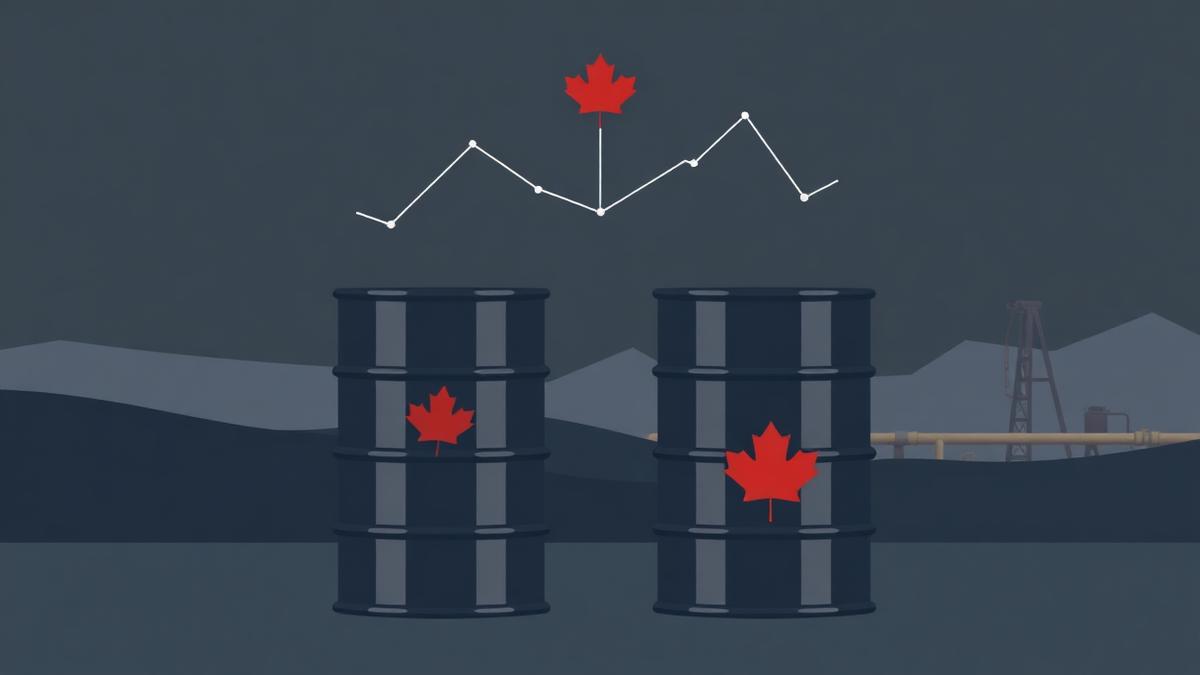
Western Canadian Select is a blended heavy sour crude priced at Hardisty, Alberta. It trades at a discount to West Texas Intermediate, and that discount — the differential — is the most important single price in Canadian oil. It is also widely misread, because the differential is not one thing. It is the sum of four separable components, and each behaves differently.
Decomposing the discount
1. Quality. Heavy sour crude yields less high-value product per barrel and costs more to process. Only refineries configured with coking capacity can run it economically. This component is structural and does not move much month to month; think of it as the floor of the discount.
2. Transportation. Hardisty is a long way from the Gulf Coast refining complex that consumes most Canadian heavy barrels. Pipeline tariffs set the baseline. When pipelines are full, the marginal barrel moves by rail at a materially higher cost, and the differential widens toward rail economics.
3. Egress scarcity premium. When production exceeds total takeaway capacity, the price is no longer set by transport cost — it is set by whatever it takes to clear the surplus barrel. This is the component that produces the violent episodes, and it is capacity-driven rather than demand-driven.
4. Refinery maintenance and demand timing. Turnaround season at Gulf Coast and Midwest refineries removes heavy-crude processing capacity temporarily, widening the differential on a seasonal rhythm.
The analytical value of the decomposition is that only components 2 and 3 are fixable by infrastructure, and only component 3 is capable of moving many dollars in weeks.
Tracing a move through to earnings
Take a producer selling 400,000 barrels per day of heavy crude and assume the differential widens by US$4.00 per barrel with WTI unchanged.
Illustrative worked example.
- Gross revenue impact: 400,000 × US$4.00 × 365 = US$584M per year.
- Crown royalties in Alberta are calculated on net revenue after allowed costs, and the rate is price-sensitive. A lower realised price reduces the royalty owed, so assume royalties absorb roughly 20% of the hit: the producer retains about US$467M of the loss.
- Operating costs are largely fixed per barrel and do not fall with price, so there is no offset there.
- At a 25% effective tax rate, the after-tax impact is approximately US$350M.
- On 1.8B shares, that is roughly US$0.19 per share of annual earnings — meaningful for a stock trading in the low twenties, and entirely outside management's control.
Now run the same move for an integrated producer that refines a large share of its own barrels. The upstream segment takes the same discount, but the downstream segment buys feedstock at that lower price and sells refined products priced off international benchmarks. The refining margin widens by approximately the same amount on the barrels processed internally. For a producer refining, say, 60% of its heavy production, roughly 60% of the differential move is recaptured downstream.
This is the single most important structural distinction in the Canadian oil patch, and it is why integrated names and pure-play heavy producers should never be valued off the same differential assumption.
Why egress capacity is the real variable
Because component 3 dominates the tail risk, the differential is fundamentally a capacity question. The relevant inputs are public:
- Total Western Canadian production versus total pipeline export capacity, including any newly commissioned systems.
- Line-fill and apportionment notices, which indicate a system is oversubscribed.
- Crude-by-rail volumes, published monthly. Rising rail volumes are the market telling you pipelines are full before the differential fully reflects it.
- Alberta storage inventories at Hardisty and Edmonton. Building inventories with full pipelines is the precondition for a blowout.
The hedging layer that obscures the picture
Producers hedge, and hedges are disclosed after the fact in the notes to the financial statements. A quarter in which the differential widened sharply can still produce an in-line realised price if the company had differential swaps in place. Two consequences follow:
- Realised price disclosure is a lagging and partially artificial indicator of exposure. Read the hedge note, not the headline realisation.
- Hedges roll off. A producer protected this year at favourable levels is fully exposed next year if the differential stays wide, and the market often prices the protected quarter as though it were structural.
What to watch
- Pipeline apportionment notices and monthly crude-by-rail volumes.
- The company's disclosed refining capacity as a percentage of its own heavy production.
- The hedge note: volumes hedged, instrument type, and expiry dates.
- Royalty structure sensitivity, disclosed in most Canadian producers' MD&A as a price-sensitivity table.
The differential will widen and narrow again; it always has. The durable question for any individual holding is not where the discount goes but how much of it the company keeps.
Weiterlesen
Also in English: The WCS Differential: Tracing Heavy Oil Discounts Into Canadian Earnings
 EconomyVier in Kanada notierte Unternehmen meldeten diese Woche Staatsgeld, und keiner der Beträge war BargeldZwischen dem 15. und dem 18. September 2026 meldeten Conifex Timber, Global Atomic, First Phosphate und Bitterroot Resources jeweils, dass eine Regierung Geld hinter sie gestellt hat: bis zu C$30 Millionen, US$414.2 Millionen, US$212.5 Millionen und bis zu US$5.22 Millionen. Vier Meldungen, vier Instrumente, und keines davon ist eine Überweisung. Was ein Darlehensvertrag, eine bedingte Zusage, eine Exportkredit-Unterstützungserklärung und eine Kostenteilungszusage jeweils verpflichten, und was zutreffen muss, bevor das Geld ankommt.Marc Belzile · 19. September 2026 · 10 min
 marketsConifex hat ein Bundesdarlehen von bis zu C$30 Millionen und eine Marktkapitalisierung von C$5.1 MillionenConifex Timber Inc. (TSX: CFF) teilte am 18. September 2026 mit, ein Large Enterprise Tariff Loan von bis zu C$30 Millionen der kanadischen Bundesregierung erhalten zu haben, mit siebenjähriger Laufzeit und besichert durch nahezu das gesamte Vermögen. Die Aktie schloss bei C$0.125, ein Plus von 38.9 Prozent. Zum 30. Juni 2026 standen C$1.3 Millionen freier Liquidität C$101.8 Millionen Schulden und ein Hinweis auf die Fortführungsprämisse gegenüber.Marc Belzile · 18. September 2026 · 6 min
 Mining and ResourcesFür Homeland Nickel läuft die Frist der Forstbehörde, doch die Bohrgenehmigung steht noch ausHomeland Nickel Inc. (TSXV: SHL) teilte am 17. September 2026 mit, der United States Forest Service habe seinen Betriebsplan für ein Sonic-Bohrprogramm in Red Flat, Oregon, angenommen, und die Umwelt- und Kulturgüterprüfung sei weit fortgeschritten, einschließlich abgeschlossener Feldarbeiten. Das Unternehmen hofft, im Oktober zu bohren. Dieselbe Mitteilung wurde am selben Tag erneut versandt, weil ihre Offenlegung zur bezahlten Bewerbung ein Videointerview mit dem Vorstandschef eines anderen Unternehmens beschrieb.Daniel Okoye · 18. September 2026 · 8 min
Dieser Geschichte folgen
CVE, SU folgen – der nächste Maple-Beitrag zu diesen Unternehmen, dazu der Maple Morning Debrief vor Handelsbeginn.
Folgen und fragen
Mehr von unserer Berichterstattung zu den kanadischen Märkten in Google Top Stories.
Offenlegung
As of the publication date, the author, editor, publisher, their immediate households and affiliated entities do not own positions in the securities discussed. The Maple Markets received no compensation from any company, its officers, investor-relations providers or financiers in connection with this article. Figures are drawn from public filings as of the date shown and are not restated for later disclosure. Worked examples labelled illustrative use assumed inputs to show a method, not a forecast. This article is informational only and is not investment, legal, accounting or tax advice. Lesen Sie den finanziellen Haftungsausschluss.
Quellen und Verweise (3)
- SEDAR+ issuer filings
- Canada Energy Regulator — crude oil exports and pipeline capacity
- Alberta Energy Regulator
Diese Analyse zitieren
Bitte The Maple Markets nennen und auf die Originalseite verlinken.
Marc Belzile (19. August 2026). The WCS Differential: Tracing Heavy Oil Discounts Into Canadian Earnings. The Maple Markets. https://themaplemarkets.ca/de/newsroom/wcs-differential-how-it-reaches-canadian-oil-earningshttps://themaplemarkets.ca/de/newsroom/wcs-differential-how-it-reaches-canadian-oil-earnings