
223 Metres of Rare Earths in One Hole Push Apex's Trinity Zone West
Hole RIFT26-026 at the Rift project in Nebraska returned 2.52% rare-earth oxide over 223.3 metres of core, the longest interval above 2.5% the company has drilled there, with a first resource estimate planned before the end of March 2027.
Apex Critical Metals reported on November 10, 2026 that two western step-out holes at its Rift rare-earth project in southeastern Nebraska extended the Trinity Zone, led by 2.52% rare-earth oxide over 223.3 metres of core in RIFT26-026. Assays for 12 more holes are at the laboratory, one rig is drilling to year-end, and the company plans its first mineral resource estimate before the end of the first quarter of 2027.
By Priya Sandhu7 min read
Best interval
2.52% TREO over 223.3 m
RIFT26-026, core length from 423.2 m downhole; company release of November 10, 2026.
Second step-out
2.49% TREO over 123.3 m
RIFT26-025, about 85 m west of RIFT26-019; company release of November 10, 2026.
Cash
C$14,986,990
at July 31, 2026, audited annual statements approved October 29, 2026; working capital C$11,938,776.
Pending assays
12 holes, about 7,200 m
of 40 holes and about 25,400 m drilled; company release of November 10, 2026.
Frankfurt listing
KL9 · WKN A40CCQ · ISIN CA03753D1042
Deutsche Börse listing page, read November 10, 2026; CSE: APXC is the home listing.
Beneath the farmland of southeastern Nebraska, a single drill rig has extended the Trinity Zone at the Rift project of Apex Critical Metals Corp. (CSE: APXC) westward, through the longest run of high-grade rare-earth rock the company has cut there. Carbonatite is an unusual igneous rock rich in carbonate minerals, and it is where much of the world's rare-earth supply is mined. This one sits inside the Elk Creek Carbonatite Complex, buried under the prairie, and Apex controls the Rift Rare Earth Project on it outright.
On November 10, 2026 the company reported 2.52 per cent total rare-earth oxide over 223.3 metres of core in its newest western step-out, with a second hole to the south returning 2.49 per cent over 123.3 metres. The company describes the long interval as the broadest of its grade drilled at Rift so far.
Chief executive Sean Charland said in the release that the holes "continue to demonstrate the significant grade and scale profile" of the Trinity Zone, with the zone extending "to the west and northwest and remaining open for expansion."
Ninety metres west of the last good hole
The value of these two holes lies in where they were drilled. A step-out is a hole placed deliberately beyond the edge of known mineralization to test whether it continues. If it hits, the zone grows; if it misses, the company has found a boundary.
Both of these hit. The long hole was collared about 90 metres west of the hole that returned 3.55 per cent over 116.0 metres in the company's update of early October. Its companion sits about 85 metres west of an earlier hole on the southern drill fence.
Two more holes tested ground north of the northern fence. The first returned 3.18 per cent over 47.0 metres, and the second cut 1.64 per cent over 125.0 metres.
The release puts the Trinity Zone at about 600 metres of north-south strike and about 500 metres of extension down-dip to the west. Strike is the length of a zone along the ground; down-dip is how far it runs as it slopes into the earth.
A simple way to compare drill intercepts of different lengths is to multiply grade by length. Geologists call the product grade-metres. It rewards a hole for both thickness and richness, and it lets a long, moderate interval stand beside a short, rich one.
| Hole | Interval (m, core length) | Total REO (%) | Grade-metres | Source |
|---|---|---|---|---|
| RIFT26-026 | 223.3 | 2.52 | 562.7 | November 10, 2026 release |
| RIFT26-024 | 116.0 | 3.55 | 411.8 | October 5, 2026 update |
| RIFT26-022 | 171.5 | 2.35 | 403.0 | October 5, 2026 update |
| RIFT26-025 | 123.3 | 2.49 | 307.0 | November 10, 2026 release |
By that measure RIFT26-026 is the strongest intercept in the four holes compared here, and it was drilled at the western edge of what was known. The grade-metre figures are Maple's own multiplication of the company's numbers.
Inside the long interval the release lists four richer bands, the thickest at 3.54 per cent over 38.7 metres. One four-metre run averaged 5.65 per cent.
The interval lengths are measured along the core, and the release gives no true widths. The holes were planned at an azimuth of 75 degrees and a dip of minus 65 degrees, so the true thickness of the zone will be set by the geological model that goes into the resource estimate. The release does not state a cut-off grade for selecting the intervals.
What sits inside a total rare-earth figure
Total rare-earth oxide, or TREO, is a sum, and the November 10 release names all fifteen oxides in it, from cerium to yttrium. The commercial weight sits with a few of them. Neodymium and praseodymium, usually priced together as NdPr, go into the permanent magnets used in electric-vehicle motors and wind turbines.
For the Trinity Zone the company reports that NdPr makes up 10 to 20 per cent of total rare-earth oxide, which it places within typical ranges for carbonatites worldwide. Applied to the 2.52 per cent interval, that implies roughly 0.25 to 0.50 per cent NdPr oxide in the rock. That range is Maple's arithmetic on the company's stated band; the release gives no hole-by-hole NdPr assays.
The company has also reported a deeper horizon it calls the Neo Zone, beneath the high-grade Trinity material, where it describes NdPr at 30 to 50 per cent of the total.
Why the basket matters is clearest from the market for NdPr in the United States. On July 10, 2025, MP Materials, the operator of the Mountain Pass mine in California, announced a 10-year agreement under which the Pentagon set a price floor of US$110 a kilogram for MP's NdPr products, alongside a US$400 million preferred-equity investment. That floor belongs to MP's contract alone, and it gives a sense of the value Washington places on a domestic source of the magnet metals. Rift is in Nebraska, and the company's own stated aim, in Mr. Charland's words, is for it to become "a strategic contributor to the domestic and international rare earth supply chains."
A sampling trail from Nebraska to Ancaster
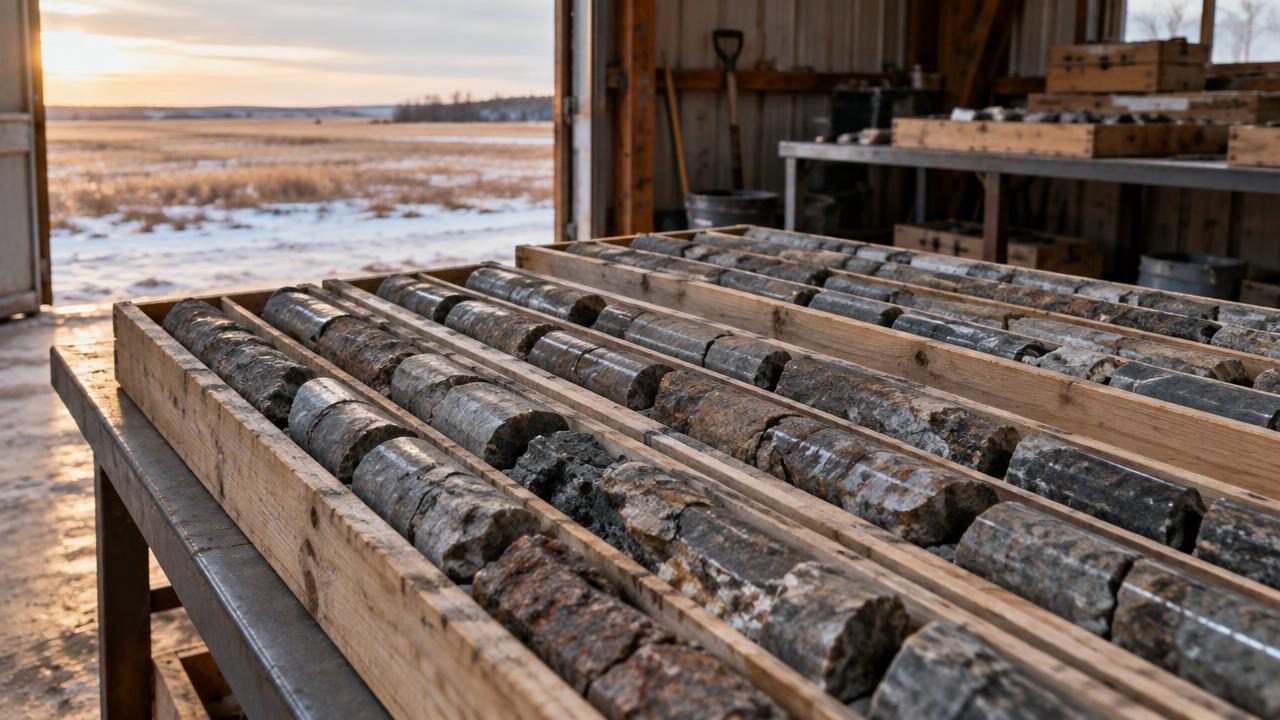
The intervals rest on HQ diamond core, a standard core about 63 millimetres across, cut lengthwise with a saw so that half goes for assay and half stays in the box. Activation Laboratories Ltd. in Ancaster, Ontario, which the company describes as independent, prepared and analysed the samples, using a fusion method with ICP and ICP-MS measurement for the rare earths and X-ray fluorescence for niobium and its companion metals.
Certified reference samples and blank silica were each inserted at about 5 per cent of the sample stream, with duplicate splits on top. Nathan Schmidt, P.Geo., a geologist with Dahrouge Geological Consulting Ltd., is the qualified person under NI 43-101, the Canadian rule that requires a named, accredited professional to stand behind technical disclosure. The release says he verified the data and found no errors or omissions.
That chain is what lets these intervals be carried into a resource model later. A resource estimate converts drill intercepts into a tonnage and grade with a stated confidence level, and it is the step that turns a drilled zone into a deposit that can be studied for economics. Rift has no resource estimate today. The company says its first is on track for completion before the end of the first quarter of 2027.
Fifteen million dollars and one rig
The program is funded from the balance sheet the company reported at its fiscal year-end. The audited statements for the year ended July 31, 2026, approved on October 29, 2026, show cash and cash equivalents of C$14,986,990 and current liabilities of C$4,182,080 at July 31, 2026, for working capital of C$11,938,776. At July 31, 2025, cash had stood at C$5,542,504.
Most of the money went into the ground. Cash spent on exploration and evaluation came to C$17,852,829 in the year to July 31, 2026, and the carrying value of the Rift property reached C$14,778,425. The June 2, 2026 brokered placement raised C$15,000,500 at C$1.90 a unit.
After the year-end, on October 23, 2026, the company sold 400,000 American depositary shares on the Nasdaq Capital Market at US$4.65 each for gross proceeds of US$1.86 million, as Maple reported on October 27.
Note 1 to the statements says the company has no significant revenue and that "these material uncertainties cast significant doubt about the Company's ability to continue as a going concern," and it adds that management is pursuing financial alternatives to fund exploration and development. At last year's rate of exploration spending, the July 31 cash would cover about ten months of drilling, which is the horizon the resource estimate falls inside.
Shares outstanding were 96,455,541 at July 31, 2026, with 17,176,621 warrants at a weighted average exercise price of C$2.24. The October offering added 2.4 million shares, represented by the depositary shares, at six common shares each.
Where the shares trade
Apex trades on the CSE and on the Nasdaq Capital Market under APXC, with further lines on the OTCQX and on Euronext Access Paris. In Germany it is listed on the Frankfurt exchange under the symbol KL9, WKN A40CCQ and ISIN CA03753D1042, per Deutsche Börse's listing page and the company's own release. The CSE line is the home market and the reference for the price; the Frankfurt line is another venue for the same common shares.
Twelve holes at the laboratory and a date for the first estimate
The drilling count has moved quickly. As of the November 10 release, 40 holes totalling about 25,400 metres are complete, against about 24,000 metres in the October 5 update.
Assays for 12 holes, about 7,200 metres of core, are pending at the laboratory.
One rig keeps drilling, and the company plans to run it to the end of 2026.
The timetable has moved once in the company's documents. The Nasdaq prospectus of October 22, 2026, as Maple reported at the time, set the first resource estimate in the first half of 2027. The November 10 release restates the earlier target, before the end of the first quarter of 2027. The newer document is the November release, and it holds to the shorter timetable.
The geology carries its own limits, and the company states them: the presence of carbonatite and hematite alteration "is not necessarily indicative of mineralization," and only assays decide grade. On the assays it has reported, Apex has now drilled the longest high-grade interval in the project's history at the western edge of the Trinity Zone, with 12 holes waiting on results and a first resource estimate promised before the end of March 2027.
Disclosure
Transparency note. This is an independent due-diligence analysis and editorial opinion piece produced by The Maple Markets editorial desk. It is not sponsored, promoted or commissioned, and no compensation of any kind has been received from Apex Critical Metals Corp Com (CSE: APXC) or MP Materials Corp. (NYSE: MP), or any party acting on their behalf. The analysis is based on public disclosure available as of the publish date; every figure is attributed to its primary source. Neither The Maple Markets nor the author holds a position in the securities mentioned; nothing here is a recommendation to buy, sell or hold any security, and readers should not treat it as investment advice. Past disclosure does not guarantee future results. Policies: Editorial Standards · Financial Disclaimer.
Read next
Auch auf Deutsch: 223 Meter Seltene Erden in einem Bohrloch verlängern Apex' Trinity-Zone nach Westen
 Mining & EnergyApex Critical Metals on Nasdaq: US$1.86 Million Raised for Nebraska Rare Earth DrillingApex Critical Metals closed a US$1.86 million underwritten offering of American depositary shares and began trading on the Nasdaq Capital Market on October 23, 2026. The prospectus assigns US$1.3 million to drilling at the Rift rare earth project in Nebraska, where the company plans a first mineral resource estimate in 2027. Its shares also trade on the Canadian Securities Exchange, in Frankfurt, in Paris and over the counter in the US.Élise Galarneau · October 27, 2026 · 7 min
 SponsoredMining & Energy19.9 Million Units Qualified as Copper One Heads to MunichCopper One Resources filed a prospectus supplement on November 3, 2026 that qualifies 19,889,750 units from its C$7,955,900 special-warrant financing, along with a voluntary annual information form, days after its first Phase 2 hole at Majuba Hill in Nevada logged visually identified native copper. Laboratory assays are pending, and the company presents in Munich on November 6 and 7.Daryl Frètu Von · November 5, 2026 · 6 min
 Mining & EnergyAya Gold & Silver Passes Its 180,000-Metre Boumadine Drilling TargetAya Gold & Silver reported on November 4, 2026 that it has drilled 181,685 metres at Boumadine this year, past its 180,000-metre infill target, along with new high-grade intercepts on the Main Trend and three permits that fill gaps around the mining licence. Zgounder set a production record in the third quarter, and third-quarter financial results follow on November 12.Daniel Okoye · November 5, 2026 · 7 min
Follow this story
Follow APXC.CN — the next Maple piece on this company, plus the Maple Morning Debrief before the open.
Follow and ask
Get more of our Canadian market coverage in Google Top Stories.
Sources and references (6)
- Apex Critical Metals: Apex Extends Trinity Zone in West Step-out Drilling with 2.52% REO over 223.3 m and 2.49% REO over 123.3 m at Rift, November 10, 2026 (Form 6-K, Exhibit 99.1)
- Apex Critical Metals: Apex Extends Trinity Zone 200 m with 3.55% REO over 116.0 m and 2.35% over 171.5 m, October 5, 2026 (Form 6-K, Exhibit 99.1)
- Apex Critical Metals: consolidated financial statements for the years ended July 31, 2026 and 2025 (Form 40-F, Exhibit 99.2)
- Deutsche Börse: Apex Critical Metals Corp listing page (ISIN CA03753D1042, WKN A40CCQ, KL9)
- MP Materials: public-private partnership with the US defence department, July 10, 2025
- The Maple Markets: Apex Critical Metals on Nasdaq, October 27, 2026
Cite this analysis
Please attribute The Maple Markets and link to the original page.
Priya Sandhu (November 11, 2026). 223 Metres of Rare Earths in One Hole Push Apex's Trinity Zone West. The Maple Markets. https://themaplemarkets.ca/en/newsroom/apex-critical-metals-reported-on-10-november-2026-that-west-step-outhttps://themaplemarkets.ca/en/newsroom/apex-critical-metals-reported-on-10-november-2026-that-west-step-out