
Apex Critical Metals Drilled 22,000 Metres in a Year After Re-Reading Core Cut in the 1970s
The rare earths at Elk Creek sat in preserved core for four decades because the people who drilled it were looking for niobium, and how Apex handled what it found there is a lesson wider than one company.
Apex Critical Metals Corp. (CSE: APXC) acquired rare earth rights around NioCorp's Nebraska niobium deposit in October 2025, re-logged and re-sampled drill core that Molycorp cut between 1973 and 1986, and by September 8, 2026 had completed 34 holes for roughly 22,000 metres against an original plan of 8,000. The execution is real and so are the limits: there is still no mineral resource estimate at Rift, and the company says so in the same releases that carry its best numbers.
By Daniel Okoye8 min read
Drilling completed
34 holes for approximately 22,000 metres
against a Phase I plan of 8,000 metres in 10 to 15 holes; assays released for 19 holes, 15 pending (Apex releases, January 19, 2026 and September 8, 2026).
RIFT26-019
2.12 per cent REO over 197.5 metres
core length, not true width, which the company states remains unknown; hole drilled to 564 metres, extending the Trinity Zone about 120 metres down dip (Apex release, September 8, 2026).
Historical Elk Creek intercepts
155.5 m at 2.70 per cent and 236.2 m at 2.10 per cent REO
holes EC-93 and NEC11-004, drilled by Molycorp and by Quantum Rare Earth Development Corp.; historical results, not current mineral resources (Apex release, October 1, 2025).
Land and financing
roughly 3,500 acres and C$15,000,500 gross
position built from approximately 2,784 acres acquired October 1, 2025; brokered offering closed June 2, 2026 (Apex releases, October 1, 2025, January 19, 2026 and as reported June 2, 2026).
Maiden mineral resource estimate
guided for the first quarter of 2027
no mineral resource estimate exists at Rift as of September 12, 2026 (Apex release, September 8, 2026).
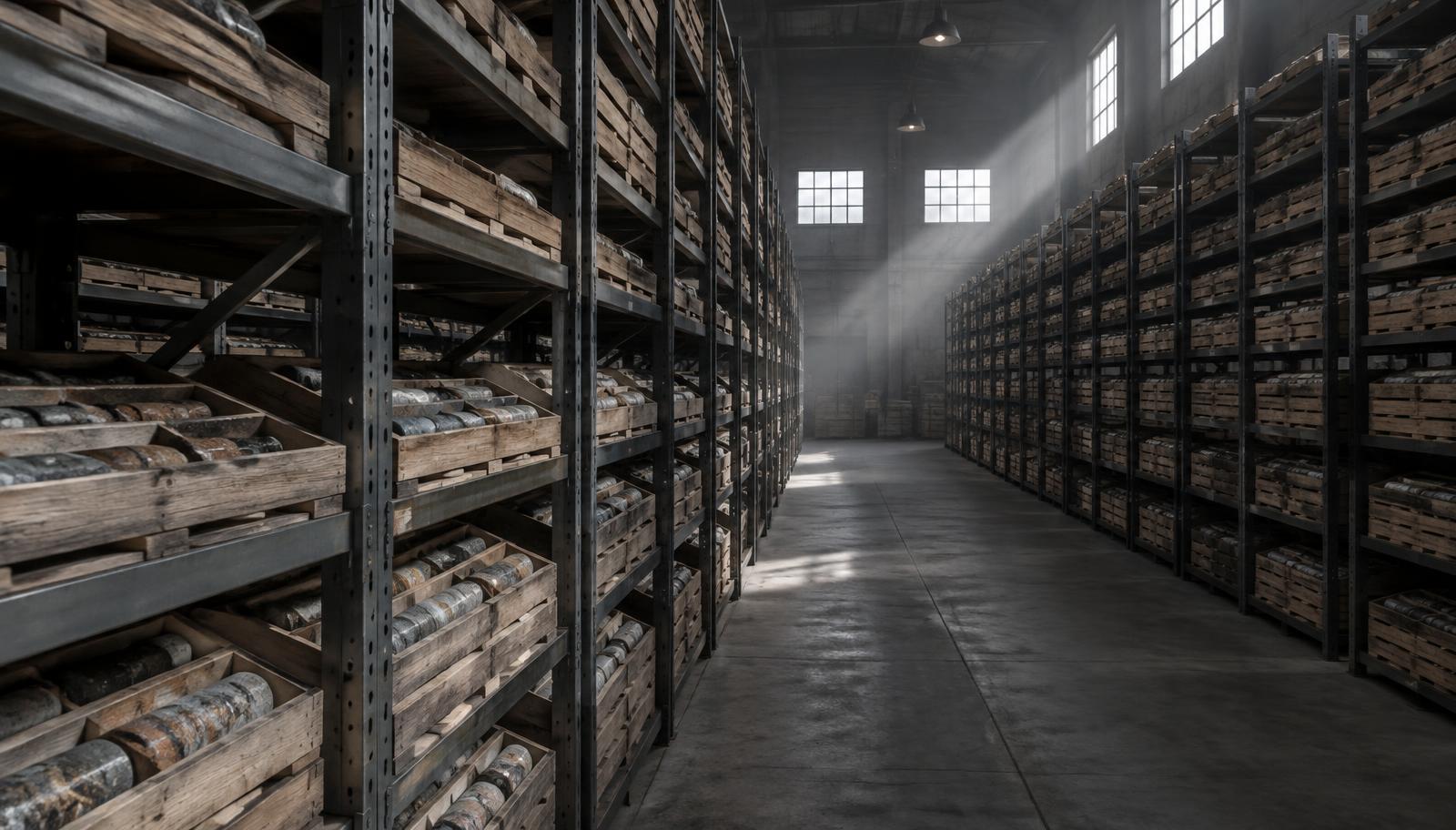
In Lincoln, Nebraska, the Conservation and Survey Division of the University of Nebraska–Lincoln keeps drill core cut out of the ground before most of the people now trading rare earth shares were born. Molycorp Inc. drilled it through the 1970s and 1980s and was looking for niobium.
The rare earths in that rock were not hidden. They were simply not the assay anyone had ordered. Half a century later a small Canadian company went and ordered it, and the result is the most instructive thing to come out of the Canadian exploration market this week.
What gets assayed depends on what the driller came for
Elk Creek is a carbonatite, a rare kind of igneous rock rich in carbonate minerals that tends to concentrate niobium and rare earth elements together. Molycorp completed roughly 106 drill holes across the complex between 1973 and 1986, according to Apex's release of October 1, 2025, and Quantum Rare Earth Development Corp. added five more in 2011. At least 19 of those historical holes fall inside the ground Apex went on to acquire.
Two of the intercepts in that historical file are large by any standard. Hole EC-93 reported 155.5 metres averaging 2.70 per cent total rare earth oxides, including 54.9 metres at 3.30 per cent. Hole NEC11-004 reported 236.2 metres at 2.10 per cent, including 68.2 metres at 3.32 per cent. Both figures come from Apex's October 1, 2025 release describing the historical work, and both carry the limitation that matters: they are historical results, not current mineral resources under Canadian reporting standards, and a modern operator has to reproduce them before they mean anything.
That is the general lesson, and it travels well beyond Nebraska. A drill hole is a physical sample of the earth that gets analysed once, for whatever the company paying the bill is interested in. Niobium was the commodity with a market in 1975. Neodymium and praseodymium, the magnet metals that carry most of the revenue in a rare earth concentrate today, were not. The core outlasted the question.
Buying the ground around somebody else's deposit
Apex announced on October 1, 2025 that it had acquired rare earth mineral rights, including exploration rights and purchase options, over approximately 2,784 acres, about 1,127 hectares, in two target areas at Elk Creek. The release states the position flanks NioCorp Developments Ltd.'s ground to the east and west. By the company's summary release of January 19, 2026 the land package had grown to roughly 3,500 acres.
Flanking ground beside a well-known deposit is normally where retail money goes to be disappointed. What separates this case is that Apex was not buying proximity. It was buying holes that had already been drilled and paid for by someone else, on a commodity that the original operator had no reason to measure.
The cheapest metres are the ones already in the box
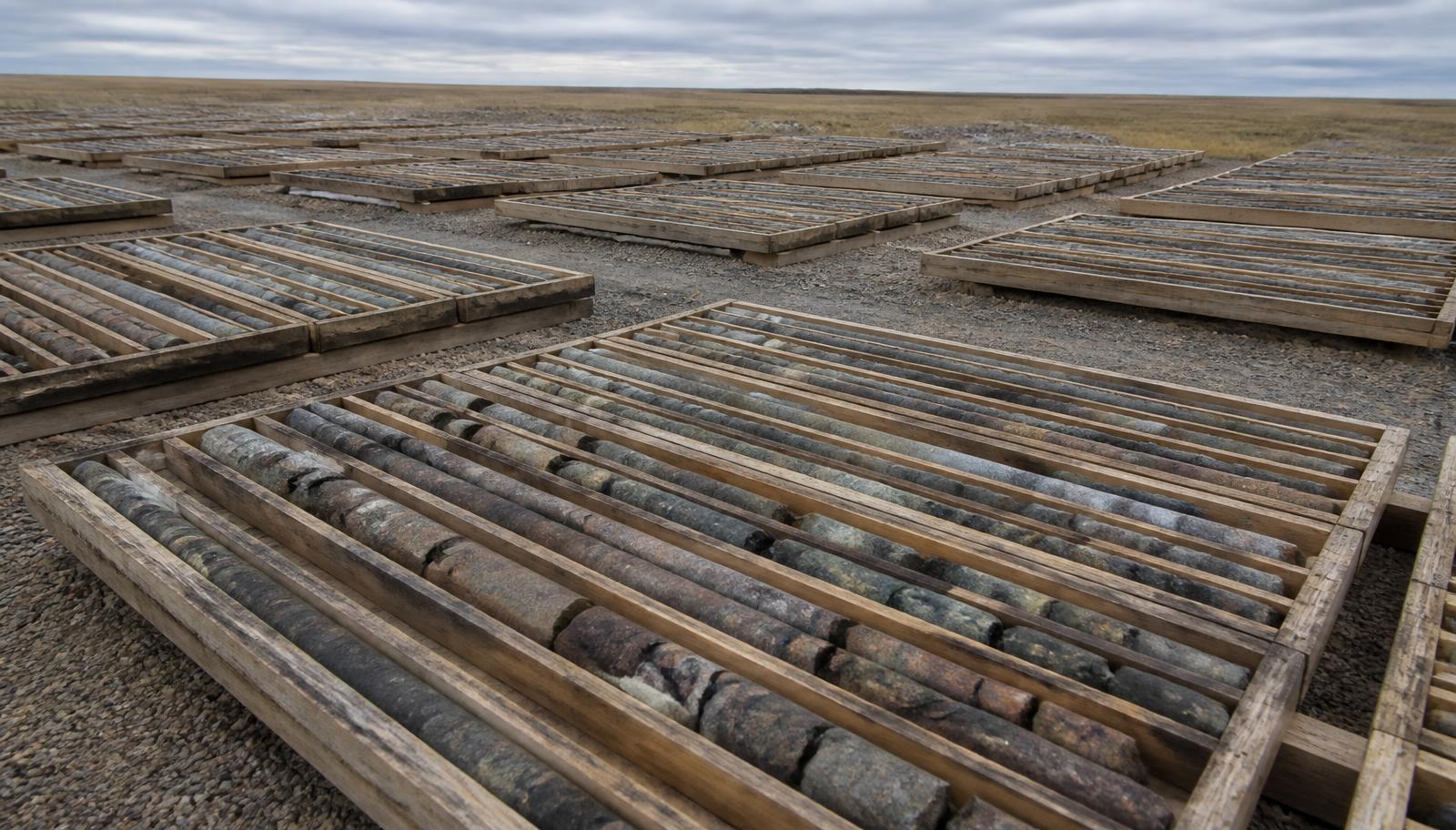
On November 24, 2025 Apex announced a re-logging and re-sampling programme on the preserved Molycorp core, run with Dahrouge Geological Consulting Ltd. and assayed by Activation Laboratories using fusion ICP-MS, ICP-OES and XRF. Chief executive Sean Charland's statement in that release thanked the Conservation and Survey Division and described the work as providing "a modern analytical foundation for understanding the scale and grade potential of the system."
Here the discipline point cuts against the company as well as for it. Apex reported completing that programme in the fourth quarter of 2025, but it has not published a standalone release setting out the re-assay grades hole by hole, and the large intercepts it continues to cite publicly are the historical Molycorp and Quantum numbers rather than results from its own re-sampling. Anyone weighing the core-library thesis is therefore weighing it on the company's own drilling rather than on the re-analysis that prompted it.
A plan for 8,000 metres became 34 holes and 22,000
The sequence after that is unusually tight for a junior. Nebraska's Department of Water, Energy and Environment approved the mineral exploration permit over the roughly 3,500 acre property on January 5, 2026. Boart Longyear was contracted on January 12, 2026. The company's January 19, 2026 outlook set out Phase I as 8,000 metres in 10 to 15 holes at depths of 600 to 900 metres.
What followed was several times that plan. Apex reported a western step-out of 137.2 metres at 2.01 per cent REO on May 15, 2026, extending mineralisation 180 metres. It closed a brokered listed-issuer financing exemption offering for gross proceeds of C$15,000,500 on June 2, 2026, filed a technical report on Rift on June 16, 2026, and headlined an intercept above 2.50 per cent REO over 191.9 metres on June 22, 2026. On August 12, 2026 it reported 4.48 per cent REO over 8.0 metres and 5.27 per cent over 10.2 metres inside multiple intervals of roughly 150 metres above 2.00 per cent. By the release of September 8, 2026 the count stood at 34 holes for approximately 22,000 metres, with assays released for 19 of them and 15 pending.
That September 8 result, which this desk covered the same day, was hole RIFT26-019: 2.12 per cent REO over 197.5 metres of core length, including 4.60 per cent over 5.1 metres and 2.87 per cent over 55.9 metres, in a hole drilled to 564 metres. It extended the Trinity Zone about 120 metres down dip to the west of hole RIFT26-005A, and the zone is now described as roughly 500 metres of north-south strike by 300 metres down dip, open in all directions.
A company that raised its money in June had nearly tripled its drilling plan by September and put a date on the document that converts drilling into tonnes. Apex has guided an inaugural mineral resource estimate for the first quarter of 2027, and that guidance has been consistent across its releases since January 2026.
The sentence the company did not have to write
The thing most worth copying here is not the drilling. It is a single line in the release that carried the year's best headline number.
"All reported intervals are downhole core lengths, and do not represent true widths, which remain unknown until further confirmation assay results are received and interpreted."
A drill hole cuts a mineralised body at whatever angle the geometry provides, so the mineralised length of core is always equal to or longer than the body's real thickness. Converting 197.5 metres of core into 197.5 metres of deposit is the most common arithmetic error in exploration reporting, and Apex put the warning against it in the same document as the number that invites it.
It is not the only instance. The September 8 release also noted that neodymium and praseodymium distributions in Trinity Zone mineralisation sit within typical global carbonatite ranges of 10 to 20 per cent, which is a statement that the magnet-metal split is ordinary for the rock type rather than exceptional. The company has separately cautioned that intersecting carbonatite and hematite alteration is not necessarily indicative of mineralisation. None of those lines helps a promoter. All three are the marks of disclosure written by people who expect to be checked, and they are a fair test to apply to any exploration release: does the document contain the sentence that limits its own headline, and did the company have to be asked for it.
Four things Rift still does not have
The case above is an execution case, and execution is not a deposit. Four gaps are open, and each is dated and checkable.
There is no mineral resource estimate at Rift. Until the first one is filed, no tonnage figure for the project has a cut-off grade, a density assumption or a qualified person behind it, whatever circulates online.
True widths are unknown, by the company's own statement, which means every interval reported in 2026 is a measurement of a hole rather than a dimension of the rock.
Metallurgy is at an early stage. Apex confirmed favourable monazite and bastnaesite mineralogy on August 20, 2026, which describes which minerals host the rare earths; a recovery rate, a concentrate grade and a separation route are separate questions still unanswered.
Funding is capacity rather than cash. The final base shelf prospectus filed on August 14, 2026 permits future issuance; it is not an issuance, and the size and price of any first take-down will change the share count.
One structural fact belongs beside all of this. Nathan Schmidt, P.Geo., of Dahrouge Geological Consulting Ltd. is the qualified person named on the Rift assays, and Jody Dahrouge, P.Geo., sits on the Apex board, as does Darren L. Smith, M.Sc., P.Geo., according to the company's corporate page read on September 12, 2026. That is a common arrangement among Canadian juniors and it is disclosed, and it also means the technical sign-off and the boardroom are not at arm's length. The same page lists Sean Charland as chief executive officer, president and director, Nathan Steinke as chief financial officer, Joness Lang as executive vice-president for growth strategy, Zayn Kalyan and Jody Bellefleur as directors, and Trevor Hall, appointed on August 5, 2026, as a director.
The question the core could always have answered
What Apex did is repeatable and cheap by the standards of this industry: find rock that has already been drilled, work out what question the original driller was not asking, buy the right to ask it, and then go and prove the answer with holes of your own. The re-analysis alone would have been a story. The 22,000 metres behind it are what make it evidence.
The maiden estimate guided for the first quarter of 2027 is where that year of work gets marked, and it is the first document that can turn any of this into tonnes.
Molycorp paid to cut the core and never asked it about rare earths. Apex asked.
Transparency note. This is an independent due-diligence analysis and editorial opinion piece produced by The Maple Markets editorial desk. It is not sponsored, promoted or commissioned, and no compensation of any kind has been received from Apex Critical Metals Corp. (CSE: APXC), NioCorp Developments Ltd., Quantum Rare Earth Development Corp. or any party acting on their behalf. The analysis is based on public disclosure available as of the publish date; every figure is attributed to its primary source. The Maple Markets and its authors may hold positions in securities mentioned; nothing here is a recommendation to buy, sell or hold any security, and readers should not treat it as investment advice. Past disclosure does not guarantee future results. Policies: Editorial Standards · Financial Disclaimer.
Read next
Auch auf Deutsch: Apex Critical Metals bohrte in einem Jahr 22,000 Meter, nachdem es Bohrkerne aus den 1970er-Jahren neu gelesen hatte
 Mining and ResourcesApex Critical Metals (CSE: APXC, FSE: KL9) Drilled 197.5 Metres of 2.12 Per Cent Rare Earths. Here Is What That Does and Does Not MeanApex Critical Metals reported a drill hole at its Rift project in southeast Nebraska on September 8, 2026: 2.12 per cent rare earth oxides over 197.5 metres. It is a strong number, and the company says plainly that the 197.5 metres is the length of core, not the thickness of the rock. This is a plain-English walk through what the assay sheet actually shows, what the company has promised for early 2027, and which numbers floating around online are simply made up.Daniel Okoye · September 9, 2026 · 7 min
 Mining and ResourcesFirst Lithium Minerals Opens a Third Financing in Four Months at a Price Above Its Own CloseFirst Lithium Minerals Corp. (CSE: FLM, FSE: X28) began a new listed issuer financing exemption offering on September 16, 2026, its third since May. Fully subscribed it would raise about C$5.0 million and issue 44.6 million shares against 112.2 million already outstanding. The company's own July offering document put working capital at roughly C$100,000 and carried a going-concern note. The Frankfurt line exists and did no business on 17 September.Priya Sandhu · September 18, 2026 · 8 min
 Mining and ResourcesQIMC Takes 823 New Soil-Gas Stations Into Ontario, the Fifth Step in a Method Built in PublicQuébec Innovative Materials Corp. (CSE: QIMC) launched an expanded 2026 natural hydrogen programme on the Ontario side of the Témiscamingue Graben on September 17, 2026: 823 new soil-gas stations at 100-metre spacing over about 80 line-kilometres, taking the Ontario database to roughly 1,733 stations, alongside more than 1,100 gravimetric stations and 78 line-kilometres of 2D seismic. The shares closed at C$0.59. The company's own disclosure says none of this measures flow.Priya Sandhu · September 17, 2026 · 7 min
Follow this story
Follow APXC.CN — the next Maple piece on this company, plus the Maple Morning Debrief before the open.
Follow and ask
Get more of our Canadian market coverage in Google Top Stories.
Opinion
This article expresses the author's personal views, is separate from news reporting and is not investment advice.
Disclosure
**Transparency note.** This is an independent due-diligence analysis and editorial opinion piece produced by The Maple Markets editorial desk. It is not sponsored, promoted or commissioned, and no compensation of any kind has been received from Apex Critical Metals Corp. (CSE: APXC), NioCorp Developments Ltd., Quantum Rare Earth Development Corp. or any party acting on their behalf. The analysis is based on public disclosure available as of the publish date; every figure is attributed to its primary source. The Maple Markets and its authors may hold positions in securities mentioned; nothing here is a recommendation to buy, sell or hold any security, and readers should not treat it as investment advice. Past disclosure does not guarantee future results. Policies: [Editorial Standards](https://themaplemarkets.ca/en/policies/editorial-standards) · [Financial Disclaimer](https://themaplemarkets.ca/en/policies/financial-disclaimer). See the Financial Disclaimer.
Sources and references (8)
- Apex Critical Metals, Apex Expands Trinity Zone with Step-out Hole Returning 197.5 m Interval of 2.12% REO at the Rift Rare Earth Project in SE Nebraska, September 8, 2026
- Apex Critical Metals, Acquires Key REE Rights at Highly Prospective Elk Creek Carbonatite Complex, Nebraska, October 1, 2025
- Apex Critical Metals, Launches Extensive 2025 Re-Analysis of Preserved Historical Drill Core at Rift Rare Earth Project Near Elk Creek, Nebraska, November 24, 2025
- Apex Critical Metals, Summarizes Progress to-date and 2026 Outlook at the Rift Rare Earth Project, January 19, 2026
- Apex Critical Metals, Receives Exploration Permit for Rift REE Project, Nebraska, January 5, 2026
- Apex Critical Metals, corporate page listing directors and officers, read September 12, 2026
- SEDAR+ continuous disclosure record for Apex Critical Metals Corp.
- The Maple Markets, Apex Critical Metals (CSE: APXC, FSE: KL9) Drills 197.5 Metres of 2.12 Per Cent REO in Core Length, September 8, 2026
Cite this analysis
Please attribute The Maple Markets and link to the original page.
Daniel Okoye (September 12, 2026). Apex Critical Metals Drilled 22,000 Metres in a Year After Re-Reading Core Cut in the 1970s. The Maple Markets. https://themaplemarkets.ca/en/newsroom/apex-critical-metals-what-a-junior-did-right-after-its-trinity-rarehttps://themaplemarkets.ca/en/newsroom/apex-critical-metals-what-a-junior-did-right-after-its-trinity-rare