
Apex Critical Metals (CSE: APXC, FSE: KL9) Drilled 197.5 Metres of 2.12 Per Cent Rare Earths. Here Is What That Does and Does Not Mean
A long, high-grade drill result in Nebraska stretches the Rift zone wider — and a candid sentence in the fine print makes the numbers easier to trust.
Apex Critical Metals reported a drill hole at its Rift project in southeast Nebraska on September 8, 2026: 2.12 per cent rare earth oxides over 197.5 metres. It is a strong number, and the company says plainly that the 197.5 metres is the length of core, not the thickness of the rock. This is a plain-English walk through what the assay sheet actually shows, what the company has promised for early 2027, and which numbers floating around online are simply made up.
By Daniel Okoye7 min read
RIFT26-019 interval
2.12 per cent REO over 197.5 m
core length, not true width, which the company states has not been determined (release dated September 8, 2026).
Step-out distance
about 120 m down dip to the west
measured from previously reported hole RIFT26-005A (release dated September 8, 2026).
Trinity Zone footprint to date
about 500 m strike by 300 m down dip
open in all directions, from 34 holes and roughly 22,000 m drilled (release dated September 8, 2026).
Maiden mineral resource estimate
guided for Q1 2027
no mineral resource estimate exists at Rift as of September 8, 2026 (release dated September 8, 2026).
Frankfurt listing
FSE KL9, WKN A40CCQ, ISIN CA03753D1042
with a Euronext Access Paris line under MLAPX since July 9, 2026 (Tradegate order book; company release boilerplate).
Apex Critical Metals Corp. (CSE: APXC, OTCQX: APXCF, FWB: KL9, Euronext Access Paris: MLAPX) reported on September 8, 2026 that a drill hole called RIFT26-019 came back with 2.12 per cent total rare earth oxides over 197.5 metres at its Rift project in southeast Nebraska. Inside that long run were richer stretches: 4.60 per cent over 5.1 metres, 3.15 per cent over 12.9 metres and 2.87 per cent over 55.9 metres. The hole sits about 120 metres further west and further down than a hole the company reported earlier, so it stretches the known mineralised area a bit wider.
That is exactly the kind of result a rare earth explorer wants to print: long, high-grade, and still finding new ground at the edges. It is also a result worth reading properly — and the company itself tells you how, which is part of what makes this story a good one.
The strongest hole in a strong batch
RIFT26-019 went down 564 metres in total. Four other holes were reported in the same release, and they are the fairest comparison, because they came from the same programme and the same lab.
| Hole | Reported interval (core length) | Grade | Hole depth |
|---|---|---|---|
| RIFT26-019 | 197.5 m | 2.12 per cent REO | 564 m |
| RIFT26-017 | 77.3 m | 1.38 per cent REO | 573 m |
| RIFT26-015 | 64.4 m | 1.54 per cent REO | 789 m |
| RIFT26-016 | 46.1 m | 1.74 per cent REO | 543 m |
| RIFT26-018 | 33.7 m | 2.00 per cent REO | 512 m |
The assays were done by Activation Laboratories Ltd. using its Code 8 rare earth method, and the company inserted known reference samples and blanks through the batch as a quality check — a standard way of proving the lab results are trustworthy. Nathan Schmidt, P.Geo., of Dahrouge Geological Consulting Ltd. is the qualified person, the licensed geologist who has to stand behind the numbers.
Chief executive Sean Charland called it one of the strongest grade-times-width intervals to date, and the arithmetic backs him up. Multiply the grade by the length and you get a rough score for how much metal a hole passed through: RIFT26-019 scores about 419, roughly four times the next best hole in the release at about 107. That is why it made the headline.
A year of holes like this one
Against Apex's own year, this is familiar territory — in the best sense. A June 22, 2026 release led with better than 2.50 per cent over 191.9 metres, and a May 15, 2026 release led with 137.2 metres at 2.01 per cent. Rift has been printing long, good-grade intervals since spring, and RIFT26-019 extends that pattern into fresh ground. For a step-out hole — one drilled to check that the mineralisation keeps going — confirming the trend is precisely the job, and it did it.
The company describes the Trinity Zone as roughly 500 metres long north to south and 300 metres down the slope to the west, with mineralised stretches running from 80 to 197 metres, and says it is still open in every direction — meaning nobody has yet drilled the edge of it. Across the programme so far: 34 holes and roughly 22,000 metres.
How to read the headline length like a professional
Apex's release says it directly: "All intercepts reported in this news release represent core length (apparent width). True widths have not yet been determined."
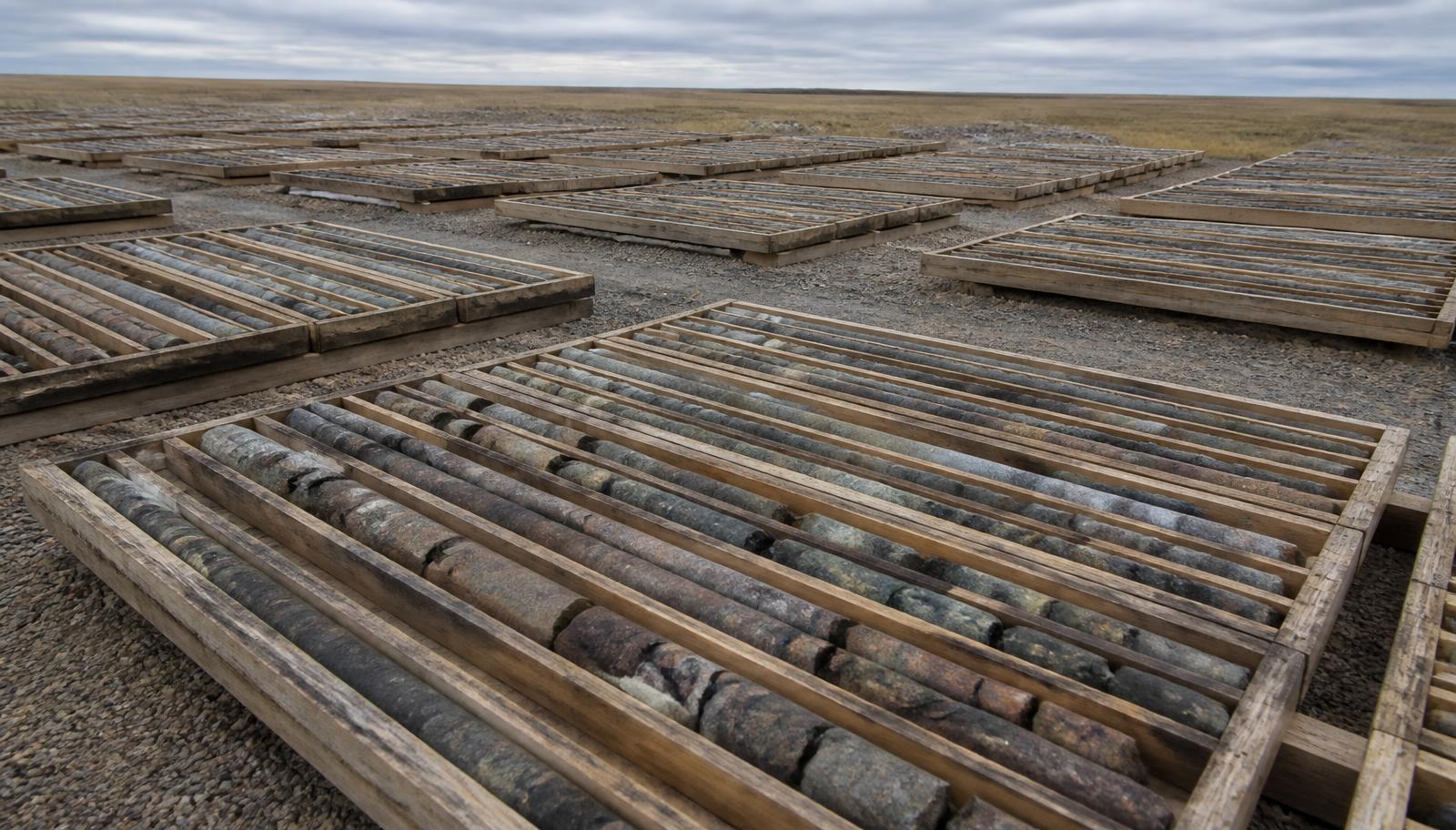
Here is what that means without the jargon. A drill rig pushes a long thin tube into the ground and pulls out a rod of rock. If the mineralised layer happens to be lying at an angle to the hole, the drill travels through it diagonally and brings back more rock than the layer is actually thick — the same way a diagonal cut through a sandwich looks longer than the sandwich is deep.
So 197.5 metres is a measurement of the hole. It is not yet a measurement of the deposit. The real thickness is always the same or smaller, never bigger. Reading 197.5 metres of core as 197.5 metres of deposit is the most common mistake made in this corner of the market, and Apex told readers not to make it.
That sentence is worth more than it looks. A company chasing the widest possible headline does not volunteer it. It reads like disclosure written by people who expect to be checked — and it makes the rest of the numbers easier to take seriously.
The milestone that matters — and the number to ignore
Apex said it is still on track for its first mineral resource estimate in the first quarter of 2027. That is company guidance with a date on it, and it is the most important line in the release, because a maiden resource estimate is the first document that turns a run of good drill holes into an actual tonnage. Everything drilled this year has been building towards it.
The other number that got attached to this release on September 8 was a tonnage range on retail message boards, labelled as an artificial-intelligence estimate. It has no author, no method and no geologist attached, and it is not repeated here. There is no resource estimate at Rift today, so any tonnage figure for the project is a guess wearing units. The real one comes from the company, on a date the company has already given.
One more detail from the release is worth knowing. Neodymium and praseodymium — the two rare earths that magnets actually need — make up 10 to 20 per cent of the mix, which the company notes is normal for this rock type. Those two metals carry most of the value in rare earths, so even an ordinary share of them matters.
Why this lands in Europe first
Apex trades in Frankfurt as KL9 (WKN A40CCQ, ISIN CA03753D1042) and added a Paris listing under MLAPX after announcing it on July 9, 2026. For a European reader, a rare earth project inside the United States is a supply-security story before it is a mining story.
On funding: Apex closed a C$15,000,500 financing on June 2, 2026 and filed a base shelf prospectus on August 14, 2026. A base shelf is permission to raise money later, not money raised. Market data from QuoteMedia showed C$9.89 million in cash against C$2.57 million of liabilities, a share price of C$1.59 and a market value of C$153.28 million on 96.41 million shares — but that panel was last updated September 4, 2026 and the underlying filings were not pulled for this piece, so treat those as panel figures rather than verified filings.
What to watch between now and early 2027
A true width, published with the survey data behind it. This is the number that turns every interval reported this year into a real dimension.
The first mineral resource estimate. Tonnage, grade, cut-off, how much is confidently known versus inferred, and the magnet-metal share all appear there for the first time. This is the big one.
Metallurgy — can the rare earths actually be separated out? The company confirmed favourable mineralogy on August 20, 2026, which is a good sign about which minerals host the metal. A recovery rate would be the next encouraging step.
Any money raised under that base shelf. The size and price of the first raise says a lot about how the company reads its own market.
More wide holes inside the same zone. A pleasant drumbeat — each one keeps confirming the zone while the bigger documents are prepared.
The takeaway
RIFT26-019 is a good confirming hole in a project that has been drilling good confirming holes since May. It is not the day Rift became a deposit, because that day is a document — and the document is due in the first quarter of 2027, from a company that has so far done what it said it would.
The most reassuring thing in the September 8 release is the true-width sentence. A company chasing the widest possible headline does not volunteer that line. That is disclosure written by people who expect to be checked.
The least reassuring thing had nothing to do with the company: an unsourced tonnage number attached itself to a project with no resource estimate within hours of the assays landing.
When the next Rift release arrives, look for a true width or a cut-off grade — the signs the resource is getting close. Everything in between is a project doing what it is supposed to do.
Transparency note. This is an independent due-diligence analysis and editorial opinion piece produced by The Maple Markets editorial desk. It is not sponsored, promoted or commissioned, and no compensation of any kind has been received from Apex Critical Metals Corp. (CSE: APXC) or any party acting on their behalf. The analysis is based on public disclosure available as of the publish date; every figure is attributed to its primary source. The Maple Markets and its authors may hold positions in securities mentioned; nothing here is a recommendation to buy, sell or hold any security, and readers should not treat it as investment advice. Past disclosure does not guarantee future results. Policies: Editorial Standards · Financial Disclaimer.
Read next
 Mining and ResourcesApex Critical Metals Drilled 22,000 Metres in a Year After Re-Reading Core Cut in the 1970sApex Critical Metals Corp. (CSE: APXC) acquired rare earth rights around NioCorp's Nebraska niobium deposit in October 2025, re-logged and re-sampled drill core that Molycorp cut between 1973 and 1986, and by September 8, 2026 had completed 34 holes for roughly 22,000 metres against an original plan of 8,000. The execution is real and so are the limits: there is still no mineral resource estimate at Rift, and the company says so in the same releases that carry its best numbers.Daniel Okoye · September 12, 2026 · 7 min
 Mining and ResourcesMyriad Uranium's First Three Holes at Gem Are Shallower and Thicker Than Anything at Lucky CliffMyriad Uranium Corp. (CSE: M, OTCQB: MYRUF, FSE: C3Q) reported three holes for 507 metres at the Gem deposit on its Copper Mountain project in Wyoming on September 10, 2026, with 21 radiometric intervals above 100 ppm equivalent uranium oxide. The longest runs 34.90 metres at 210 ppm from 10.65 metres downhole. Every figure is a downhole gamma estimate awaiting laboratory verification, and the company has not said when those assays are due.Daniel Okoye · September 11, 2026 · 8 min
 Mining and ResourcesMyriad Uranium (CSE: M, FSE: C3Q) Now Owns All of Copper Mountain. It Still Has No Current ResourceMyriad Uranium finished buying out its partner on August 21, 2026 and now owns 100 per cent of the Copper Mountain uranium project in Wyoming. The day before, it reported early readings from four new drill holes. The project sits on roughly 2,000 holes drilled by a railway company in the late 1970s, plus a 1979 estimate that is not a current resource and does not add up on its own numbers. This is a plain-English look at what is proven, what is not, and what would settle it.Daniel Okoye · September 9, 2026 · 8 min
Follow this story
Follow APXC.CN — the next Maple piece on this company, plus the Maple Morning Debrief before the open.
Follow and ask
Get more of our Canadian market coverage in Google Top Stories.
Opinion
This article expresses the author's personal views, is separate from news reporting and is not investment advice.
Sources and references (5)
- Apex Critical Metals, Apex Expands Trinity Zone with Step-out Hole Returning 197.5 m Interval of 2.12% REO at the Rift Rare Earth Project in SE Nebraska, September 8, 2026
- Apex Critical Metals corporate website, Rift Rare Earth Project and listings
- Tradegate order book, Apex Critical Metals Corp., ISIN CA03753D1042, WKN A40CCQ, symbol KL9
- Apex Critical Metals, Announces Filing of Technical Report on the Rift Rare Earth Project, June 16, 2026
- SEDAR+ continuous disclosure record for Apex Critical Metals Corp.
Cite this analysis
Please attribute The Maple Markets and link to the original page.
Daniel Okoye (September 9, 2026). Apex Critical Metals (CSE: APXC, FSE: KL9) Drilled 197.5 Metres of 2.12 Per Cent Rare Earths. Here Is What That Does and Does Not Mean. The Maple Markets. https://themaplemarkets.ca/en/newsroom/apex-critical-metals-the-interval-is-not-the-resource-reading-apexhttps://themaplemarkets.ca/en/newsroom/apex-critical-metals-the-interval-is-not-the-resource-reading-apex