
One 0.65-Metre Sample Supplies Three Quarters of the Gold in Ashley Gold's 60-Metre Interval
Ashley Gold reported 3.333 grams of gold per tonne over 60 metres at its Tak Patents property on September 25, 2026, and a single 65-centimetre length of core accounts for 148.85 of the interval's 199.98 gram-metres.
Ashley Gold Corp. (CSE: ASHL) closed at C$0.11 on September 25, 2026, up 69.2 per cent on roughly 48 times its 30-day average volume, after reporting 3.333 g/t gold over 60.00 metres downhole at the Tak Patents in northwestern Ontario. Three quarters of the metal in that average comes from one 0.65-metre sample assaying 229 g/t. The company capped that sample at 40 g/t in its own release and said true thickness is unknown. Ashley Gold has no mineral resource on the property.
By Élise Galarneau7 min read
TAK-26-16 headline interval
3.333 g/t Au over 60.00 m
from 24.00 m downhole; 74.4 per cent of the interval's gold comes from one 0.65 m sample at 229 g/t (Ashley Gold release, September 25, 2026).
Same interval at the company's own 40 g/t cap
about 1.29 g/t Au over 60.00 m
Maple Markets arithmetic on the release's cap disclosure; true thickness stated as unknown.
Close, September 25, 2026
C$0.11, up 69.2 per cent
on about 10.04 million shares against a 209,344 30-day average; market data read after the close, 15-minute delayed.
Shares and reserve
101,568,386 issued, 36,968,386 reserved
market value about C$11.2 million at C$0.11 (Canadian Securities Exchange listing record).
Cash and equivalents
C$429,607
against liabilities of C$218,695; market data read after the close, not verified against the interim statements filed since.
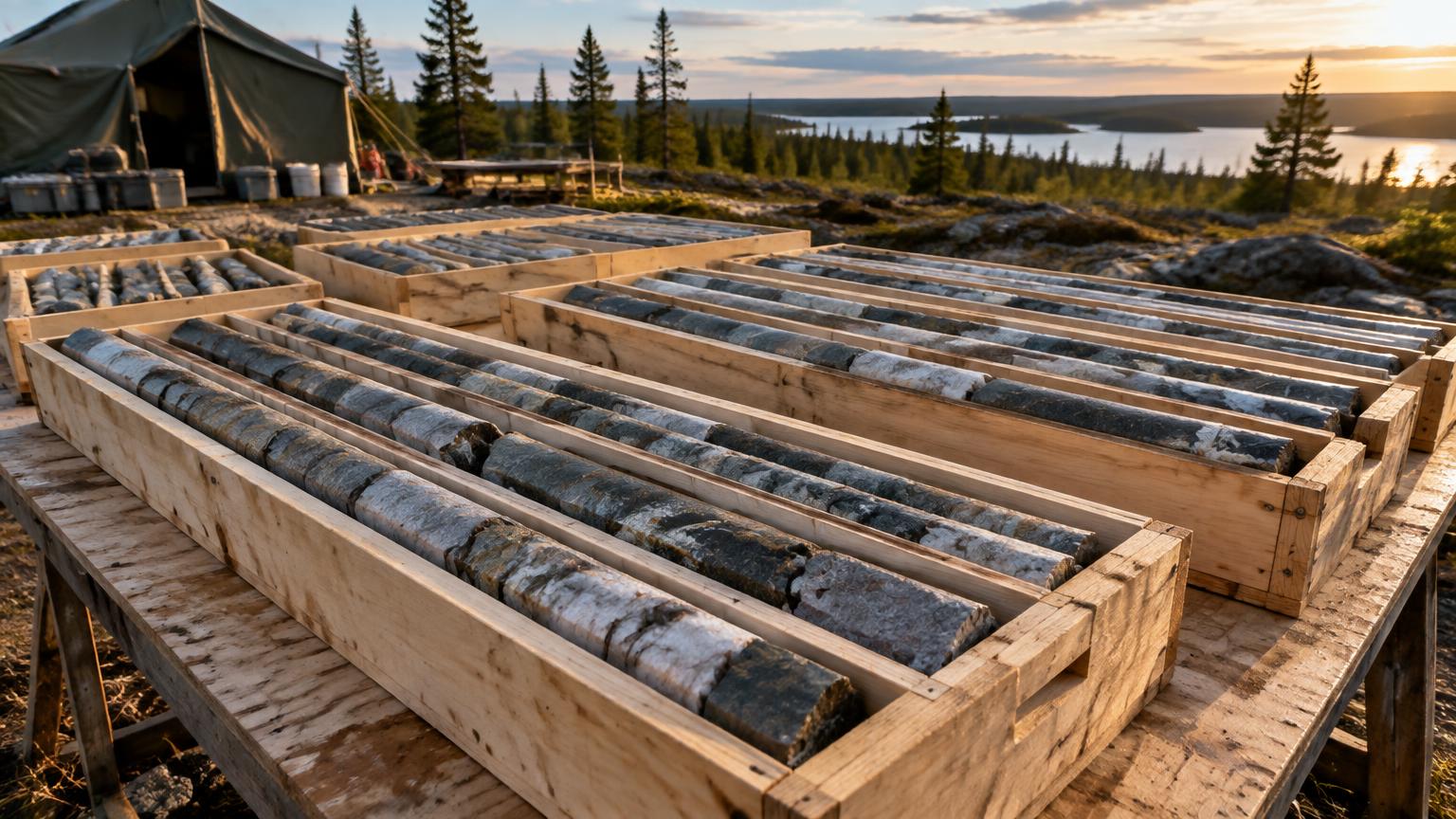
About sixty-three metres down a hole on a hundred hectares of patented ground northeast of Dryden, Ontario, Ashley Gold Corp.'s geologists could see gold in the core. The lab confirmed it: 229 grams of gold per tonne across sixty-five centimetres.
That sample is the reason Ashley Gold Corp. (CSE: ASHL) closed Friday September 25, 2026 at C$0.11, up 69.2 per cent, on roughly 10.04 million shares against a 30-day average of 209,344, per market data read after the close and delayed fifteen minutes. It is also the reason the headline number needs unpacking, because the release did not lead with the sixty-five centimetres. It led with sixty metres.
Sixty metres of rock, and where the gold in it actually sits
The company reported hole TAK-26-16 cutting 3.333 grams of gold per tonne over 60.00 metres from 24.00 metres downhole, including the 229 g/t over 0.65 metres at 63.15 metres, in its release of September 25, 2026.
A grade over a length is an average, and the way to test an average is to multiply it back out. Multiplying grade by metres gives gram-metres, which is simply how much gold the interval contains per tonne of rock, spread over its length. It is the unit that shows whether a long interval is uniformly mineralised or whether one sample is carrying it.
Run it on this hole. The full interval is 3.333 g/t over 60.00 metres, or 199.98 gram-metres. The high-grade sample is 229 g/t over 0.65 metres, or 148.85 gram-metres. One sample, one per cent of the interval's length, supplies 74.4 per cent of its gold.
Strip that sample out and the other 59.35 metres carry 51.13 gram-metres between them, an average of 0.861 g/t. That is not nothing for an Ontario gold property, and it is not 3.333 g/t either. Both figures come from the release of September 25, 2026 and describe the same hole.
| TAK-26-16, per the release of September 25, 2026 | Length | Grade | Gram-metres | Share of the interval's gold |
|---|---|---|---|---|
| Full reported interval, from 24.00 m | 60.00 m | 3.333 g/t Au | 199.98 | 100 per cent |
| The high-grade sample at 63.15 m | 0.65 m | 229 g/t Au | 148.85 | 74.4 per cent |
| Everything else in the interval | 59.35 m | 0.861 g/t Au | 51.13 | 25.6 per cent |
Maple Markets arithmetic on the grades and lengths the company reported.
Ashley Gold capped the sample itself, and explained why
The company did not leave this to arithmetic done by outsiders. Its 25 September release states that it "does not have sufficient assay counts to statistically identify an appropriate grade cap for the high-grade zone encountered in TAK-26-16," and that "due to high grain counts of visible gold, the Company feels that capping extremely high-grade domains at 40 g/t Au for the time being is prudent."
Capping is the standard treatment for a sample so much richer than its neighbours that leaving it at face value would distort every average it touches. Coarse visible gold is the classic cause: a nugget in the core sample is real gold, but it may represent a few centimetres of vein rather than sixty metres of rock.
Apply the company's own 40 g/t cap to that sample and the sums change. The capped sample contributes 26.00 gram-metres instead of 148.85. Total metal in the interval falls to 77.13 gram-metres, and the 60.00-metre average falls to about 1.29 g/t. Ashley Gold added that its cap "is not representative of what a block model or resource model may make as assumptions and is provided to only demonstrate the interval using a lower grade value," which is a fair caution: a resource model would set its own cap from a much larger assay population.
So the release supports a range rather than a point. Somewhere between roughly 1.29 g/t and 3.333 g/t over 60 metres, depending on how the nugget is treated, with one genuinely high-grade centimetre-scale hit inside it.
The company says the true thickness is unknown
Every interval in the release is a length measured along the drill hole, not a thickness measured across the rock. The qualified person's statement at the foot of the release puts it in four words: "True thickness is unknown."
That matters because a hole drilled obliquely through a steeply dipping vein reports more metres than the vein is wide. Until the orientation of the mineralised structure is known, sixty metres downhole could be sixty metres of true width or a good deal less. Shannon Baird, P.Geo., the company's exploration manager and the qualified person named on the release, is the person who will resolve it with further drilling. Noah Komavli, P.Eng., is named as president and a director, and Darcy Christian, P.Geo., as chief executive officer, per that same release.
The historic record on the 67Z zone is thin and the company labels it as such. Two holes drilled in 2002, TAK-02-06 and TAK-02-07, returned 3.08 g/t over 7.57 metres and 3.18 g/t over 8.7 metres. Ashley Gold states that neither it nor its qualified person has done sufficient work to verify that historical data, and that the results may not be reliable.
The ounces next door belong to the company next door
The release describes the Tak Patents as abutting the northeast of the Goliath Gold Complex operated by NexGold Mining Corp., and discloses NexGold's figures as adjacent-property information under National Instrument 43-101: measured and indicated resources of 67.7 million tonnes at 0.98 g/t gold, about 2.14 million ounces, and proven and probable reserves of 30.3 million tonnes at 1.30 g/t, about 1.27 million ounces.
Those are NexGold's ounces, disclosed by Ashley Gold as at the date of its September 25, 2026 release. Ontario geology does not stop at a property line, and a well-endowed belt is a reasonable place to look, but adjacency is a reason to drill rather than evidence of what a drill will find. Ashley Gold has no mineral resource estimate on the Tak Patents. Sixteen holes have been reported there, under 2,000 metres of diamond drilling in total, with four Phase III holes still awaiting assays and Phase IV holes drilled.
The company reported that it acquired the property outright in January 2026 for 3.5 million shares, and it carries a 5 per cent net smelter return royalty to Royal Gold Inc., of which 2.5 per cent can be bought back for a payment of one million dollars, a currency the release does not specify. A net smelter return royalty is a share of revenue paid off the top, before costs, so it reduces the economics of anything eventually mined regardless of how the mine performs.
An eleven-million-dollar company with four hundred thousand dollars
The share count is where a 69 per cent day gets its scale. The Canadian Securities Exchange's listing record shows 101,568,386 shares issued and outstanding for Ashley Gold as at September 25, 2026, which at the C$0.11 close gives a market value of about C$11.2 million. The exchange also shows 36,968,386 shares reserved for issuance, equal to 36.4 per cent of the shares already out; taken up in full they would lift the count to roughly 138.5 million.
Against that, cash and equivalents of C$429,607 and liabilities of C$218,695, per market data read after the close and not verified against the interim statements filed since. Four hundred thousand dollars does not pay for four more phases of drilling, so the money for the next holes has to come from somewhere, and at C$0.11 with a third of the share count already reserved, the cheapest place to get it is more shares.
Two other things sat around Friday's trading. CIRO, the self-regulatory body that oversees Canadian investment dealers and marketplaces, halted the stock on September 24, 2026 and resumed it on September 25, 2026, according to its own notices, so the release arrived into a market that had been told to wait for something. And Ashley Gold was the day's only name carrying a paid "boosted" listing on a Canadian retail investor board, six boosts from two accounts. Paid placement buys attention, not assays, and the attention here was measurable: volume ran to roughly 48 times the 30-day average.
Nothing in the day's disclosure was paid research as far as the company's filings show. The release reads like a company that found something and said so, with its cap and its caveat attached.
The distance between a nugget and a deposit
What Ashley Gold has is a hole with visible gold in it, in a belt that has produced real deposits, on ground it owns, with more assays coming and a treasury that will need refilling before the drilling finishes. That is a genuine exploration result and it is a long way short of a resource.
The 0.65 metres of core is the most interesting rock the company has cut. It is also 0.65 metres.
Transparency note
Transparency note. This is an independent due-diligence analysis and editorial opinion piece produced by The Maple Markets editorial desk. It is not sponsored, promoted or commissioned, and no compensation of any kind has been received from Ashley Gold Corp. (CSE: ASHL), NexGold Mining Corp. (TSXV: NEXG), Royal Gold Inc. (NASDAQ: RGLD) or any party acting on their behalf. The analysis is based on public disclosure available as of the publish date; every figure is attributed to its primary source. The Maple Markets and its authors may hold positions in securities mentioned; nothing here is a recommendation to buy, sell or hold any security, and readers should not treat it as investment advice. Past disclosure does not guarantee future results. Policies: Editorial Standards · Financial Disclaimer.
Read next
Auch auf Deutsch: Eine 0,65-Meter-Probe liefert drei Viertel des Goldes in Ashley Golds 60-Meter-Intervall
 Mining and ResourcesQIMC Takes 823 New Soil-Gas Stations Into Ontario, the Fifth Step in a Method Built in PublicQuébec Innovative Materials Corp. (CSE: QIMC) launched an expanded 2026 natural hydrogen programme on the Ontario side of the Témiscamingue Graben on September 17, 2026: 823 new soil-gas stations at 100-metre spacing over about 80 line-kilometres, taking the Ontario database to roughly 1,733 stations, alongside more than 1,100 gravimetric stations and 78 line-kilometres of 2D seismic. The shares closed at C$0.59. The company's own disclosure says none of this measures flow.Priya Sandhu · September 17, 2026 · 7 min
 Mining and ResourcesProspect Ridge Has Reported 979 Metres of Excalibur Core and Not One Assay From ItProspect Ridge Resources Corp. (CSE: PRR) reported long intervals of alteration and sulphide mineralisation in the first two holes at its Excalibur copper-gold project in British Columbia on 10 September 2026, with assays still at the laboratory. On 15 September the shares closed at C$0.09, up 38.5 per cent, on 6.18 times their average exchange volume, with nothing new filed. What the logs describe, and what they cannot, is the whole question before Wednesday's open.Daniel Okoye · September 16, 2026 · 6 min
 Mining and ResourcesHemlo Mining Drills 89.9 g/t Gold 50 Metres From a Working Stope, and Changes Its True-Width EstimateHemlo Mining Corp. (TSX: HMMC) reported 89.89 g/t gold over 3.0 metres of core length in hole 6702608 at South-Rim on September 10, 2026, from a zone 50 to 150 metres from active C-Zone mining. The release also revises the estimated true-thickness conversion to 65 to 90 per cent of downhole length, from 30 to 70 per cent in the May 14, 2026 release on the same zone, without stating why. South-Rim carries no resource, no reserve and no economics.Priya Sandhu · September 11, 2026 · 9 min
Follow this story
Follow ASHL.CN — the next Maple piece on this company, plus the Maple Morning Debrief before the open.
Follow and ask
Get more of our Canadian market coverage in Google Top Stories.
Opinion
This article expresses the author's personal views, is separate from news reporting and is not investment advice.
Disclosure
## Transparency note **Transparency note.** This is an independent due-diligence analysis and editorial opinion piece produced by The Maple Markets editorial desk. It is not sponsored, promoted or commissioned, and no compensation of any kind has been received from Ashley Gold Corp. (CSE: ASHL), NexGold Mining Corp. (TSXV: NEXG), Royal Gold Inc. (NASDAQ: RGLD) or any party acting on their behalf. The analysis is based on public disclosure available as of the publish date; every figure is attributed to its primary source. The Maple Markets and its authors may hold positions in securities mentioned; nothing here is a recommendation to buy, sell or hold any security, and readers should not treat it as investment advice. Past disclosure does not guarantee future results. Policies: [Editorial Standards](https://themaplemarkets.ca/en/policies/editorial-standards) · [Financial Disclaimer](https://themaplemarkets.ca/en/policies/financial-disclaimer). See the Financial Disclaimer.
Sources and references (5)
- Ashley Gold Corp. news releases, Canadian Securities Exchange
- Ashley Gold Corp. listing record, shares issued and reserved, Canadian Securities Exchange
- Ashley Gold Corp., Burnthut project, including the Tak Patents
- Ashley Gold Corp. news and releases, company site
- NexGold Mining Corp. Goliath Gold Complex disclosure, referenced as adjacent-property information
Cite this analysis
Please attribute The Maple Markets and link to the original page.
Élise Galarneau (September 25, 2026). One 0.65-Metre Sample Supplies Three Quarters of the Gold in Ashley Gold's 60-Metre Interval. The Maple Markets. https://themaplemarkets.ca/en/newsroom/ashley-gold-sixty-nine-per-cent-on-34-6-times-volume-ashley-gold-shttps://themaplemarkets.ca/en/newsroom/ashley-gold-sixty-nine-per-cent-on-34-6-times-volume-ashley-gold-s