
CanAlaska Fell 12 Per Cent With Nothing Filed Since 8 September, and Half Its Value Is Cash
Taken in order, the ten days before Friday's fall contain two drill programmes, a treasury figure and no document that explains the session.
CanAlaska Uranium Ltd. (TSXV: CVV; FSE: DH7) fell about 12.3 per cent on 18 September 2026 on roughly 5.8 times its average volume, with no company release since 8 September. Three larger Athabasca Basin names fell the same day. The company holds about C$32.9 million against a market value of about C$66.9 million, and has published no mineral resource estimate for its main project.
By Priya Sandhu7 min read
closing price on 18 September 2026
C$0.3025
down about 12.3 per cent on 2.91 million shares against a 499,734 thirty-day average; QuoteMedia, 15-minute delayed, secondary market data
market value at that close
C$66.9 million
221.26 million shares outstanding; the Frankfurt line trades under DH7 (Deutsche Börse: DH7N), ISIN CA13709C1005
cash and cash equivalents
C$32.9 million
carried by market data services from the most recently filed statements; the company stated a treasury above C$25 million as at 17 August 2026
best reported winter interval, hole WMA101-02 from 812.1 metres
5.4 m at 1.48% U₃O₈
including 0.5 m at 8.42 per cent; West McArthur assay release, 17 August 2026
for West McArthur or the Pike Zone
No mineral resource estimate
the company's project page reports intersections and discoveries only, as published at 18 September 2026
The last document CanAlaska Uranium Ltd. put on the wire is dated 8 September 2026. Its shares fell sharply on Friday, and nothing was filed in between.
The fall was about 12.3 per cent, on roughly six times the stock's average volume. Taking the intervening days in the order they happened is the only way to see what that session can and cannot be attributed to.
CanAlaska trades as CVV on the TSX Venture Exchange, as CVVUF on OTCQX, and on the Frankfurt Stock Exchange under DH7, with the Deutsche Börse symbol DH7N and ISIN CA13709C1005. The Canadian line is where the volume is, and it is the Canadian session that is described below.
17 August: two half-metre intervals above 8 per cent uranium
The company reported assay results from its winter drilling at the West McArthur project in northern Saskatchewan, which it owns 88.89 per cent and operates, with Cameco Corporation holding the remaining 11.11 per cent.
Hole WMA101-02 returned 5.4 metres grading 1.48 per cent U₃O₈ from 812.1 metres, and inside that interval two much narrower and much richer slices: 0.5 metres at 8.42 per cent from 816.1 metres, and 0.4 metres at 10.5 per cent from 821.9 metres. A second hole, WMA100-02, returned 0.5 metres at 2.89 per cent. Nathan Bridge, the company's vice-president of exploration, is named as the qualified person for the results.
U₃O₈ is the uranium oxide the ore is reported as, and the percentages are a proportion of rock by weight. At an Athabasca grade of 8 per cent, one tonne of rock holds 80 kilograms of uranium oxide; a typical open-pit uranium mine elsewhere in the world works on something closer to one or two kilograms. That is the reason this basin is drilled at these depths in the first place.
The release also stated the company's treasury as over C$25 million as at 17 August 2026.
8 September: one drill, six to ten holes, and a programme the company says is paid for
CanAlaska announced the start of its autumn drilling, not at West McArthur but at Key Extension, in the southeastern part of the basin. One diamond drill, an estimated six to ten holes, targeting basement-hosted uranium, with completion expected in late October 2026. The company said it is fully funded to carry out the programme. Cory Belyk, chief executive, president and a director, is the officer named in the release.
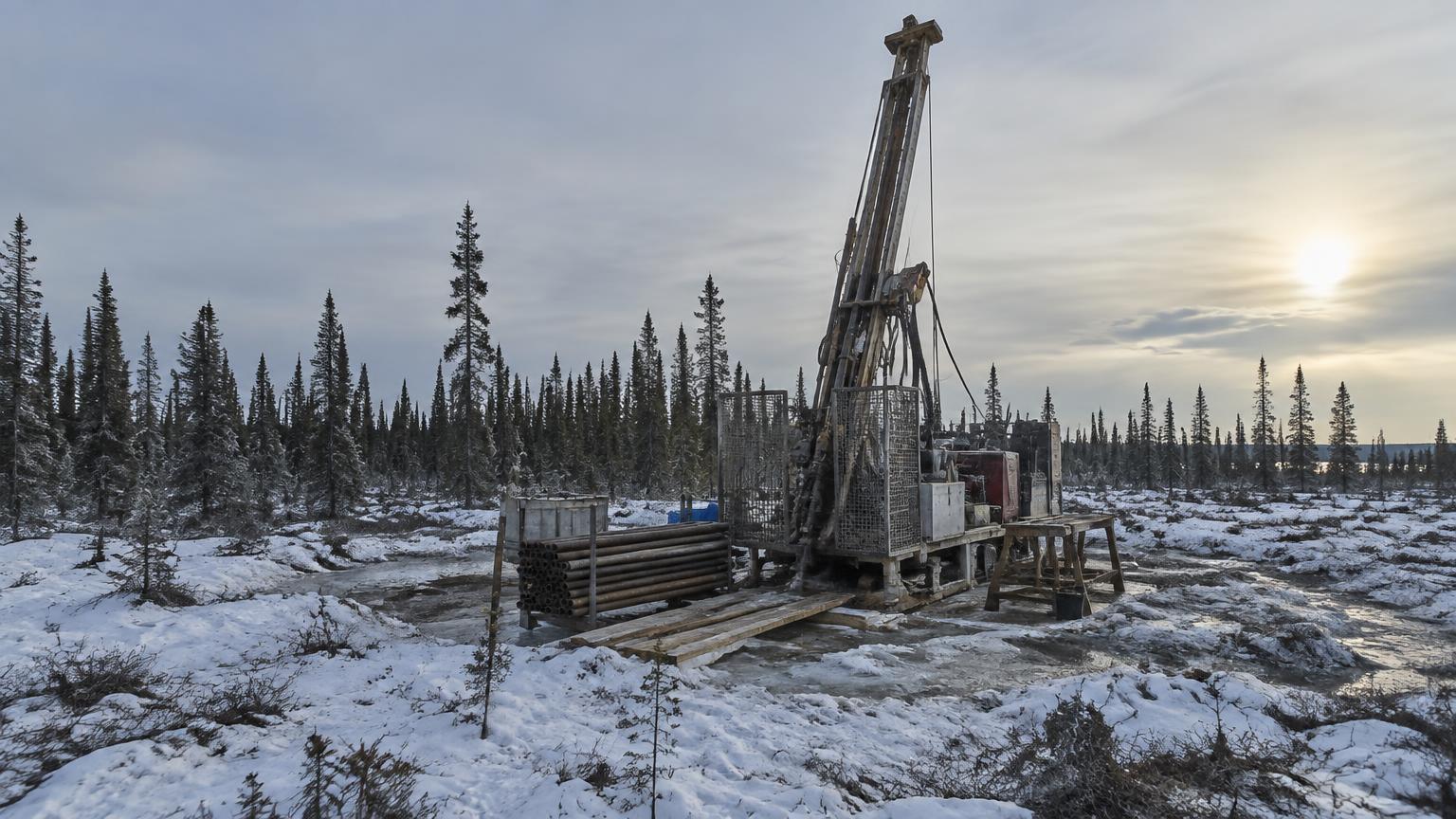
"Basement-hosted" is worth a sentence. At West McArthur the uranium sits below 600 to 850 metres of flat-lying sandstone, in the older rock underneath, which the company's own project page describes as mineralisation extending into the basement rather than sitting on the contact above it. Drilling to those depths is slow and expensive, and six to ten holes is a modest programme by the standards of the basin.
That was the last thing the company published.
18 September: a 12 per cent fall on almost six times the volume
The shares closed at C$0.3025, down about 12.3 per cent, having traded between C$0.295 and C$0.345 with a volume-weighted average price of C$0.3077. Volume was 2.91 million shares against a thirty-day average of 499,734, or about 5.8 times. With 221.26 million shares outstanding, that put the company's market value near C$66.9 million. The figures are exchange data carried by QuoteMedia on a 15-minute delay, and are secondary market data rather than filings.
There was no halt, no bulletin and no release. On the evidence available at the close on 18 September 2026, no company-specific document explains the session.
The same session, across the basin
The obvious alternative explanation is that this was not about CanAlaska at all, and the tape from its peers supports that explanation without settling it.
On the same day, using the same delayed exchange data: NexGen Energy closed at C$13.14, down about 0.7 per cent; Denison Mines at C$3.94, down about 2.6 per cent; IsoEnergy at C$13.38, down about 8.3 per cent, having traded as high as C$14.99. All four are Athabasca Basin names, and all four were lower. The order is instructive. The largest, NexGen at about C$8.8 billion, barely moved; the smallest of the four, CanAlaska at about C$66.9 million, moved most.
That pattern is what a sector-wide sell-off looks like in a market where the small names are thinly traded and the marginal seller is a bigger proportion of the day. It is not proof. A single session in four securities is a small sample, and a company-specific explanation could yet appear in a filing made after the close or in a bulletin published next week. But the alternative claim, that something happened at CanAlaska specifically on 18 September, currently has no document behind it at all.
What the remaining C$34 million is being asked to cover
The balance sheet makes the fall easier to size.
Market data services carry cash and cash equivalents of about C$32.9 million and total liabilities of about C$3.94 million from the company's most recently filed financial statements. Those are secondary figures and are not verified against the statements on SEDAR+; the company's own 17 August 2026 release put its treasury above C$25 million, and the two are consistent with a treasury somewhere in that range.
Subtract the cash from the C$66.9 million market value and roughly C$34 million is left. That C$34 million is what the market was paying, at Friday's close, for 88.89 per cent of West McArthur including the Pike Zone, for Key Extension, and for a land position the company puts at approximately 375,000 hectares across the basin.
Here is the standard that figure has to be measured against, and CanAlaska does not yet meet it. The company's project page for West McArthur reports drill intersections and discoveries; it reports no mineral resource estimate. An intersection is a measurement in one hole. A mineral resource estimate is a modelled tonnage and grade across a deposit, signed by a qualified person under National Instrument 43-101, and it is the first stage at which a quantity of metal, rather than a set of intercepts, can be said to exist. Grades of 8 and 10 per cent in half-metre slices are among the highest numbers reported anywhere in the world, and they still do not answer how much there is.
What "fully funded" does and does not oblige
Two funding facts sit behind the autumn programme, and they are different in kind.
The first is the company's own statement on 8 September 2026 that it is fully funded to carry out the Key Extension drilling. That is a statement about a single programme of six to ten holes, not about the company's plans beyond it, and no budget figure for the programme was given in the release.
The second is the joint venture. CanAlaska owns 88.89 per cent of West McArthur and operates it; Cameco Corporation holds 11.11 per cent, and the company's project page states that in 2026 the two are co-funding exploration there. In a joint venture of this shape the operator spends and the partners contribute their share, which means West McArthur's costs are not carried by CanAlaska's treasury alone. It also means the partner can choose not to contribute in a future year and be diluted instead, so co-funding in one year is not a commitment to the next.
Neither fact tells anyone how long the treasury lasts, because the company has not published an exploration budget for 2027 or a burn rate against it. What both facts do establish is that the cash figure on the balance sheet is not being consumed at the rate a sole-funded deep-drilling programme would imply.
What Friday changed, and what it did not
It changed the price of a half-built exploration story by about four cents a share. It did not change the drill count at Key Extension, the depth of the sandstone cover, the 88.89 per cent ownership, or the absence of a resource estimate. The autumn programme is due to finish in late October, and holes drilled through 800 metres of sandstone are not assayed quickly.
A company with roughly half its market value in cash and no resource estimate is priced on what the next holes say. On 18 September the market repriced that expectation by twelve per cent and published no reason for it.
Disclosure
Transparency note. This is an independent due-diligence analysis and editorial opinion piece produced by The Maple Markets editorial desk. It is not sponsored, promoted or commissioned, and no compensation of any kind has been received from CanAlaska Uranium Ltd. (TSXV: CVV), Cameco Corporation (TSX: CCO), NexGen Energy Ltd. (TSX: NXE), Denison Mines Corp. (TSX: DML), IsoEnergy Ltd. (TSX: ISO) or any party acting on their behalf. The analysis is based on public disclosure available as of the publish date; every figure is attributed to its primary source. The Maple Markets and its authors may hold positions in securities mentioned; nothing here is a recommendation to buy, sell or hold any security, and readers should not treat it as investment advice. Past disclosure does not guarantee future results. Policies: Editorial Standards · Financial Disclaimer.
Read next
Auch auf Deutsch: CanAlaska fiel 12 Prozent ohne eine Einreichung seit dem 8. September, und die Hälfte des Werts ist Liquidität
 Mining & EnergyF3 Uranium's Strongest Exploration Hole: 4,400 cps Outside JR and TetraF3 Uranium reported on 21 October that hole PLN26-232, drilled about a kilometre east of its Tetra Zone discovery in Saskatchewan's western Athabasca Basin, returned 4,400 counts per second on a handheld spectrometer, its strongest reading in an exploration hole away from its known zones. A second drill rig is following it up. F3 ended its fiscal year on 30 June 2026 with C$22.7 million in cash and term deposits. That leaves the follow-up drilling funded. Assays are pending, and this week's option and RSU grants are routine compensation filings.Daniel Okoye · October 30, 2026 · 7 min
 Mining & EnergyUranium One Adds a 14-Year Exploration Geologist for Its First Athabasca SeasonUranium One Mining engaged Saskatoon geologist Adrian Huerta Ruiz on October 23, 2026 to help plan its first field season in the Athabasca Basin, where it holds the Nucleon and Quark claims and has agreed to acquire Pasfield Lake. The company held C$2.87 million in cash at June 30, 2026, with about C$1.55 million committed to Canadian exploration.Daniel Okoye · October 27, 2026 · 6 min
 Mining and ResourcesMyriad Uranium Agrees to Buy 55,000 Hectares Beside Cerro SoloMyriad Uranium Corp. (CSE: M; FSE: C3Q) agreed on October 9, 2026 to acquire Buenavida Metales S.A., which holds 23 uranium properties covering 55,013 hectares in central Chubut, Argentina, for C$300,000 in cash, 1,571,268 shares and a 2% net smelter return royalty. The ground flanks the state-held Cerro Solo deposit. No mineral resource has been estimated on it, and the 12,500 metres of historical drilling on the claims has not been verified.Daniel Okoye · October 14, 2026 · 9 min
Follow this story
Follow CVV.V — the next Maple piece on this company, plus the Maple Morning Debrief before the open.
Follow and ask
Get more of our Canadian market coverage in Google Top Stories.
Sources and references (5)
- CanAlaska Begins Fall Drill Program at Key Extension Project, 8 September 2026
- CanAlaska Announces Assay Results from Winter Drill Program on West McArthur Project, 17 August 2026
- CanAlaska Uranium, West McArthur project page
- CanAlaska Uranium news release archive
- CanAlaska Uranium Ltd., Frankfurt Stock Exchange listing (DH7N)
Cite this analysis
Please attribute The Maple Markets and link to the original page.
Priya Sandhu (September 21, 2026). CanAlaska Fell 12 Per Cent With Nothing Filed Since 8 September, and Half Its Value Is Cash. The Maple Markets. https://themaplemarkets.ca/en/newsroom/canalaska-uranium-a-13-8-per-cent-markdown-with-no-release-behind-ithttps://themaplemarkets.ca/en/newsroom/canalaska-uranium-a-13-8-per-cent-markdown-with-no-release-behind-it