
Hemlo Mining Joined the GDXJ on Friday, and the Fund Held About US$1.6 Million of It
Index inclusion moved a sum roughly equal to four tenths of one day's trading in the stock, which is a useful thing to know before Monday.
Hemlo Mining Corp. (TSX: HMMC) was added to the VanEck Junior Gold Miners ETF at the close on 18 September 2026. The fund's own holdings file put the position at US$1,562,814, or 0.02 per cent of net assets. That is about one tenth of one per cent of a company worth C$2.14 billion, and the shares fell about 3 per cent on the day the change took effect.
By Élise Galarneau7 min read
GDXJ's position in Hemlo Mining
US$1,562,814
0.02 per cent of the fund's US$8.75 billion in net assets; VanEck published holdings, as at 17 September 2026
Hemlo Mining's market value
C$2.14 billion
296.4 million shares at the C$7.23 close on 18 September 2026; QuoteMedia, 15-minute delayed, secondary market data
volume on the day inclusion took effect
749,008 shares
against a 649,126 thirty-day average, at a C$7.19 volume-weighted average price, 18 September 2026
cash at 30 June 2026
US$130.2 million
against a US$150 million term facility, the revolving facility repaid in full; second-quarter results released 11 August 2026
expected delivery of the replacement substation
December 2026
the Alimak area on the 9765 level runs on a temporary bypass at reduced capacity until then; company release, 14 September 2026
On 18 September 2026 Hemlo Mining Corp. announced that it had been added to the VanEck Junior Gold Miners ETF, the fund that trades under the symbol GDXJ, effective at the close of business that day. The company said the change came out of the fund's semi-annual review and quarterly rebalancing. Jason Kosec, president, chief executive and a director, said in the release that the inclusion would enhance trading liquidity, broaden the shareholder base and increase awareness among institutional and retail investors globally.
That is the announcement. The size of it can be looked up, and it is smaller than the words suggest.
A fund that buys without deciding
The phrase "added to the index" sounds like a judgement. It is closer to a filing.
An exchange-traded fund of this kind is a pooled investment that sells its own units on a stock exchange and, with the money raised, buys the shares on a published list. The list is the index. GDXJ follows the MVIS Global Junior Gold Miners Index, which is compiled by a company called MarketVector, and the fund's job is to hold what the index holds, in the proportions the index sets, as closely as it can.
Nobody at the fund studies Hemlo's drill results and decides the shares are cheap. The index has rules about size, listing venue, trading volume and what sort of company counts as a junior gold miner. Twice a year the index compiler runs those rules over the universe of eligible companies and publishes the resulting list. Any company that now qualifies goes in. Every fund tracking that index then has to buy enough of it to match its new weight, and it has to do so around the moment the change takes effect, because a tracking fund that holds something different from its index has failed at its only task.
So the buying is real, and it is also mechanical, one-off and indifferent. It is the same size whether the company is about to have its best year or its worst. It will happen again in reverse, with the same indifference, if a future review takes the company out.
The purchase, in dollars
VanEck publishes what the fund holds. As at 17 September 2026 the fund reported total net assets of about US$8.75 billion across 162 positions, and it listed Hemlo Mining at US$1,562,814, or 0.02 per cent of net assets. For scale, the largest position in the same file, Equinox Gold, was 7.09 per cent.
Now put that next to the company. Hemlo Mining closed on 18 September 2026 at C$7.23, with 296.4 million shares outstanding, for a market value of about C$2.14 billion, according to exchange data carried by QuoteMedia on a 15-minute delay. Using the Bank of Canada's daily rate for 17 September 2026 of C$1.3988 to one US dollar, the fund's position converts to roughly C$2.19 million.
Divide C$2.19 million by C$2.14 billion and the answer is about one tenth of one per cent of the company.
There is a second way to size it that may be plainer still. On 18 September 2026 the shares traded 749,008 times against a thirty-day average of 649,126, at a volume-weighted average price of C$7.19. That is about C$5.4 million of stock changing hands in one session. The fund's entire holding is worth less than half of that. A buyer who wanted the whole index position could have taken it in an hour and a half of ordinary Friday trading.
And the shares did not go up. Hemlo fell about 3 per cent on 18 September, from a high of C$7.66 to a close of C$7.23. One session proves nothing on its own, in either direction, which is exactly the point: a flow that small is not visible in a market that size.
One detail in the fund's own file is worth holding onto. The position was already listed on 17 September 2026, a day before the effective time the company's release gave. Tracking funds commonly build a new position into the rebalance rather than at the bell, so the buying was spread rather than dropped in at one moment. That spreads the effect thinner still.
A producing gold mine, filed under juniors
There is a second thing the classification shows, and it cuts the other way.
The index is called Global Junior Gold Miners. In ordinary use a junior is an explorer: a company with ground, drills and no revenue. Hemlo has a mine that has been pouring gold since 1985, and it sold 27,858 ounces in a single quarter. The index's rules are about market value, listing and liquidity rather than about whether a company produces anything, so a mid-sized producer worth C$2.14 billion sits in the same list as companies that have never sold an ounce.
That is not a criticism of the index, which is doing what its rulebook says. It is a caution about reading anything into the label. Being in the junior index does not mean the market values Hemlo as an explorer, and being included does not mean an index committee formed a view about the Hemlo camp. It means the company crossed a set of published thresholds on a particular date.
What inclusion does change, quietly and permanently, is the shape of the share register. A tracking fund is a holder that never sells on bad news and never buys more on good news, unless the index tells it to. At 0.02 per cent of net assets, Hemlo has acquired a very small holder of that kind.
The power is still routed around a failed substation
The thing that will decide Hemlo's next two quarters was disclosed four days before the index news, and it drew almost no attention.
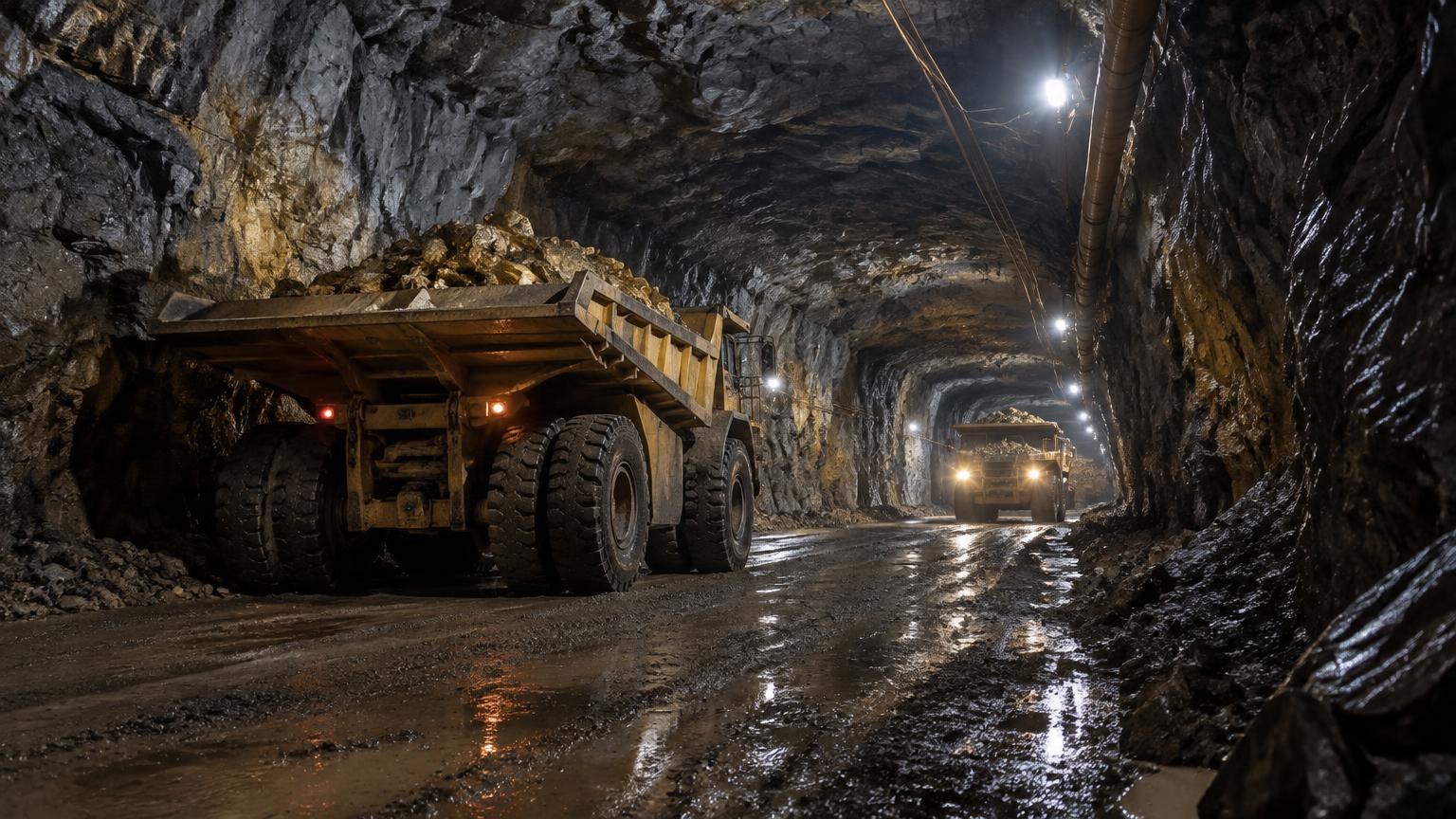
On 14 September 2026 the company reported that an underground electrical substation had failed on 4 September 2026. The substation supplied part of the Alimak production area on the 9765 level of the Hemlo mine, which is where the company had been advancing its production ramp-up. Nobody was hurt, and everyone underground was brought to surface safely. The processing plant and the rest of the mine kept running normally.
An Alimak is a climbing platform that rides a rail up a steep raise, letting miners drill and blast a narrow, near-vertical block of ore from below. It needs power at the face to work, and the substation is what supplies it.
A temporary bypass has restored power to the affected area at reduced capacity. On that bypass, the company said, some mining continues while development and exploration work stays limited. A replacement substation had already been ordered as part of a critical spare parts audit, at a cost of roughly US$250,000, with delivery expected in December 2026. The company said the reduced power may result in deferring mining from certain planned stopes, and that it is looking at alternative sequencing, expedited procurement, backup power and moving electrical equipment from elsewhere in the mine.
What it did not do was quantify any of it. No ounce figure was attached to the deferral, and the company has published no formal 2026 production guidance to measure the deferral against. Three months of a limited ramp in the area being ramped is a real cost, and as at 18 September 2026 its size is not on the record.
The quarter underneath all of this was a good one
None of the above is a gloomy picture, and the register of the last few paragraphs should not be allowed to suggest it is.
Hemlo reported second-quarter results on 11 August 2026, in US dollars. Revenue was US$142.5 million and net income US$31.0 million. The mine produced 25,188 attributable ounces of gold and sold 27,858, at an all-in sustaining cost of US$2,561 an ounce sold. Cash stood at US$130.2 million. The revolving credit facility had been repaid in full, leaving a US$150 million term facility. Management said it was targeting a mill throughput of 4,800 tonnes a day by the end of 2026 as new mining areas came into production.
Maple reported on 10 September 2026 that the company had intersected 89.9 grams of gold per tonne roughly 50 metres from a working stope in the South Rim area, and had revised its true-width estimate for the intercept at the same time. Grade that close to existing infrastructure is worth more than the same grade in open ground, because the tunnels needed to reach it largely exist. That remains the case.
Set against a camp that the company says has produced some 25 million ounces since 1985, a fund position of US$1.6 million is not the story of the year and was never going to be. What it does buy is a line of shareholders who did not choose the company and will not sell it for any reason of their own.
The index bought its slice on Friday and stopped. The substation is still on a bypass until December.
Disclosure
Transparency note. This is an independent due-diligence analysis and editorial opinion piece produced by The Maple Markets editorial desk. It is not sponsored, promoted or commissioned, and no compensation of any kind has been received from Hemlo Mining Corp. (TSX: HMMC), Equinox Gold Corp. (TSX: EQX) or any party acting on their behalf. The analysis is based on public disclosure available as of the publish date; every figure is attributed to its primary source. The Maple Markets and its authors may hold positions in securities mentioned; nothing here is a recommendation to buy, sell or hold any security, and readers should not treat it as investment advice. Past disclosure does not guarantee future results. Policies: Editorial Standards · Financial Disclaimer.
Read next
Auch auf Deutsch: Hemlo Mining kam am Freitag in den GDXJ, und der Fonds hielt rund US$1.6 Millionen davon
 Mining and ResourcesEquinox Gold Fell 5% on Its Largest Quarter of ProductionEquinox Gold Corp. (TSX: EQX) reported 237,019 ounces of gold for the third quarter of 2026 on October 13, its largest quarterly output this year, and the shares closed down 5.2 per cent at C$15.47. The quarter included only August and September for Musselwhite and Camino Rojo, the two mines acquired from Orla Mining. Against reaffirmed 2026 guidance of 870,000 to 920,000 ounces, the fourth quarter has to deliver between 258,517 and 308,517 ounces. US$172.5 million of convertible notes is redeemed on October 20.Élise Galarneau · October 13, 2026 · 7 min
 Mining & EnergyKinross Gold's Third Quarter: 425,000 Ounces After a Lower 2026 ForecastKinross Gold produced 424,693 attributable gold equivalent ounces in the third quarter of 2026, in line with the figure it gave on September 23 when it lowered its 2026 forecast to 1.84 to 1.86 million ounces. Net earnings were US$583.2 million and net cash US$1.9 billion at September 30. Great Bear's declines passed 500 metres and Round Mountain Phase X stays on track for 2028. Two contractor employees died after separate September incidents at Bald Mountain.Daniel Okoye · November 2, 2026 · 7 min
 Mining & EnergyIsland Gold Sets a Record, and Alamos Gold Makes 119,000 OuncesAlamos Gold reported 119,000 ounces of gold for the third quarter of 2026 on 28 October, down 16% from a year earlier. Island Gold set a quarterly record while Young-Davidson and Mulatos produced less, and all-in sustaining costs rose to US$1,956 an ounce. The company kept its revised 2026 guidance, moved the Island Gold shaft to mid-2027 and held US$597.4 million of cash at 30 September.Élise Galarneau · October 29, 2026 · 6 min
Follow this story
Follow HMMC.TO — the next Maple piece on this company, plus the Maple Morning Debrief before the open.
Follow and ask
Get more of our Canadian market coverage in Google Top Stories.
Sources and references (6)
- Hemlo Mining Corp. Announces Inclusion in VanEck Junior Gold Miners ETF (GDXJ), 18 September 2026
- VanEck Junior Gold Miners ETF (GDXJ) fund page and published holdings
- Hemlo Mining Corp. Reports Underground Electrical Substation Outage; Mine-Wide Operations Continue, 14 September 2026
- Hemlo Mining Corp. Reports Second Quarter 2026 Financial and Operating Results, 11 August 2026
- Bank of Canada daily exchange rate, US dollar to Canadian dollar, 17 September 2026
- Maple Markets, Hemlo Mining Drills 89.9 g/t Gold 50 Metres From a Working Stope, 10 September 2026
Cite this analysis
Please attribute The Maple Markets and link to the original page.
Élise Galarneau (September 21, 2026). Hemlo Mining Joined the GDXJ on Friday, and the Fund Held About US$1.6 Million of It. The Maple Markets. https://themaplemarkets.ca/en/newsroom/hemlo-mining-index-inclusion-is-not-demand-hemlo-mining-after-the-gdxjhttps://themaplemarkets.ca/en/newsroom/hemlo-mining-index-inclusion-is-not-demand-hemlo-mining-after-the-gdxj