
Why Light AI Stopped Work on Its Only Product
A Friday-evening release said the company's own quality review had found gaps in the evidence behind QuickScan Strep A, and the shares fell 72 per cent in the first session that could price it.
Light AI Inc. (Cboe Canada: ALGO) closed at C$0.04 on October 5, 2026, down 72.4 per cent, after telling the market at 20:34 ET on Friday October 2 that it had found gaps in the evidence supporting its only product and would not advance toward a U.S. Food and Drug Administration submission. The share count did not change, so the fall is a loss of value rather than a consolidation. The Health Canada licence granted in August remains in force.
By Élise Galarneau8 min read
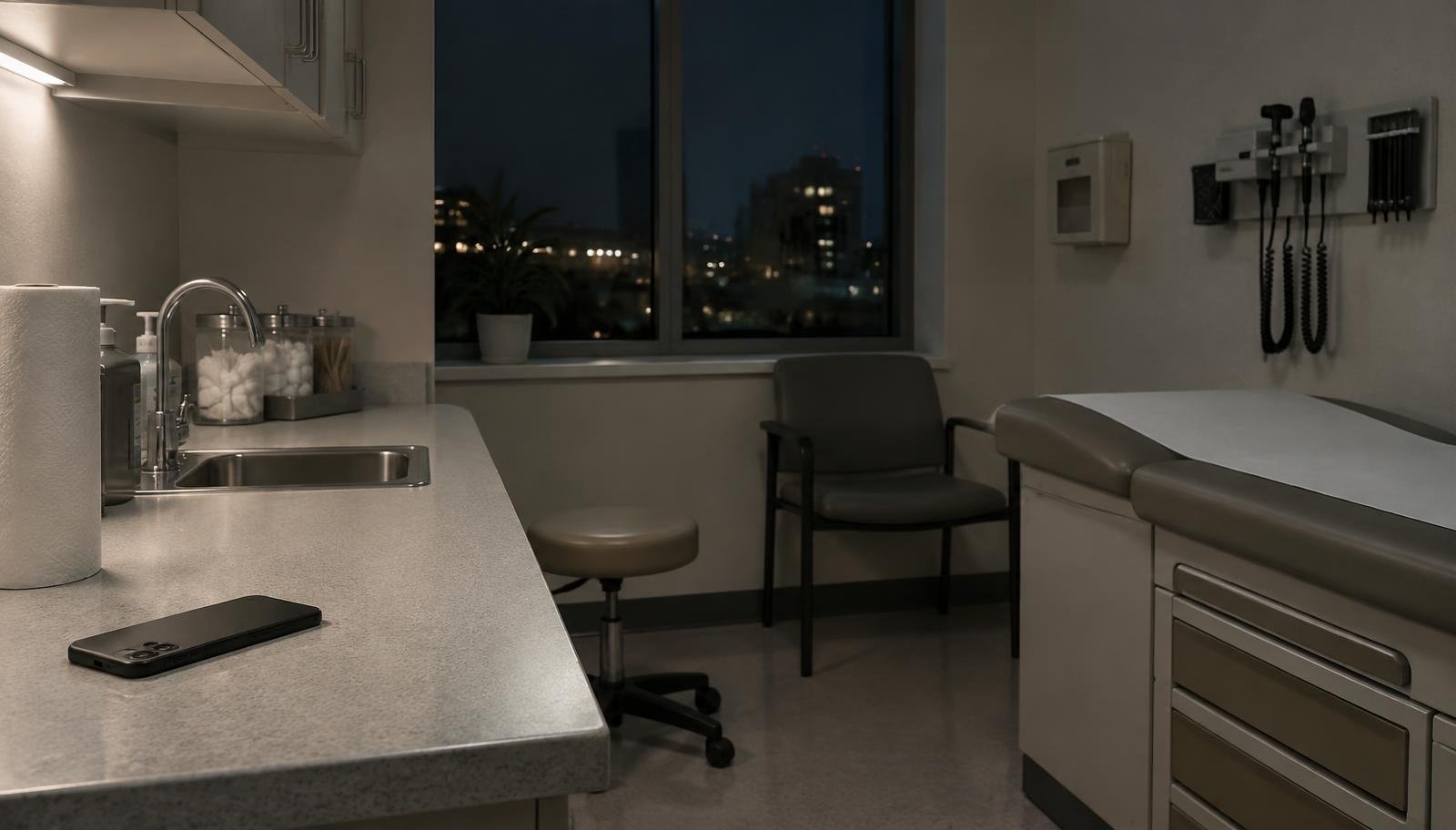
Closing price, October 5, 2026
C$0.04, down C$0.105 or 72.4 per cent
market data read after the close; day's range C$0.015 to C$0.06, session VWAP C$0.0362
Volume
6.11 million shares, about 43 times the 141,090-share average
4.77 million on Cboe Canada and 1.34 million on alternative venues, October 5, 2026; secondary market data
Shares outstanding
122,559,735
unchanged from the July 3, 2026 record date through the August 19, 2026 annual meeting results; market value C$4,902,389 at C$0.04
Cash
C$7,848,624
as at June 30, 2026, per the company's August 17, 2026 results release; C$5,000,000 of 12 per cent convertible debentures rank ahead of shareholders
FDA status
no submission made, pathway suspended with no timetable
per the company's release dated October 2, 2026
The release went out at 20:34 on Friday evening, more than three hours after the market closed and two days before anyone could act on it. In it, Light AI Inc. told shareholders that it had reviewed its own product and did not like what it found.
Light AI trades on Cboe Canada, the exchange formerly called NEO, under the symbol ALGO. It has one product: QuickScan Strep A, software that looks at a digital photograph of a throat and helps a clinician judge whether the patient has a streptococcal infection. Software that performs a medical function in its own right, rather than running a machine, is regulated as a device. The industry calls it software as a medical device, and it has to prove it works in the same way a thermometer or a blood test does.
That proof is what the Friday release was about.
The sentence in the release that did the damage
The company said that management had completed a preliminary product, quality and verification and validation assessment. Verification and validation is the documented process of showing that software does what its designers intended and that it works in the setting where it will actually be used. The assessment, Light AI reported, "identified gaps in the objective evidence currently available to substantiate performance of the complete QuickScan Strep A system across its intended-use population and use environment."
The consequence followed in the next paragraph. The company said it "will not resume external clinical validation or advance toward a U.S. Food and Drug Administration submission until the product configuration and supporting objective evidence establish readiness for clinical use."
Four specific things were put on hold or opened up. The company said it was continuing a hold on its New Zealand feasibility work and its planned United States clinical study. It said it was commissioning an independent robustness assessment of the machine-learning model and the data used to build it. It said it was "determining whether the existing model can be remediated and/or retrained or whether redevelopment is required." And it said it was evaluating alternatives to the smartphone-based image capture the product currently relies on.
The last two are the ones that reach furthest. A model that may need rebuilding and an image-capture method that may need replacing are the two halves of the product. John R. Luna, the chief executive, said in the release that the review "identified gaps in the evidence supporting the performance of the complete QuickScan system" and called the position "a setback in timing." The company also said it "will not provide a revised timetable" until the work has progressed far enough to support one.
No date was given for anything.
Four months earlier, the same product was heading for a trial
The chronology matters here, because the company had been publishing in the opposite direction all year.
Light AI announced John Luna's appointment as chief executive on January 20, 2026. On May 21 it announced a C$5,000,000 secured convertible debenture financing, closing it on June 19. A convertible debenture is a loan the lender can later turn into shares instead of taking its money back; this one carries a 12 per cent coupon compounded quarterly, matures 24 months from closing, and converts at C$0.125 a share, with warrants attached at C$0.25. The lender was MV Capital LP, which also took a board nomination right and was approved as a new control person at the annual meeting in August.
On June 4 the company announced the initiation of an FDA pivotal clinical trial for QuickScan Strep A. On June 15 it announced a company-funded field study in New Zealand. On June 29 it announced ISO 13485 and MDSAP certification, the quality-system credentials a device maker needs before regulators will take its file seriously.
On August 12 the Canadian Investment Regulatory Organization halted the stock at 13:41 ET pending news. The news arrived at 14:14: Health Canada had issued a Class II medical device licence, number 115921, dated August 10. A Class II licence is Canadian market authorisation for a lower-risk device, and it is a real permission to sell. Trading resumed the same day.
Then the company reported its half-year figures on August 17, published its annual meeting results on August 19, and said nothing at all for six weeks.
So the position on Friday evening was this. A company that had announced a licence in Canada in August and a United States trial in June was now saying the evidence behind the product did not yet support either the trial or the submission. The licence itself is not affected. Light AI said the Health Canada authorisation "remains in effect."
Monday, and a low of one and a half cents
The shares had closed at C$0.145 on Friday October 2, before the release. On Monday October 5 they closed at C$0.04, a fall of C$0.105, or 72.4 per cent, per market data read after the close. The day's high was C$0.06 and the low was C$0.015. The volume-weighted average price for the session was C$0.0362, which is below the closing print, so the selling was heaviest when the price was lowest.
Volume on October 5, 2026 was 6.11 million shares, of which 4.77 million went through Cboe Canada and 1.34 million through alternative Canadian venues. Against an average daily volume of 141,090 shares, that is roughly 43 times normal. These are secondary market figures and are not verified against filings.
There was no trading halt on Monday. The contrast with August is worth setting down, because it is a fact about how the information reached people rather than a complaint: the favourable August announcement was preceded by a regulatory halt, and the unfavourable October one was issued after Friday's close with no halt, so the whole adjustment happened inside one uninterrupted session.
The share count did not move, which is what makes the fall real
A 72 per cent print on a stock worth four cents is not automatically a loss of value. A share consolidation, where a company swaps ten old shares for one new one, moves the quoted price without changing what anyone owns. On a sub-nickel name it is the first thing to rule out, and the questions appearing on Canadian retail message boards during the session were mostly asking exactly that.
It was not a consolidation. Light AI reported 122,559,735 common shares issued and outstanding in its management information circular, at a record date of July 3, 2026, and the same figure again in its annual meeting results on August 19. No consolidation, split or unit adjustment was announced between then and October 5, and the Cboe Canada listing record for ALGO shows common shares listed since January 8, 2025 with no symbol change.
The multiplication confirms it. At the October 5, 2026 close of C$0.04, 122,559,735 shares are worth C$4,902,389. At Friday's C$0.145, as at October 2, 2026, they were worth C$17,771,161. About C$12.9 million of market value went, and the number of shares it was divided among stayed the same.
What the June balance sheet says, and what it cannot
Light AI reported cash and cash equivalents of C$7,848,624 at June 30, 2026, net working capital of C$7,312,040, a net loss of C$3,691,770 for the six months then ended, and an accumulated deficit of C$47,268,554. Those are the newest published figures, all as at June 30, 2026. The news release carrying them contains no going-concern language; the interim financial statements filed on SEDAR+ were not available when this was written, so whether they carry a material-uncertainty note is not established here.
The June 30 cash figure is higher than Monday's entire closing market value of C$4.9 million. That comparison is arresting, and two limits belong right beside it. The figure is three months old, and the company has been spending: the reported six-month loss works out near C$615,000 a month, though that includes C$640,539 of share-based compensation, which is not cash. And the C$5,000,000 debenture ranks ahead of shareholders, with interest accruing at 12 per cent. The conversion price of C$0.125 and the warrant strike of C$0.25 are both far above four cents, so neither is a route to new equity money at these levels.
Light AI has never reported revenue or a commercial launch. The Health Canada licence it won in August authorises Canadian sale of a product the company said on Friday it is not yet ready to validate clinically.
The order of the two announcements is the story
Set the August release beside the October one and the sequence is unusual. A company obtained market authorisation in Canada for a device in August, and in October disclosed that its own internal review had found the evidence for that device's performance incomplete across its intended population and setting. Both statements are the company's own. Nothing in the October release withdraws the August licence, and nothing in the August release anticipated the October finding.
What has actually been proven is narrow. The product holds a current Canadian Class II licence. It has never been submitted to the FDA. Its pivotal trial, announced in June, is on hold. And the company has said its machine-learning model may need to be rebuilt rather than repaired, with no date attached to finding out.
Light AI chose to publish that before a regulator or a trial result forced it to. That is the most creditable thing in the file, and it is also the reason Monday happened.
Transparency note. This article is a Maple Markets editorial due-diligence opinion piece. It is not sponsored, not commissioned, and not paid for by Light AI Inc. (Cboe Canada: ALGO) or any third party, and no compensation of any kind has been received from the company or any party acting on its behalf. The analysis is based on public disclosure available as of the publish date; figures are attributed to their primary sources. The Maple Markets and its authors may hold positions in securities mentioned; this is not investment advice. Past disclosure does not guarantee future results.
Read next
Auch auf Deutsch: Warum Light AI die Arbeit an seinem einzigen Produkt eingestellt hat
 Mining and Resources33% for Beyond Oil on a Global Restaurant Vendor ApprovalBeyond Oil Ltd. (TSX: BOIL) said on October 1, 2026 that it has been added to the global approved products list of a multinational restaurant parent company it does not name, and the shares closed up 33.9 per cent at C$2.41 on about 4.6 times average volume. The release states in its own words that the approval does not guarantee commercial adoption, deployment schedules or minimum order volumes from individual franchise partners. The company sells a frying-oil treatment, not oil and gas, and it reported US$1.4 million of revenue in its most recent quarter.Élise Galarneau · October 1, 2026 · 6 min
 Mining and ResourcesA Drill Can Go Onto Red Flat, and Homeland Nickel Still Has No Current ResourceHomeland Nickel Inc. told the market on 17 September 2026 that the US Forest Service had accepted its plan of operation for a sonic drill programme at Red Flat in southwest Oregon, and that it can produce updated resource estimates for Red Flat and Cleopatra without drilling a single new hole. Both are genuine steps forward. Neither is a grade. The company's own technical report says Red Flat contains no current mineral resource estimate, and the shares have gone from 7 cents to 49 cents in a year on that basis.Élise Galarneau · September 24, 2026 · 9 min
 Canadian MarketsTSX Venture Stocks: Separating the Signal from the NoiseThe TSX Venture Exchange is where Canadian resource and technology startups raise capital. Here is how to evaluate them without getting swept up by promotion.Hannah Kuan · August 30, 2026 · 8 min
Follow this story
Follow ALGO.NEO — the next Maple piece on this company, plus the Maple Morning Debrief before the open.
Follow and ask
Get more of our Canadian market coverage in Google Top Stories.
Opinion
This article expresses the author's personal views, is separate from news reporting and is not investment advice.
Disclosure
Transparency note. This article is a Maple Markets editorial due-diligence opinion piece. It is not sponsored, not commissioned, and not paid for by Light AI Inc. (Cboe Canada: ALGO) or any third party, and no compensation of any kind has been received from the company or any party acting on its behalf. The analysis is based on public disclosure available as of the publish date; figures are attributed to their primary sources. The Maple Markets and its authors may hold positions in securities mentioned; this is not investment advice. Past disclosure does not guarantee future results. See the Financial Disclaimer.
Sources and references (9)
- Light AI Provides QuickScan Strep A Product Development Update, October 2, 2026
- Light AI Receives Health Canada Medical Device License for QuickScan Strep A, August 12, 2026
- Light AI reports Financial Results for Three and Six Months ended June 30, 2026, August 17, 2026
- Notice of Meeting and Information Circular, 2026 Annual General Meeting (record date July 3, 2026)
- Light AI announces Voting Results from its Annual General Meeting, August 19, 2026
- Light AI Announces Closing of C$5,000,000 Secured Convertible Debenture Unit Financing, June 19, 2026
- Light AI Announces Initiation of FDA Pivotal Clinical Trial for QuickScan Strep A, June 4, 2026
- Cboe Canada listing record, ALGO
- CIRO Trading Halt, ALGO, August 12, 2026
Cite this analysis
Please attribute The Maple Markets and link to the original page.
Élise Galarneau (October 5, 2026). Why Light AI Stopped Work on Its Only Product. The Maple Markets. https://themaplemarkets.ca/en/newsroom/light-ai-a-sixty-nine-per-cent-day-needs-a-document-light-ai-s-mondayhttps://themaplemarkets.ca/en/newsroom/light-ai-a-sixty-nine-per-cent-day-needs-a-document-light-ai-s-monday