
The Loonie Has Two Engines: Why a 1.4-Point Rate Gap Is Only Half of the Canadian Dollar Story
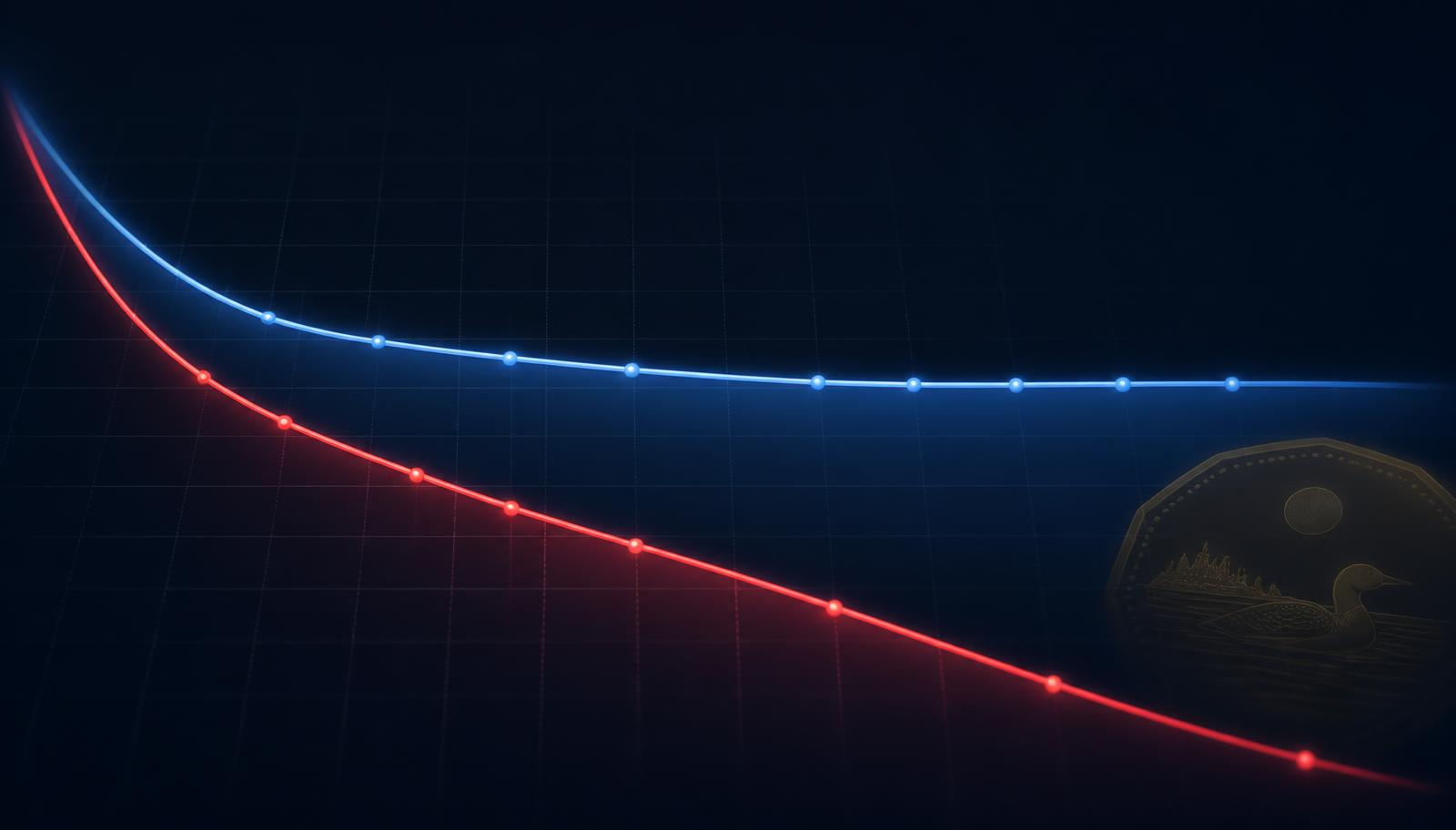
The rate differential gets the headlines. The price of what Canada sells to the world does the other half of the work, and a Canadian who owns US assets earns both.
The Bank of Canada's policy rate sat about 1.4 percentage points below the US effective federal funds rate in early September 2026, metals prices rose 4.2 per cent into August, and the loonie ended the week close to where it began. That stops being a puzzle once the currency is read as the net of two forces, the rate gap and the terms of trade. Here is how each one works, what the Bank's commodity index says about August, and what a five per cent move in the loonie does to a US$10,000 position.
By Hannah Kuan8 min read

Bank of Canada policy rate
2.25 per cent as of September 3, 2026
the target for the overnight rate (Bank of Canada).
US effective federal funds rate
3.63 per cent on September 3, 2026
about 1.4 percentage points above Canada's policy rate (US Federal Reserve, H.15).
USD/CAD
C$1.3840 per US$1 on September 4, 2026
the week traded in a C$1.3789 to C$1.3896 band; one loonie bought about US$0.7225 (Bank of Canada).
BCPI, metals and minerals
1,165.55 in August 2026, up 4.2 per cent from July
all items 708.61, energy 1,468.40 (Bank of Canada).
Illustrative currency effect
about C$692
the change in a US$10,000 position from a 5 per cent loonie move, US asset held flat (worked example, not a forecast).
Our colleagues wrote last week that the gap between Canadian and US interest rates is a signal for the loonie, not a forecast of it. I want to add the other half. As of September 3, 2026, the Bank of Canada's target for the overnight rate was 2.25 per cent and the US effective federal funds rate was 3.63 per cent, according to the Federal Reserve's H.15 release: a gap of about 1.4 percentage points in the US dollar's favour. In the same stretch the Bank of Canada's metals and minerals price index for August 2026 came in 4.2 per cent above July. And the loonie went almost nowhere: the US dollar cost C$1.3866 on August 31, C$1.3896 on September 1 and C$1.3840 on September 4, 2026, per the Bank of Canada's daily rate, leaving one Canadian dollar worth about US$0.7225 at the week's end.
A rate gap that wide should have weighed on the loonie. A metals move that size should have lifted it. The currency sat still.
That is the fact. The reframe is that neither number was wrong. They were pulling against each other, and the market has a habit of naming only one of them.
Two forces, and the market names only one
The first force is the rate differential. The Bank of Canada's policy rate is its target for the overnight rate, the rate at which major financial institutions lend to one another overnight. The effective federal funds rate is the rate the New York Fed calculates from actual overnight lending between US banks, as reported in the Fed's H.15 release. Because money drifts toward the higher rate, a wider gap in the US dollar's favour tends to weigh on the loonie. This is the carry argument.
The second force is the terms of trade: the prices Canada receives for what it sells abroad, measured against the prices it pays for what it buys. When export prices rise faster than import prices, the terms of trade improve and the currency tends to firm. This is what people mean by a commodity currency, one whose value tends to track the prices of the raw materials its country ships to the world. Commodities are a large share of what Canada exports, so the commodity tape is, in effect, a running estimate of Canada's terms of trade.
The two forces are measured in different units by different institutions and can point in opposite directions in the same week, as they did in the first week of September 2026.
I find it easier to think of the loonie as a sum of the two rather than a reflection of either.
How a metal price turns into an exchange rate
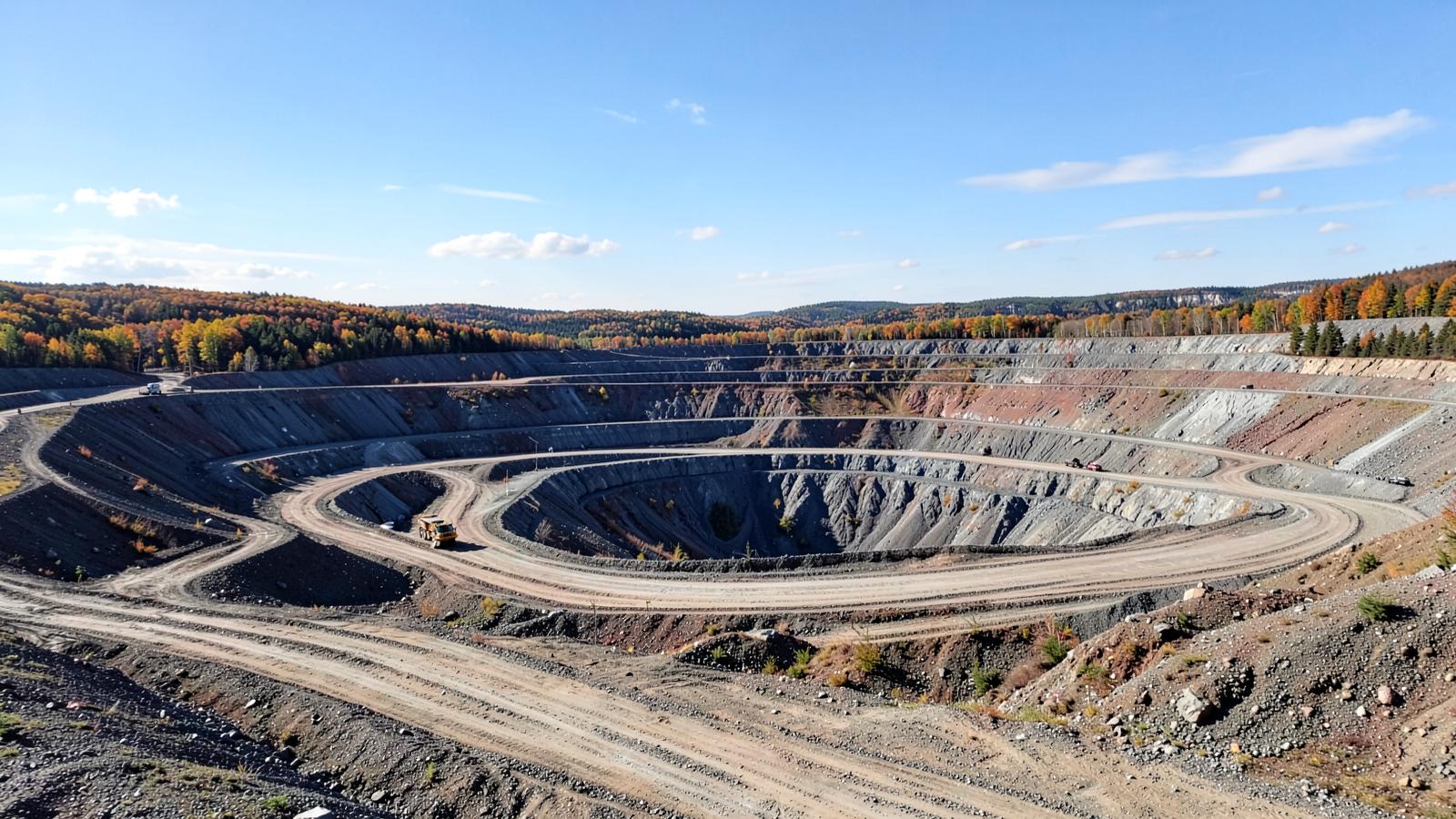
Start with a Canadian mine that sells abroad. Its metal is priced and paid for in US dollars, so when the world price rises, its US-dollar revenue rises with it.
The mine pays its workers, suppliers, royalties and taxes in Canadian dollars, so it sells US dollars and buys Canadian ones, and so does every other exporter. A higher commodity price means more US dollars coming in and more of them converted into loonies.
That conversion is the channel: more demand for Canadian dollars against a given supply nudges the exchange rate in the loonie's favour. No central bank has to do anything for this to happen.
The terms-of-trade channel works through the actual flow of export receipts into Canadian dollars, which is why it can move the currency in a week when neither central bank has met.
That flow was present in early September 2026, after the metals and minerals sub-index rose into August, and the rate gap pulled money the other way at the same time. It is inaccurate to say the loonie ignored commodities that week. The support arrived and was absorbed by the carry; the C$1.3789 to C$1.3896 band in the Bank of Canada's daily rates is the record of that standoff.
Neither engine won that week. That is a different statement from saying neither engine ran.
The second return a Canadian earns without noticing
The clearest place to see why this matters is a Canadian who owns a US asset, where the exchange rate is part of the return.
Such an investor earns two returns at once. The first is the asset's own return, in US dollars: the stock or fund rises or falls. The second is the currency's return: the same number of US dollars is worth more or fewer Canadian dollars when the loonie moves. An unhedged position leaves both in place. A hedged position uses a currency-hedged fund or a forward contract to offset the currency move, leaving only the asset's return; the hedge is not free.
The table that follows is illustrative, not a forecast: a US$10,000 position, the Bank of Canada's September 4, 2026 rate as the starting point, and the US asset held flat so that only the loonie moves.
| Scenario | USD/CAD | Value of US$10,000 in C$ | Currency contribution |
|---|---|---|---|
| Start (September 4, 2026) | 1.3840 | C$13,840 | reference |
| Loonie weakens 5 per cent | 1.4532 | C$14,532 | +C$692 |
| Loonie strengthens 5 per cent | 1.3148 | C$13,148 | -C$692 |
Read it slowly. The position never changed in US dollars, yet a five per cent move in the loonie adds or removes about C$692, roughly five per cent of the Canadian-dollar value. A Canadian who owned US stocks through a stretch of loonie weakness collected that on top of whatever the market did, and hands it back when the loonie firms.
A Canadian portfolio of US assets can rise in Canadian-dollar terms while the underlying US market is flat, or fall while it is flat, and the exchange rate is the entire explanation.
A commodity move that firms the loonie therefore subtracts from an unhedged owner's translated return, and compresses the Canadian-dollar value of a Canadian producer's US-dollar sales, which is the thread connecting this piece to the metals discussion elsewhere on the site today.
What the Bank of Canada's commodity index says about August
The terms-of-trade force needs a gauge, and the Bank of Canada publishes one: the Commodity Price Index, or BCPI, which tracks the prices of the commodities Canada produces and sells abroad, with sub-indexes for energy and for metals and minerals among others.
For August 2026, the Bank's monthly observations showed the all-items index at 708.61, the energy sub-index at 1,468.40 and the metals and minerals sub-index at 1,165.55, the last of these 4.2 per cent above July.
Two reading habits help. An index level means little on its own; the information is in the change from the prior month and the direction over several months. And the sub-indexes are not ranked against each other: energy sitting above metals does not mean energy is dearer than metals, because each series is measured against its own starting point.
The number to carry from August's print is the 4.2 per cent monthly rise in metals and minerals, because that is the terms-of-trade impulse the currency had to digest in the first week of September.
The index is monthly, so it confirms a commodity move rather than announcing it.
When the rate gap wins, and when commodities do
Three public, datable developments would change the balance of early September 2026.
A change in the gap between the Bank of Canada's policy rate and the US effective federal funds rate alters the carry force directly. A narrower gap, whether the Bank of Canada moves up or the Federal Reserve moves down, would let a commodity rise of August's size show through far more visibly; a wider gap would absorb even more commodity support than it did this time.
A sustained turn in the commodity cycle changes the terms-of-trade force. A run of monthly BCPI declines would leave the rate gap unopposed; a run of increases across energy as well as metals would strengthen the loonie's support, and Statistics Canada's merchandise trade data would show it a step later.
A shift in global risk sentiment moves the US dollar against nearly everything at once and can swamp both Canadian channels for weeks; such a move is not a verdict on Canadian rates or exports.
The two forces can also line up: firm commodity prices meeting a narrowing rate gap would push the loonie in one direction from both sides. A reader who watches only the rate differential is surprised when commodities move, and one who watches only commodities is surprised when the rate gap dominates; the discipline is to look at both.
What to watch, and where to check it
All of this can be checked in public data.
- Bank of Canada target for the overnight rate, on the Bank's website: 2.25 per cent as of September 3, 2026.
- US effective federal funds rate, in the Federal Reserve's H.15 release: 3.63 per cent on the same date. The difference is the carry.
- Bank of Canada Commodity Price Index, monthly, with its energy and metals and minerals sub-indexes; the September print is the next test.
- Daily USD/CAD rate from the Bank of Canada, which turns the rest into a Canadian-dollar return.
- Statistics Canada merchandise trade release, for the export values behind the terms of trade.
I would judge the coming weeks on the pairing, not on either number alone: where the rate gap sits, and what the next BCPI print says about the prices of what Canada sells.
The loonie did not stand still in early September 2026 because nothing was happening. It stood still because two things were happening at once.
Transparency note
Transparency note. This is an independent big-picture analysis and editorial opinion piece produced by The Maple Markets editorial desk. It is not sponsored, promoted or commissioned, and no compensation of any kind has been received from any issuer, government body or organisation named in this article, or any party acting on their behalf. The analysis is based on public data available as of the publish date; every figure is attributed to its primary source, and the currency tables are illustrative worked examples with assumed inputs, not forecasts. Nothing here is a recommendation to buy, sell or hold any security or currency, and readers should not treat it as investment advice. Past prices do not guarantee future results. Policies: Editorial Standards · Financial Disclaimer.
Read next
 EconomyThe Canada–U.S. Rate Gap Is a Signal, Not a Loonie ForecastThe Bank of Canada's target sits well below the federal-funds range. That is factual. The conclusion that the loonie must therefore weaken is not.Élise Galarneau · September 4, 2026 · 6 min
 Mining and ResourcesThe quote is not the margin: what a copper and gold week is worth to a Canadian mine in looniesCopper traded at US$6.58 per pound on September 6, 2026, gold near US$4,331 per ounce on September 1, and the Bank of Canada's metals and minerals index rose 4.2 per cent in August. None of those is a Canadian producer's margin. This piece walks the arithmetic from the US-dollar quote through the exchange rate to the Canadian-dollar cash margin, shows what a five per cent stronger loonie does to it, and explains why a pre-revenue explorer reads the same week as a financing window.Daniel Okoye · September 7, 2026 · 7 min
 EconomyWhy Bank of Canada Cuts Do Not Guarantee Lower Long-Term Bond YieldsThe Bank of Canada can cut while the ten-year yield holds or rises. That is not a contradiction — it is what happens when inflation expectations, term premium and sovereign supply price duration separately.Daniel Okoye · September 1, 2026 · 7 min
Get the Maple Morning Debrief
Yesterday's close, overnight, and what to watch before the open — in your inbox by 6 a.m. ET. Free, and one click to unsubscribe.
Follow and ask
Get more of our Canadian market coverage in Google Top Stories.
Opinion
This article expresses the author's personal views, is separate from news reporting and is not investment advice.
Sources and references (5)
- Bank of Canada, daily USD/CAD exchange rate
- Bank of Canada, target for the overnight rate
- Bank of Canada, Commodity Price Index (BCPI), monthly observations
- US Federal Reserve, H.15 Selected Interest Rates
- Statistics Canada, Canadian international merchandise trade (terms-of-trade context)
Cite this analysis
Please attribute The Maple Markets and link to the original page.
Hannah Kuan (September 7, 2026). The Loonie Has Two Engines: Why a 1.4-Point Rate Gap Is Only Half of the Canadian Dollar Story. The Maple Markets. https://themaplemarkets.ca/en/newsroom/loonie-commodity-currency-terms-of-trade-and-canadian-returnshttps://themaplemarkets.ca/en/newsroom/loonie-commodity-currency-terms-of-trade-and-canadian-returns