
Metalsource Steps 1.1 Kilometres North of Everything It Has Drilled
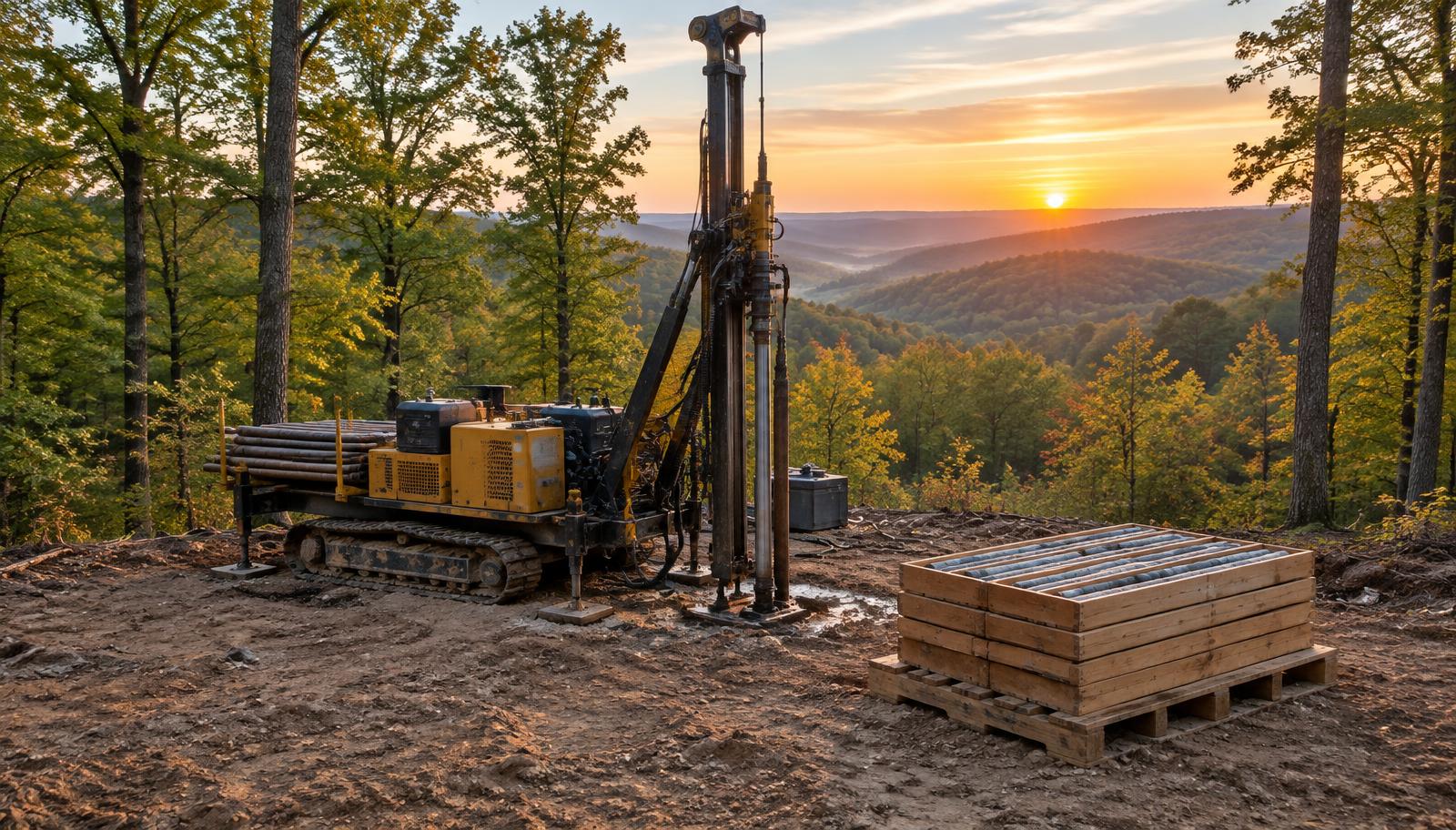
Nine months of drilling at Silver Hill went into ground where the company already knew mineralization existed; the rig that started this week is pointed at ground where it does not yet know.
Metalsource Mining (CSE: MSM) said on 7 October 2026 that Phase 2 drilling has begun at Silver Hill in North Carolina, with holes planned about 1,120 metres north of the known deposit against induced-polarization anomalies that have never been tested. The company has spent 2026 calibrating that geophysical signal against real intercepts, which is what makes the northern targets more than lines on a map. It is also the whole of what has been proven about them.
By Priya Sandhu7 min read
Northern step-out
approximately 1,120 metres north of Silver Hill
the distance from known mineralization to the planned Phase 2 holes, per the company release dated 7 October 2026.
IP calibration near the mine
about +25 msec chargeability and about +2,000 ohm-m resistivity
the geophysical signature that correlates with known mineralization at Silver Hill, per the same release.
Cash and equivalents
about C$7.53 million against about C$396,000 of total liabilities
as at the latest filed statements, from secondary market data on 7 October 2026 and not verified against SEDAR+.
Close and turnover
C$0.71, down 2.7 per cent on 24,407 shares
CSE, 7 October 2026, 15-minute delayed data from QuoteMedia; 30-day average volume 57,752.
German line
FSE E9Z, WKN A4021B, ISIN CA59132M1086
zero shares and zero euros traded on Tradegate on 7 October 2026.
Metalsource Mining has drilled Silver Hill for most of 2026 by asking the same question over and over: how much further does the known mineralization go? On 7 October the company said it had started asking a different one.
Phase 2 drilling has begun at the Silver Hill project in Davidson County, North Carolina, and the plan includes holes about 1,120 metres north of the deposit the company has been extending all year, into ground where no drill has been. The release is dated 7 October 2026 and was issued over Newsfile.
The order in which Metalsource got here matters more than the headline distance, because each step added something the next one leaned on.
The first half of the year bought a corridor, one step-out at a time
Through the winter and spring the drilling stayed close to known mineralization and kept finding more of it. On 11 March the company reported 267 grams of silver-equivalent per tonne over 18.17 metres and 237 g/t over 15.33 metres. On 13 April it reported 48.04 grams of gold-equivalent per tonne over 12.62 metres, extending mineralization roughly 195 metres down dip. On 10 June it reported 434 g/t silver-equivalent over 10.64 metres, including an interval running at 2.1 kilograms per tonne.
A word on those units, because they do a lot of work in junior mining releases. A silver-equivalent or gold-equivalent grade converts the copper, lead and zinc in an assay into an imagined quantity of silver or gold using assumed metal prices and assumed recoveries. It makes a polymetallic intercept easy to compare against a precious-metals one. It is also an accounting convention: the company states its price and recovery assumptions in the release, and change those assumptions and the headline grade changes with them.
None of these intercepts is a mineral resource. A resource is a formal estimate of tonnes and grade prepared under National Instrument 43-101, the Canadian rule that governs how mining companies may describe what is in the ground. As at 7 October 2026 Metalsource had published no such estimate for Silver Hill.
By 16 and 17 June the company was describing something broader than a single lens: multiple open induced-polarization targets across 2.4 kilometres of strike, and on 16 July a set of high-priority drill targets across that same footprint. On 2 July it added ground through a land acquisition.
Capacity arrived before the targets did
On 21 July Metalsource said it had added a second drill rig and roughly tripled its drilling capacity. The 7 October release confirms the arrangement now in place: production has tripled with the second rig and a night shift, with one drill staying on Silver Hill expansion and the second testing trend targets.
That split is the quiet structural change of the year. It means the company no longer has to choose between proving what it has and looking for what it does not have. Both programs run at once.
The expansion drilling kept working. On 18 August the company reported mineralization to 335 metres below surface with 55-metre down-plunge step-outs. On 16 September it reported high-grade mineralization extended at depth. The 7 October release puts the known system at 550 metres depth in lenses that remain open, across a 1,225-acre property, described in the 7 October 2026 release as a historic producer dating to 1839.
Why these northern anomalies are not just lines on a map
The strongest thing in the 7 October release is not the 1,120-metre number. It is the calibration underneath it.
Induced polarization is a surface survey that pushes current into the ground and measures two things: chargeability, how long the rock holds an electrical charge, which sulphide minerals do well, and resistivity, how strongly the rock resists current, which altered silica-rich rock does well. As of 7 October 2026 none of the northern anomalies had been drilled. On its own an IP anomaly is a physical property, not a metal. It becomes useful only when someone drills enough of them in one district to learn which combination of readings sits over mineralization and which sits over barren rock.
Metalsource has now done that near the mine. The release reports a positive correlation at Silver Hill between chargeability around +25 milliseconds and resistivity around +2,000 ohm-metres and the mineralization the drills have actually hit. It notes that hole SH26-34 sits beside an IP response of 35 milliseconds and 2,500 ohm-metres, and that the hole visually intersected about 20 metres of mineralization including multiple intervals of near-solid sulphide. A second and independent pointer sits to the north as well: surface mineralization in subcrop carrying gold, silver, lead and zinc about 240 metres northeast of Silver Hill, which the company describes as possibly on trend with the northern anomalies, and for which a drill pad has been built.
A local calibration is a real asset. It is the difference between drilling a geophysical feature and drilling a geophysical feature that has been tested against ground truth in the same rocks. That is a genuine advance in what the company knows, and it is also the entire extent of what the northern ground has going for it today.
What the northern ground has not yet produced
Assays from SH26-34 are pending; the 20 metres is a visual log, and visual sulphide is not grade. The surface rock chips north of Silver Hill in the release's Table 1 are spotty rather than uniform: the highlights are 0.98 grams of gold per tonne with 61.10 g/t silver at sample 1800N-2R and 12,050 parts per million lead at 1750N-3R, and several samples in the same table carry very low precious-metal values. Rock chips are grab samples by nature; they say a rock exists, not how much of it there is.
The release gives no planned metreage for the northern holes. Head Geologist Dale Moore puts the timing for testing whether Silver Hill is "a smaller portion of a potentially broader mineralized system" at late Q4 2026 or Q1 2027. Chief Executive Joe Cullen calls it "the exploration phase we've been building toward all year." Darcy Vis, P.Geo., of Tripoint Geological Services, a company contractor, approved the technical content as qualified person.
There is one claim circulating about this program that the documents do not carry. Retail discussion of the release has leaned on remarks management is said to have made in an interview, to the effect that geophysics, geochemistry and drilling all point to the trend continuing north. The 7 October release supports the correlation and the subcrop; it does not contain that statement, and an interview relayed second-hand is not a company disclosure. The discussion itself is thin, a handful of posts with no opposing case in them, which makes it a mood rather than a signal.
The money that has to carry this
Cash and equivalents stood at about C$7.53 million against total liabilities of about C$396,000 at the company's most recently filed statements; both figures are as reported by QuoteMedia on 7 October 2026 and carry that data vendor's lag, not an audit trail back to the statements. What is on the public record directly is where the money came from: Metalsource announced a C$7.5 million private placement on 10 February 2026, increased it the same day, and closed a C$6 million placement on 6 March 2026. On the exchange's own count the company has about 71.62 million shares outstanding.
A step-out program is cash converted into information. Two rigs and a night shift spend it faster than one rig does, and the northern holes are the ones most likely to come back with nothing, because that is what untested ground usually does.
The tape and the two places this trades
Metalsource closed at C$0.71 on the CSE on 7 October 2026, down 2.7 per cent, on 24,407 shares against a 30-day average of 57,752, roughly C$17,000 of turnover. The high was C$0.73 and the low C$0.70. Market capitalisation was about C$50.85 million. Those figures are 15-minute delayed secondary market data from QuoteMedia, not verified against SEDAR+. The 52-week range runs from C$0.285 to C$2.29, which places the current quote nearer the bottom of its own year than the top.
The shares also carry a German line: Frankfurt ticker E9Z, WKN A4021B, ISIN CA59132M1086, quoted in euros in the Freiverkehr segment, per Tradegate Exchange's order book read on 7 October 2026. On that day the German line showed a bid of €0.436 and an ask of €0.448 and recorded no trades at all: turnover of zero euros on zero shares. The listing is there so a European holder can buy the security in their own market and currency. It is not where this company's price is made, and on a day like 7 October it is not where anything happened.
A program that moves 1,120 metres north is the company telling the market it thinks Silver Hill is the middle of something rather than the end of it. Whether it is right is a question the first northern core box will start to answer, and nothing before then will.
Transparency note. This is an independent due-diligence analysis and editorial opinion piece produced by The Maple Markets editorial desk. It is not sponsored, promoted or commissioned, and no compensation of any kind has been received from Metalsource Mining Inc. (CSE: MSM) or any party acting on their behalf. The analysis is based on public disclosure available as of the publish date; every figure is attributed to its primary source. The Maple Markets and its authors may hold positions in securities mentioned; nothing here is a recommendation to buy, sell or hold any security, and readers should not treat it as investment advice. Past disclosure does not guarantee future results. Policies: Editorial Standards · Financial Disclaimer.
Read next
Auch auf Deutsch: Metalsource bohrt 1.1 Kilometer nördlich von allem, was es bisher kennt
 Mining and ResourcesMyriad Uranium Slid 10.0 Per Cent While Only One Fund Filing Supported the Flow StoryMyriad Uranium Corp. (CSE: M) closed down 10.0 per cent at C$0.4275 on 21 September 2026 with no filing behind the move and nothing released since 10 September. One part of the buying story is documented: a uranium ETF publishes a holding of 5,153,552 shares. The other claims are unverified. Underneath them sits real drilling at Copper Mountain, Wyoming, a historical estimate from 1979, and no current mineral resource estimate.Daniel Okoye · September 22, 2026 · 9 min
 Mining and ResourcesQIMC Takes 823 New Soil-Gas Stations Into Ontario, the Fifth Step in a Method Built in PublicQuébec Innovative Materials Corp. (CSE: QIMC) launched an expanded 2026 natural hydrogen programme on the Ontario side of the Témiscamingue Graben on September 17, 2026: 823 new soil-gas stations at 100-metre spacing over about 80 line-kilometres, taking the Ontario database to roughly 1,733 stations, alongside more than 1,100 gravimetric stations and 78 line-kilometres of 2D seismic. The shares closed at C$0.59. The company's own disclosure says none of this measures flow.Priya Sandhu · September 17, 2026 · 7 min
 Mining & EnergyQuebec's New Government Inherits First Phosphate's Fast-Track StatusFirst Phosphate Corp. (CSE: PHOS) holds Filon fast-track status from Quebec's Ministry of Natural Resources and Forests, granted 27 July 2026, and letters from two European export credit agencies covering up to US$212.5 million and EUR 170 million. None of those is a permit or a drawn loan. After the Parti Québécois won a minority on 5 October 2026, this is what the documents actually support and what they do not.Priya Sandhu · October 7, 2026 · 7 min
Follow this story
Follow MSM.CN — the next Maple piece on this company, plus the Maple Morning Debrief before the open.
Follow and ask
Get more of our Canadian market coverage in Google Top Stories.
Opinion
This article expresses the author's personal views, is separate from news reporting and is not investment advice.
Disclosure
Transparency note. This is an independent due-diligence analysis and editorial opinion piece produced by The Maple Markets editorial desk. It is not sponsored, promoted or commissioned, and no compensation of any kind has been received from Metalsource Mining Inc. (CSE: MSM) or any party acting on their behalf. The analysis is based on public disclosure available as of the publish date; every figure is attributed to its primary source. The Maple Markets and its authors may hold positions in securities mentioned; nothing here is a recommendation to buy, sell or hold any security, and readers should not treat it as investment advice. Past disclosure does not guarantee future results. Policies: Editorial Standards · Financial Disclaimer. See the Financial Disclaimer.
Sources and references (6)
- Metalsource Mining Launches Major Step Out Program With 1.1 km Northern Target to Test Broader Scale of Silver Hill, 7 October 2026 (Newsfile)
- Metalsource Mining news archive (company website)
- Metalsource Mining Intersects 434 g/t AgEq Over 10.64 Metres at Silver Hill, 10 June 2026
- Metalsource Mining Accelerates Silver Hill Exploration with Second Drill Rig, 21 July 2026 (Newsfile)
- Metalsource Mining closes C$6 million private placement, 6 March 2026
- Tradegate Exchange order book, Metalsource Mining Inc., ISIN CA59132M1086, read 7 October 2026
Cite this analysis
Please attribute The Maple Markets and link to the original page.
Priya Sandhu (October 8, 2026). Metalsource Steps 1.1 Kilometres North of Everything It Has Drilled. The Maple Markets. https://themaplemarkets.ca/en/newsroom/metalsource-mining-a-step-out-program-is-not-a-step-out-result-whathttps://themaplemarkets.ca/en/newsroom/metalsource-mining-a-step-out-program-is-not-a-step-out-result-what