
TAG Oil Falls 53% as Its Egyptian Well Waits for an Acid Treatment
The Egyptian well reached its target and logged oil-bearing rock, but no formation oil reached surface over the final 48 hours of a nitrogen clean-up, so TAG Oil has shut it in to treat it and test again.
TAG Oil's T-200 well in Egypt's Western Desert reached 4,160 metres and logged 14 metres of oil-bearing limestone, but no formation oil reached surface over the final 48 hours of a nitrogen clean-up. The company has shut the well in, plans an acid treatment and a re-test, and will update with its third-quarter results on 25 November 2026. The shares roughly halved on about 58 times their usual volume.
By Daniel Okoye6 min read
Close, 19 October 2026
C$0.04, down 52.94 per cent
TSX Venture Exchange via TMX Money, end-of-day data read at 13:21 Pacific
Volume
13,961,788 shares against a 239,001-share 30-day average, about 58 times
QuoteMedia, 19 October 2026
Net oil pay
14 metres in a 58-metre limestone interval, 8 per cent average porosity
company release, 12 October 2026, preliminary
Clean-up result
no formation oil to surface over the final 48 hours
company release, 19 October 2026
Cash
C$10.4 million, no debt
as at 30 June 2026, company release of 27 August 2026
Brine came up and oil did not. TAG Oil Ltd. reported on 19 October 2026 that a nitrogen-assisted clean-up of its newest well in Egypt brought no oil from the target formation to surface.
The company's own explanation is that the rock near the borehole is choking the flow. It plans to treat the well, called T-200, with acid and test it again. The share price did not wait for that second test. TAG Oil closed at C$0.04 on the TSX Venture Exchange, down 52.94 per cent, on 13,961,788 shares, per end-of-day data read at 13:21 Pacific on 19 October 2026 on TMX Money.
What the well was meant to prove
T-200 is a vertical well at the Badr Oil Field, on the BED-1 concession in Egypt's Western Desert. TAG Oil drilled it to test the Abu Roash "F" formation, a limestone the company describes as naturally fractured at this location. In a fractured limestone, oil sits in the tiny pores of the rock and moves mainly through cracks, so whether a well flows depends on whether it connects to those cracks.
The company spudded the well in early August and said it expected about two months of drilling and completion. If the well succeeded, the plan was to put it straight into production through an early production facility, according to the company's 6 August 2026 release. That plan is why the test mattered more than an ordinary exploration result would.
In the second quarter of 2026 the two producing BED-1 wells averaged 66 barrels of oil per day, gross, according to the company's results release of 27 August. Crude oil sales from BED-1 in the same period were 53 barrels per day, according to the same release. In its 12 October 2026 release the company's Executive Chairman described T-200's on-budget operations as an important milestone for the BED-1 program. T-200 is the company's current test of the Abu Roash "F" plan.
The logs found oil-bearing rock
The first half of the evidence came in on 12 October 2026. TAG Oil said the well reached a total depth of 4,160 metres, the bottom 58 metres of it in limestone with good oil shows.
The company's preliminary interpretation of its wireline logs counted 14 metres of net oil pay. Net pay is the thickness of rock that the logs judge to hold recoverable oil, after the tight or wet layers are removed.
| Measure, per the 12 October 2026 release | Value | Status |
|---|---|---|
| Net oil pay | 14 metres | preliminary log interpretation |
| Average porosity | 8 per cent | preliminary log interpretation |
| Limestone interval with oil shows | 58 metres | reported |
Porosity is the share of the rock that is open space, and in this interval it averaged 8 per cent with a peak of 10 per cent, according to the company. The release pointed to natural fractures as the source of permeability, which is the property that lets oil move.
Logs measure what is in the rock. They do not measure whether it will flow. The company said so itself on 12 October, calling the interpretation preliminary and stating that it did not guarantee commercial production.
The test brought up brine and no oil
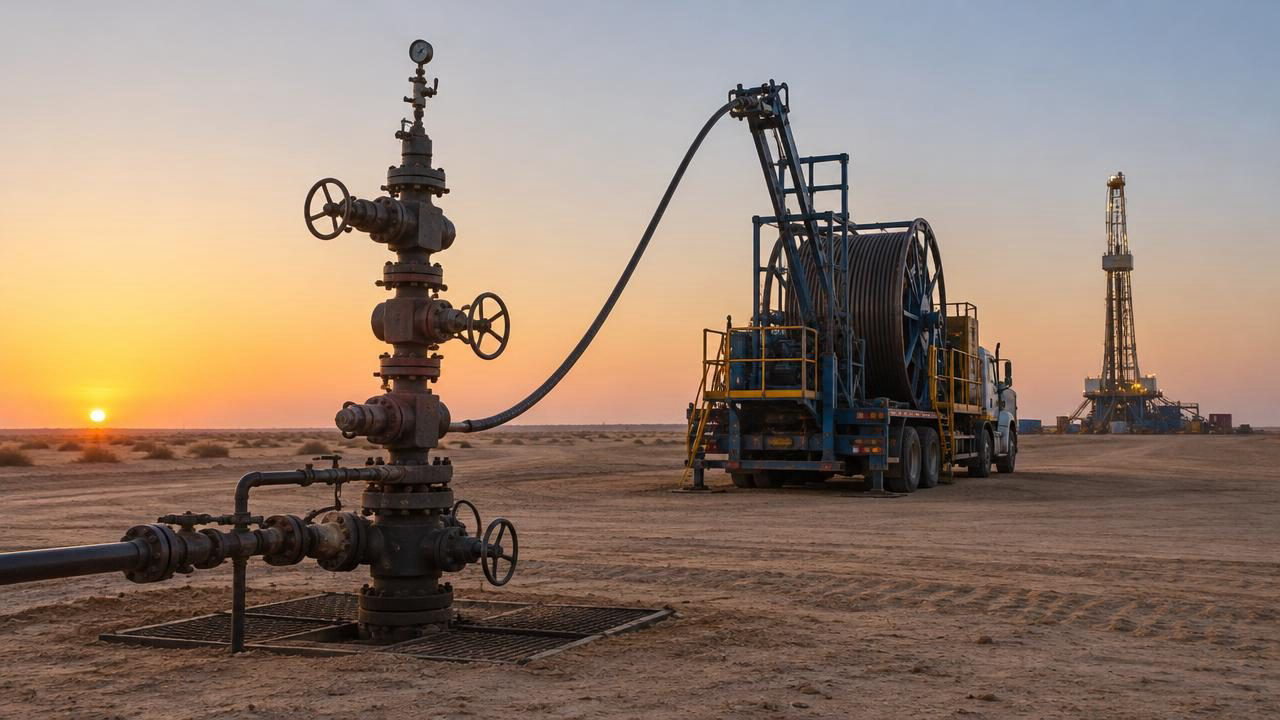
The second half arrived on 19 October. To start the well, TAG Oil pumped nitrogen through coiled tubing to push out the brine left in the hole. Nitrogen lightens the column of fluid so that the reservoir's own pressure can push oil up behind it.
Over the final 48 hours of that work, no formation oil reached surface. The company drew its own conclusion from what it saw: restricted flow, which it said was potentially associated with near-wellbore formation damage or reservoir skin.
Skin is the engineering term for a zone of damaged rock immediately around the borehole. Drilling mud and fine particles can plug the pores and cracks there, so a reservoir that holds oil can still look dead at the wellhead. The company described this interpretation as preliminary.
Acid is the next step
TAG Oil has shut the well in so that the drilling rig could be released, which stops the daily cost of keeping a rig on site. The company plans an acid stimulation, then a re-test. Acid stimulation in a limestone means pumping acid into the well to dissolve the damaged zone and reopen the paths into the fractures behind it. Limestone dissolves in acid, which is why this is a standard repair for this kind of rock. In the company's words, the aim of the treatment is to improve wellbore clean-up and restore formation flow capacity.
After the re-test, the company said it will monitor pressure and decline behaviour to estimate a stabilised production rate. That is the figure that would show whether T-200 can feed the early production facility. The release says there is no assurance the treatment will succeed or that the well will flow oil at commercial rates.
The release gave no date for the acid job. It named one firm date: a further update with the third-quarter 2026 operating and financial results on 25 November 2026.
What the share price did with it
The fall took TAG Oil from a previous close of C$0.085 to C$0.04 on 19 October, which cut the company's market value by more than half in a session. Turnover ran at about 58 times the 30-day average, according to QuoteMedia data for the day. The 19 October release was the only document the company published that day. Oil itself was firm: front-month WTI crude settled at US$101.41 a barrel on 16 October 2026, the last session before the release, and the most-traded December contract was at US$98.37 late on 19 October 2026, according to CME Group.
The 19 October release and the TSX Venture Exchange quote page carry no reference to a share consolidation, a halt or a relisting, so the 52.94 per cent figure is a move in an unchanged share count.
The money behind the next test
The balance sheet is the context for the acid treatment and re-test. On 30 June 2026 the company reported C$10.4 million in cash and cash equivalents and C$10.3 million in working capital, and said it had no debt, in its 27 August 2026 release summarising its interim statements.
That cash figure predates most of the T-200 spending, which began with the spud on 6 August. The company described the drilling as on budget and did not give the budget in dollars, so its cash today is lower than the 30 June 2026 balance by an amount it has not yet reported. The 25 November results will show it.
At the close, QuoteMedia put the company's market value at about C$13.7 million. Set against the 30 June 2026 cash balance, the 19 October market value is higher by about C$3.3 million, before the unreported well costs are taken off the cash side.
What comes next
T-200 has produced two documented results in a week. The logs show 14 metres of oil-bearing limestone at the depth the company targeted, and the first clean-up did not bring that oil to surface. Both statements are the company's own, and neither is the last word on the well.
The company attributes the restricted flow, on a preliminary interpretation, to near-wellbore damage or reservoir skin, and describes acid treatment as a primary method in carbonate reservoirs. The re-test will show whether that interpretation holds.
The re-test result, and the stabilised rate that follows from it, will tell more than either document published so far. The company's next scheduled word is 25 November.
Disclosure
Transparency note. This is an independent due-diligence analysis and editorial opinion piece produced by The Maple Markets editorial desk. It is not sponsored, promoted or commissioned, and no compensation of any kind has been received from TAG Oil Ltd. (TSXV: TAO) or any party acting on their behalf. The analysis is based on public disclosure available as of the publish date; every figure is attributed to its primary source. The Maple Markets and its authors may hold positions in securities mentioned; nothing here is a recommendation to buy, sell or hold any security, and readers should not treat it as investment advice. Past disclosure does not guarantee future results. Policies: Editorial Standards · Financial Disclaimer.
Read next
 Mining & EnergyVault Strategic Samples 1,100 ppm Tungsten at War Bond in NevadaVault Strategic has reported surface samples of up to 1,100 ppm tungsten at War Bond in Nevada, started a magnetic survey programme and closed a C$1.5 million financing. The results and funding provide a practical foundation for follow-up exploration. A technical report and drill-target work are the next steps; the project’s scale and economics remain to be established.Daniel Okoye · October 16, 2026 · 7 min
 Mining & Energy55% for Radius Gold on Permission to Drill in PeruRadius Gold (TSXV: RDU) said on 7 October 2026 that Peru's regional mining authority in Arequipa has authorised exploration, including drilling, at its Tierra Roja copper project. The shares closed up 55.2 per cent at C$0.225 on about 35 times average volume. The release sets out the permitting chain in detail and says nothing about holes, metres, timing beyond year-end or cost, and the company's own interim statements carry a going-concern warning.Élise Galarneau · October 7, 2026 · 6 min
 Mining and ResourcesHomeland Nickel: A Binding Offtake With Two ConditionsHomeland Nickel Inc. (TSXV: SHL) signed a binding offtake agreement with Westwin Elements on 2026-10-01 covering about 20,000 tonnes of nickel concentrate a year from its Red Flat property in Oregon. The agreement is conditional on an updated mineral resource estimate and a preliminary economic assessment the company expects in the first half of 2027. Homeland has no current mineral resource on any of its Oregon ground, and held about C$2.39 million of cash at its most recent reported balance sheet date.Priya Sandhu · October 15, 2026 · 7 min
Follow this story
Follow [TAO.V] — the next Maple piece on this company, plus the Maple Morning Debrief before the open.
Follow and ask
Get more of our Canadian market coverage in Google Top Stories.
Sources and references (6)
- TAG Oil Ltd., "TAG Oil Production Test Update", Newsfile, 19 October 2026
- TAG Oil Ltd., "TAG Oil Announces T-200 Well Reaches Total Depth and Reports Positive Abu Roash 'F' Reservoir Log Results", Newsfile, 12 October 2026
- TAG Oil Ltd., "TAG Oil Provides Financial Results and Operating Updates for First Half 2026", Newsfile, 27 August 2026
- TAG Oil Ltd., "TAG Oil Spuds T-200 Well at the BED-1 Concession in Egypt", Newsfile, 6 August 2026
- TMX Money, TAG Oil Ltd. (TSXV: TAO) quote page with QuoteMedia data (volume, 30-day average volume, market value), read 19 October 2026
- CME Group, NYMEX Light Sweet Crude Oil (WTI) futures settlements and quotes, read 19 October 2026
Cite this analysis
Please attribute The Maple Markets and link to the original page.
Daniel Okoye (October 19, 2026). TAG Oil Falls 53% as Its Egyptian Well Waits for an Acid Treatment. The Maple Markets. https://themaplemarkets.ca/en/newsroom/tag-oil-shares-fell-52-94-per-cent-to-c-0-04-on-12-486-788-shareshttps://themaplemarkets.ca/en/newsroom/tag-oil-shares-fell-52-94-per-cent-to-c-0-04-on-12-486-788-shares