
How First Phosphate Plans to Mine Battery Phosphate in Quebec by 2030
At Kinvestor Day on October 22, First Phosphate set out its path from a Saguenay phosphate deposit to battery-grade phosphoric acid, with a feasibility study scheduled for the first quarter of 2027.
First Phosphate presented its October 2026 plan at Kinvestor Day: a 204.7-million-tonne measured and indicated phosphate resource at Bégin-Lamarche in Quebec, definitive offtake agreements, provincial fast-track status, about C$21.5 million in signed federal contributions, a feasibility study due in the first quarter of 2027 and commercial production targeted for 2030. It held C$19.9 million in cash at August 31, 2026.
By Élise Galarneau6 min read
Dieser Artikel ist derzeit nur auf Englisch verfügbar.
Measured and indicated resource
204.7 million tonnes at 6.05% P2O5
effective May 1, 2026; release of May 26, 2026, NI 43-101 report filed August 24, 2026
Cash and equivalents
C$19.9 million
at August 31, 2026; interim financial statements filed October 15, 2026
Federal contributions signed
about C$21.5 million
C$16.7 million in March 2026 plus about C$4.84 million on August 5, 2026 (about C$3.07 million for transmission-line studies and design, about C$1.77 million for access-road work); company releases and October 2026 presentation
Feasibility study
first quarter of 2027
company schedule in the October 2026 presentation; commercial production targeted for 2030
CSE close
C$1.66, up 6.41%
October 27, 2026, per end-of-day data read at 13:20 Pacific from the CSE listing page; market value about C$316 million
Shares outstanding
190,419,664
at August 31, 2026, per the interim statements filed October 15, 2026
First Phosphate Corp. took a mine-to-battery plan to Kinvestor Day on October 22, 2026. It starts at a phosphate deposit north of Saguenay, Quebec, and ends in the cathodes of lithium iron phosphate batteries. The company's October presentation now puts a year on the last step. Commercial production is targeted for 2030.
Kin Communications, the Vancouver investor relations firm that runs the Kinvestor events, hosted the virtual conference on October 22, with First Phosphate presenting first at 7:00 a.m. Pacific, according to Kin's October 20 release. An investor conference brings no new drill results or studies. What it offers is the company's own current account of where its project stands, and First Phosphate's account is a schedule with a date against each milestone.
Phosphate from igneous rock, turned into battery acid
Most of the world's phosphate is mined from sedimentary rock, the layered beds left by ancient seas, and most of it goes into fertiliser. First Phosphate's deposit, Bégin-Lamarche in the Saguenay–Lac-Saint-Jean region, is igneous: the phosphate mineral, apatite, crystallised out of cooled magma. The company's presentation describes igneous phosphate as rare, at roughly 1 to 5 per cent of known deposits, and says igneous rock tends to carry fewer of the impurities that battery makers have to remove.
That matters because of where the company wants to sell. Lithium iron phosphate batteries, known as LFP, use iron phosphate in the cathode, the battery's positive side. Making that cathode material takes purified phosphoric acid, a cleaner grade than fertiliser acid. The presentation counts five purified phosphoric acid plants in the West today.
The company's chain has four links. It plans to mine and concentrate apatite at Bégin-Lamarche, convert the concentrate into purified phosphoric acid at a plant planned for Port Saguenay, and supply that acid toward iron phosphate and LFP cathode material. The presentation puts the potential output at about 350 gigawatt-hours a year of LFP batteries. That figure is the company's projection of what its acid could supply, and the mine and the plant are to be built.
Six steps in the company's documents, from resource to study
Each rung below is a document the company has published, in the order it was put in place. The lower rungs are complete. The upper rungs are scheduled or conditional, and the company's forward-looking statements say such plans "are not guarantees of future performance."
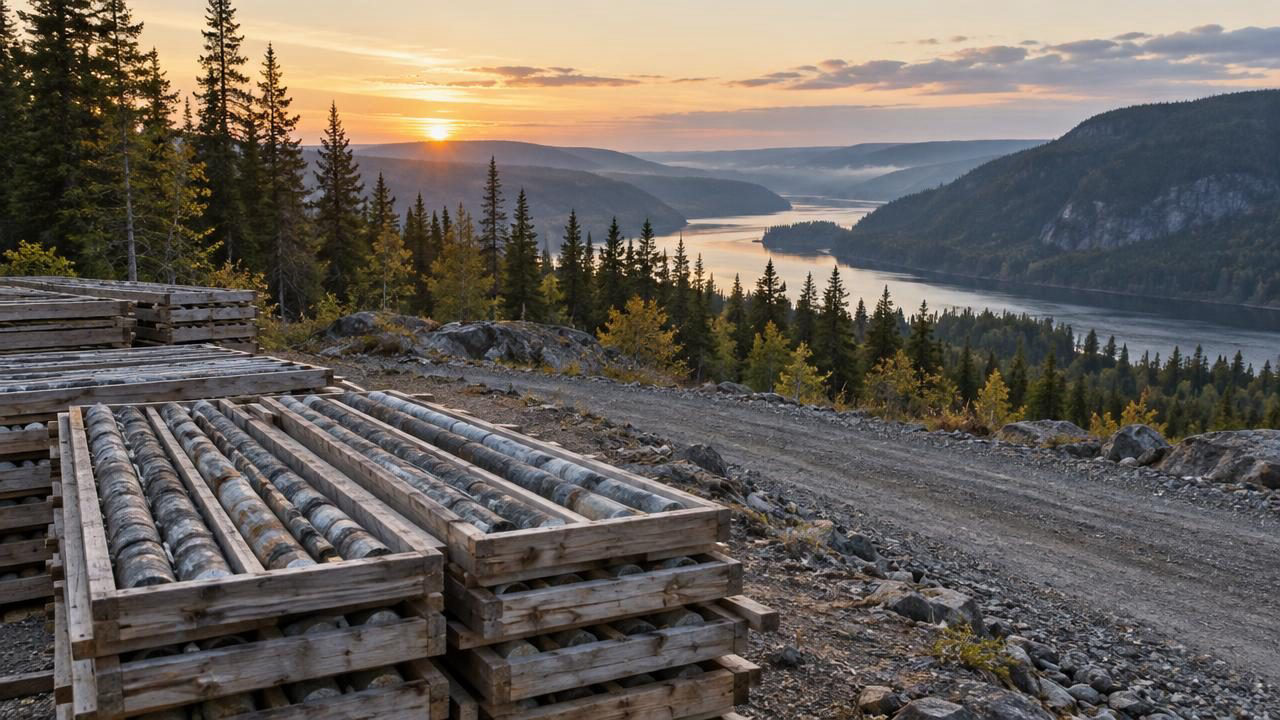
- The resource. On May 26, 2026, First Phosphate reported an updated mineral resource for Bégin-Lamarche of 204.7 million tonnes at 6.05 per cent phosphorus pentoxide in the measured and indicated categories. Measured and indicated is the part of a resource drilled closely enough to support a mine plan, and phosphorus pentoxide is the standard way phosphate grade is reported. The supporting technical report under National Instrument 43-101, Canada's disclosure standard for mineral projects, was filed on August 24. A further inferred tonnage, drilled too sparsely to plan a mine on, sits outside that figure.
- The buyers. A release of June 17, 2026 describes two definitive offtake agreements with an unnamed international partner, one for at least 200,000 tonnes a year of phosphate concentrate and one for phosphoric acid. An offtake agreement is a commitment to buy future output. The release gives no duration for either.
- Federal money. The company signed a C$16.7 million non-repayable contribution with Natural Resources Canada in March 2026. Two more agreements followed on August 5 under Natural Resources Canada's First and Last Mile Fund, one for studies and design of a 161-kilovolt transmission line and one for preparatory and study work on a mine access road and bypass roads linking to rail and the Port of Saguenay. They bring the federal total to the roughly C$21.5 million the presentation cites.
- Provincial support. On July 27, 2026, Quebec's Ministry of Natural Resources and Forests selected Bégin-Lamarche for Filon, its fast-track program for critical and strategic minerals. The release says Filon brings specialised help in dealing with the departments that issue mining permits.
- Export-credit interest. Export-credit and state finance agencies in three European countries have written letters aimed at the construction bill. Denmark's EIFO signed a letter of interest on March 30, 2026 for a guarantee of up to C$275 million for the mine. Italy's SACE, CDP and SIMEST signed letters of interest for the Port Saguenay acid plant between May 26 and June 4, 2026, with support from the engineering group MAIRE alongside them. Switzerland's SERV followed on September 16 with a letter of support for a guarantee of about US$212.5 million. Each letter is subject to due diligence and final agreements, and none has become a loan agreement.
- The study. The presentation schedules a feasibility study, the detailed engineering and cost study that lenders use to decide on project debt, for the first quarter of 2027. Environmental studies and Quebec's public hearings follow later that year, then permit applications and a target investment decision in 2028, and commercial production in 2030.
The balance sheet at August 31
The latest filed statements cover the six months to August 31, 2026 and were filed on SEDAR+ on October 15. On August 31, 2026 First Phosphate held C$19.9 million in cash and equivalents, and the October presentation describes the company as debt free.
| At August 31, 2026 | C$ |
|---|---|
| Cash and equivalents | 19.9 million |
| Current assets | 26.8 million |
| Current liabilities | 4.2 million |
| Working capital | 22.7 million |
| Total liabilities | 4.9 million |
| Net loss, six months to August 31 | 19.5 million |
The table rounds the figures in the statements for August 31, 2026, which is why working capital is not the simple difference of the two rounded rows above it.
Development costs money before a mine earns any. The net loss of C$19.5 million for the six months to August 31, 2026 reflects the study and drilling work on a project at the study stage. Note 2 of the statements says the company's ability to continue as a going concern "is contingent on its ability to obtain additional financing." The same note says that as of August 31, 2026 the company "has raised adequate financing that is sufficient to sustain operations for the next twelve months."
The July placement refilled the account. Its final tranche closed on July 10, 2026, bringing gross proceeds to C$17.7 million at C$2.00 a security, most of it in flow-through shares, which pass Canadian exploration tax deductions to the buyer.
Shares outstanding were 190,419,664 at August 31, 2026, the same count the October presentation gives in its share structure, priced at October 16.
Tuesday on the CSE
First Phosphate closed at C$1.66 on October 27, 2026, up 6.41 per cent, per end-of-day data read at 13:20 Pacific on October 27 from the exchange's own listing page. Volume on the CSE line came to 436,056 shares.
At that close the shares outstanding at August 31 carry a market value of about C$316 million.
The shares also trade in New York as American depositary receipts on the Nasdaq Global Market, under the symbol PHOS since August 2026.
Where the record stands now
My own view: for a CSE company whose first permit applications are scheduled for early 2028, First Phosphate has put an unusual amount into signed and filed documents, a resource and definitive buyers among them. Its largest numbers, the acid plant and the guarantees behind it, are plans with conditions attached. The feasibility study is the document that turns the cost side from a projection into an engineered estimate.
That study is dated for the first quarter of 2027, with the environmental hearings behind it later in the year. Until then the work runs on a filed measured and indicated resource and two definitive offtake agreements. Quebec's fast-track status sits beside them, and the work toward the feasibility study is paid from the C$19.9 million in cash the company held on August 31, 2026.
Offenlegung
Transparency note. This is an independent due-diligence analysis and editorial opinion piece produced by The Maple Markets editorial desk. It is not sponsored, promoted or commissioned, and no compensation of any kind has been received from First Phosphate Corp. (CSE: PHOS), Kin Communications Inc. or any party acting on their behalf. The analysis is based on public disclosure available as of the publish date; every figure is attributed to its primary source. The Maple Markets and its authors may hold positions in securities mentioned; nothing here is a recommendation to buy, sell or hold any security, and readers should not treat it as investment advice. Past disclosure does not guarantee future results. Policies: Editorial Standards · Financial Disclaimer.
Weiterlesen
Also in English: How First Phosphate Plans to Mine Battery Phosphate in Quebec by 2030
 Mining & EnergyFirst Phosphate verfügt über C$21.5 Millionen an unterzeichneten Fördermitteln des BundesFirst Phosphate hat drei nicht rückzahlbare Beitragsvereinbarungen aus zwei Programmen von Natural Resources Canada unterzeichnet, zusammen rund C$21.5 Millionen, für die Machbarkeitsstudie, die Verfahrensarbeiten, eine Studie zu einer 161-kV-Stromleitung und eine Zufahrtsstraße zur Mine. Das Geschäftsjahr schloss es mit C$20.2 Millionen an Barmitteln ab, im Juli nahm es C$17.7 Millionen auf, und am 22. Oktober präsentiert es vor Investoren. Laut Präsentation ist die Machbarkeitsstudie für das erste Quartal 2027 geplant.Priya Sandhu · 21. Oktober 2026 · 8 min
 Mining & EnergyFirst Phosphates Lagerstätte in Quebec erreicht 204.7 Millionen TonnenFirst Phosphate Corp. (CSE: PHOS) weist bei Bégin-Lamarche in Quebec 204.7 Millionen Tonnen mit 6.05 Prozent P2O5 in den Kategorien gemessen und angezeigt aus, mit Stichtag 1. Mai 2026, wobei der zugrunde liegende NI-43-101-Bericht am 24. August 2026 bei SEDAR+ eingereicht wurde. Die Testarbeiten deuten auf ein Konzentrat von 40.4 Prozent P2O5 bei 88 Prozent Ausbringung hin, und zwei Exportkreditagenturen haben Schreiben zum größten Teil der veranschlagten Ausrüstungsrechnung verfasst. Der nächste datierte Schritt ist eine Machbarkeitsstudie für das erste Quartal 2027.Priya Sandhu · 16. Oktober 2026 · 7 min
 Mining & Energy26.8 Kilometer neue Seismik tragen die Wasserstoffsuche von QIMC nach OntarioQuebec Innovative Materials hat Line 5 hinzugefügt, ein 26.8 Kilometer langes seismisches Profil über die Ontario-Seite des Témiscamingue-Grabens, gelegt dorthin, wo die Bodengas-Wasserstoffwerte des Unternehmens in Ontario am höchsten sind. Nach einer Platzierung im April hielt das Unternehmen am 30. Juni 2026 liquide Mittel von C$14.13 Millionen, und die Tests an der Bohrung DDH-26-05 in Nova Scotia gehen weiter.Élise Galarneau · 21. Oktober 2026 · 8 min
Dieser Geschichte folgen
PHOS.CN folgen – der nächste Maple-Beitrag zu diesem Unternehmen, dazu der Maple Morning Debrief vor Handelsbeginn.
Folgen und fragen
Mehr von unserer Berichterstattung zu den kanadischen Märkten in Google Top Stories.
Quellen und Verweise (12)
- First Phosphate corporate presentation, October 2026
- First Phosphate interim financial statements for the six months ended August 31, 2026 (SEDAR+ filing, CSE copy)
- First Phosphate: Updated Mineral Resource Estimate for Bégin-Lamarche, May 26, 2026 (Newsfile)
- First Phosphate: NI 43-101 technical report filed, August 24, 2026 (Newsfile)
- First Phosphate: G7 investment and offtake agreements, June 17, 2026
- First Phosphate: Filon fast-track status, July 27, 2026
- First Phosphate: C$4.84 million in federal contributions, August 5, 2026 (Newsfile)
- First Phosphate: C$16.7 million contribution agreement, March 16, 2026 (Newsfile)
- SERV letter of support, September 16, 2026 (Newsfile)
- Kin Communications: Kinvestor Day 2026 schedule, October 20, 2026 (GlobeNewswire)
- First Phosphate: final tranche of private placement, July 13, 2026
- Canadian Securities Exchange: First Phosphate Corp. listing and quote, read October 27, 2026
Diese Analyse zitieren
Bitte The Maple Markets nennen und auf die Originalseite verlinken.
Élise Galarneau (27. Oktober 2026). How First Phosphate Plans to Mine Battery Phosphate in Quebec by 2030. The Maple Markets. https://themaplemarkets.ca/de/newsroom/first-phosphate-published-its-kinvestor-day-2026-investor-presentationhttps://themaplemarkets.ca/de/newsroom/first-phosphate-published-its-kinvestor-day-2026-investor-presentation