
QIMC Takes 823 New Soil-Gas Stations Into Ontario, the Fifth Step in a Method Built in Public
The expanded Témiscamingue Graben programme is the largest single piece of survey work the company has announced, and the release itself says what the technique cannot measure.
Québec Innovative Materials Corp. (CSE: QIMC) launched an expanded 2026 natural hydrogen programme on the Ontario side of the Témiscamingue Graben on September 17, 2026: 823 new soil-gas stations at 100-metre spacing over about 80 line-kilometres, taking the Ontario database to roughly 1,733 stations, alongside more than 1,100 gravimetric stations and 78 line-kilometres of 2D seismic. The shares closed at C$0.59. The company's own disclosure says none of this measures flow.
By Priya Sandhu6 min read
New soil-gas stations
823 at 100 m spacing over about 80 line-km
Ontario Témiscamingue Graben, announced September 17, 2026 (company release)
Ontario soil-gas database
about 1,733 stations over more than 125 line-km
after the 2026 expansion, per the September 17, 2026 release
2025 screening result
460 of 910 samples above 500 ppm H₂, peak 2,817 ppm
eight lines, July and October 2025, against an Abitibi regional background median of 50 to 125 ppm
Anomalous zone
about 260 km², 11.3 km by 23 km
company description as at September 17, 2026; a surface anomaly, not a resource
Close
C$0.59
September 17, 2026 on the CSE, up 1.7 per cent on 850,610 shares against a 689,504 average (15-minute delayed secondary market data read after the close)
Québec Innovative Materials Corp. launched an expanded natural hydrogen exploration programme on the Ontario side of the Témiscamingue Graben on September 17, 2026. Its largest single component is 823 new soil-gas stations.
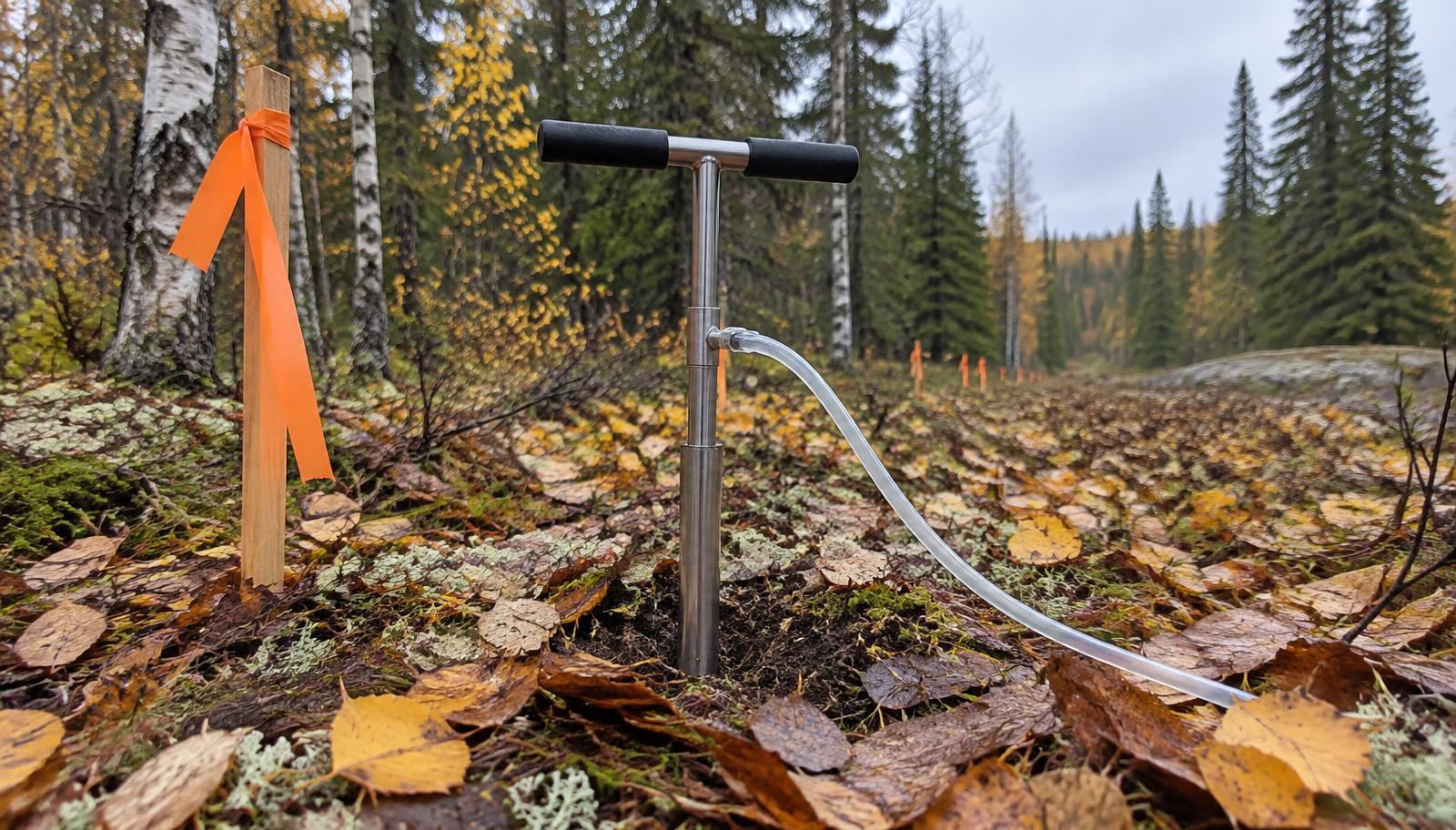
They go in at 100-metre spacing along about 80 line-kilometres, and this is the biggest piece of survey work the company has put into a single announcement. The kind of work it is needs stating exactly. A soil-gas station is a shallow probe that measures hydrogen in the soil above the rock. It tells an explorer where gas is escaping at surface. It does not tell anyone what is underneath.
Ontario is new ground, and the method is one Maple has been following since August
The four Maple pieces on this company before today were all about Bennett Hill, where QIMC has been drilling. The 30 August explainer separated hydrogen concentration from deliverability and placed Canadian results on a ladder of proof. The 26 August and 1 September pieces read DDH-26-05 as it went from a record concentration to free gas reaching surface under apparent pressure. On 14 September the desk set out the plainest version of the position: five holes, no flow test, and no reserve category in Canadian securities rules for natural hydrogen in the first place.
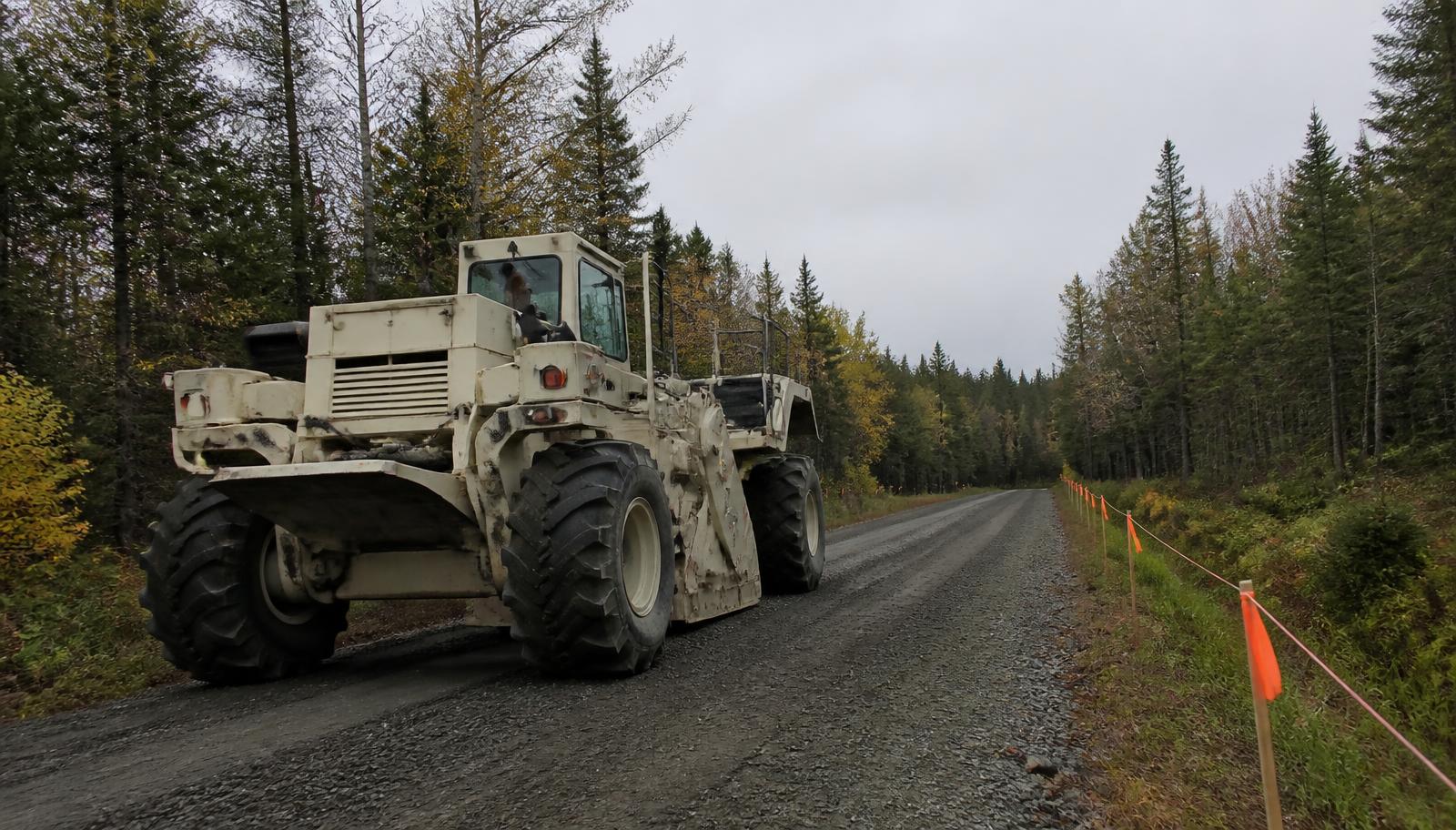
Today's announcement is not about that ground. It is district-scale surface work on the Ontario side of a rift structure that continues into Québec, and the seismic component runs across provinces: 78 line-kilometres of 2D Vibroseis in total, of which about 36 line-kilometres are in Témiscamingue, Québec, around Ville-Marie and St-Bruno-de-Guigues, with the balance in Nova Scotia.
The through-line is method rather than discovery. Since August the company has been publishing each stage of a systematic exploration sequence as it happens, and this is the stage where the surface screening is scaled up from eight lines to a district.
823 stations at 100 metres, and the eight lines that argued for them
The new work rests on soil-gas surveys QIMC ran in Ontario in 2025, and those numbers are the reason the expansion is defensible rather than speculative.
Phase 1, in July 2025, covered lines 1 to 4: 456 samples, of which 209 returned more than 500 parts per million hydrogen, with a peak of 2,458 ppm, a mean of 558 ppm and a median of 456 ppm. Phase 2, in October 2025, covered lines 5 to 8: 454 samples, 251 above 500 ppm, 116 above 1,000 ppm, 19 above 2,000 ppm, and a peak of 2,817 ppm. Across the eight lines that is 910 samples with 460 readings above 500 ppm. Phase 2 extended the anomalous zone about 11 kilometres northward over 45.3 line-kilometres, and the company now describes an anomalous area of roughly 260 square kilometres, 11.3 kilometres north to south by 23 kilometres east to west.
The comparison that gives those readings meaning is the regional one. QIMC cites median background hydrogen in soil across the Abitibi at 50 to 125 ppm. A Phase 1 median of 456 ppm is between four and nine times that background, sustained across hundreds of samples rather than appearing in a handful of them. Half the samples on those lines sat above a level that is several times regional normal.
That is a genuinely strong screening dataset by the standards of surface hydrogen exploration, and the response to it is the right one: tighter spacing over a larger area, with independent methods layered on top. The 2026 programme adds more than 1,100 gravimetric stations, which measure small variations in the pull of gravity to infer where denser and lighter rock sits and therefore where structures and basins are; district-wide mobile gamma-ray spectrometry; radon-thoron measurements; and an audiomagnetotelluric survey, which uses natural electromagnetic fields to image how well rock conducts electricity at depth. The scientific work is directed with Prof. Marc Richer-Laflèche, Ph.D., of the Institut national de la recherche scientifique. John Karagiannidis is President and Chief Executive Officer.
Taken together, a company that had eight lines of soil gas a year ago now has a programme with roughly 1,733 Ontario soil-gas stations over more than 125 line-kilometres, more than a thousand gravity readings, and seismic. That is a material improvement in the quality of its targeting, and the expansion is being funded rather than announced: market data shows C$14.84 million of cash against C$1.92 million of liabilities at June 30, 2026, the end of fiscal Q3 2026, which is a secondary feed rather than the filed statements.
The company wrote the boundary into its own release
The limit on all of it is not an outside criticism. It is in QIMC's own forward-looking statement, and it is unusually direct:
"Soil-gas, radon-thoron, gravimetric and gamma-ray spectrometric surveys are near-surface, indirect exploration techniques. Soil-gas hydrogen concentrations reported in parts per million are screening-level measurements of gas in shallow soil horizons; they do not measure, and cannot be used to infer, subsurface hydrogen concentration, gas saturation, formation pressure, flow rate, deliverability, recoverable volumes or commerciality."
That sentence covers every technique in the 2026 programme. An anomaly of 260 square kilometres is a map of where to drill. It carries no information about how much hydrogen is beneath it, at what pressure, or whether any of it would flow.
Maple's 14 September piece established the other half of the position and nothing since has changed it: QIMC has no flow test, and Canadian securities rules provide no reserve category for natural hydrogen, so there is no route by which soil gas becomes a booked quantity of anything. The 30 August explainer set out why concentration and deliverability are different measurements, and that distinction does not need making again. It simply applies here, in full, to every number in today's release.
So the accurate summary is two sentences that sit side by side. The evidence that a hydrogen-generating and hydrogen-venting system exists across a large part of the Ontario Témiscamingue has strengthened, and the programme announced today is the correct and reasonably expensive way to test where it concentrates. Nothing in it moves the company any closer to demonstrating that hydrogen can be produced.
The market gave it a cent
The shares closed at C$0.59 on the Canadian Securities Exchange on September 17, 2026, up one cent or 1.7 per cent, having traded between C$0.57 and C$0.60 with a volume-weighted average price of C$0.58. Total volume was 850,610 shares, split 435,675 on the exchange and 414,935 on alternative venues, against a 689,504-share 30-day average. The 52-week range is C$0.29 to C$2.37, and at 156.05 million shares the market value at the close was about C$92.1 million. Those figures are 15-minute delayed secondary market data read after the close and are not verified against SEDAR+ filings.
A 1.7 per cent move on 1.2 times average volume, for the biggest survey programme the company has announced, is a restrained response. There are two ordinary explanations and no way to choose between them from public information: either the market had already priced a programme expansion that had been signalled through a year of staged disclosure, or it correctly read a surface survey as a long way from the measurements that would change the company's valuation. The shares are at roughly a quarter of their 52-week high, which is consistent with either.
The security also carries a Frankfurt line, FSE 7FJ, and trades on the OTCQB as QIMCF, per the company's release boilerplate of September 17, 2026.
Five Maple pieces in three weeks on one small company is a lot, and the reason is that QIMC keeps publishing steps rather than conclusions. Today it published its largest step so far in the target-finding half of the work. Testing whether those targets hold anything has not started in Ontario, and the company has said as much in its own words.
Transparency note. This is an independent due-diligence analysis and editorial opinion piece produced by The Maple Markets editorial desk. It is not sponsored, promoted or commissioned, and no compensation of any kind has been received from Québec Innovative Materials Corp. (CSE: QIMC) or any party acting on their behalf. The analysis is based on public disclosure available as of the publish date; every figure is attributed to its primary source. The Maple Markets and its authors may hold positions in securities mentioned; nothing here is a recommendation to buy, sell or hold any security, and readers should not treat it as investment advice. Past disclosure does not guarantee future results. Policies: Editorial Standards · Financial Disclaimer.
Read next
Auch auf Deutsch: QIMC bringt 823 neue Bodengas-Stationen nach Ontario, der fünfte Schritt einer öffentlich aufgebauten Methode
 Mining and ResourcesQIMC Buys the Picture: Seismic Contractors Engaged for 42 Kilometres at Bennett HillQuebec Innovative Materials Corp. (CSE: QIMC, FSE: 7FJ) engaged Echo Seismic and Strum Consulting on September 14, 2026 for 42 line-kilometres of 2D seismic across Bennett Hill and Apple River in Nova Scotia, the larger half of a 78-kilometre campaign and the biggest geophysical programme it has funded. It follows five drill holes that measured up to 30.0 per cent hydrogen at two centres about fifteen kilometres apart. The structural picture arrives this autumn; a flow test, the step that would settle deliverability, has still not been announced.Priya Sandhu · September 14, 2026 · 9 min
 EnergyThe Pressure Event Is the Result: Reading QIMC's 30.0% Hydrogen Update at Bennett HillQuébec Innovative Materials Corp. (CSE: QIMC) reported a record 30.0% H2 field reading at 413 metres in DDH-26-05 — then reported free gas reaching surface under apparent pressure between 413 and 416 metres, triggering repeated hydrogen alarms and halting the hole. Evidence for a mobile hydrogen-bearing system has strengthened. Evidence for reservoir performance has not. Benchmarked against MAX Power's completed-interval flow test at Lawson.Daniel Okoye · September 1, 2026 · 11 min
 EnergyThe Number Is Not the Discovery: How to Read a Natural-Hydrogen ResultQIMC reported 27.8% hydrogen at Bennett Hill; MAX Power reported 28.6% at Lawson. The headline percentages look interchangeable. The measurements behind them are at different stages of proof.Marc Belzile · August 30, 2026 · 9 min
Follow this story
Follow QIMC.CN — the next Maple piece on this company, plus the Maple Morning Debrief before the open.
Follow and ask
Get more of our Canadian market coverage in Google Top Stories.
Opinion
This article expresses the author's personal views, is separate from news reporting and is not investment advice.
Disclosure
**Transparency note.** This is an independent due-diligence analysis and editorial opinion piece produced by The Maple Markets editorial desk. It is not sponsored, promoted or commissioned, and no compensation of any kind has been received from Québec Innovative Materials Corp. (CSE: QIMC) or any party acting on their behalf. The analysis is based on public disclosure available as of the publish date; every figure is attributed to its primary source. The Maple Markets and its authors may hold positions in securities mentioned; nothing here is a recommendation to buy, sell or hold any security, and readers should not treat it as investment advice. Past disclosure does not guarantee future results. Policies: [Editorial Standards](https://themaplemarkets.ca/en/policies/editorial-standards) · [Financial Disclaimer](https://themaplemarkets.ca/en/policies/financial-disclaimer). See the Financial Disclaimer.
Sources and references (5)
- QIMC Launches Expanded 2026 Ontario Natural Hydrogen Program in the Témiscamingue Graben, September 17, 2026
- Québec Innovative Materials Corp. news archive
- SEDAR+ continuous disclosure filings
- The Maple Markets, September 14, 2026: Five Holes, No Flow Test
- The Maple Markets, August 30, 2026: concentration versus deliverability
Cite this analysis
Please attribute The Maple Markets and link to the original page.
Priya Sandhu (September 17, 2026). QIMC Takes 823 New Soil-Gas Stations Into Ontario, the Fifth Step in a Method Built in Public. The Maple Markets. https://themaplemarkets.ca/en/newsroom/quebec-innovative-materials-823-stations-across-the-temiscaminguehttps://themaplemarkets.ca/en/newsroom/quebec-innovative-materials-823-stations-across-the-temiscamingue