
QIMC Buys the Picture: Seismic Contractors Engaged for 42 Kilometres at Bennett Hill
Hydrogen at two drilling centres fifteen kilometres apart, five holes of control, and now the largest geophysical campaign the company has funded, under contract.
Quebec Innovative Materials Corp. (CSE: QIMC, FSE: 7FJ) engaged Echo Seismic and Strum Consulting on September 14, 2026 for 42 line-kilometres of 2D seismic across Bennett Hill and Apple River in Nova Scotia, the larger half of a 78-kilometre campaign and the biggest geophysical programme it has funded. It follows five drill holes that measured up to 30.0 per cent hydrogen at two centres about fifteen kilometres apart. The structural picture arrives this autumn; a flow test, the step that would settle deliverability, has still not been announced.
By Priya Sandhu8 min read
Seismic under contract
42 line-km, nine lines
Nova Scotia portion of the 78 line-km campaign; Echo Seismic and Strum Consulting engaged September 14, 2026; acquisition planned for autumn 2026
Hydrogen measured at two centres
up to 30.0 per cent H2 at 413 m
DDH-26-05, Bennett Hill, reported September 1, 2026; IsoJar headspace sample read on a portable analyser; DDH-26-04 gave 24.3 per cent at 707 m, about 15 km away
Geological control behind the survey
5 drill holes, about 6,000 soil-gas samples
plus ground magnetics and structural mapping; the seismic interpretation is calibrated against these
Cash
about C$14.84M
as at June 30, 2026, from market data services rather than a filed statement; no debt; funds this campaign and the next drill phase, not a decade
Flow rate, formation pressure, recoverable volume
none measured or reported
the company states as much as of September 14, 2026; natural hydrogen has no NI 43-101 or NI 51-101 category in Canada
Every time we have written about Québec Innovative Materials Corp. (CSE: QIMC, OTCQB: QIMCF, FSE: 7FJ) this summer, the company has answered with work rather than with adjectives. In August it reported a company-record hydrogen reading in DDH-26-05. On September 1 it reported free gas reaching surface under apparent pressure in the same hole, which was the most interesting thing it had disclosed all year.
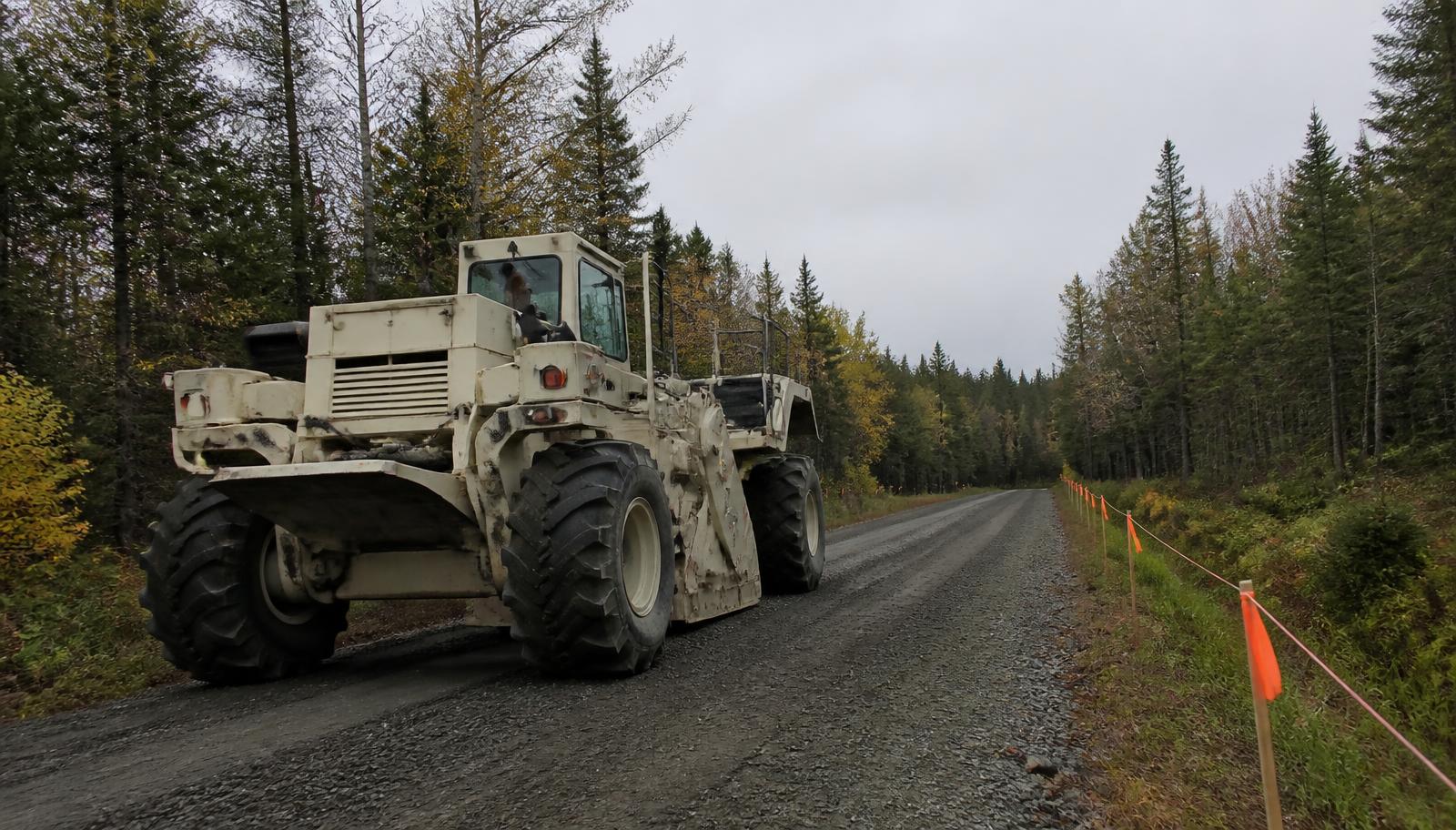
On September 14, 2026 it took the next step in that sequence. QIMC engaged Echo Seismic Ltd. of Calgary as seismic contractor and Strum Consulting of Halifax for health, safety and environmental oversight, to shoot approximately 42 line-kilometres of 2D seismic across the Bennett Hill and Apple River corridor in Nova Scotia. Nine lines across five target areas, an INOVA Quantum nodal recording system running roughly 1,400 channels, 5-Hz geophones at 25-metre spacing, and vibrator trucks working from existing roads. Acquisition is planned for this autumn.
Contractors signed is a different thing from a programme announced. On September 8 the company said it intended to shoot 78 line-kilometres across Québec and Nova Scotia. Six days later the crews, the equipment and the local oversight for the larger half of that campaign are named. That is the largest geophysical campaign QIMC has funded, and it is now under contract.
What the past three months established
Seismic reflection surveying sends a controlled sound pulse into the ground and times the echoes coming back off the boundaries between rock layers. The result is a picture of structure: where faults run, where the basement contact sits, where a porous rock might be trapped beneath something that will not let gas through.
That picture is only useful if you already have something to tie it to, and QIMC now does. Across five drill holes it has measured hydrogen at two centres about fifteen kilometres apart: 24.3 per cent at 707 metres in DDH-26-04, reported July 20, 2026, then 23.5 per cent at 170 metres, 27.8 per cent at 374 metres and 30.0 per cent at 413 metres in DDH-26-05, reported through August and on September 1. Behind the holes sit roughly 6,000 soil-gas samples, ground magnetics and structural mapping.
Those readings are IsoJar headspace samples, meaning gas liberated from the drilling returns is sealed in a jar and the air above it is read on a portable analyser at the rig. As we set out in an earlier piece on how to read a hydrogen number, a concentration is not a flow rate. What it is, though, is hard geological control, and five holes of it is more than most people exploring for natural hydrogen anywhere in the world currently hold.
The sequence is the argument
The Bennett Hill and Apple River district had no legacy oil and gas wells and no seismic shot with hydrogen in mind, so QIMC had to build its subsurface picture from the surface down. It did it in a defensible order: regional interpretation using its R2G2 framework, then district-scale soil-gas geochemistry, then ground magnetics and mapping, then validation drilling, and now district-scale seismic, with characterization drilling, pressure testing and flow testing set out as what follows.
Plenty of juniors buy the imaging first, because a seismic line makes a better slide than a soil survey. Drilling before imaging costs more and risks an empty hole in public. QIMC took that risk and got hydrogen at both centres, which means the seismic it is now paying for will be calibrated against real intersections rather than interpreted in a vacuum. Chief executive John Karagiannidis put the logic plainly in the release: the company drilled first to find out whether hydrogen was present at depth, and seismic is the step that connects what it found.
The survey design follows from that. The nine lines are positioned to test the relationship between the drill holes, the surface hydrogen and helium anomalies, the interpreted faults and shear zones, the basement contacts and the regional Cobequid structures. Helium matters here as a tracer: it travels along the same structural pathways, so an anomaly in one can point at plumbing for the other.
A low-impact programme is a fast programme
The nodal system records without cables, and the vibrator trucks work from roads that already exist. That means no line cutting, no shot holes, no explosives, no hydraulic fracturing and no stimulation of any kind. For a company working in rural Nova Scotia, a survey that leaves the landowner's woodlot alone is not a detail. It shortens the permitting conversation, it lowers the odds of a weather or access delay, and Strum's Halifax base puts the community and environmental side of the job in local hands rather than in a contractor flying in.
Where this sits against the rest of the field
Natural hydrogen is followed closely in Germany, France and Spain, and several of those programmes are behind this one rather than ahead of it.
| Programme | Furthest stage reached | Date |
|---|---|---|
| Hydroma, Bourakebougou, Mali | Commercial production, about 1,500 m³/day | Producing since 2012 |
| HyTerra, Hoarty NE3, Nebraska | Concentration measured, swab test flared | Drilled 2023 |
| QIMC, Bennett Hill, Nova Scotia | Concentration at two centres, district seismic under contract | 2026 |
| Helios Aragón, Monzón, Spain | Historic gas show, no modern well | Well drilled 1963 |
| 45-8 Energy, Grand Rieu, France | Licence held, desk studies, no well | Granted March 2025 |
| Mantle8, Comminges, France | Licence held, pre-drilling | Awarded April 2026 |
In France, 45-8 Energy's Grand Rieu licence, granted in March 2025 over 266 square kilometres, is still at the stage of geological studies and light geophysics with no well drilled; its Fonts-Bouillants pilot in the Nièvre produces helium-rich gas rather than hydrogen. In Spain, Helios Aragón's Monzón project rests on a well drilled in 1963 and abandoned, with a second well discussed for years and not yet drilled. Germany, which is talked about most, has no verifiable public count of natural-hydrogen exploration permits at all.
The benchmark remains Bourakebougou in Mali, operated by the Montreal-based private company Hydroma, the only place natural hydrogen has been sold commercially. Gas there is about 98 per cent hydrogen and has supplied village electricity since 2012 at roughly 1,500 cubic metres a day, and peer-reviewed work published in 2023 reported that wellhead pressure rose slightly over eleven years of production rather than declining. That is the encouraging half of the benchmark: these systems can be recharged rather than depleted. The sobering half is scale, because 1,500 cubic metres a day powers a village.
Measured against that field, QIMC has drilled where most licence-holders have not, and it is now buying the structural picture that none of them have published either.
What the money says
QIMC closed a bought-deal financing on April 27, 2026 for gross proceeds of C$17,250,345, selling 19,167,050 units at C$0.90, each with a warrant exercisable at C$1.30 to April 27, 2029. A bought deal means the underwriter buys the whole offering itself and then resells it, so the company gets its money whether or not the book fills. Research Capital Corporation was sole bookrunner.
As at June 30, 2026 the most recently reported cash was about C$14.84 million against total liabilities near C$1.92 million, with no debt. Those figures come from market data services rather than from a statement read directly, because QIMC's investor page posts no financial statements and directs enquiries to SEDAR+, which was not readable when this was written. On roughly 156 million shares, that balance pays for this seismic campaign and the next phase of drilling without an immediate return to the market. It does not pay for a decade.
The shares closed at C$0.59 on the CSE on September 14, 2026, up five cents or 9.3 per cent, on 729,988 shares against a 30-day average near 659,500, which is ordinary turnover rather than a volume event. Market value was about C$92.1 million, per QuoteMedia data read after the close, against a 52-week range of C$0.29 to C$2.37. In Frankfurt the same shares trade as 7FJ, WKN A3D2JV, ISIN CA7480331072, per Deutsche Börse.
What still has to happen
The bounds have not moved, and QIMC states them itself at the bottom of every release. Natural hydrogen falls between Canada's two disclosure codes: it is not a mineral, so National Instrument 43-101 offers no category for it, and the company has not brought this work under National Instrument 51-101 either, so there is no reserve, no resource and no independent evaluator's report to lean on. Québec's Bill 17, adopted June 15, 2026, is a licensing regime and not a disclosure standard. Seismic will image the structures; it cannot measure hydrogen concentration, sustained flow, formation pressure or recoverable volume. Only a completed well test does that, and none has been announced.
What has changed is the odds of getting to that test with the right hole in the right place. A company with hydrogen at two centres fifteen kilometres apart, five holes of calibration, about C$14.8 million in the bank and contractors under engagement for its largest survey to date is executing the sequence in the order a serious operator would. The structural picture arrives this autumn, and pressure and flow testing is the step QIMC has named as coming after it.
Seismic maps the trap. The flow test proves the tenant, and QIMC has just bought the map it needs to know where to drill for it.
Transparency note. This is an independent due-diligence analysis and editorial opinion piece produced by The Maple Markets editorial desk. It is not sponsored, promoted or commissioned, and no compensation of any kind has been received from Quebec Innovative Materials Corp. (CSE: QIMC), Hydroma Inc., 45-8 Energy SAS, Helios Aragón, Mantle8, HyTerra Ltd. or any party acting on their behalf. The analysis is based on public disclosure available as of the publish date; every figure is attributed to its primary source. The Maple Markets and its authors may hold positions in securities mentioned; nothing here is a recommendation to buy, sell or hold any security, and readers should not treat it as investment advice. Past disclosure does not guarantee future results. Policies: Editorial Standards · Financial Disclaimer.
Read next
Auch auf Deutsch: QIMC kauft das Bild: Seismik-Dienstleister für 42 Kilometer bei Bennett Hill beauftragt
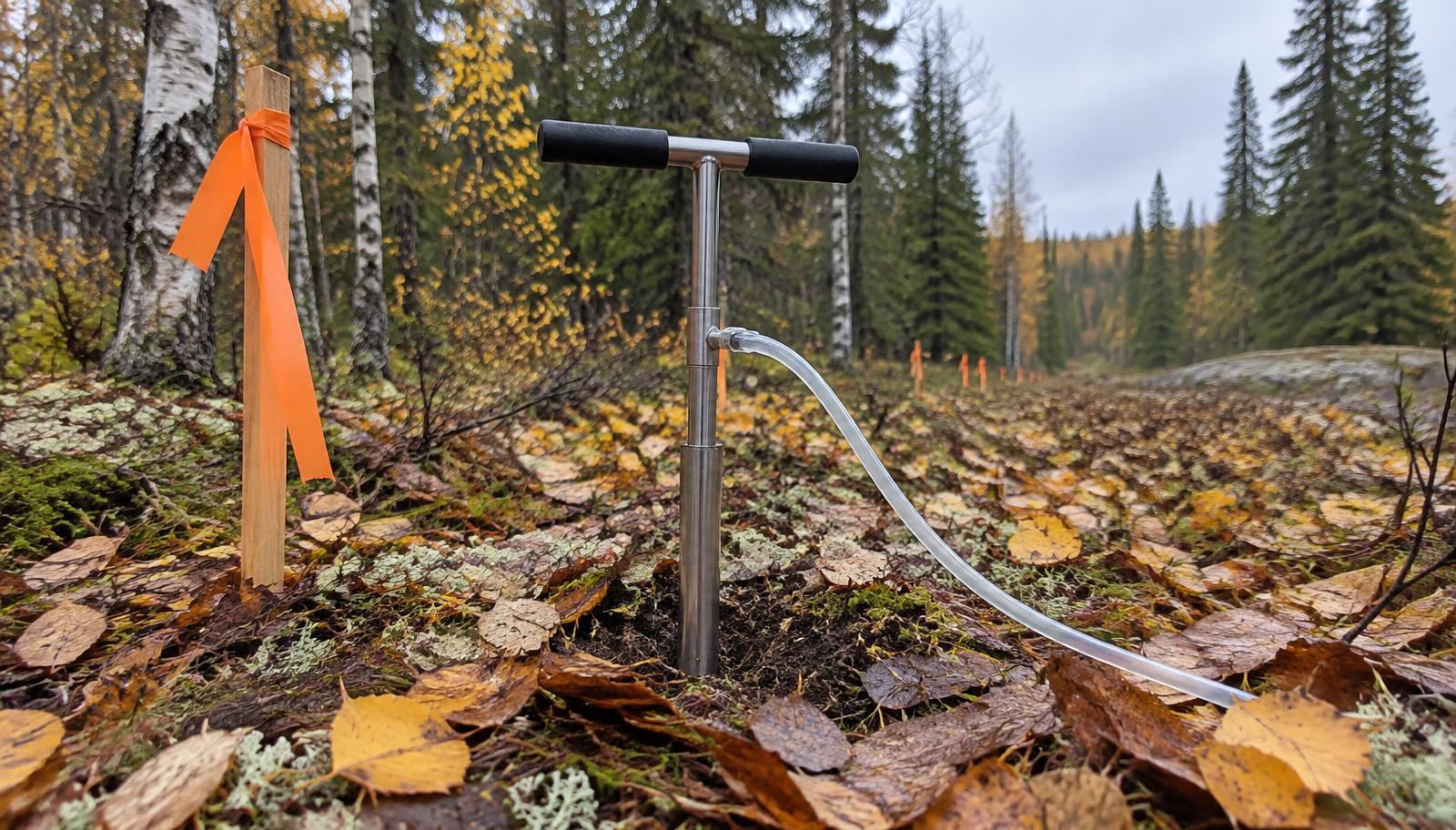 Mining and ResourcesQIMC Takes 823 New Soil-Gas Stations Into Ontario, the Fifth Step in a Method Built in PublicQuébec Innovative Materials Corp. (CSE: QIMC) launched an expanded 2026 natural hydrogen programme on the Ontario side of the Témiscamingue Graben on September 17, 2026: 823 new soil-gas stations at 100-metre spacing over about 80 line-kilometres, taking the Ontario database to roughly 1,733 stations, alongside more than 1,100 gravimetric stations and 78 line-kilometres of 2D seismic. The shares closed at C$0.59. The company's own disclosure says none of this measures flow.Priya Sandhu · September 17, 2026 · 7 min
 EnergyThe Pressure Event Is the Result: Reading QIMC's 30.0% Hydrogen Update at Bennett HillQuébec Innovative Materials Corp. (CSE: QIMC) reported a record 30.0% H2 field reading at 413 metres in DDH-26-05 — then reported free gas reaching surface under apparent pressure between 413 and 416 metres, triggering repeated hydrogen alarms and halting the hole. Evidence for a mobile hydrogen-bearing system has strengthened. Evidence for reservoir performance has not. Benchmarked against MAX Power's completed-interval flow test at Lawson.Daniel Okoye · September 1, 2026 · 11 min
 EnergyThe Number Is Not the Discovery: How to Read a Natural-Hydrogen ResultQIMC reported 27.8% hydrogen at Bennett Hill; MAX Power reported 28.6% at Lawson. The headline percentages look interchangeable. The measurements behind them are at different stages of proof.Marc Belzile · August 30, 2026 · 9 min
Follow this story
Follow QIMC.CN — the next Maple piece on this company, plus the Maple Morning Debrief before the open.
Follow and ask
Get more of our Canadian market coverage in Google Top Stories.
Opinion
This article expresses the author's personal views, is separate from news reporting and is not investment advice.
Disclosure
**Transparency note.** This is an independent due-diligence analysis and editorial opinion piece produced by The Maple Markets editorial desk. It is not sponsored, promoted or commissioned, and no compensation of any kind has been received from Quebec Innovative Materials Corp. (CSE: QIMC), Hydroma Inc., 45-8 Energy SAS, Helios Aragón, Mantle8, HyTerra Ltd. or any party acting on their behalf. The analysis is based on public disclosure available as of the publish date; every figure is attributed to its primary source. The Maple Markets and its authors may hold positions in securities mentioned; nothing here is a recommendation to buy, sell or hold any security, and readers should not treat it as investment advice. Past disclosure does not guarantee future results. Policies: [Editorial Standards](https://themaplemarkets.ca/en/policies/editorial-standards) · [Financial Disclaimer](https://themaplemarkets.ca/en/policies/financial-disclaimer). See the Financial Disclaimer.
Sources and references (10)
- QIMC: Echo Seismic and Strum Consulting engaged for a 42-kilometre Nova Scotia 2D seismic programme, September 14, 2026
- QIMC: 78-kilometre 2D seismic campaign across Quebec and Nova Scotia, September 8, 2026
- QIMC: record 30.0 per cent hydrogen at 413 metres, DDH-26-05, September 1, 2026
- QIMC: 24.3 per cent hydrogen in DDH-26-04 and pilot-scale evaluation, July 20, 2026
- QIMC: closing of the C$17.25 million bought deal offering, April 27, 2026
- Scientific Reports: reservoir characterisation of the Bourakebougou hydrogen accumulation, Mali, 2023
- 45-8 Energy: Fonts-Bouillants licence and pilot unit
- 45-8 Energy: Grand Rieu natural hydrogen exploration licence
- Helios Aragón: Monzón natural hydrogen project
- Deutsche Börse: Quebec Innovative Materials Corp., WKN A3D2JV, ISIN CA7480331072
Cite this analysis
Please attribute The Maple Markets and link to the original page.
Priya Sandhu (September 14, 2026). QIMC Buys the Picture: Seismic Contractors Engaged for 42 Kilometres at Bennett Hill. The Maple Markets. https://themaplemarkets.ca/en/newsroom/quebec-innovative-materials-natural-hydrogen-has-no-reserve-categoryhttps://themaplemarkets.ca/en/newsroom/quebec-innovative-materials-natural-hydrogen-has-no-reserve-category