
QIMC Completes a 63.7-Kilometre Seismic Survey in Nova Scotia
The crew finished ahead of plan, the data is already with a Calgary processor, and the ground has already shown free gas at surface.
Quebec Innovative Materials Corp. (CSE: QIMC) said on 14 October 2026 that it had finished acquiring 63.7 line-kilometres of 2D seismic across its Cumberland County ground in Nova Scotia, 13.7 kilometres more than planned, and the data is already with a Calgary processor. The programme was delivered ahead of plan on ground where free gas has already reached surface once, with a treasury of about C$14.84 million against liabilities of about C$1.92 million.
By Élise Galarneau7 min read
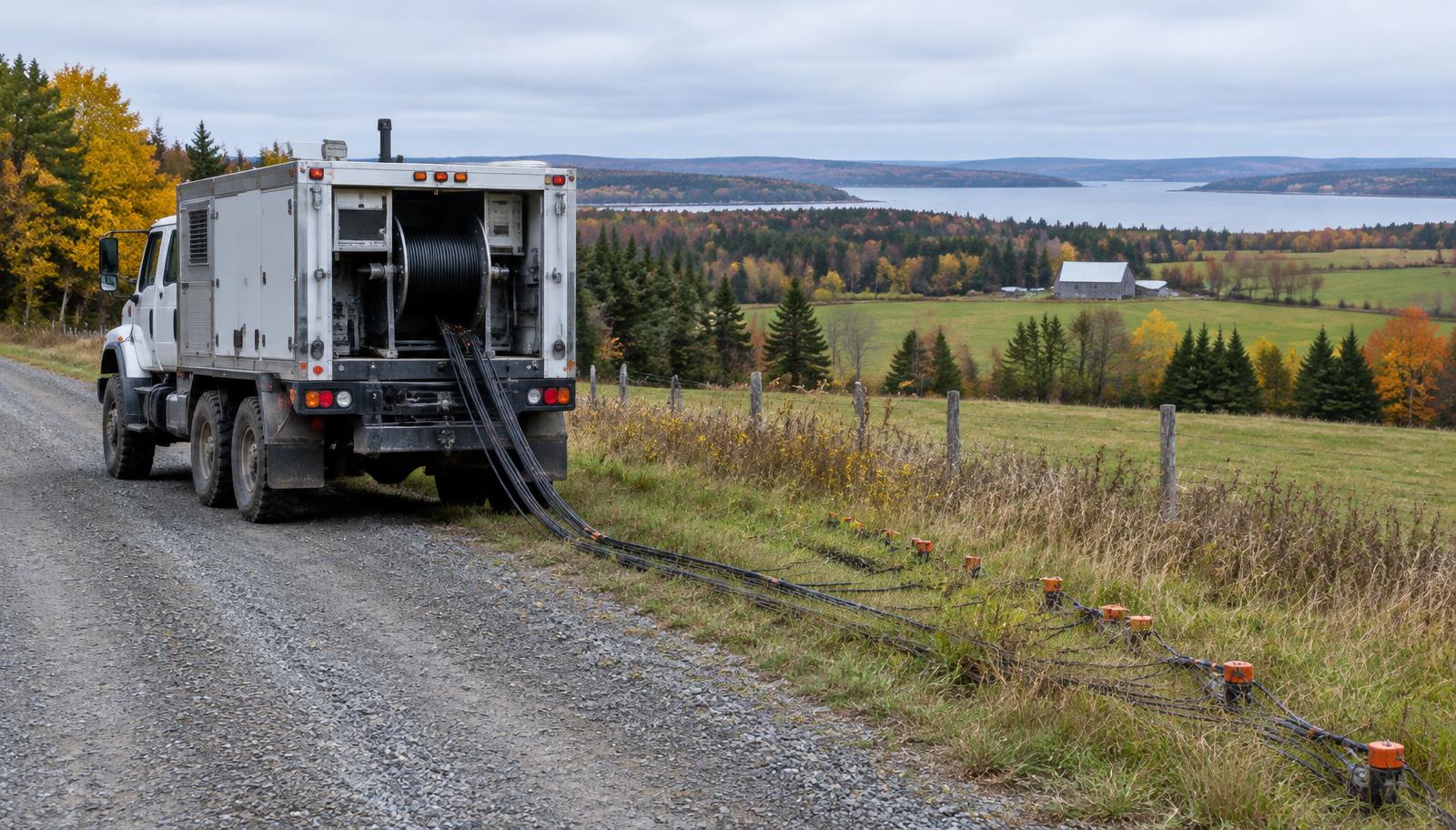
Seismic acquired
63.7 line-kilometres
2D programme in Cumberland County, Nova Scotia, completed per the company's release of 2026-10-14; planned at 50 km and expanded by 13.7 km.
Mineral resource
none
QIMC claims no mineral resource or reserve on its Nova Scotia ground in the release of 2026-10-14.
Share price
C$0.385, down 11.5%
close on 2026-10-14 on total volume of about 2.88 million shares against an average near 558,166; 15-minute delayed market data read after the close, secondary market data, not verified against SEDAR+.
Market value
about C$60.08 million
on about 156.05 million shares outstanding, per market data read after the close on 2026-10-14.
Frankfurt listing
FSE 7FJ, WKN A3D2JV, ISIN CA7480331072
per Deutsche Börse's venue page for the security and the company's own release boilerplate, 2026-10-14; bid EUR 0.237 against ask EUR 0.254 on Börse Stuttgart the same day.
A seismic crew spends its days laying cable along country roads, thumping energy into the ground and recording what comes back. Quebec Innovative Materials Corp. (CSE: QIMC) said on 14 October 2026 that its crew had finished that work in Cumberland County, Nova Scotia, after recording 63.7 line-kilometres across the Apple River, Advocate, Bennett Hill and Port Greville ground.
The programme was planned at 50 kilometres. It grew by 13.7 kilometres because, the company said, new target areas were identified while the crew was in the field. Field acquisition is complete, and the recordings have already gone to Earth Signal Processing Ltd. in Calgary, where processing is under way.
Recording the ground and reading it are two different jobs
A 2D seismic survey sends sound into the earth along a line and times the echoes coming back off the boundaries between rock layers. Processed well, it produces a cross-section: where the layers sit, where they are broken by faults, where a structure might hold gas. Raw field recordings do not look like that. They become a picture only after a processor removes noise and lines the echoes up, which is the step now under way.
The company is unusually clear about what that step can and cannot show. In its 1 October release engaging Earth Signal, QIMC stated that seismic processing does not measure hydrogen or helium concentrations, formation pressure, sustained flow, reservoir deliverability or recoverable volumes, and that further drilling and subsurface testing would be required. Management writing its own limits that plainly is rare in junior exploration, and it makes the rest of the disclosure easier to trust.
What 14 October 2026 establishes is coverage: a single continuous 2D grid over four named target areas in one field season, 27 per cent larger than the programme it set out to shoot, with the recordings already in the hands of a processor rather than waiting for one to be hired. For an explorer at this stage, that is the work delivered on time, on the ground it said it would cover, and ahead of its own plan.
The programme grew in four steps over five weeks
The scale of the survey moved quickly, and the sequence is on the public record.
On 8 September QIMC announced a 78-kilometre 2D campaign across its Quebec and Nova Scotia ground. On 14 September it engaged Echo Seismic Ltd. and Strum Consulting for a 42-kilometre Nova Scotia programme. On 22 September it said it had identified three fault-controlled helium zones at New Salem-Apple River and was expanding the Nova Scotia survey to roughly 50 line-kilometres. On 1 October it engaged Earth Signal to process the data. On 14 October it reported 63.7 kilometres acquired.
Each step was a decision to spend more on the same ground, and each was announced before the money was spent rather than after. For a company with no revenue, that sequence is a real signal about where management believes the targets are, and management kept adding ground as the results came in.
What the dataset contains
QIMC listed what it has gathered in Nova Scotia: more than 10,000 soil-gas samples, more than 3,500 metres of drill core, and gravity, airborne and ground magnetic and radon-thoron surveys. The company says it believes this is the most complete natural hydrogen exploration dataset in Canada. That is the company's own assessment, not an independent one, and no third party is cited for it, but the inventory behind it is long and still growing.
Two things have been measured rather than inferred, and they are the reason the ground is being shot at all. QIMC reported on 6 October 2026 that 86 per cent of soil-gas samples at New Salem-Apple River carried a thermogenic wet-gas signature, a chemical fingerprint showing gas generated at depth rather than near surface. And on 1 September 2026 it reported free gas reaching surface under apparent pressure in DDH-26-05 at Bennett Hill, an event the drill crew's alarms recorded. Gas is present, and some of it is mobile. Those two measurements are real, they are the company's own, and they are an improvement on where the project stood a year ago.
What remains ahead is equally clear. QIMC has no mineral resource and no reserve on its Nova Scotia ground yet, and the 14 October release claims none; it refers to hot zones and targets, the company's words for areas it wants to test. No measured formation pressure or sustained flow rate has been published from any hole. Drill hole DDH-26-05, where free gas reached surface in September, is tied to the Bennett Hill seismic line and is the subject of continued testing, which is exactly the test that comes next.
The money that carries the programme
Exploration of this kind is paid for out of the treasury, because there are no sales to pay for it. Market data read after the close on 14 October 2026 showed QIMC with about 156.05 million shares outstanding and a market value near C$60.08 million at C$0.385 a share.
The same data source carries cash and equivalents of about C$14.84 million against total liabilities of about C$1.92 million from the company's most recent filed financial statements; these are secondary market data figures and were not checked against the interim statements for the period ended 30 June 2026, which QIMC filed on SEDAR+ on 2026-08-26. Cash of nearly eight times liabilities is a comfortable position for a junior explorer, and what it buys is a question of pace rather than survival: processing 63.7 kilometres, mobilising the crew to Quebec and then Ontario, and continuing to test DDH-26-05 are three programmes running at once on one balance sheet.
Four things said about QIMC on Tuesday, and what the documents show
The discussion around the stock on Tuesday was loud and mostly about the share price, which closed at C$0.385, down 11.5 per cent on the day on total volume of about 2.88 million shares against an average near 558,166, per market data read after the close. Four claims circulated widely enough to be worth checking against documents, and the documents are on the company's side.
The first is that naked short selling is driving the price and is missing from the biweekly short report. The reported short position is 565,456 shares, about 0.4 per cent of shares outstanding, on the same market data. No filing, bulletin or exchange notice supports a claim of naked short selling.
The second is that the company is buying back stock. QIMC has announced no normal course issuer bid in any release, and none appears in its filings.
The third is that insiders are barred from buying because results from a drill hole are material unreleased information. QIMC has not published a trading-blackout notice, and insider trades, when they happen, are reported on SEDI.
The fourth is arithmetic. The shares reached C$2.37 in the past 52 weeks and closed at C$0.385, a fall of C$1.985, or 83.8 per cent, with a 52-week low of C$0.29. The decline is real, and it is also why a programme delivered ahead of plan, on ground where gas has already reached surface, trades at a market value not far above its cash.
The German line, and what it costs to use
QIMC trades in Frankfurt under the symbol 7FJ, WKN A3D2JV, ISIN CA7480331072, a listing the company carries in the boilerplate of its own releases and which appears on Deutsche Börse's venue page for the security. A holder buying there on 14 October faced a bid of EUR 0.237 against an ask of EUR 0.254 on Börse Stuttgart's open-market segment, a spread of about 7.2 per cent. The Canadian line traded 2.88 million shares the same day. The German listing is a route to the same security; it is a narrower one, and the price a buyer pays for the convenience is visible in that spread.
What has actually been added
The total of 14 October is this: QIMC has more data than it had in September, gathered over more ground than it planned, on a property where free gas has already reached surface once. That is a reasonable use of exploration money, and the execution has been better than the share price suggests. The processed sections, when they arrive, will show structures, and structures are places to drill. A drill hole that holds pressure and flows gas at a measured rate is the result that would move this project from a geochemical story to an energy one, and the survey just completed is the map that tells the company where to drill it.
The lines are shot; the pictures are being developed.
Transparency note. This is an independent due-diligence analysis and editorial opinion piece produced by The Maple Markets editorial desk. It is not sponsored, promoted or commissioned, and no compensation of any kind has been received from Quebec Innovative Materials Corp. (CSE: QIMC) or any party acting on their behalf. The analysis is based on public disclosure available as of the publish date; every figure is attributed to its primary source. The Maple Markets and its authors may hold positions in securities mentioned; nothing here is a recommendation to buy, sell or hold any security, and readers should not treat it as investment advice. Past disclosure does not guarantee future results. Policies: Editorial Standards · Financial Disclaimer.
Read next
Auch auf Deutsch: QIMC schliesst seismisches Programm über 63.7 Kilometer in Nova Scotia ab
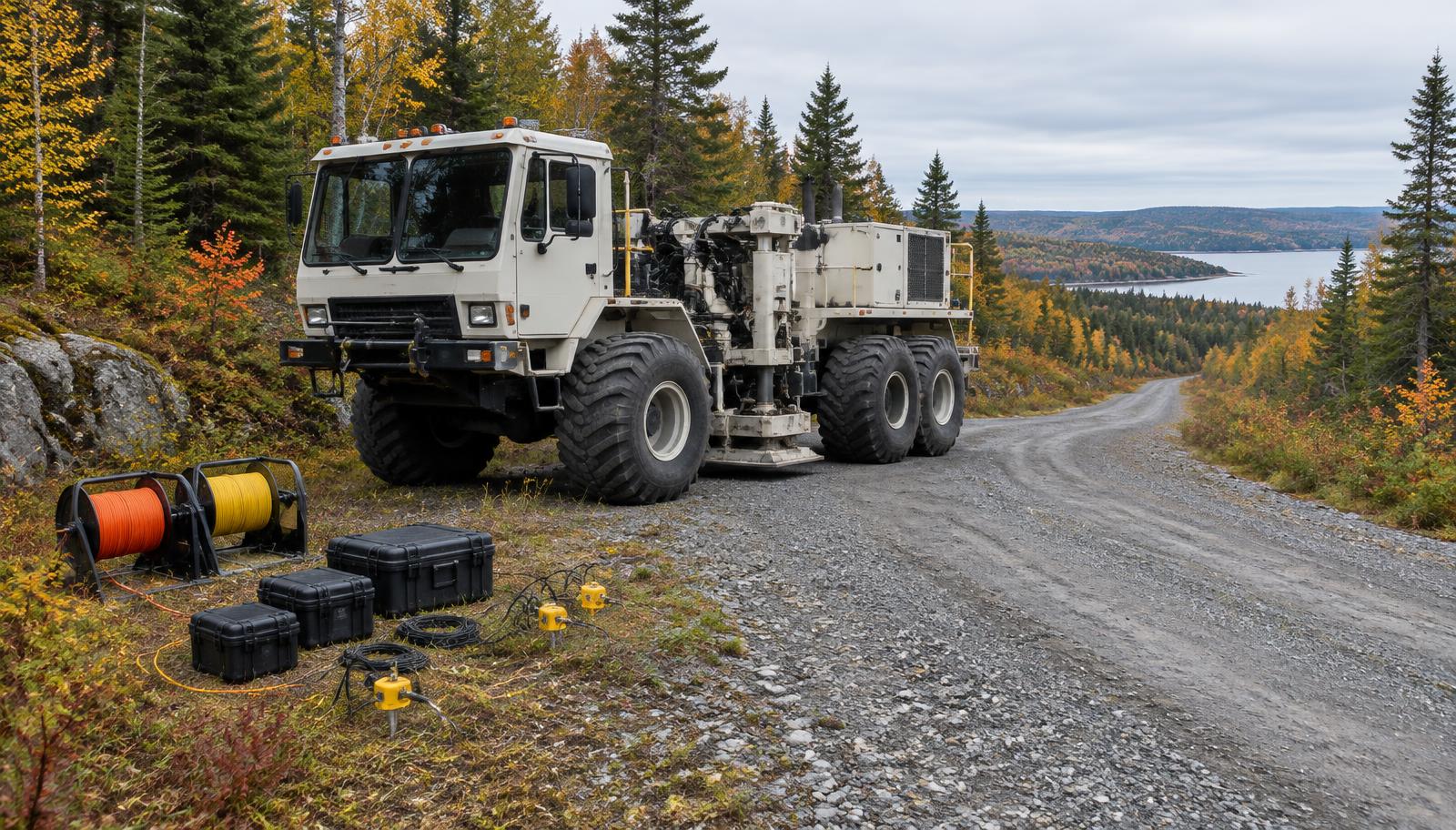 Mining and ResourcesQIMC Hires a Calgary Firm to Process 50 Kilometres of SeismicQuebec Innovative Materials Corp. (CSE: QIMC) engaged Calgary’s Earth Signal Processing Ltd. on October 1, 2026 to process about 50 line-kilometres of two-dimensional seismic from Apple River and Bennett Hill, Nova Scotia. The appointment adds experienced processing support to a better-defined hydrogen and helium exploration programme. The images can help focus drilling targets, while pressure and flow measurements remain later steps with no announced date.Daniel Okoye · October 2, 2026 · 7 min
 Mining and ResourcesUnder QIMC's Helium Zones: A Magnetic Body 10 Kilometres LongQuébec Innovative Materials Corp. reported on 28 September 2026 that its 526-sample soil-gas helium survey at New Salem-Apple River in Nova Scotia, regional gravity data and aeromagnetic data all describe a single fault-bounded structure, with a magnetic body about 10 kilometres by 2 kilometres beneath two of the helium zones. The work is a reinterpretation of data the company already held. It reports no flow rate, no gas purity and no resource, and the shares closed down 3.6 per cent at C$0.54.Élise Galarneau · September 28, 2026 · 6 min
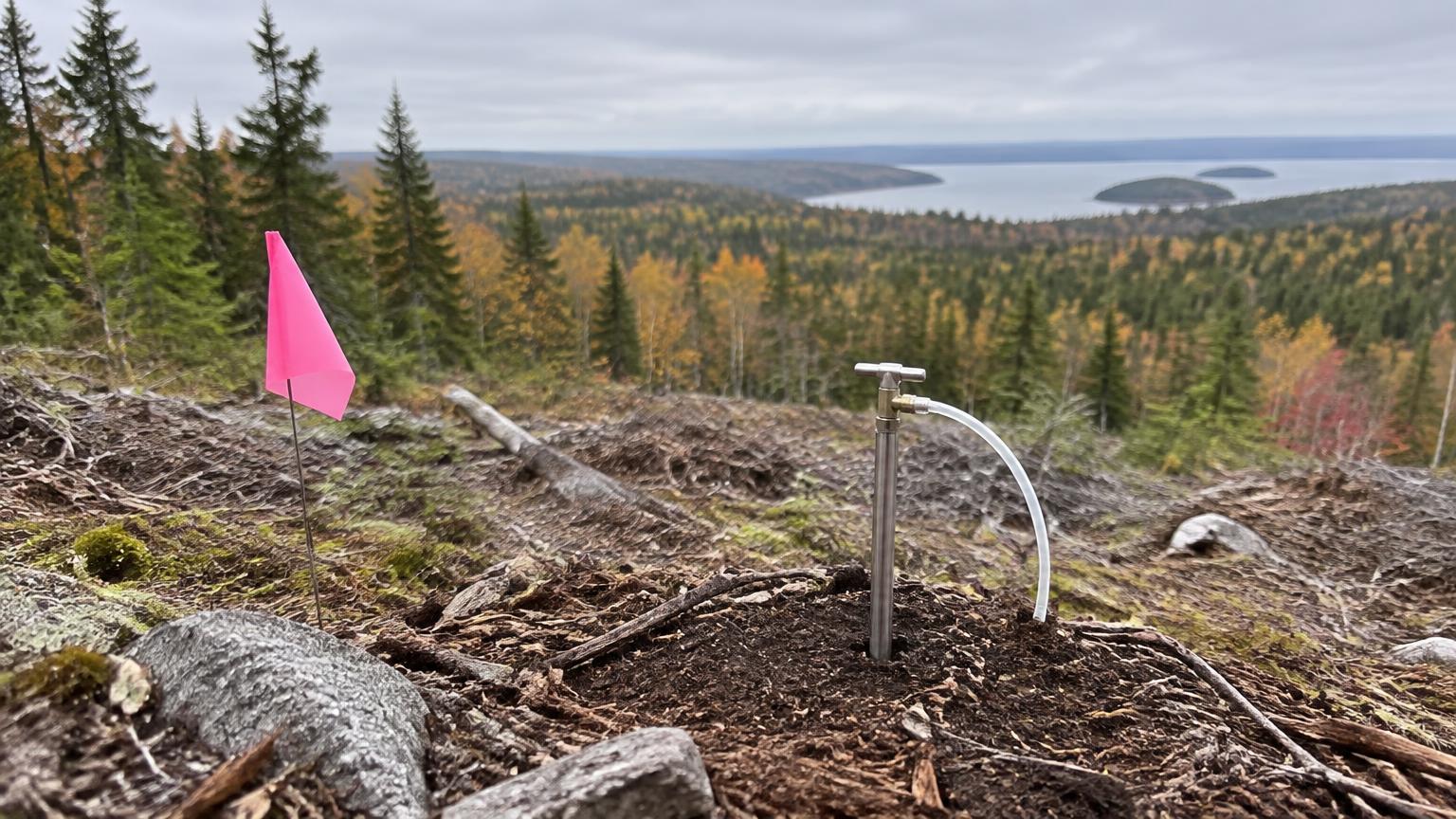 Mining and ResourcesFive Times More Helium Anomalies Near a Fault: QIMC's 526-Sample Survey in Nova ScotiaQuébec Innovative Materials Corp. (CSE: QIMC) reported on September 22, 2026 that a 526-sample helium soil-gas survey across 28 lines at New Salem-Apple River, Nova Scotia, identified fault-associated helium zones, with a peak of 5.864 parts per million by volume against a district background of 5.40 ppmv. The survey's load-bearing number is not the peak. It is the finding that anomalous stations occur roughly five times more often within 1.5 kilometres of a mapped fault than beyond two kilometres, which is why the 2D seismic programme grew from 42 to about 50 line-kilometres.Priya Sandhu · September 23, 2026 · 8 min
Follow this story
Follow QIMC.CN — the next Maple piece on this company, plus the Maple Morning Debrief before the open.
Follow and ask
Get more of our Canadian market coverage in Google Top Stories.
Opinion
This article expresses the author's personal views, is separate from news reporting and is not investment advice.
Disclosure
Transparency note. This is an independent due-diligence analysis and editorial opinion piece produced by The Maple Markets editorial desk. It is not sponsored, promoted or commissioned, and no compensation of any kind has been received from Quebec Innovative Materials Corp. (CSE: QIMC) or any party acting on their behalf. The analysis is based on public disclosure available as of the publish date; every figure is attributed to its primary source. The Maple Markets and its authors may hold positions in securities mentioned; nothing here is a recommendation to buy, sell or hold any security, and readers should not treat it as investment advice. Past disclosure does not guarantee future results. Policies: Editorial Standards · Financial Disclaimer. See the Financial Disclaimer.
Sources and references (7)
- QIMC Completes Expanded 63.7 km Seismic Program Targeting Hydrogen, Helium and Natural Gas Hot Zones in Nova Scotia (14 October 2026)
- QIMC Engages Global Seismic Processing Leader Earth Signal to Advance Nova Scotia Hydrogen and Helium Multi-Gas Pilot Production Pathway (1 October 2026)
- QIMC Identifies Three Fault-Controlled Helium Zones at New Salem-Apple River and Expands Seismic Program to Approximately 50 Line-Kilometres (22 September 2026)
- QIMC Engages Echo Seismic and Strum Consulting for 42-kilometre Nova Scotia 2D Seismic Program (14 September 2026)
- Quebec Innovative Materials Corp. filing history, SEDAR+
- Quebec Innovative Materials Corp. security page, Deutsche Börse (WKN A3D2JV, ISIN CA7480331072, symbol 7FJ)
- Quebec Innovative Materials Corp. quote, Börse Stuttgart open market
Cite this analysis
Please attribute The Maple Markets and link to the original page.
Élise Galarneau (October 15, 2026). QIMC Completes a 63.7-Kilometre Seismic Survey in Nova Scotia. The Maple Markets. https://themaplemarkets.ca/en/newsroom/quebec-innovative-materials-acquisition-is-not-interpretation-what-qimchttps://themaplemarkets.ca/en/newsroom/quebec-innovative-materials-acquisition-is-not-interpretation-what-qimc