
What Is Inside Apex's Longest Rare Earth Intercept?
The step-out holes at Rift returned the longest intervals above 4 per cent rare earth oxide the project has produced, and the release still does not publish a cut-off grade or the depths the intervals came from.
Apex Critical Metals Corp. (CSE: APXC, FWB: KL9) reported on October 5, 2026 that step-out drilling extended the Trinity Zone at its Rift project in Nebraska about 200 metres down dip to the west, returning 3.55 per cent rare earth oxide over 116.0 metres and 2.35 per cent over 171.5 metres in core length. The drilling is real and the grades are among the project's best. The release carries no cut-off grade, no downhole depths and no oxide-by-oxide assay, and Rift has no mineral resource estimate.
By Daniel Okoye9 min read
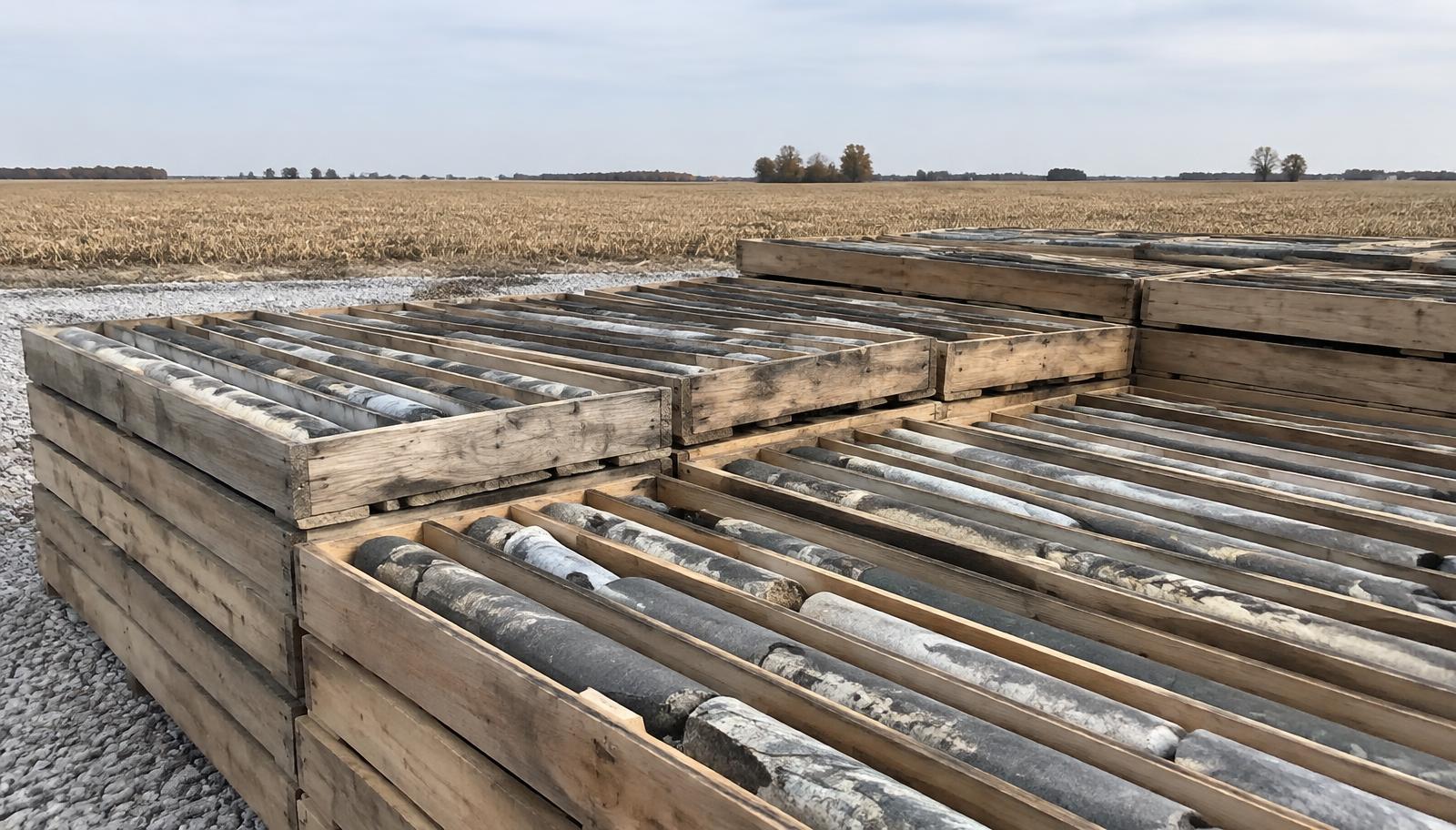
RIFT26-024
3.55% REO over 116.0 m core length, including 4.75% over 22.9 m
the project's longest interval above 4.00% REO; per the company's release dated October 5, 2026; core length, not true width
NdPr content of that interval
between 0.36% and 0.71%
derived from the company's stated Trinity Zone NdPr distribution of 10-20% of the basket; no hole-by-hole oxide split disclosed
Drilling and backlog
approximately 37 holes, 24,000 m completed; 13 holes, about 8,000 m pending
per the release dated October 5, 2026, against 34 holes and about 22,000 m on September 8, 2026
Mineral resource
none
the company states no current mineral resources or reserves have been identified; inaugural estimate targeted before the end of Q1 2027
Market value and listings
C$131.11 million at C$1.36 on 96,405,541 shares
CSE close October 5, 2026, 52-week range C$1.10 to C$4.95; also FWB: KL9 (WKN A40CCQ, ISIN CA03753D1042), OTCQX: APXCF, Euronext Access Paris: MLAPX
Apex Critical Metals Corp. reported on October 5, 2026 that step-out drilling had pushed the western edge of its Trinity Zone rare earth discovery deeper into the ground beneath southeastern Nebraska. The holes behind that extension carried the highest grades the Rift project has produced.
Five holes were reported, and the zone moved about 200 metres down dip to the west. The best of them, RIFT26-024, returned 3.55 per cent rare earth oxide over 116.0 metres of core, including 4.75 per cent over 22.9 metres. That included interval is the longest run above 4.00 per cent rare earth oxide the project has produced, and the company said so in those terms.
It is a genuine step forward, and the holes behind it are competently documented. The core is HQ-size diamond core, saw-cut and half-sampled, prepared and assayed at Activation Laboratories in Ancaster, Ontario. Certified reference material and silica blanks were inserted at about 5 per cent each, with pulp and reject duplicates at about 5 and 2.5 per cent. Apex also states, in its own footnote, that the reported lengths are core lengths and not true widths. Few juniors volunteer that sentence.
So the drilling is better than it was a month ago. What the release will not let anyone do is convert it into a quantity.
Multiply the basket by the magnet share and the answer doubles
Rare earth grades are reported as a basket. Apex defines rare earth oxide, which it abbreviates REO, as the sum of fifteen separate oxides: cerium, lanthanum, praseodymium, neodymium, europium, samarium, gadolinium, terbium, dysprosium, holmium, erbium, thulium, ytterbium, lutetium and yttrium. Scandium is excluded.
Those fifteen are not worth the same money. The value in a rare earth deposit sits mostly in neodymium and praseodymium, which go into permanent magnets, and in small quantities of dysprosium and terbium, which keep those magnets working when they get hot. Cerium and lanthanum, which are usually the bulk of the basket by weight, are comparatively cheap and abundant. A basket percentage on its own therefore says how much rare earth material is present, not how much of the valuable kind.
Apex gives one figure for the valuable kind, and it is a range. The company defines its neodymium-praseodymium distribution as those two oxides divided by the whole basket, and states that for Trinity Zone mineralisation the distribution remains "within typical global carbonatite ranges of 10-20%."
Apply that to the headline interval and the result is an uncomfortably wide band:
| Interval | Basket grade | At 10% NdPr | At 20% NdPr |
|---|---|---|---|
| RIFT26-024, 116.0 m | 3.55% REO | 0.36% NdPr | 0.71% NdPr |
| RIFT26-024 included, 22.9 m | 4.75% REO | 0.48% NdPr | 0.95% NdPr |
| RIFT26-022, 171.5 m | 2.35% REO | 0.24% NdPr | 0.47% NdPr |
The magnet-metal content of the best interval in the release is somewhere between 0.36 and 0.71 per cent. The top of that range is almost exactly double the bottom. No hole-by-hole neodymium-praseodymium figure appears in the release, and no individual oxide assay appears anywhere in it, so the band cannot be narrowed from the document.
The second piece of arithmetic is the drilling itself. Apex said approximately 37 holes totalling 24,000 metres have been completed, with assays for 13 holes covering roughly 8,000 metres still pending. A third of the metres drilled at Rift have no published assays. On September 8, 2026, the comparable figure was 34 holes and about 22,000 metres. The programme is advancing and the assay backlog is advancing with it.
The 30 to 50 per cent figure belongs to different rock
The release does contain a high neodymium-praseodymium number. It says drilling "has delineated a new deeper horizon ("Neo Zone") of strongly elevated NdPr beneath the high-grade material with NdPr distributions between 30-50%."
That figure is attached to the Neo Zone, a separate and deeper horizon, not to the Trinity Zone intervals in the headline. The two must not be run together. Trinity carries the length and the basket grade; Neo carries the better magnet ratio, sits underneath, and has no interval in this release at all. A summary that reports 3.55 per cent over 116 metres alongside a 30 to 50 per cent magnet share has combined two different rocks into one deposit that nobody has described.
Two numbers are missing, and Maple asked for them four weeks ago
When this desk covered Apex's September 8, 2026 release, it ended by saying that the signs a resource estimate was approaching would be a true width or a cut-off grade in the next release. The next release has now arrived. It contains neither.
There is no cut-off grade in the October 5 document. A cut-off grade is the minimum grade a sample must carry to be counted inside a reported interval, together with the rule for how much low-grade rock may be averaged in before the interval is broken in two. Without it, a 116-metre composite cannot be reproduced by anyone outside the company, because the rule used to assemble it is unknown.
Nor are there downhole depths for the assays. Table 1 of the release gives each hole's collar position, azimuth, dip and total depth, and those are in the text. The assay highlights are in Table 2, and Table 2 was published only as an image file. There is no way to tell from the release whether the 116.0 metres at 3.55 per cent begins at 80 metres or at 480 metres in a hole that was drilled to 652 metres.
The core-length disclosure, creditable as it is, also has to be read against the geometry. The five holes were drilled at a dip of 65 degrees below horizontal into a body the company describes as plunging westward, and the extension is explicitly "down-dip to the west." Drilling down the plunge of a body is the orientation most likely to make an intercept look longer than the rock is thick. Apex says true widths "remain unknown until further confirmation assay results are received and interpreted," and publishes no ratio between core length and true width. The 116 metres is therefore a maximum, not a thickness.
One more item in the release is forward-looking rather than measured. The company says "visual indications suggest potential for an additional 150 metres of westward extension." That is core logged by eye, not assayed.
Rift has no resource, and the company says so
Apex states in the release that "no current mineral resources or reserves have been identified by the Company," and that it "remains on track to deliver an inaugural mineral resource estimate at the Rift Project before the end of Q1/2027."
This is the distinction that governs how the intervals should be understood. A drill intercept says what the core contained along one line through the ground. A mineral resource estimate, prepared under National Instrument 43-101, says how many tonnes of rock at what grade a qualified person believes are present, with a stated confidence category and a stated cut-off. Apex has produced a great many of the first and none of the second. The company describes a Trinity Zone footprint of roughly 500 metres north to south with more than 300 metres of western down-dip extension, which is a footprint, not a tonnage.
The project sits in the Elk Creek Carbonatite Complex, about 100 kilometres from Lincoln, Nebraska, on privately owned land. The company's own description of Rift is that it "hosts extensive rare earth rights surrounding one of North America's most advanced niobium deposits." That neighbouring deposit belongs to another company, which the release neither names nor bounds against Apex's own ground.
Who signed the technical content
The technical information in the release was reviewed and approved by Nathan Schmidt, P.Geo., a qualified person under NI 43-101. The release states that Mr Schmidt is a geologist with Dahrouge Geological Consulting Ltd., which it describes as "the consulting firm engaged by Apex Critical Metals Corp. to conduct and oversee all of the Company's exploration work, including the 2026 drill program."
That is disclosed plainly, and it is not unusual for a junior. It also means the qualified person certifying the data works for the firm that generated it. Neither Mr Schmidt nor Dahrouge is described as independent of the issuer. Sean Charland is Apex's chief executive and is the officer quoted in the release.
The money, the paper and who paid to amplify this
Apex reported 96,405,541 shares outstanding and 126,828,162 on a fully diluted basis in its corporate presentation version-dated September 24, 2026. The gap is about 30.4 million securities, roughly 32 per cent of the current count, mostly warrants struck between C$0.75 and C$3.00 and expiring between December 2026 and June 2028.
The company closed a brokered offering for gross proceeds of C$15,000,500 on June 2, 2026, and filed a final base shelf prospectus on August 14, 2026, which is standing authority to issue securities rather than money raised. Cash stood at about C$9.89 million against liabilities of about C$2.57 million per market data read after the close on October 5, 2026. That is secondary data, and it is the same figure this desk published in September, because the interim statements filed since have not been checked against it.
Apex shares closed at C$1.36 on the CSE on October 5, 2026, up 3.0 per cent, on 42,129 shares against a 45,418-share average, so the day's volume was slightly below normal. The 52-week range is C$1.10 to C$4.95. A year of long, high-grade intervals has coincided with a share price near the bottom of that range, and Monday's drill release moved it by four cents on below-average turnover.
The enthusiasm that did surround the release came from distribution rather than from investors. The October 5 announcement was pushed to German-speaking retail audiences through IRW-Press, a paid financial public-relations distributor, and onward to a chain of German financial content sites. The release carries no disclosure of that arrangement. Separately, Apex disclosed on May 1, 2026 that it had extended a marketing agreement with Rumble Strip Media Inc. for a 60-day term at a cost of C$500,000, describing the services as investor relations activities under Canadian securities law. That term expired at the end of June 2026. No marketing or investor-relations contract disclosed since has been located.
The shares are quoted in Frankfurt under the symbol KL9, with WKN A40CCQ and ISIN CA03753D1042, per Deutsche Börse's own listing record, and also on OTCQX as APXCF and on Euronext Access Paris as MLAPX since July 9, 2026. Four quotation venues for a company with no mineral resource is a distribution decision, not a geological one.
What the holes have earned
Apex has drilled 24,000 metres into a carbonatite in Nebraska and keeps hitting long runs of rare earth mineralisation, and the October 5 holes are the strongest yet by the measure the company chose to report. That is a better exploration result than the share price has reflected, and saying otherwise would be inaccurate.
It is also the whole of what has been established. Thirteen holes are at the laboratory, the composites cannot be rebuilt from the published document, the valuable fraction of the basket is given as a range twice as wide at the top as the bottom, and the tonnage that would turn any of it into a number is due in the first quarter of 2027. The drilling has earned the resource estimate. It has not replaced it.
Transparency note. This article is a Maple Markets editorial due-diligence opinion piece. It is not sponsored, not commissioned, and not paid for by Apex Critical Metals Corp. (CSE: APXC) or any third party, and no compensation of any kind has been received from the company or any party acting on its behalf. Rumble Strip Media Inc. and IRW-Press are named as paid service providers engaged by or distributing for the subject company, not as parties to this article. The analysis is based on public disclosure available as of the publish date; figures are attributed to their primary sources. The Maple Markets and its authors may hold positions in securities mentioned; this is not investment advice. Past disclosure does not guarantee future results.
Read next
Auch auf Deutsch: Was steckt im längsten Seltenerd-Bohrabschnitt von Apex Critical Metals?
 Mining and ResourcesApex Critical Metals Drilled 22,000 Metres in a Year After Re-Reading Core Cut in the 1970sApex Critical Metals Corp. (CSE: APXC) acquired rare earth rights around NioCorp's Nebraska niobium deposit in October 2025, re-logged and re-sampled drill core that Molycorp cut between 1973 and 1986, and by September 8, 2026 had completed 34 holes for roughly 22,000 metres against an original plan of 8,000. The execution is real and so are the limits: there is still no mineral resource estimate at Rift, and the company says so in the same releases that carry its best numbers.Daniel Okoye · September 12, 2026 · 7 min
 Mining and ResourcesApex Critical Metals (CSE: APXC, FSE: KL9) Drilled 197.5 Metres of 2.12 Per Cent Rare Earths. Here Is What That Does and Does Not MeanApex Critical Metals reported a drill hole at its Rift project in southeast Nebraska on September 8, 2026: 2.12 per cent rare earth oxides over 197.5 metres. It is a strong number, and the company says plainly that the 197.5 metres is the length of core, not the thickness of the rock. This is a plain-English walk through what the assay sheet actually shows, what the company has promised for early 2027, and which numbers floating around online are simply made up.Daniel Okoye · September 9, 2026 · 7 min
 Mining and ResourcesWhere Are the Assays From Super Copper's First Four Chilean Holes?Super Copper Corp. (CSE: CUPR; FSE: N60) reported on 1 October 2026 that visible copper minerals were logged in all four completed holes of its maiden drill programme at Cordillera Cobre in Chile's Atacama region, across roughly 2,348 metres. No assays have been returned. The project is held under an option to earn up to 100 per cent, not owned, and carries no mineral resource estimate of any kind, current or historical.Priya Sandhu · October 5, 2026 · 9 min
Follow this story
Follow APXC.CN — the next Maple piece on this company, plus the Maple Morning Debrief before the open.
Follow and ask
Get more of our Canadian market coverage in Google Top Stories.
Opinion
This article expresses the author's personal views, is separate from news reporting and is not investment advice.
Disclosure
Transparency note. This article is a Maple Markets editorial due-diligence opinion piece. It is not sponsored, not commissioned, and not paid for by Apex Critical Metals Corp. (CSE: APXC) or any third party, and no compensation of any kind has been received from the company or any party acting on its behalf. Rumble Strip Media Inc. and IRW-Press are named as paid service providers engaged by or distributing for the subject company, not as parties to this article. The analysis is based on public disclosure available as of the publish date; figures are attributed to their primary sources. The Maple Markets and its authors may hold positions in securities mentioned; this is not investment advice. Past disclosure does not guarantee future results. See the Financial Disclaimer.
Sources and references (8)
- Apex Extends Trinity Zone 200 m with 3.55% REO over 116.0 m and 2.35% over 171.5 m in Western Step-out Drilling at Rift, October 5, 2026
- Apex Expands Trinity Zone with Step-out Hole Returning 197.5 m Interval of 2.12% REO at the Rift Rare Earth Project, September 8, 2026
- Apex Confirms Favourable Monazite and Bastnaesite Mineralogy at the Rift Rare Earth Project, August 20, 2026
- Apex Critical Metals Announces Extension of Marketing Agreement with Rumble Strip Media Inc., May 1, 2026
- Apex Critical Metals corporate presentation, version dated September 24, 2026
- Deutsche Börse listing record, Apex Critical Metals Corp. (KL9, WKN A40CCQ, ISIN CA03753D1042)
- Apex Announces Filing of Final Base Shelf Prospectus, August 14, 2026
- Rift Rare Earth Project, company project page
Cite this analysis
Please attribute The Maple Markets and link to the original page.
Daniel Okoye (October 6, 2026). What Is Inside Apex's Longest Rare Earth Intercept?. The Maple Markets. https://themaplemarkets.ca/en/newsroom/apex-critical-metals-width-is-not-tonnage-apex-critical-metals-116https://themaplemarkets.ca/en/newsroom/apex-critical-metals-width-is-not-tonnage-apex-critical-metals-116