
QIMC Finds a Wet-Gas Signature in 86% of Nova Scotia Soil Samples
The survey makes a stronger case that a hydrocarbon system sits beneath New Salem-Apple River, and the company's own closing line is that nothing there has been tested by drilling.
Québec Innovative Materials Corp. (CSE: QIMC) reported on 6 October 2026 that 86 per cent of classified soil-gas samples at its New Salem-Apple River property in Nova Scotia carry a thermogenic wet-gas signature, drawn from more than 1,000 analyses. The dataset is the company's largest and most internally consistent at the property. It measures gas in soil, not gas in a reservoir, and the release states the system has not been tested by drilling.
By Daniel Okoye7 min read

Wet-gas signature
86% of classified soil-gas samples
New Salem-Apple River, Nova Scotia; QIMC release, 6 October 2026
Survey size
more than 1,000 independent soil-gas analyses
helium and C1-C4 hydrocarbons, 2026 programme; QIMC release, 6 October 2026
Seismic in progress
approximately 50 line-kilometres of 2D seismic
under way at the date of the release; QIMC release, 6 October 2026
Share price
C$0.485, up about 1% on 566,588 shares
close of 6 October 2026, 15-minute delayed market data read after the close; 30-day average volume 543,499
Market value and cash
about C$75.7 million against about C$14.8 million cash
market value at the 6 October 2026 close; cash as last compiled from company filings, not from an interim statement read here
Québec Innovative Materials Corp. (CSE: QIMC) reported on 6 October 2026 that most of the soil-gas samples from its summer programme at New Salem-Apple River, Nova Scotia, carry what the company calls a thermogenic wet-gas signature. The survey covered the eastern side of the Cumberland Basin, on the mainland north shore of the province.
The proportion was 86 per cent of classified samples, per the release of 6 October 2026. The remainder split into dry gas at 8.7 per cent, a condensate-to-oil range at 3.4 per cent, and roughly 2 per cent reading as biogenic or mixed. Those four figures describe one thing, the chemical fingerprint of gas found in the top layer of soil, and nothing at all about what is underneath it.
What a soil-gas survey can and cannot see
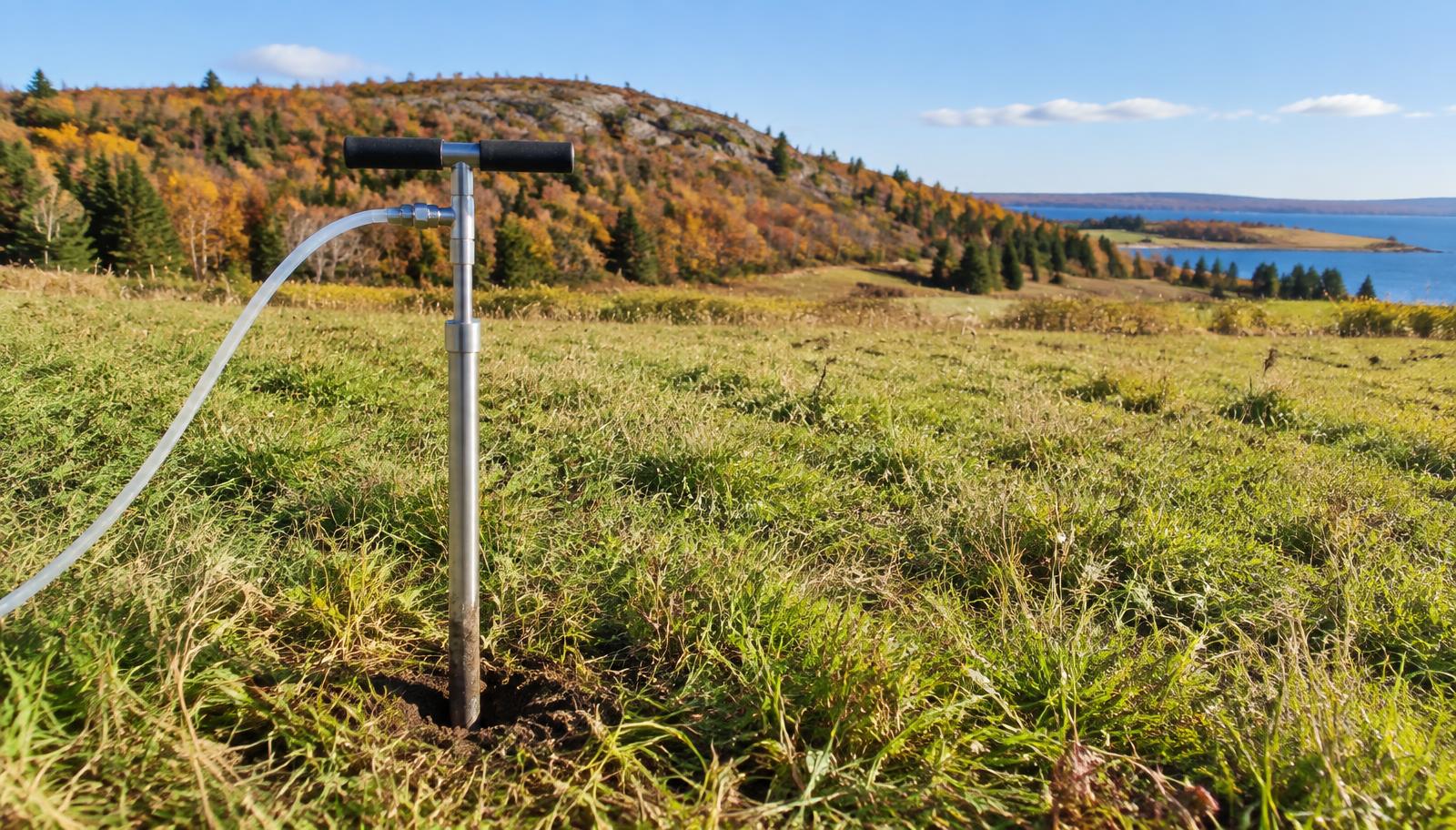
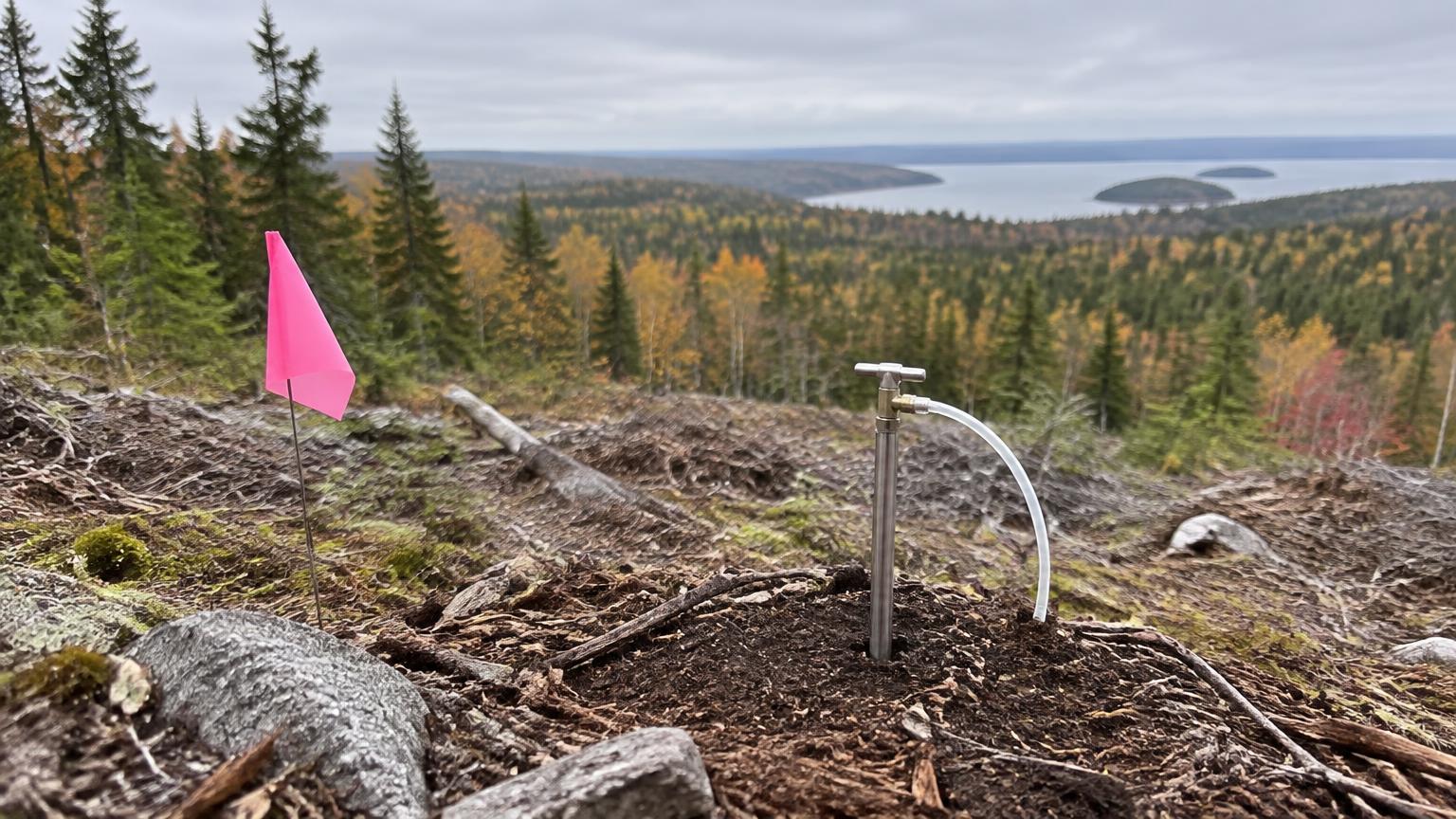
Natural gas leaks. Over geological time, gas generated deep in a sedimentary basin works its way upward along faults and fractures, and traces of it end up dissolved in the moisture and air held between grains of soil at surface. A soil-gas survey collects that air, usually from shallow probes pushed a metre or so into the ground, and sends it to a laboratory to be separated into its components. QIMC's analyses were done by GeoFrontiers Corporation of Wichita Falls, Texas, and covered methane through butane, the four lightest hydrocarbon gases, which the industry labels C1 to C4.
The ratio between those four is what the laboratory reads as a signature. Gas made by bacteria chewing through organic matter near surface is almost entirely methane, and is called biogenic. Gas made by heat and pressure cooking organic-rich rock over millions of years comes out with a tail of heavier molecules attached, ethane and propane and butane, and is called thermogenic. When that heavier tail is pronounced, the industry calls it wet gas, as opposed to the dry gas that is nearly all methane. Wet gas usually means the source rock was cooked at a temperature associated with commercial hydrocarbon generation rather than shallow decay.
So an 86 per cent wet-gas result is a statement about origin. It says that most of the gas reaching surface across this ground was made by heat at depth, not by bacteria in the topsoil. That is a real finding and it is the kind of result that justifies spending money to look deeper.
What the signature cannot do is give a volume, a depth, a pressure or a rate. A molecule of ethane at surface weighs the same whether it seeped from a thin smear of gas a few hundred metres down or from a body large enough to produce. Soil gas is a presence test. Everything that decides whether presence is worth anything is measured somewhere else.
The dataset is the strongest thing in the release
Set against QIMC's earlier work in Nova Scotia, the geochemistry at New Salem-Apple River has improved in two specific ways, and both of them come before the limits.
First, scale. The release of 6 October 2026 describes more than 1,000 independent soil-gas analyses across the survey area, covering helium and the C1 to C4 hydrocarbons. Most junior exploration geochemistry in Canada is reported in the low hundreds of samples. A thousand analyses over one property is a dataset large enough that a dominant signature is unlikely to be an artefact of where the crew happened to walk.
Second, internal consistency. Roughly 98 per cent of the classified samples in the 6 October 2026 release fall into thermogenic categories, with biogenic and mixed readings at about 2 per cent. A survey that returns a scattered mixture of origins is usually telling you about surface conditions. A survey that returns one answer almost everywhere is more likely telling you about a source.
The company also reports that the strongest ethane anomalies sit over a regional gravity low, and attributes the hydrocarbon charge to the organic-rich shales of the Horton Group, the Carboniferous rock sequence that underlies much of mainland Nova Scotia. A gravity low is a patch of ground where the pull of gravity measures slightly weaker than its surroundings, which usually means the rock below is less dense, which in a basin usually means thicker sediment. Lining up a chemical anomaly with an independent geophysical one is better evidence than either alone, because the two methods fail in different ways.
That is the honest extent of the improvement. QIMC has gone from scattered readings to a coherent picture of where gas is reaching surface and, by inference, what kind of rock is likely making it.
The company's own last sentence is the one that bounds the result
The release states that the New Salem-Apple River gas system is defined by surface geochemistry and geophysics and has not been tested by drilling. That is QIMC's wording, in QIMC's own release, and it is the most useful sentence in the document.
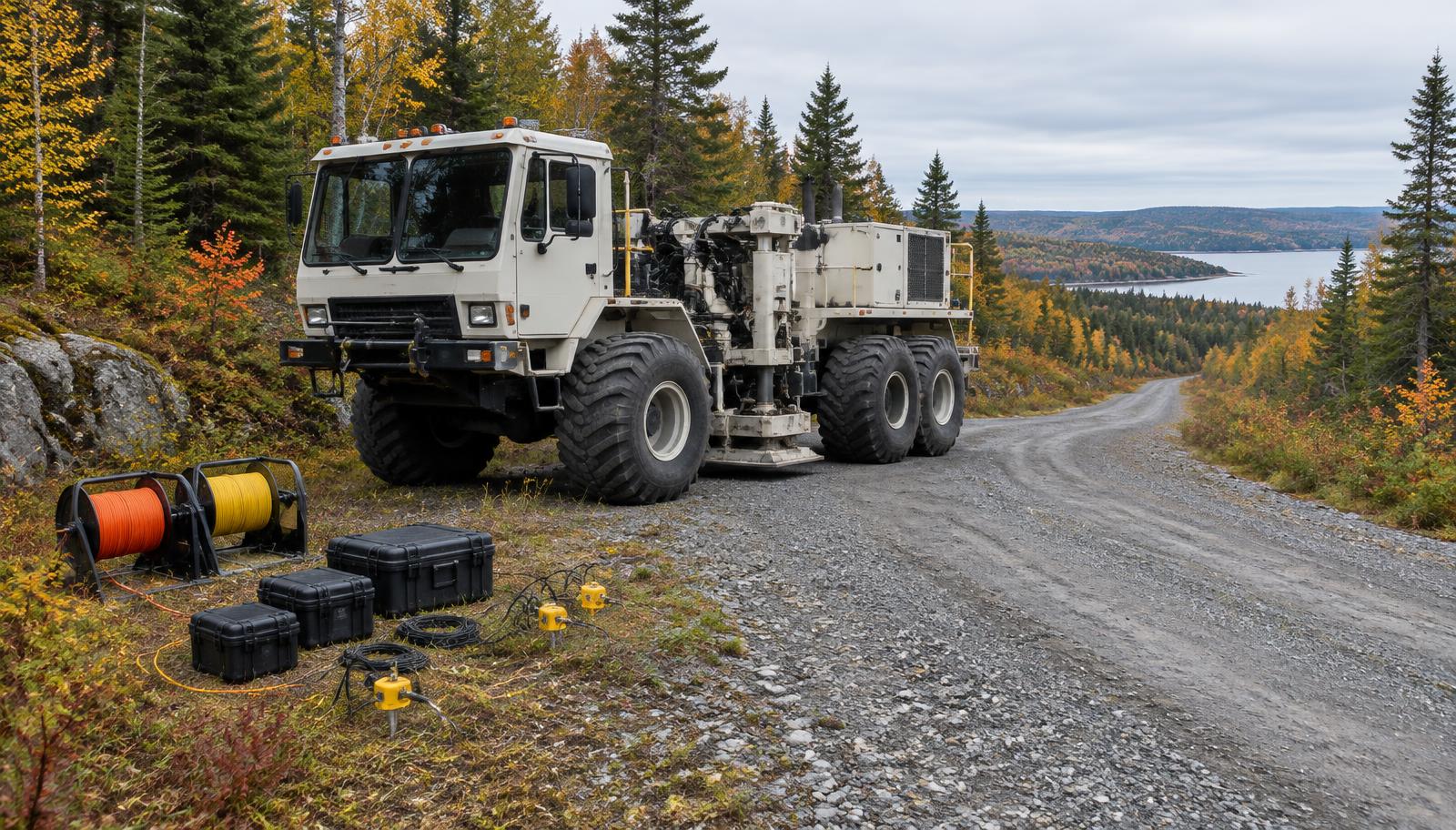
Approximately 50 line-kilometres of two-dimensional seismic survey were in progress as at 6 October 2026, the date of the release. Seismic imaging bounces sound waves off rock layers to map structure, which is how an explorer decides where to put a hole. It maps shapes. It does not measure what fills them.
At the company's separate Bennett Hill property, a hole did reach a hydrocarbon system. QIMC reported on 1 September 2026 a field reading of 30.0 per cent hydrogen at about 413 metres in DDH-26-05, followed by free gas reaching surface under conditions it described as pressurised between roughly 413 and 416 metres. In that release the company said it planned to resume the hole with adapted equipment and was evaluating equipment and procedures to enable pressure and flow measurements in the next phase. No release since has given a date for those measurements, named the equipment selected, or said how the results will be reported. Retail discussion has treated a combined pressure-and-flow disclosure as scheduled; no QIMC release says that.
Those two properties are separate, and nothing at New Salem-Apple River has reached the stage Bennett Hill reached in September. The survey published on 6 October is three stages back from a flow rate: signature, then structure, then a hole, then a test.
The share price argument and the evidence argument are not the same argument
QIMC closed at C$0.485 on 6 October 2026, up C$0.005 or about 1 per cent, on 566,588 shares against a 30-day average of 543,499, per market data read after the close on a 15-minute delay. The day's volume-weighted average price was C$0.487 and the 52-week range runs from C$0.29 to C$2.37. Market value at that price was about C$75.7 million on 156.05 million shares. Reported cash was about C$14.8 million against about C$1.9 million of liabilities; those two figures come from market data compiled from the company's filings rather than from an interim statement, which was not read here, so they carry the date of the last filing rather than of today's close.
A release describing a materially better dataset produced a one per cent move on an ordinary day's volume. The retail explanation circulating for that gap is that a persistent seller is holding the price down, with two named brokerage firms identified as accumulators or as a market maker. Neither characterisation is supported by anything filed. There is no company release or exchange notice naming a market-making or liquidity-provider agreement for QIMC, and broker-level trade attribution on the Canadian Securities Exchange is not a disclosed fact that can be checked against a document. Those claims stay out of the evidence here.
A second argument compares QIMC's roughly C$75.7 million market value and roughly C$14.8 million of cash with the same two figures at other exploration companies, and concludes the shares are cheap relative to the peer group. Cash-to-market-value is a ratio between two numbers that have almost nothing to do with each other at this stage. Cash funds the next programme; market value prices the assets the programme is meant to prove. Two explorers with different rocks, different depths and different stages of testing can trade at very different multiples of cash for perfectly good reasons. Dividing one by the other does not settle anything about either company's assets.
What has strengthened at QIMC this autumn is the quality of the argument that something is generating hydrocarbons under this ground in Nova Scotia. More than 1,000 analyses pointing one direction, matched against gravity data, is better than what the company had in the spring. What has not changed is that no gas from New Salem-Apple River has been produced into a pipe, measured for pressure, or counted. The company said as much itself on 6 October, in a single sentence at the end of the release, and that sentence will stay true until a hole goes down.
Transparency note. This is an independent due-diligence analysis and editorial opinion piece produced by The Maple Markets editorial desk. It is not sponsored, promoted or commissioned, and no compensation of any kind has been received from Quebec Innovative Materials Corp. (CSE: QIMC) or any party acting on their behalf. The analysis is based on public disclosure available as of the publish date; every figure is attributed to its primary source. The Maple Markets and its authors may hold positions in securities mentioned; nothing here is a recommendation to buy, sell or hold any security, and readers should not treat it as investment advice. Past disclosure does not guarantee future results. Policies: Editorial Standards · Financial Disclaimer.
Read next
Auch auf Deutsch: QIMC findet Nassgas-Signatur in 86% der Bodenproben in Nova Scotia
 Mining and ResourcesQIMC Hires a Calgary Firm to Process 50 Kilometres of SeismicQuebec Innovative Materials Corp. (CSE: QIMC) engaged Earth Signal Processing Ltd. of Calgary on October 1, 2026 to process about 50 line-kilometres of two-dimensional seismic shot over its Apple River and Bennett Hill ground in Nova Scotia. The work programme behind the company's hydrogen and helium story is now defined and contracted out at every stage, which is more than it was in the spring. It also produces no new measurement of gas until a hole is drilled, pressured and flowed, and no company document puts a date on that.Daniel Okoye · October 2, 2026 · 7 min
 Mining and ResourcesUnder QIMC's Helium Zones: A Magnetic Body 10 Kilometres LongQuébec Innovative Materials Corp. reported on 28 September 2026 that its 526-sample soil-gas helium survey at New Salem-Apple River in Nova Scotia, regional gravity data and aeromagnetic data all describe a single fault-bounded structure, with a magnetic body about 10 kilometres by 2 kilometres beneath two of the helium zones. The work is a reinterpretation of data the company already held. It reports no flow rate, no gas purity and no resource, and the shares closed down 3.6 per cent at C$0.54.Élise Galarneau · September 28, 2026 · 6 min
 Mining and ResourcesFive Times More Helium Anomalies Near a Fault: QIMC's 526-Sample Survey in Nova ScotiaQuébec Innovative Materials Corp. (CSE: QIMC) reported on September 22, 2026 that a 526-sample helium soil-gas survey across 28 lines at New Salem-Apple River, Nova Scotia, identified fault-associated helium zones, with a peak of 5.864 parts per million by volume against a district background of 5.40 ppmv. The survey's load-bearing number is not the peak. It is the finding that anomalous stations occur roughly five times more often within 1.5 kilometres of a mapped fault than beyond two kilometres, which is why the 2D seismic programme grew from 42 to about 50 line-kilometres.Priya Sandhu · September 23, 2026 · 8 min
Follow this story
Follow QIMC.CN — the next Maple piece on this company, plus the Maple Morning Debrief before the open.
Follow and ask
Get more of our Canadian market coverage in Google Top Stories.
Opinion
This article expresses the author's personal views, is separate from news reporting and is not investment advice.
Disclosure
Transparency note. This is an independent due-diligence analysis and editorial opinion piece produced by The Maple Markets editorial desk. It is not sponsored, promoted or commissioned, and no compensation of any kind has been received from Quebec Innovative Materials Corp. (CSE: QIMC) or any party acting on their behalf. The analysis is based on public disclosure available as of the publish date; every figure is attributed to its primary source. The Maple Markets and its authors may hold positions in securities mentioned; nothing here is a recommendation to buy, sell or hold any security, and readers should not treat it as investment advice. Past disclosure does not guarantee future results. Policies: Editorial Standards · Financial Disclaimer. See the Financial Disclaimer.
Sources and references (4)
- QIMC Announces Thermogenic Wet-Gas Signature in 86% of Soil-Gas Samples at New Salem-Apple River, Nova Scotia (6 October 2026)
- QIMC Reports Record 30.0% Clean Natural Hydrogen at 413 Metres as Pressurized Free Gas Observations Trigger Repeated Hydrogen Alarms at Bennett Hill (1-2 September 2026)
- QIMC Identifies Three Fault-Controlled Helium Zones at New Salem-Apple River and Expands Seismic Program (22 September 2026)
- Québec Innovative Materials Corp. corporate site
Cite this analysis
Please attribute The Maple Markets and link to the original page.
Daniel Okoye (October 6, 2026). QIMC Finds a Wet-Gas Signature in 86% of Nova Scotia Soil Samples. The Maple Markets. https://themaplemarkets.ca/en/newsroom/quebec-innovative-materials-a-gas-signature-is-not-a-flow-rate-qimc-shttps://themaplemarkets.ca/en/newsroom/quebec-innovative-materials-a-gas-signature-is-not-a-flow-rate-qimc-s