
QIMC Maps a 126.5-Kilometre Seismic Plan Across Three Provinces
Nova Scotia's 63.7 line-kilometres, 27 per cent more than planned, are in processing in Calgary, and the same crew and processor are lined up next for about 63 kilometres across the Témiscamingue graben in Quebec and Ontario.
Quebec Innovative Materials has finished acquiring 63.7 line-kilometres of seismic in Cumberland County, Nova Scotia, where its soil-gas, helium, gravity and magnetic work and the DDH-26-05 gas event sit on one grid now being processed in Calgary. It has planned 36 kilometres in Quebec and 26.8 kilometres in Ontario with the same contractors, bringing completed and planned coverage to about 126.5 line-kilometres, and held C$14.1 million in cash at June 30, 2026.
By Priya Sandhu8 min read
Nova Scotia seismic
63.7 line-kilometres
acquisition completed, about 50 planned; processing by Earth Signal Processing Ltd., Calgary; QIMC release, October 14, 2026
Témiscamingue seismic
about 63 kilometres planned
36 km Quebec and 26.8 km Ontario Line 5, not yet acquired; QIMC release, October 20, 2026
Thermogenic signature
145 of 147 stations (99%)
soil gas sampled September 2026; QIMC release, October 26, 2026
Cash
C$14,127,210
at June 30, 2026, interim financial statements for the nine months ended June 30, 2026
Listings
CSE: QIMC; Frankfurt: 7FJ (WKN A3D2JV, ISIN CA7480331072)
QIMC release boilerplate, October 20, 2026, and Börse Stuttgart listing page, read October 26, 2026
A seismic crew from Echo Seismic Ltd. completed Quebec Innovative Materials' survey of Cumberland County, Nova Scotia, in mid-October. The company has already named the crew's next job: its Quebec properties, then Ontario.
The Nova Scotia survey ran to 63.7 line-kilometres, against about 50 planned, and the company said on October 14 that the extra lines followed new hot zones found while the work was under way. Every line now sits with Earth Signal Processing Ltd. in Calgary.
Since then the momentum has continued, with one more seismic plan and one more encouraging Nova Scotia data set. On October 20 it added a line in Ontario to the survey already planned in Quebec. On October 26 it reported a thermogenic gas signature at almost every new soil station inside the Nova Scotia grid. The company's own tally of completed and planned seismic across the three provinces is about 126.5 line-kilometres.
One district, several kinds of evidence
QIMC is a Canadian Securities Exchange-listed explorer for natural hydrogen and helium in eastern Canada. Natural hydrogen is hydrogen gas generated underground by reactions between rock and water, as opposed to hydrogen made in a plant from natural gas or by electrolysis. There is no resource or reserve category for it in Canada, so the work is measured by the data an explorer gathers and what that data points to.
In Nova Scotia that data now comes in mutually reinforcing layers, all in one corridor from Apple River to Port Greville.
| Layer | What the company reported | Release |
|---|---|---|
| Drill hole DDH-26-05, Bennett Hill | 30.0% hydrogen in a headspace sample at about 413 metres; free gas to surface between about 413 and 416 metres | September 1, 2026 |
| Helium and structure | Helium anomalies in a 526-sample survey within about 1.5 km of three mapped faults; a magnetic body of about 10 km by 2 km beneath two zones | September 28, 2026 |
| Soil gas, first set | Wet thermogenic signature in 86% of samples around New Salem and Apple River | October 6, 2026 |
| Seismic | 63.7 line-kilometres acquired, against about 50 planned | October 14, 2026 |
| Soil gas, second set | Wet thermogenic signature at 145 of 147 new stations; four above the 5.48 ppmv regional anomaly threshold, peaking at 5.573 ppmv | October 26, 2026 |
The company says the system has become more consistent with each set: 86 per cent of the first samples carried the wet thermogenic signature, and 145 of 147 of the second. "The system is not fading at its edges; it is getting more consistent," Mr. Karagiannidis said on October 26. Thermogenic gas forms when organic matter is cooked at depth, and the company reads its fingerprint in shallow soil as the sign of a deeper source. The second set was sampled entirely inside the seismic grid.
The helium benchmark has a stated basis. Air carries about 5.240 ppmv of helium, and on September 22 the company published a regional background of 5.40 ppmv for the district and set its anomaly threshold at 5.48 ppmv. Readings a few hundredths above background, repeated along a line, are the scale at which soil-gas helium is read, because the gas is light and rises along faults.
The structural work gives that chemistry an address. Professor Marc Richer-Laflèche of INRS, the Quebec research institute, led the September interpretation as the qualified person. The company called the buried magnetic body a likely deep source of the surface degassing and said its depth estimates are model-dependent.
DDH-26-05 is where gas has come up from depth. A headspace reading measures the gas trapped in a sealed sample jar, so it gives a concentration. The company described the gas reaching surface as a qualitative operational observation, separate from a flow or pressure test. Its October 14 release lists continued testing at the hole as a next step.
Across the programme the company cites more than 10,000 soil-gas samples and over 3,500 metres of drill core from five Nova Scotia holes.
Processing is the step that joins the layers
Two-dimensional seismic sends sound into the ground along a line and records the echoes, producing a cross-section of rock layers and faults. Raw field records are noisy, and processing is the work of turning them into a section a geologist can interpret.
Earth Signal was engaged on October 1, when the company said the firm had processed more than 27,600 two-dimensional lines in over 63 countries since 2000, including work in the Cumberland Basin. The plan in that release is to merge the processed sections with the soil-gas, gravity, magnetic and drill data, which in the company's words moves it from exploration into planning a hydrogen, helium and multi-gas pilot production pathway.
Chief executive John Karagiannidis put the logic in one line on October 1: "data drives our pilot production pathway."
The company is precise about the limits of the tool. Its October 1 release states that seismic images and soil-gas anomalies do not establish the presence, size or commercial viability of a gas accumulation, and that seismic processing does not measure hydrogen or helium concentrations, formation pressure, sustained flow or recoverable volumes. Further drilling and subsurface testing would be required, it says. What processed seismic can do is place a fault, a seal or a trap at depth and show whether the surface anomalies line up with them. That is the step the soil-gas and helium work was designed to feed.
Every one of the October 26 soil-gas lines lies inside the seismic footprint, and DDH-26-05 ties into the Bennett Hill seismic line, according to the October 14 release. Once the sections arrive, each surface anomaly and the gas event in the hole can be read against a processed image of the ground beneath them.
Neither Earth Signal nor the company has given a completion date for the processing.
The wider search gives that sequence context. On January 16, 2025 the US Geological Survey published its first national map of potential for geologic hydrogen, scoring the lower 48 states on three conditions: hydrogen sources, reservoir rocks and seals to trap the gas. The map does not cover Nova Scotia. Its three conditions are the ones QIMC's processed sections and drilling are meant to test, so it serves as a yardstick for the method rather than for this ground.
The Témiscamingue graben is the next survey
A graben is a block of the earth's crust that has dropped between two faults, and the Témiscamingue graben straddles the Quebec and Ontario border around Lake Timiskaming. QIMC has explored for natural hydrogen on both sides.
The seismic there is planned and has not been acquired. The October 20 release sets out 36 kilometres in the Ville-Marie and St-Bruno-de-Guigues area of Quebec.
In Ontario it adds Line 5, 26.8 kilometres in three segments running from the provincial border through Hilliard, Armstrong and Brethour townships. The two plans come to about 63 kilometres, close to the Nova Scotia total.
The company gave its reasons for Line 5 in some detail. The corridor carries the highest soil-gas hydrogen readings it has recorded in the Ontario part of the graben. Large magnetic anomalies along it are interpreted as Nipissing mafic dykes and sills, iron-rich intrusive rocks the company treats as a possible hydrogen source. The line crosses Ordovician and Silurian sedimentary cover that may act as a seal. In Mr. Karagiannidis's words, Line 5 "satisfies every criterion in our targeting model at once."
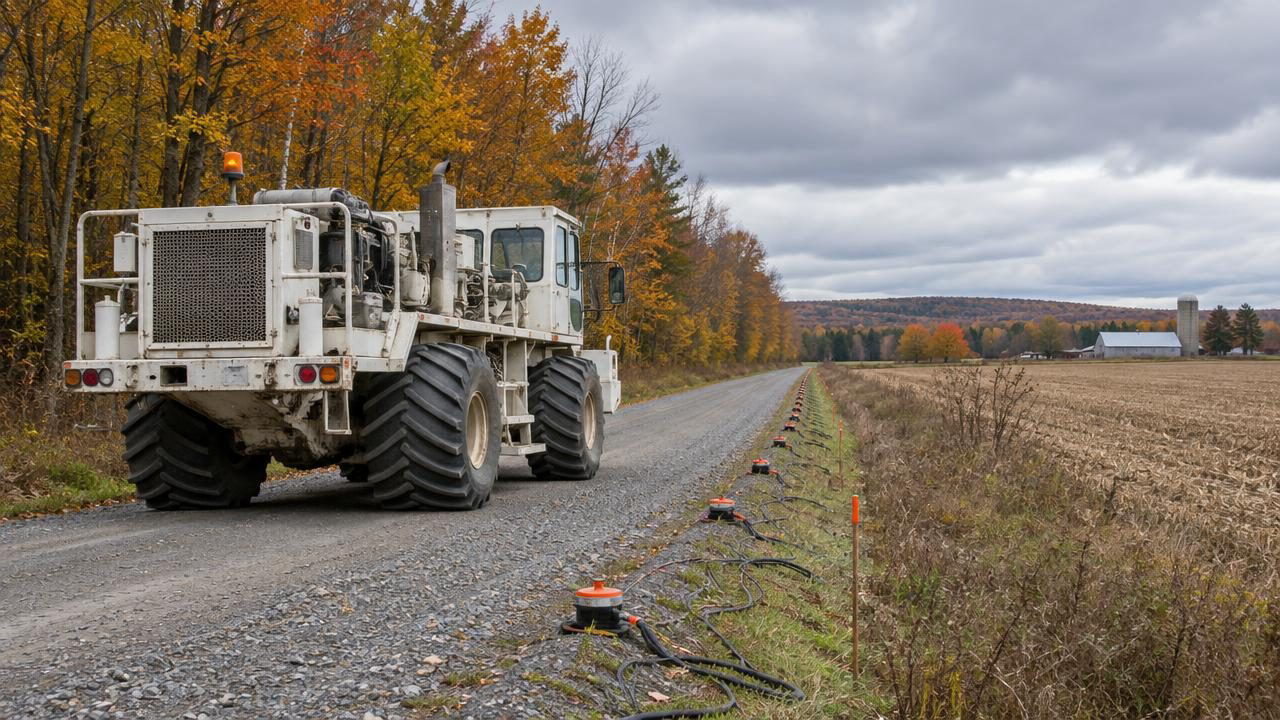
The method matches Nova Scotia's. Echo Seismic is to acquire the data with the same vibroseis parameters, a technique that uses truck-mounted plates to vibrate the ground, run along existing roads and rights-of-way. Earth Signal is to process it. The company says the programme involves no drilling, blasting or hydraulic fracturing, and that it is consulting the municipalities and First Nations in the area, including Timiskaming First Nation.
No acquisition dates were given. The next step named on October 20 is moving the Echo crew from Nova Scotia to Quebec.
C$14.1 million at the last balance sheet
The programme is backed by a strengthened balance sheet, built on a spring placement. The interim financial statements for the nine months ended June 30, 2026 are the latest QIMC has filed, and they show cash and cash equivalents of C$14,127,210 at June 30, 2026.
| From the June 30, 2026 interim statements | Figure |
|---|---|
| Cash and cash equivalents, June 30, 2026 | C$14,127,210 |
| Cash and cash equivalents, September 30, 2025 (comparative) | C$794,701 |
| Total liabilities, June 30, 2026 | C$1,919,887 |
| Shares outstanding, June 30, 2026 | 156,054,801 |
| Exploration and evaluation spending, nine months | C$2,045,251, expensed as incurred |
| Private placement closed April 27, 2026 | 19,167,050 units at C$0.90, gross C$17,250,345 |
| Warrant in each unit | exercisable at C$1.30 until April 27, 2029 |
The placement's gross proceeds exceed the C$13.3 million rise in cash between September 30, 2025 and June 30, 2026.
Note 1 of those statements says the company's circumstances indicate "a material uncertainty that may cast significant doubt" on its ability to continue as a going concern. The note ties that uncertainty to the company not yet having earned a profit, and says continuing depends on raising financing and on its exploration results. The Nova Scotia seismic, the September soil-gas lines and the processing contract all fall after that balance-sheet date. They will first appear in the annual statements for the fiscal year that ended in September, which a venture issuer must file within 120 days.
Where the shares trade
The shares were trading at C$0.38 at midday on November 3, 2026, down 3.80 per cent, according to 15-minute delayed QuoteMedia market data. At that price the June 30 share count is worth about C$59.3 million.
QIMC also trades on the OTCQB as QIMCF and in Frankfurt under the symbol 7FJ, according to the boilerplate of its October 20 release; the Frankfurt identifiers are in Key numbers.
Eight weeks of field data on one grid
From September 1 to October 26 the company put a gas-bearing drill hole, fault-bound helium zones, two soil-gas sets and a completed seismic survey onto one Nova Scotia grid. The survey came in 27 per cent longer than planned. Mr. Karagiannidis summed up the October 14 release in five words: "This district keeps getting bigger."
The next catalyst in Nova Scotia is Earth Signal's processed sections, which the company will merge with its field data to plan a pilot production pathway, while the Echo crew heads for the Témiscamingue graben.
Disclosure
Transparency note. This is an independent due-diligence analysis and editorial opinion piece produced by The Maple Markets editorial desk. It is not sponsored, promoted or commissioned, and no compensation of any kind has been received from Quebec Innovative Materials Corp. (CSE: QIMC) or any party acting on their behalf. The analysis is based on public disclosure available as of the publish date; every figure is attributed to its primary source. The Maple Markets and its authors may hold positions in securities mentioned; nothing here is a recommendation to buy, sell or hold any security, and readers should not treat it as investment advice. Past disclosure does not guarantee future results. Policies: Editorial Standards · Financial Disclaimer.
Read next
Auch auf Deutsch: QIMC plant ein seismisches Programm über 126.5 Kilometer in drei Provinzen
 Mining & Energy26.8 Kilometres of New Seismic Take QIMC's Hydrogen Search Into OntarioQuebec Innovative Materials has added Line 5, a 26.8-kilometre seismic transect across the Ontario side of the Témiscamingue Graben, placed where its Ontario soil-gas hydrogen readings are highest. The company held C$14.13 million in cash at June 30, 2026, after an April placement, and testing continues at its Nova Scotia hole DDH-26-05.Élise Galarneau · October 21, 2026 · 7 min
 Mining & Energy99% of QIMC's New Nova Scotia Soil Stations Show Wet Thermogenic GasQuebec Innovative Materials reported on October 26, 2026 that 145 of 147 new soil-gas stations in Cumberland County, Nova Scotia carried a wet thermogenic gas signature, up from 86 per cent in the set it reported on October 6. A four-kilometre line stayed anomalous end to end and held seven of the ten highest helium readings. The new lines sit inside the 63.7 line-kilometre seismic survey now being processed in Calgary, and the company held C$14.1 million in cash at June 30, 2026.Priya Sandhu · October 27, 2026 · 7 min
 Mining and ResourcesQIMC Completes a 63.7-Kilometre Seismic Survey in Nova ScotiaQuebec Innovative Materials Corp. (CSE: QIMC) said on 14 October 2026 that it had finished acquiring 63.7 line-kilometres of 2D seismic across its Cumberland County ground in Nova Scotia, 13.7 kilometres more than planned, and the data is already with a Calgary processor. The programme was delivered ahead of plan on ground where free gas has already reached surface once, with a treasury of about C$14.84 million against liabilities of about C$1.92 million.Élise Galarneau · October 15, 2026 · 8 min
Follow this story
Follow QIMC.CN — the next Maple piece on this company, plus the Maple Morning Debrief before the open.
Follow and ask
Get more of our Canadian market coverage in Google Top Stories.
Sources and references (10)
- QIMC: Further Derisks Nova Scotia Natural Hydrogen Multi-Gas System with New Thermogenic Gas and Helium Results (Newsfile, October 26, 2026)
- QIMC: Extends Natural Hydrogen and Helium Seismic Program Across the Temiscamingue Graben into Ontario with 26.8 km New Seismic Line (Newsfile, October 20, 2026)
- QIMC: Completes Expanded 63.7 km Seismic Program in Nova Scotia (Newsfile, October 14, 2026)
- QIMC: Engages Earth Signal to Advance Nova Scotia Hydrogen and Helium Multi-Gas Pilot Production Pathway (Newsfile, October 1, 2026)
- QIMC: Ties New Salem-Apple River Helium Zones to a Buried Basement Structure (Newsfile, September 28, 2026)
- QIMC: Thermogenic Wet-Gas Signature in 86% of Soil-Gas Samples at New Salem-Apple River (Newsfile, October 6, 2026)
- QIMC: DDH-26-05 update at Bennett Hill (Newsfile, September 1, 2026)
- QIMC interim financial statements, three and nine months ended June 30, 2026 (filed copy, OTC Markets)
- US Geological Survey: first-ever map of potential for geologic hydrogen in the US (January 16, 2025)
- Börse Stuttgart: Quebec Innovative Materials listing page (WKN A3D2JV)
Cite this analysis
Please attribute The Maple Markets and link to the original page.
Priya Sandhu (November 4, 2026). QIMC Maps a 126.5-Kilometre Seismic Plan Across Three Provinces. The Maple Markets. https://themaplemarkets.ca/en/newsroom/quebec-innovative-materials-has-its-63-7-kilometre-temiscaminguehttps://themaplemarkets.ca/en/newsroom/quebec-innovative-materials-has-its-63-7-kilometre-temiscamingue