
Canadian Natural Resources and the Long-Life, Low-Decline Argument
The company's asset base needs less sustaining capital than most producers. That is the whole investment thesis, and it is testable.
By Marc Belzile4 min readTranslation: human

Asset decline rate
Low single digits
Oil sands mining
Key differential
WCS vs WTI
Egress-driven
Cash priority
Base dividend
Then buybacks
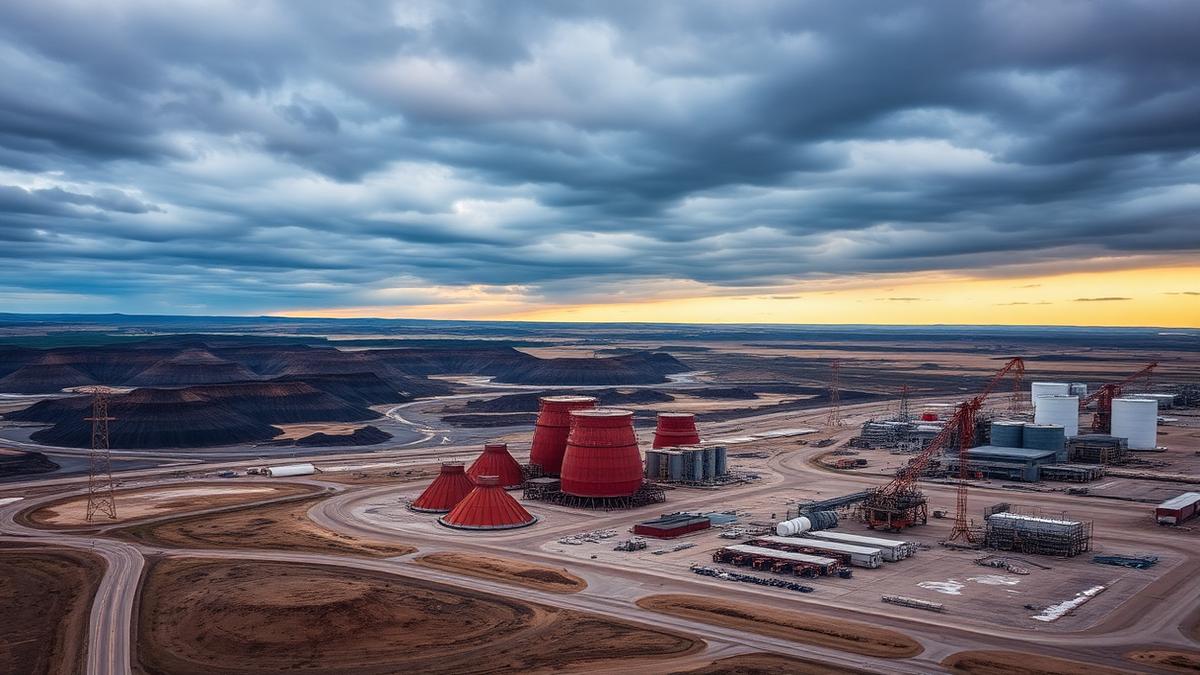
Canadian Natural Resources has spent years describing its portfolio as long-life and low-decline. The phrase is marketing until you check it against sustaining capital per barrel, and there it largely holds up. The company's asset base spans oil sands mining, thermal in-situ operations, conventional heavy oil and light oil and natural gas, giving it a diversification within Canadian production that few domestic peers can match. That diversification is central to the long-life argument: it is not one field in decline but a portfolio where different asset classes decline at different rates and can be sequenced against capital availability.
What low decline means in cash terms
Conventional shale assets can decline more than half in the first year, requiring continuous drilling simply to hold production flat. Oil sands mining declines at a small fraction of that. The practical consequence is that a much larger share of operating cash flow is genuinely discretionary rather than committed to a treadmill of replacement drilling. A shale operator that stops reinvesting sees output collapse within a year or two. An oil sands mine that stops investing in expansion can still run for decades off existing infrastructure, with output falling only gradually as mine sequencing and maintenance requirements evolve. This distinction matters most in a downturn, because it determines how much of a company's cash flow can be redirected to debt reduction or shareholder returns without immediately compromising future production. For a long-life low-decline producer, capital allocation becomes a genuine choice rather than a forced expenditure, and that optionality is the core of the valuation argument bulls make for the stock.
The break-even that matters
Management's stated WTI break-even to cover sustaining capital and the base dividend sits well below current strip pricing. Stress-testing that number against a sustained downturn, rather than a two-month dip, is the exercise a serious holder should run. Break-even figures published by producers are typically calculated using current cost structures, current royalty regimes and current currency assumptions, all of which can move against the company simultaneously in a genuine downturn. A weaker Canadian dollar partially offsets lower US-dollar oil prices for a Canadian producer, which is one reason break-evens can look more resilient than a simple oil-price comparison would suggest. But that offset is imperfect, and investors should distinguish between a break-even that covers sustaining capital alone and one that also covers the full dividend, since the two numbers can differ by a meaningful margin and the company's public messaging sometimes blends them.
Where the thesis is vulnerable
Egress remains the structural constraint on Canadian heavy crude. Pipeline availability, the WCS differential and carbon-compliance costs are the three variables that can widen the gap between realised and benchmark pricing regardless of how efficiently the barrels are produced. A low decline rate protects volume; it does not protect price realization. When pipeline capacity is tight relative to production growth across the basin, the WCS-to-WTI differential widens, and every barrel the company produces is worth less at the wellhead even if operating costs have not changed at all. Carbon-compliance costs add a second layer that is likely to grow over time rather than shrink, and the company's ability to manage that cost trajectory through technology investment is a variable that is harder to underwrite than production decline curves, which are largely a function of geology and engineering rather than policy.
Balance sheet discipline as the swing factor
A long-life asset base is only an advantage if the balance sheet can survive the interval between commodity cycles without forced asset sales or dilutive equity issuance. The company's approach to debt reduction during periods of strong cash flow, and its willingness to slow shareholder returns during weaker stretches, is what determines whether the low-decline advantage actually compounds into shareholder value over a full cycle or is instead consumed by leverage taken on during a prior downturn. Investors comparing this company to shale-weighted peers should weigh not just the decline rate difference but the debt capacity each business model can sustainably support.
How this compares with shale-weighted peers
The trade-off against shale-weighted producers is not one-sided. Shale assets can be brought on and shut in quickly, giving those operators more flexibility to respond to short-term price swings, while a long-life asset base is more expensive to build initially and less nimble to throttle. The long-life model rewards patience and penalizes producers who over-lever during a boom; the shale model rewards fast capital redeployment and penalizes producers who cannot access capital markets during a bust. Judging which model performs better over a specific holding period requires taking a view on where in the cycle the commodity currently sits, not simply which decline profile sounds more attractive on paper.
What to watch
Track the reported sustaining capital per barrel over several quarters rather than a single one, since maintenance capital can be deferred temporarily to flatter near-term free cash flow. Watch the WCS differential alongside pipeline utilization data, since a widening differential during a period of otherwise stable production is the clearest sign that egress constraints are reasserting themselves. Finally, monitor the pace of debt reduction during the current part of the cycle, since that pace indicates how much of the long-life advantage management intends to bank for the next downturn rather than distribute immediately.
Read next
 EnergyThe WCS Differential: Tracing Heavy Oil Discounts Into Canadian EarningsEvery Canadian oil investor knows the WCS differential matters. Fewer can trace how a US$4 move in the discount travels through royalties, transport and refining margin to arrive at earnings per share.Marc Belzile · August 19, 2026 · 8 min
 Mining and ResourcesCanadian Commodity Stocks in the Global CycleCanadian commodity producers are sensitive to the same global cycle. Here is how to read the signals and separate the quality operators from the price takers.Daniel Okoye · August 23, 2026 · 8 min
 EnergyThe Pressure Event Is the Result: Reading QIMC's 30.0% Hydrogen Update at Bennett HillQuébec Innovative Materials Corp. (CSE: QIMC) reported a record 30.0% H2 field reading at 413 metres in DDH-26-05 — then reported free gas reaching surface under apparent pressure between 413 and 416 metres, triggering repeated hydrogen alarms and halting the hole. Evidence for a mobile hydrogen-bearing system has strengthened. Evidence for reservoir performance has not. Benchmarked against MAX Power's completed-interval flow test at Lawson.Daniel Okoye · September 1, 2026 · 11 min
Follow this story
Follow CNQ — the next Maple piece on this company, plus the Maple Morning Debrief before the open.
Follow and ask
Get more of our Canadian market coverage in Google Top Stories.
Disclosure
Information only. Not investment advice. The Maple Markets does not hold positions in securities discussed. See the Financial Disclaimer.
Sources and references (2)
Cite this analysis
Please attribute The Maple Markets and link to the original page.
Marc Belzile (April 15, 2026). Canadian Natural Resources and the Long-Life, Low-Decline Argument. The Maple Markets. https://themaplemarkets.ca/en/newsroom/canadian-natural-resources-and-the-long-life-low-decline-argumenthttps://themaplemarkets.ca/en/newsroom/canadian-natural-resources-and-the-long-life-low-decline-argument