
Behind Encouraging at Myriad Uranium: 83.9 Per Cent of the Uranium Into 29.3 Per Cent of the Rock
A bench test on 50 kilograms of Wyoming drill core reports the mass pull and the recovery that most processing releases leave out, and the arithmetic in it holds together.
Myriad Uranium Corp. (CSE: M; FSE: C3Q) reported on September 22, 2026 that high-pressure slurry ablation testing by DISA Uranium Corporation concentrated 83.9 per cent of the uranium in a 306 ppm feed into 29.3 per cent of the mass, lifting the concentrate to 929 ppm. A second interval put 90.6 per cent into 37.5 per cent of the mass. The release quantifies feed grade, product grade, mass split and recovery, which is more than the word encouraging usually carries. It is also a laboratory test on about 50 kilograms of core, at a project whose resource estimates are historical.
By Daniel Okoye7 min read
Recovery and mass split
83.9 per cent of uranium into 29.3 per cent of the mass
first ablation interval on a 306 ppm feed, per Myriad's release of September 22, 2026; a second interval gave 90.6 per cent into 37.5 per cent
Grade upgrade
306 ppm to 929 ppm uranium, about 3.0 times
concentrate grade at the first interval, per the September 22, 2026 release; the coarse reject fell to 128 ppm
Radioactivity in the reject
radium-226 down 78.8 per cent, thorium-230 down 83.5 per cent
in the cleaned coarse fraction, per the September 22, 2026 release
Published ablation benchmark
about 90 per cent mass rejection, roughly tenfold upgrade
experimental half-tonne-per-hour unit described in an ablation white paper filed with the U.S. Nuclear Regulatory Commission, on a different deposit and not proven at production scale
Listing and market value
CSE: M, FSE: C3Q, WKN A3D1E0, ISIN CA62857Y1097
C$0.42 close and about C$59.1 million market value on 140,803,948 shares, September 22, 2026 (exchange closing data, 15-minute delayed)
About 50 kilograms of drill core from the Canning deposit in central Wyoming was crushed, mixed with water and fired at itself under pressure. Most of the uranium in it ended up in less than a third of the rock.
Myriad Uranium Corp. (CSE: M; OTCQB: MYRUF; FSE: C3Q) reported that result on September 22, 2026. The testing was run by DISA Uranium Corporation of Casper, Wyoming, on a composite taken from Myriad's 2024 drilling at Canning, and the material came from the company's Copper Mountain uranium project.
Releases with the word "encouraging" in the headline usually withhold the numbers that would let anyone check it. This one does not.
What high-pressure slurry ablation does to rock
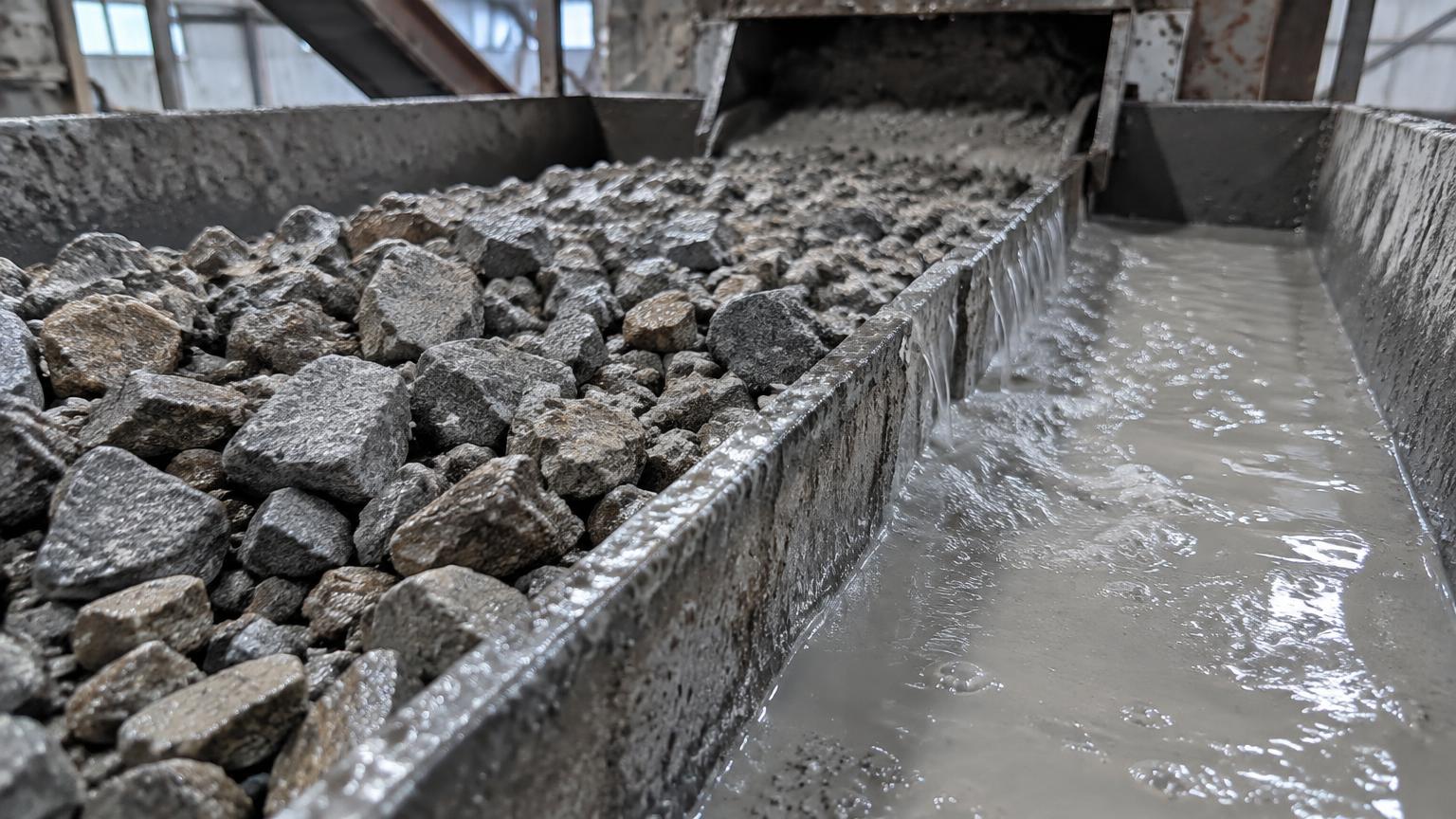
Ablation is a mechanical process, not a chemical one. Crushed ore is mixed with water and two streams of that slurry are fired at each other under pressure. The particles break along their natural grain boundaries rather than being crushed at random, and in a sandstone-hosted uranium deposit the uranium sits mostly as coatings and cements on the outside of the sand grains rather than inside them. Knock the coatings off and the uranium reports to the fine fraction while the cleaned sand reports to the coarse fraction.
That is why the process is applied to this deposit type and not to others. It works on the geometry of where the metal sits. If the uranium were locked inside the grains, ablation would move mass around and nothing else.
The practical prize is mass. Leaching, heap or tank, costs money per tonne treated. A step that discards two thirds of the tonnage as clean sand before any acid is bought changes the denominator of every later cost.
What the test reported
DISA ran the composite at three ablation intervals and Energy Labs, a third-party laboratory, analysed the products. The feed assayed 306 ppm uranium. The cleaned coarse fraction came back at 128 ppm, 78 ppm and 37 ppm at the three intervals, a reduction of 74.5 to 87.9 per cent in the material destined to be discarded. The fines concentrate came back at 929 ppm, 977 ppm and 593 ppm.
Expressed as a split, 83.9 per cent of the uranium reported to 29.3 per cent of the mass in the first interval, and 90.6 per cent to 37.5 per cent in the second. The release also reports reductions in radioactivity in the coarse reject: radium-226 activity down 78.8 per cent and thorium-230 down 83.5 per cent. Those two isotopes are what make uranium mine waste a long-term management problem, so lowering them in the discarded fraction is a permitting fact as much as a metallurgical one.
One technical distinction has to be kept. The test results are expressed in parts per million of uranium. Myriad's drill results from the same project are reported in parts per million of eU₃O₈, which is uranium oxide equivalent estimated from a downhole gamma probe rather than assayed chemically. The two are different measurements of different compounds and cannot be set side by side without conversion, and the September 22 release does not perform that conversion.
The chief executive's three-fold claim survives the arithmetic
Thomas Lamb, the chief executive, described the process as one that can "reduce rock mass by about 70%, while producing a 3-fold increase in grade." Each claim in that sentence is checkable against figures in the same release, which is not always true of a chief executive's summary.
The mass claim is direct: 100 per cent less 29.3 per cent is a 70.7 per cent rejection. The grade claim is 929 divided by 306, which is 3.04 times. A cross-check runs the other way and roughly ties: putting 83.9 per cent of a 306 ppm feed into 29.3 per cent of the mass implies a concentrate near 876 ppm, against the 929 ppm reported. The six per cent gap is the kind of difference that comes from rounding and from products reported at different intervals, and the release does not set out the reconciliation.
What that arithmetic does not do is establish economics. A 929 ppm concentrate is roughly 0.09 per cent uranium. That is better than 306 ppm by a factor of three and it is still a low-grade feed by the standards of the uranium industry, where Athabasca Basin ore is measured in whole percentage points.
Ninety per cent is what ablation has claimed elsewhere
The useful benchmark is the ablation literature filed with the United States Nuclear Regulatory Commission. A white paper on ablation technology applied to uranium resources describes an experimental half-tonne-per-hour unit rejecting approximately 90 per cent of the original ore mass and reporting up to 95 per cent of the uranium to the concentrate, with experimental results ranging from 80 to 99 per cent recovery and "an approximate ten times increase in the concentration of uranium."
Myriad's numbers are below that on both axes: about 70 per cent mass rejection against 90, and roughly three times upgrade against ten. The comparison has real limits and they should be stated with it. The white paper describes a different deposit, a different machine and an experimental unit, and it states plainly that the technology has not been proven at production scale. Ablation performance depends on how the uranium sits in the particular rock, so a lower ratio at Canning is a fact about Canning, not a verdict on the method.
It does set the direction for optimisation. DISA's own recommendation, per the release, is further testing at scale to improve selective liberation. That is the company saying the same thing: this result is a starting point on a curve, not a plateau.
A 50-kilogram composite sits low on the ladder of proof
Metallurgical work has stages, and they are not interchangeable. A bench-scale test on a composite establishes that a process responds to a sample. A locked-cycle or pilot programme on tonnes of material establishes that it responds consistently and at rate. An engineering study establishes what it costs. Myriad has the first of those three.
The sample also has to be read for what it is. Roughly 50 kilograms drawn from 2024 core at Canning is a composite, and the release does not state whether it was assembled to represent the deposit's range of grades and lithologies or selected from favourable intervals. That distinction governs how far the recoveries travel, and it is not resolved in the document.
The resource position underneath is the larger qualification and Myriad states it itself: a qualified person has not done sufficient work to classify Copper Mountain's historical estimates as current mineral resources, and the company is not treating them as such. The project's historical figures, 26.63 million pounds eU₃O₈ in 48.95 million tonnes across Copper Mountain and 1.44 million pounds in 3.07 million tonnes at Gem from 1979, are context, not tonnage anyone may rely on.
George van der Walt, MSc., Pr.Sci.Nat., FGSSA, principal consultant with The MSA Group, is named as the qualified person who reviewed the technical content of the September 22, 2026 release.
The balance sheet and where the shares trade
Myriad completed its move to full ownership of Copper Mountain on August 21, 2026 by acquiring Rush Rare Metals, having earned in stages from an option agreement dated October 18, 2023. Maple reported that sequence on September 21, 2026 and nothing since has changed it.
The company's shares closed at C$0.42 on September 22, 2026, down three quarters of a cent or 1.75 per cent, on 72,490 shares against a 160,532-share 30-day average, roughly 0.45 times normal (exchange closing data, 15-minute delayed). The Canadian Securities Exchange listing record carries 140,803,948 shares issued and outstanding with a further 50,912,283 reserved for issuance, which puts the market value at about C$59.1 million at that close. Maple's September 21 piece reported 140,773,948 shares and 50,942,283 reserved, so both counts have moved slightly and neither difference is explained by a filing available at the time of writing. Market data showed cash of C$8.81 million against liabilities of C$365,783 at the April 30, 2026 fiscal date. SEDAR+ was not readable when this was written, so those balance-sheet figures are not verified against statements filed since.
The German line is FSE: C3Q, WKN A3D1E0, ISIN CA62857Y1097, per the Frankfurt Stock Exchange listing record and the company's own release boilerplate. Volume sits on the Canadian listing.
What a processing release can and cannot move
A metallurgical result is one of the few kinds of news that can change a low-grade uranium project without another metre being drilled, because it acts on cost rather than on tonnage. Myriad has a quantified first-pass answer on a rock type where the physics of the method should work, and it published the recoveries rather than the adjective.
The deposit those recoveries would be applied to is still a set of 1979 numbers nobody has re-certified.
Transparency note > Transparency note. This is an independent due-diligence analysis and editorial opinion piece produced by The Maple Markets editorial desk. It is not sponsored, promoted or commissioned, and no compensation of any kind has been received from Myriad Uranium Corp. (CSE: M), Rush Rare Metals Corp. or any party acting on their behalf. The analysis is based on public disclosure available as of the publish date; every figure is attributed to its primary source. The Maple Markets and its authors may hold positions in securities mentioned; nothing here is a recommendation to buy, sell or hold any security, and readers should not treat it as investment advice. Past disclosure does not guarantee future results. Policies: Editorial Standards · Financial Disclaimer.
Read next
Auch auf Deutsch: Hinter dem Wort Encouraging bei Myriad Uranium: 83.9 Prozent des Urans in 29.3 Prozent des Gesteins
 Mining and ResourcesMyriad Uranium Slid 10.0 Per Cent While Only One Fund Filing Supported the Flow StoryMyriad Uranium Corp. (CSE: M) closed down 10.0 per cent at C$0.4275 on 21 September 2026 with no filing behind the move and nothing released since 10 September. One part of the buying story is documented: a uranium ETF publishes a holding of 5,153,552 shares. The other claims are unverified. Underneath them sits real drilling at Copper Mountain, Wyoming, a historical estimate from 1979, and no current mineral resource estimate.Daniel Okoye · September 22, 2026 · 9 min
 Mining and ResourcesMyriad Uranium's First Three Holes at Gem Are Shallower and Thicker Than Anything at Lucky CliffMyriad Uranium Corp. (CSE: M, OTCQB: MYRUF, FSE: C3Q) reported three holes for 507 metres at the Gem deposit on its Copper Mountain project in Wyoming on September 10, 2026, with 21 radiometric intervals above 100 ppm equivalent uranium oxide. The longest runs 34.90 metres at 210 ppm from 10.65 metres downhole. Every figure is a downhole gamma estimate awaiting laboratory verification, and the company has not said when those assays are due.Daniel Okoye · September 11, 2026 · 8 min
 Mining and ResourcesMyriad Uranium (CSE: M, FSE: C3Q) Now Owns All of Copper Mountain. It Still Has No Current ResourceMyriad Uranium finished buying out its partner on August 21, 2026 and now owns 100 per cent of the Copper Mountain uranium project in Wyoming. The day before, it reported early readings from four new drill holes. The project sits on roughly 2,000 holes drilled by a railway company in the late 1970s, plus a 1979 estimate that is not a current resource and does not add up on its own numbers. This is a plain-English look at what is proven, what is not, and what would settle it.Daniel Okoye · September 9, 2026 · 8 min
Follow this story
Follow M.CN — the next Maple piece on this company, plus the Maple Morning Debrief before the open.
Follow and ask
Get more of our Canadian market coverage in Google Top Stories.
Opinion
This article expresses the author's personal views, is separate from news reporting and is not investment advice.
Disclosure
**Transparency note.** This is an independent due-diligence analysis and editorial opinion piece produced by The Maple Markets editorial desk. It is not sponsored, promoted or commissioned, and no compensation of any kind has been received from Myriad Uranium Corp. (CSE: M), Rush Rare Metals Corp. or any party acting on their behalf. The analysis is based on public disclosure available as of the publish date; every figure is attributed to its primary source. The Maple Markets and its authors may hold positions in securities mentioned; nothing here is a recommendation to buy, sell or hold any security, and readers should not treat it as investment advice. Past disclosure does not guarantee future results. Policies: [Editorial Standards](https://themaplemarkets.ca/en/policies/editorial-standards) · [Financial Disclaimer](https://themaplemarkets.ca/en/policies/financial-disclaimer). See the Financial Disclaimer.
Sources and references (5)
- Encouraging High-Pressure Slurry Ablation Test Results at Myriad's Copper Mountain Uranium Project (September 22, 2026)
- Myriad Uranium Announces Further Phase II Drill Results from Copper Mountain (September 10, 2026)
- Ablation Technology Applied to Uranium Resources, white paper filed with the U.S. Nuclear Regulatory Commission (ML16271A168)
- Frankfurt Stock Exchange listing record, Myriad Uranium Corp. (WKN A3D1E0, ISIN CA62857Y1097)
- The Maple Markets, Myriad Uranium Slid 10.5 Per Cent on a Flow Story Only One Fund's Holdings File Supports (September 21, 2026)
Cite this analysis
Please attribute The Maple Markets and link to the original page.
Daniel Okoye (September 23, 2026). Behind Encouraging at Myriad Uranium: 83.9 Per Cent of the Uranium Into 29.3 Per Cent of the Rock. The Maple Markets. https://themaplemarkets.ca/en/newsroom/myriad-uranium-behind-encouraging-what-myriad-uranium-s-high-pressurehttps://themaplemarkets.ca/en/newsroom/myriad-uranium-behind-encouraging-what-myriad-uranium-s-high-pressure