
QIMC Hires a Calgary Firm to Process 50 Kilometres of Seismic
The Earth Signal engagement turns a finished survey into a picture of the faults under Apple River, and it sits several steps before the pressure and flow measurement the project is waiting on.
Quebec Innovative Materials Corp. (CSE: QIMC) engaged Earth Signal Processing Ltd. of Calgary on October 1, 2026 to process about 50 line-kilometres of two-dimensional seismic shot over its Apple River and Bennett Hill ground in Nova Scotia. The work programme behind the company's hydrogen and helium story is now defined and contracted out at every stage, which is more than it was in the spring. It also produces no new measurement of gas until a hole is drilled, pressured and flowed, and no company document puts a date on that.
By Daniel Okoye8 min read
Seismic to be processed
about 50 line-kilometres of 2D data
Apple River and Bennett Hill, Nova Scotia; QIMC release, October 1, 2026
Strongest helium station
5.864 ppmv against a 5.40 ppmv survey background
about 8 per cent above background, from 526 soil-gas samples analysed by GeoFrontiers; QIMC release, September 22, 2026
Last announced financing
C$17,250,345 gross, 19,167,050 units at C$0.90
each unit carries a warrant at C$1.30 to April 27, 2029; QIMC release, April 27, 2026
Market value
about C$79.6 million at C$0.51
October 1, 2026, QuoteMedia 15-minute delayed data; secondary market data, not verified against SEDAR+ filings
German line
FSE: 7FJ, WKN A3D2JV, ISIN CA7480331072
Frankfurt listing data read October 1, 2026; the company's release boilerplate carries the same symbol
Quebec Innovative Materials Corp. said on October 1, 2026 that it has engaged Earth Signal Processing Ltd., a Calgary seismic processing house, to work up roughly 50 line-kilometres of two-dimensional seismic data shot over its Apple River and Bennett Hill ground in Nova Scotia. In the company's own words, once that dataset is in hand it "moves from exploration into planning its clean hydrogen, helium and multi-gas pilot production pathway."
That sentence is doing careful work, and the care is deserved. Planning is what the engagement buys. The company now has a named contractor at every stage of a sequence it published three weeks ago, which is better than the position it held in the spring, when the Nova Scotia ground was a scatter of soil-gas readings and a drill hole that had stopped. What the engagement does not buy is a number that anyone can put against the gas.
What a processing contract actually produces
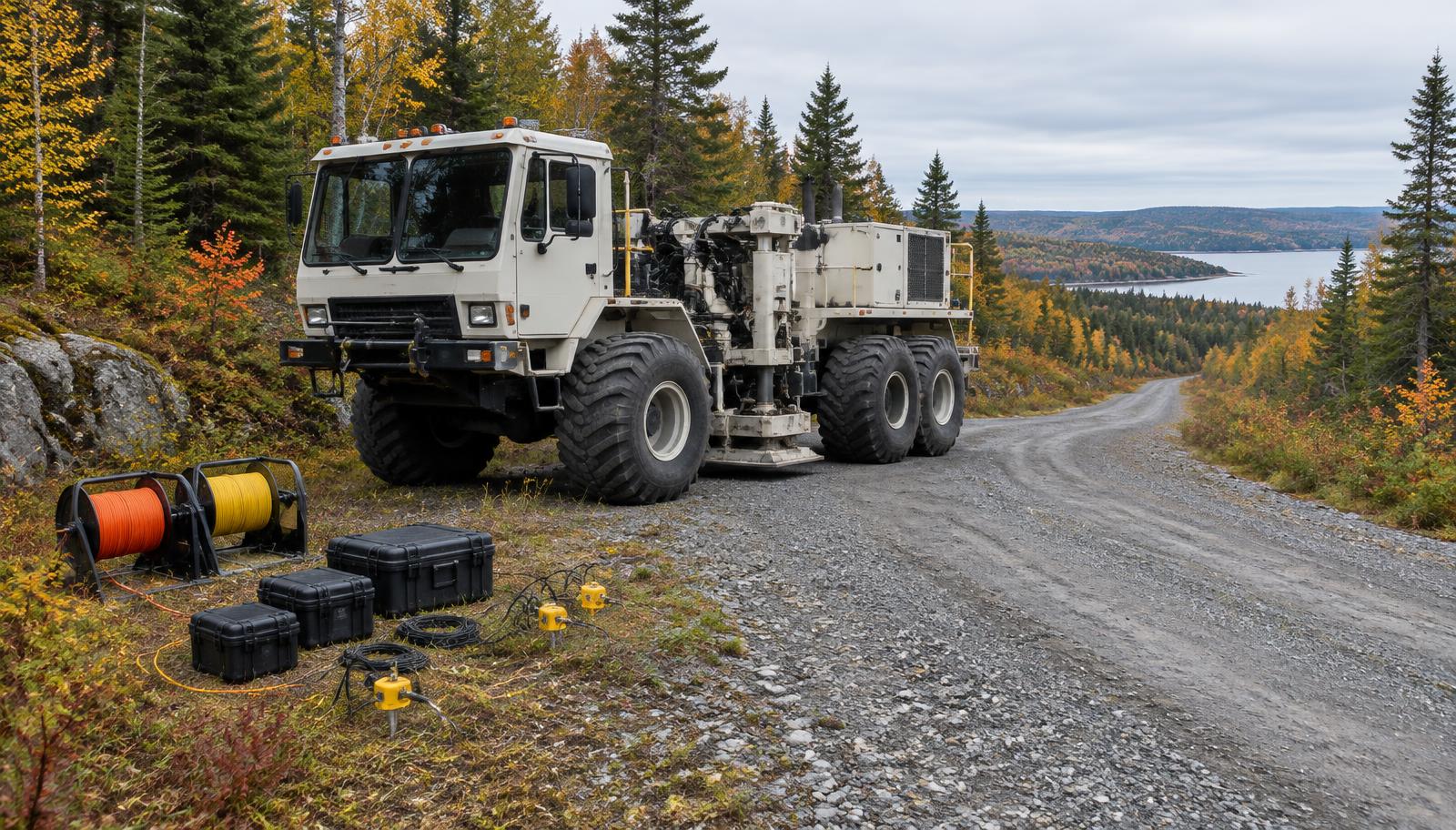
A two-dimensional seismic survey works by thumping energy into the ground along a line and recording the echoes that come back off boundaries in the rock. The raw recording is almost entirely noise. Processing is the computational step that strips the noise out and turns those echoes into a cross-section a geologist can read, showing where the rock is broken, folded or faulted. Until that step is finished, the field data is not a picture of anything.
Earth Signal has operated since 1993 and, according to the October 1 release, has processed more than 27,600 two-dimensional lines in over 63 countries since 2000, including prior work in the Cumberland Basin, which is the geological setting of the Nova Scotia ground. That matters more than it sounds. Imaging faults in deformed sedimentary rock is a specialist job, and a weak processing result on good field data is a common and expensive way to lose a season.
The engagement does establish two things. The lines were shot, since there is finished data to hand over, and the company has put them with a contractor that has worked this basin before. The product is an address. It will show where structures sit, how they connect and which of them a drill could test. It will not show whether hydrogen or helium is in them, how much, or at what pressure. Seismic sees rock geometry, not gas.
The company's own sequence puts the testing after the picture
QIMC set out the order of work in its September 14, 2026 release, which engaged Echo Seismic Ltd. to acquire the lines and Strum Consulting to handle health, safety and environmental oversight. The company stated that field acquisition was scheduled for the fall of 2026, using roughly 1,400 recording channels, 5-Hz geophones and 25-metre receiver spacing across nine lines. The company said processing and interpretation follow, then integration with its existing soil-gas and geophysical data. Only then come targeted characterisation drilling, pressure testing, flow testing and an assessment of whether an accumulation exists.
The October 1 engagement is the second step of five. The seismic programme itself grew from about 42 line-kilometres as announced on September 14 to about 50 on September 22, when the company disclosed added coverage over its helium zones.
Retail discussion of this company has settled on one event as the only one that counts: a pressure and flow measurement at the fifth hole drilled this year, DDH-26-05, where, as QIMC reported at the time, free gas reached surface under apparent pressure during drilling and the hole was stopped. On the evidence of the company's own releases, that discussion has the sequence right and the timing wrong. Pressure and flow work sits at the far end of the published programme, after the processed lines come back and are interpreted, and none of the four Nova Scotia releases from September 8 onward attaches a date to it.
| What the October 1 engagement supports | What it does not establish |
|---|---|
| A defined work programme with named contractors at acquisition, processing and environmental oversight | That gas is present in any structure the survey images |
| An interpretation step over about 50 line-kilometres of the Apple River and Bennett Hill ground | A mineral resource, a reserve, or a gas accumulation of any category |
| Processing experience in the same basin, per QIMC's description of Earth Signal's record | Formation pressure, a flow rate, or a recoverable volume |
| A stated path from exploration into pilot-production planning | A date for the drilling, pressure testing or flow testing at the end of that path |
The helium anomalies are real and they are fractions of a part per million
The September 22 release is the one most often cited as proof the Nova Scotia ground is working, so it is worth being precise about what it measured. GeoFrontiers Corporation analysed 526 soil-gas samples and the company defined three fault-controlled helium zones from them. The statistical background across the survey came in at 5.40 parts per million by volume and the anomaly threshold at 5.48. The strongest station, in Zone C on fault F-III, read 5.864 parts per million by volume; Zone A peaked at 5.722 and Zone B at 5.690.
Parts per million by volume is exactly what it says: the share of the gas sample that is helium. The peak station therefore sits about 8 per cent above the local background by our own division of the company's two figures, not multiples above it. What makes Zone C interesting, on the company's own description, is not the height of that number but its persistence: the company reported 17 of 25 stations above threshold and an 800-metre unbroken anomalous run along a mapped fault. That pattern does support a leak along a mapped structure, and the survey showed it across three separate zones. The case for pointing a drill at the Apple River faults is stronger than it was before those 526 samples were taken.
Soil gas measures seepage at surface. A tight cluster of anomalous stations along a fault is good evidence that something is leaking along that fault, which is why it is a sensible place to point a seismic line. It is not a measurement of what is underneath, and the absolute concentrations here are small. The Maple Markets covered the same survey on September 22 and counted the anomalous stations; the count is the part that grew, and the concentrations are unchanged.
What the balance sheet has to carry next
QIMC entered this programme funded. According to its release of that date, it closed a bought deal on April 27, 2026 for gross proceeds of C$17,250,345, issuing 19,167,050 units at C$0.90, each unit one common share and one warrant exercisable at C$1.30 until April 27, 2029. Research Capital Corporation acted as sole underwriter and took C$1,201,224.15 in cash commission plus 1,334,694 broker warrants at C$0.90 to the same date.
What remains of that money is not public. QIMC has published no cash figure in a news release since the April closing, and its interim financial statements could not be opened on October 1, 2026, so no current cash balance appears here. The Canadian Securities Exchange's listing page for the company shows 123,704,001 common shares issued and outstanding with 16,733,750 reserved for issuance, and carries no date for those figures. Market data from QuoteMedia as of October 1, 2026, delayed by 15 minutes, put the company at about C$79.6 million at C$0.51 a share, which divides out at roughly 156 million shares. The two counts describe different dates, and the larger one is the one to work from, since the April financing alone added more than 19 million shares.
The cost shape of the published sequence runs the wrong way for an explorer. Processing is the cheap part. Drilling a characterisation hole and equipping it to measure pressure and flow is the expensive part, and it comes last.
Several claims circulating about this name match no document
Discussion of QIMC is heavy and openly divided, and a number of specific assertions travel with it: that a Canadian brokerage is acting as market maker or building a position of its own, that more than three million shares moved through another dealer into a single account over three months last year, that a private American competitor shot seismic in the area before QIMC did, and that an earlier run in the share price was engineered. Each was checked against the company's filings, exchange bulletins and insider reports available on October 1, 2026, and none of them could be matched to a document. None of them appears above as evidence. Several specific future prices also circulate with no published basis behind them, and none is used here.
What can be said about the discussion is only that it exists and that it is split, which is context rather than information.
The programme is better defined than it was in the spring
A company that names its acquisition contractor, its processor and its environmental supervisor, and that describes its own position as moving into planning rather than into production, is behaving like one that expects to be measured on results. QIMC's position is improved on exactly that measure since the spring: the Nova Scotia work has a shape, a sequence and three contracted parties, where in April it had drill core and soil samples.
That is also the whole of what has changed. Nothing in the October 1 release is a measurement of gas, and the next one will not be either. The first number that can settle anything about Apple River comes from a gauge on a hole, and QIMC has not said when that hole will be drilled.
Transparency note. This is an independent due-diligence analysis and editorial opinion piece produced by The Maple Markets editorial desk. It is not sponsored, promoted or commissioned, and no compensation of any kind has been received from Quebec Innovative Materials Corp. (CSE: QIMC) or any party acting on their behalf. The analysis is based on public disclosure available as of the publish date; every figure is attributed to its primary source. The Maple Markets and its authors may hold positions in securities mentioned; nothing here is a recommendation to buy, sell or hold any security, and readers should not treat it as investment advice. Past disclosure does not guarantee future results. Policies: Editorial Standards · Financial Disclaimer.
Read next
Auch auf Deutsch: QIMC beauftragt eine Calgary-Firma mit 50 Kilometern Seismik
 Mining and ResourcesUnder QIMC's Helium Zones: A Magnetic Body 10 Kilometres LongQuébec Innovative Materials Corp. reported on 28 September 2026 that its 526-sample soil-gas helium survey at New Salem-Apple River in Nova Scotia, regional gravity data and aeromagnetic data all describe a single fault-bounded structure, with a magnetic body about 10 kilometres by 2 kilometres beneath two of the helium zones. The work is a reinterpretation of data the company already held. It reports no flow rate, no gas purity and no resource, and the shares closed down 3.6 per cent at C$0.54.Élise Galarneau · September 28, 2026 · 6 min
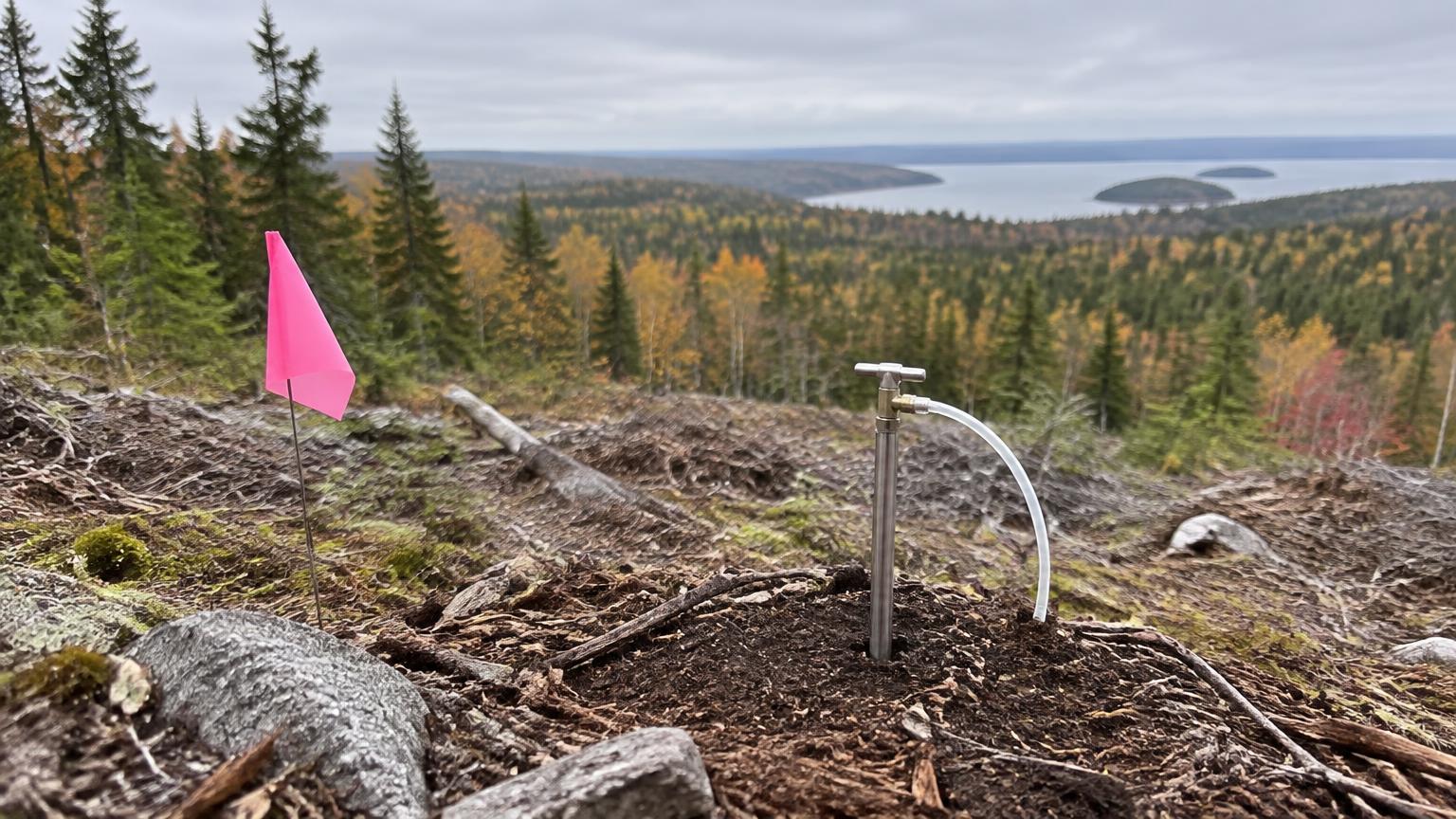 Mining and ResourcesFive Times More Helium Anomalies Near a Fault: QIMC's 526-Sample Survey in Nova ScotiaQuébec Innovative Materials Corp. (CSE: QIMC) reported on September 22, 2026 that a 526-sample helium soil-gas survey across 28 lines at New Salem-Apple River, Nova Scotia, identified fault-associated helium zones, with a peak of 5.864 parts per million by volume against a district background of 5.40 ppmv. The survey's load-bearing number is not the peak. It is the finding that anomalous stations occur roughly five times more often within 1.5 kilometres of a mapped fault than beyond two kilometres, which is why the 2D seismic programme grew from 42 to about 50 line-kilometres.Priya Sandhu · September 23, 2026 · 8 min
 EnergyThe Pressure Event Is the Result: Reading QIMC's 30.0% Hydrogen Update at Bennett HillQuébec Innovative Materials Corp. (CSE: QIMC) reported a record 30.0% H2 field reading at 413 metres in DDH-26-05 — then reported free gas reaching surface under apparent pressure between 413 and 416 metres, triggering repeated hydrogen alarms and halting the hole. Evidence for a mobile hydrogen-bearing system has strengthened. Evidence for reservoir performance has not. Benchmarked against MAX Power's completed-interval flow test at Lawson.Daniel Okoye · September 1, 2026 · 11 min
Follow this story
Follow QIMC.CN — the next Maple piece on this company, plus the Maple Morning Debrief before the open.
Follow and ask
Get more of our Canadian market coverage in Google Top Stories.
Opinion
This article expresses the author's personal views, is separate from news reporting and is not investment advice.
Disclosure
Transparency note. This is an independent due-diligence analysis and editorial opinion piece produced by The Maple Markets editorial desk. It is not sponsored, promoted or commissioned, and no compensation of any kind has been received from Quebec Innovative Materials Corp. (CSE: QIMC) or any party acting on their behalf. The analysis is based on public disclosure available as of the publish date; every figure is attributed to its primary source. The Maple Markets and its authors may hold positions in securities mentioned; nothing here is a recommendation to buy, sell or hold any security, and readers should not treat it as investment advice. Past disclosure does not guarantee future results. Policies: Editorial Standards · Financial Disclaimer. See the Financial Disclaimer.
Sources and references (6)
- QIMC news release, Earth Signal engagement, October 1, 2026
- QIMC news release, Echo Seismic and Strum Consulting, 42-kilometre 2D seismic programme, September 14, 2026
- QIMC news release, three fault-controlled helium zones and seismic expansion to about 50 line-kilometres, September 22, 2026
- QIMC news release, closing of C$17.3 million bought deal, April 27, 2026
- Canadian Securities Exchange listing record, Quebec Innovative Materials Corp.
- Frankfurt Stock Exchange security record, ISIN CA7480331072
Cite this analysis
Please attribute The Maple Markets and link to the original page.
Daniel Okoye (October 2, 2026). QIMC Hires a Calgary Firm to Process 50 Kilometres of Seismic. The Maple Markets. https://themaplemarkets.ca/en/newsroom/quebec-innovative-materials-a-seismic-contractor-is-not-a-flow-testhttps://themaplemarkets.ca/en/newsroom/quebec-innovative-materials-a-seismic-contractor-is-not-a-flow-test