
26.8 Kilometres of New Seismic Take QIMC's Hydrogen Search Into Ontario
The Montreal explorer has added a new seismic line, Line 5, on the Ontario side of the Témiscamingue Graben, bringing its completed and planned coverage across three provinces to about 126.5 kilometres.
Quebec Innovative Materials has added Line 5, a 26.8-kilometre seismic transect across the Ontario side of the Témiscamingue Graben, placed where its Ontario soil-gas hydrogen readings are highest. The company held C$14.13 million in cash at June 30, 2026, after an April placement, and testing continues at its Nova Scotia hole DDH-26-05.
By Élise Galarneau7 min read
Line 5 length
26.8 km
New Ontario seismic transect in three segments (12.9 km, 0.58 km, 13.3 km), per QIMC's October 20, 2026 release.
Total seismic coverage
about 126.5 km
Completed and planned, Nova Scotia, Quebec and Ontario, per the October 20, 2026 release.
Peak hydrogen, DDH-26-05
30.0% at 413 m
Preliminary headspace concentration, not a flow rate, per QIMC's September 1, 2026 release.
Cash and cash equivalents
C$14,127,210
At June 30, 2026, unaudited interim statements approved August 26, 2026; total liabilities C$1,919,887 at the same date.
Frankfurt listing
7FJ / WKN A3D2JV / ISIN CA7480331072
FSE symbol per QIMC's October 20, 2026 release; WKN and ISIN per Börse Stuttgart's listing page.
The seismic crew that finished in Nova Scotia this month has two more provinces' worth of lines ahead of it. On October 20, 2026, Quebec Innovative Materials Corp. said it will run a new seismic line across the Ontario side of the Témiscamingue Graben, the long rift valley that straddles the Quebec-Ontario border around Lake Timiskaming.
Line 5 measures 26.8 kilometres, in three segments, and runs west from the Quebec border through Hilliard, Armstrong and Brethour townships. The company placed it along the corridor where it has recorded its highest soil-gas hydrogen readings on the Ontario side (the release describes the readings without giving them as numbers).
A second district gets the Nova Scotia treatment
QIMC is a Montreal-based explorer listed on the Canadian Securities Exchange that looks for natural hydrogen and helium, gases that form underground and can collect in rock the way natural gas does. Its work began on the Quebec side of the graben and in Nova Scotia. Ontario is now the third front.
The October 20 release describes Line 5 as the same method run a second time. In Nova Scotia the company mapped gas at surface, then drilled, then shot seismic across the ground where the gas was strongest. On the Témiscamingue side it has the surface work: soil-gas sampling, and gravity and magnetic surveys completed with the Institut national de la recherche scientifique (INRS), Quebec's graduate research university.
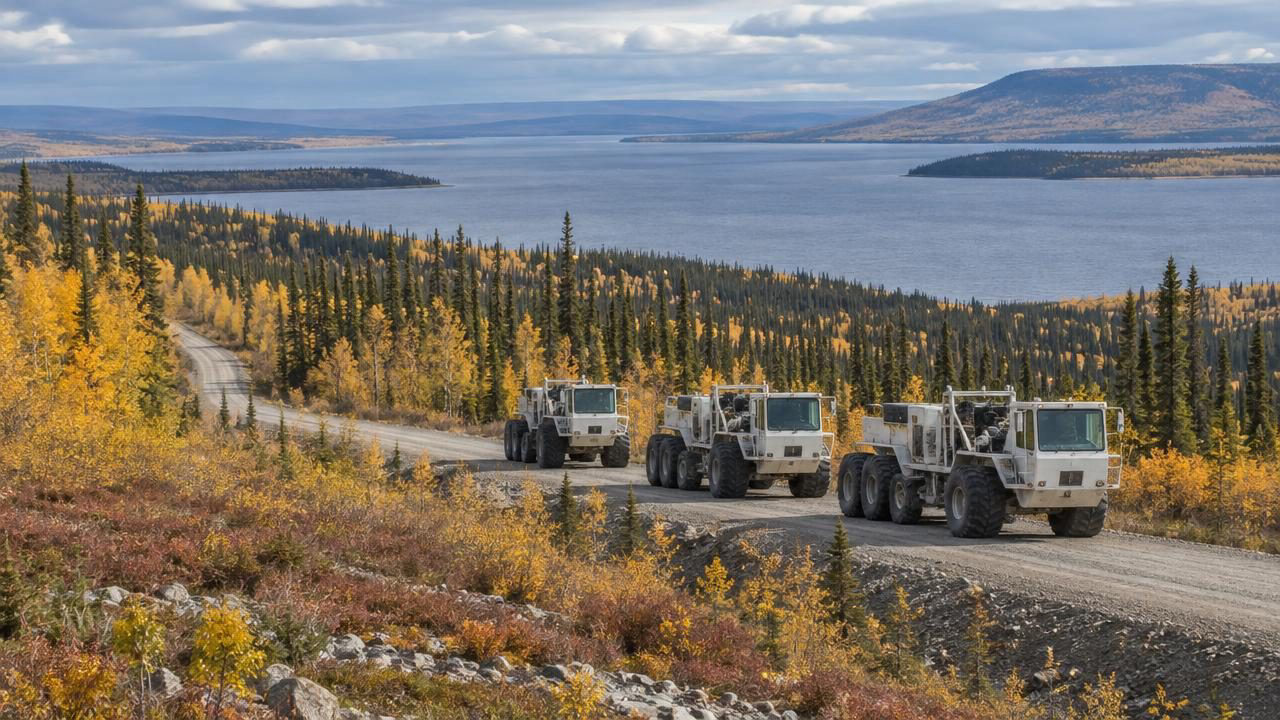
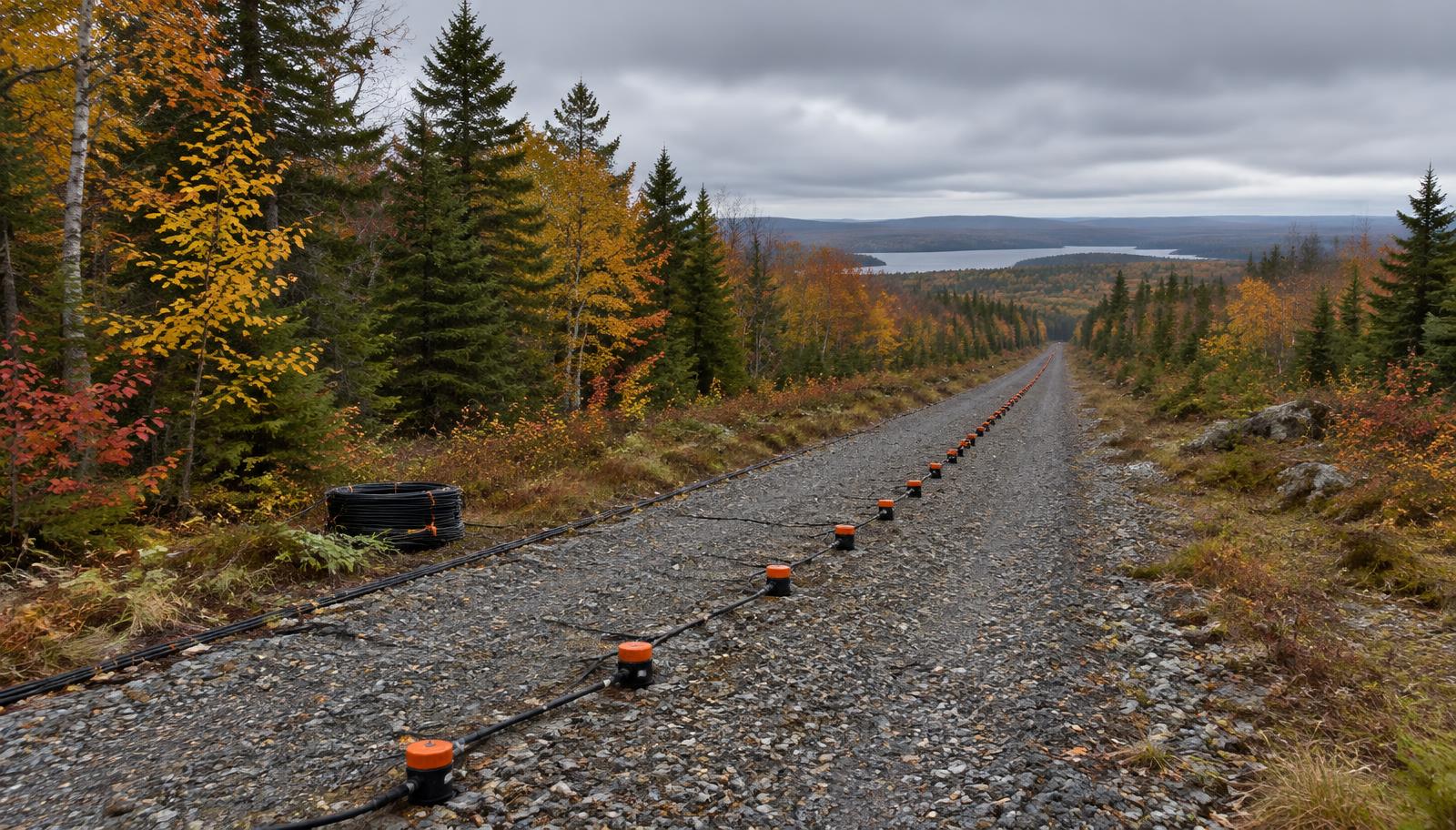
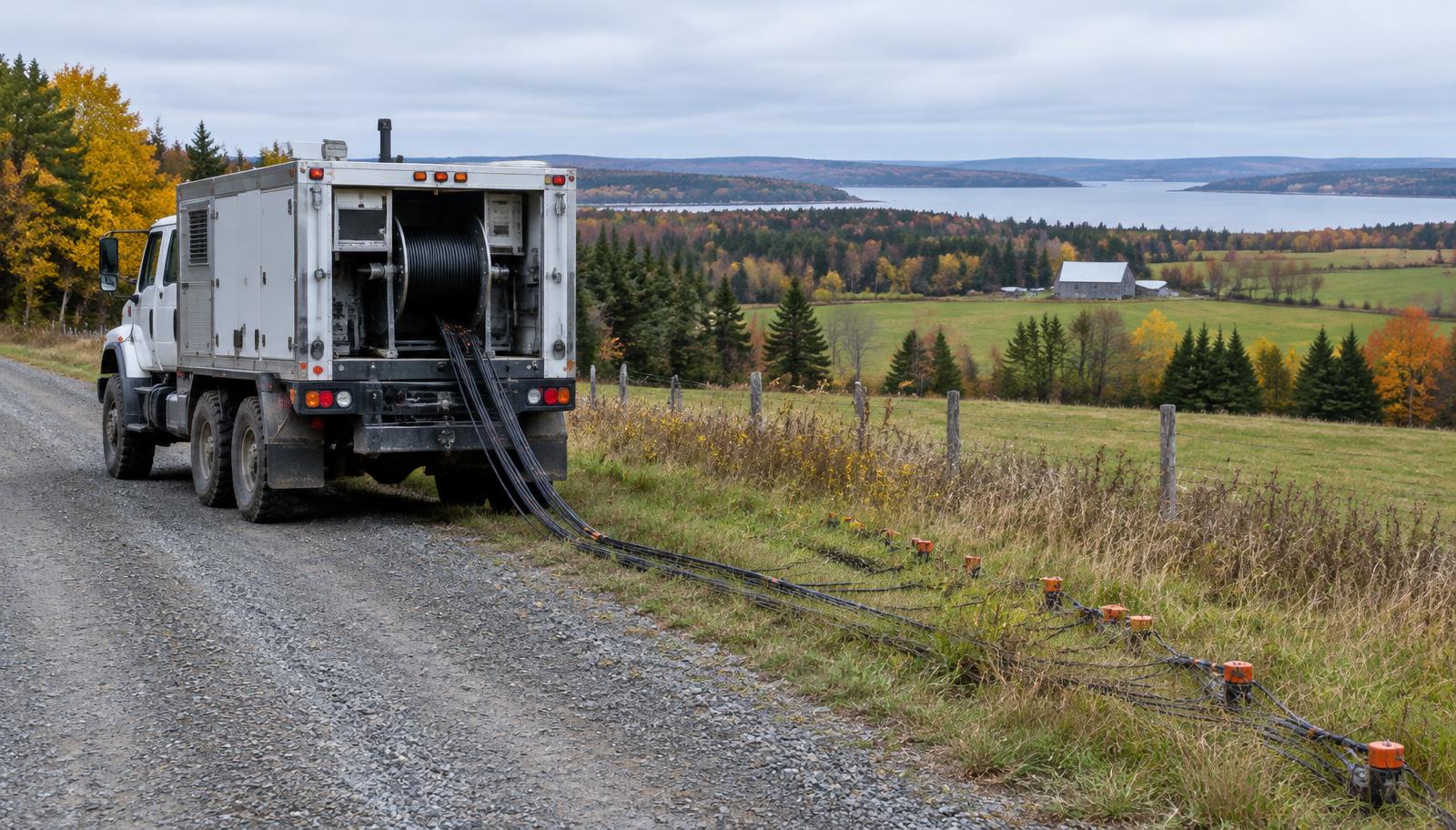
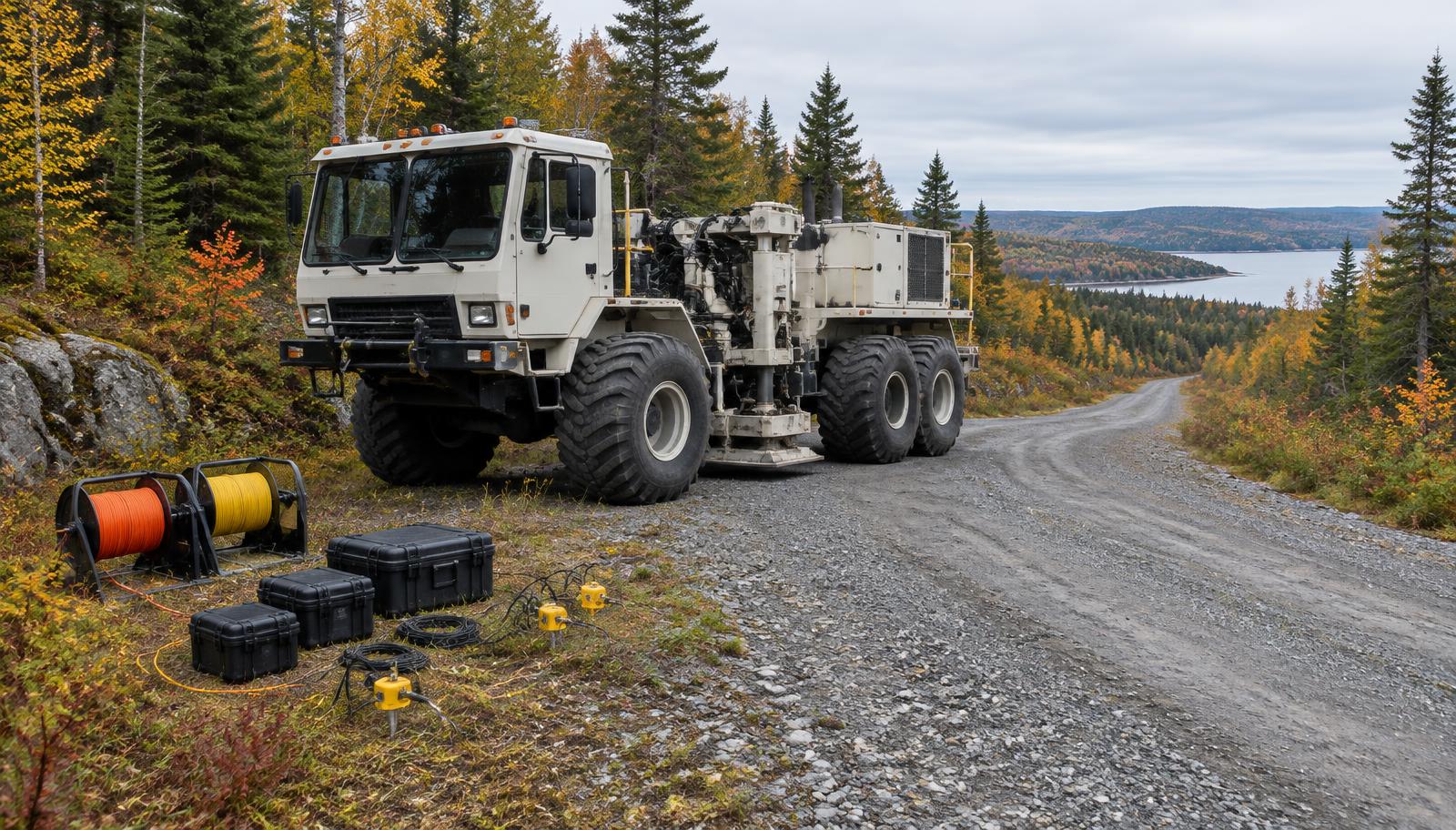
Seismic is the next layer. A vibroseis truck shakes the ground with a controlled vibration while sensors along the road record the echoes coming back from the rock layers below. A processing firm then turns those echoes into a cross-section of the subsurface. The release says the work needs no drilling or blasting and will use existing roads and rights-of-way.
Chief executive John Karagiannidis put the purpose in one line in the release: "Seismic is the tool that converts that interpretation into a potential pilot production pathway."
Why the line sits where it does
Natural hydrogen needs rock that makes it, a path to rise along, and a cap that holds it. In the release Mr. Karagiannidis describes the company's "hot zones" as the places where all of that lines up.
The Ontario side has a candidate for each.
The INRS magnetic survey found large anomalies under the three townships that the company interprets as Nipissing mafic dykes and sills, iron-rich intrusive igneous rock that can generate hydrogen when it reacts with water. The gravity survey shows a gradient along the Rivière-Blanche fault, a candidate path. Line 5 also crosses as much as it can of the Ordovician and Silurian sedimentary rock above the basement, layers the company considers possible seals.
The release presents these as interpretations. Seismic is how they get tested. A section that shows a fault reaching the basement beneath a continuous shale layer would give the company a drill target. A section without that geometry would send it back to the map.
About 126.5 kilometres across three provinces
The Ontario line adds to work already under way. The company said on October 14 that it had completed a 63.7-kilometre seismic program in Nova Scotia, longer than first planned because new hot zones turned up along the way. The Quebec program covers 36 kilometres.
| Program | Length | Status, per the company |
|---|---|---|
| Nova Scotia, Cumberland County | 63.7 km | acquired; processing under way (October 14, 2026) |
| Quebec, Témiscamingue Graben | 36 km | crew mobilising from Nova Scotia (October 20, 2026) |
| Ontario, Line 5 | 26.8 km | planned; to follow Quebec (October 20, 2026) |
| Total | about 126.5 km | completed and planned |
The Ontario and Quebec lines together come to about 63 kilometres, almost exactly the length of the finished Nova Scotia program. The company calls the three-province total its largest combined seismic program to date. Echo Seismic Ltd., which acquired the Nova Scotia data, will acquire the Quebec and Ontario lines, and Earth Signal Processing Ltd. of Calgary will process all three datasets together.
The release sets no acquisition dates for Quebec or Ontario. It lists the order of work instead. The crew moves to Quebec first, Line 5 is acquired with the same settings, and the Témiscamingue data is then combined with the earlier surveys and the Quebec monitoring-well data.
The hole that set the pattern
Nova Scotia is where the method has been furthest. The company has drilled five exploration holes there, and the fifth, DDH-26-05 at Bennett Hill, produced its most notable result.
On September 1, 2026, QIMC reported a company-record reading of 30.0 per cent hydrogen at 413 metres in that hole. The figure is a preliminary headspace concentration: the share of hydrogen in gas collected from sealed sample jars and measured with an EAGLE II gas analyser. Most of the depths sampled near the bottom of the hole read above 20 per cent, and methane read zero.
The same release described something different from a concentration. Between about 413 and 416 metres, the crew saw free gas reach surface under pressure, setting off the site's hydrogen alarms. When drilling water was added on a restart, the pressure rose again and drilling was paused.
The company was careful about what that event measures. The observations "do not constitute a flow test, formation-pressure test or reservoir test," the release said, and QIMC has not assigned a concentration, flow rate or pressure to the gas. It said it was evaluating equipment to measure pressure and flow. The October 14 release lists "continued testing at DDH-26-05" among the next steps and states that the hole ties directly into the Bennett Hill seismic line.
That puts a drill hole, a gas event and a seismic section in one place. The Ontario line is an attempt to reach that position in a second district.
C$14.13 million at the end of June
The program is funded from a treasury the company raised this spring.
In its unaudited interim statements for the nine months to June 30, 2026, approved by the board on August 26, 2026, QIMC reported cash and cash equivalents of C$14,127,210 at June 30, 2026. Total liabilities at June 30, 2026 were C$1,919,887, and marketable securities stood at C$711,980.
Most of that cash came from one financing. On April 27, 2026 the company closed a private placement that raised gross proceeds of C$17,250,345 at C$0.90 a unit.
Each unit carried one share and one warrant to buy another share at C$1.30 until April 27, 2029.
At September 30, 2025, before the placement, cash stood at C$794,701, according to the comparative column of the same statements.
The statements also carry the company's going-concern note. In Note 1, the company states that its circumstances "indicate a material uncertainty that may cast significant doubt on the Company's ability to continue as a going concern." QIMC has no revenue, and its statement of loss carries exploration and evaluation spending as an expense, detailed in Note 5.
QIMC had 156,054,801 shares outstanding at June 30, 2026, per the share-capital note. The release announced no new financing. The statements do not break out a budget for the Quebec or Ontario seismic.
The shares trade on the Canadian Securities Exchange under QIMC, on the OTCQB under QIMCF, and in Frankfurt under the symbol 7FJ, per the company's October 20 release. The German line carries WKN A3D2JV and ISIN CA7480331072, per Börse Stuttgart's listing page.
QIMC finished October 20 at C$0.385 on the CSE, unchanged on the day, on 467,106 shares, per end-of-day data read at 14:01 Pacific on October 20, 2026.
The field QIMC works in is young. The US Geological Survey published its first national map of geologic hydrogen potential on January 16, 2025, built on the same ingredients the company describes, a hydrogen source and reservoir rock under a seal. The map ranks areas by relative prospectivity on a scale of 0 to 1.
Pilot production, in the company's own words
Discussion of QIMC on retail investor message boards this week has turned to pilot production, the stage at which a company would draw gas from the ground on a small scale to test whether it flows and in what volume. Some of that discussion relays statements attributed to the company's investor-relations staff, including one that no further diamond drilling would be needed before pilot production.
That statement does not appear in the company's releases. The releases describe the objective as a pilot production pathway. On October 20 the chief executive described the objective as moving "each district from anomaly to defined target to pilot production pathway," and the October 14 release spoke of advancing toward a pilot production pathway in Nova Scotia. Neither release sets a date, a site or a budget for a pilot.
The plan the documents describe runs in a fixed order. Nova Scotia's seismic is processed and DDH-26-05 is tested while the crew acquires the Quebec and Ontario lines. The hot zones and targets are updated as the processing comes in. The October 20 release lists permitting, weather, contractor availability, interpretation, financing and regulatory approval as risks to that timing.
Where Line 5 leaves the company
Since September 1, QIMC has recorded pressurized gas in a Nova Scotia hole and completed 63.7 kilometres of seismic over that district. It has now laid out a second program on both sides of the graben, with consultation under way with municipalities and First Nations along the route, including Timiskaming First Nation.
The Line 5 sections are what will show whether the Ontario rock is stacked the way Bennett Hill appears to be. The Echo Seismic crew is moving from Nova Scotia to Quebec, and Line 5 is next on its list.
Disclosure
Transparency note. This is an independent due-diligence analysis and editorial opinion piece produced by The Maple Markets editorial desk. It is not sponsored, promoted or commissioned, and no compensation of any kind has been received from Quebec Innovative Materials Corp. (CSE: QIMC) or any party acting on their behalf. The analysis is based on public disclosure available as of the publish date; every figure is attributed to its primary source. The Maple Markets and its authors may hold positions in securities mentioned; nothing here is a recommendation to buy, sell or hold any security, and readers should not treat it as investment advice. Past disclosure does not guarantee future results. Policies: Editorial Standards · Financial Disclaimer.
Read next
Auch auf Deutsch: 26.8 Kilometer neue Seismik tragen die Wasserstoffsuche von QIMC nach Ontario
 Mining & Energy63.7 Kilometres of QIMC Seismic Data Reach the Processing StageQuebec Innovative Materials Corp. (CSE: QIMC) said on 14 October 2026 that it had finished acquiring 63.7 line-kilometres of 2D seismic across its Nova Scotia multi-gas district, expanded from a planned 50 kilometres, with Earth Signal Processing of Calgary now working on the data. Filings published on SEDI during Thursday's session record 95,000 shares bought on 14 October by the president and chief executive through a holding company and by a senior officer through another. The shares closed at C$0.385.Élise Galarneau · October 15, 2026 · 8 min
 Mining and ResourcesQIMC Completes a 63.7-Kilometre Seismic Survey in Nova ScotiaQuebec Innovative Materials Corp. (CSE: QIMC) said on 14 October 2026 that it had finished acquiring 63.7 line-kilometres of 2D seismic across its Cumberland County ground in Nova Scotia, 13.7 kilometres more than planned, and the data is already with a Calgary processor. The programme was delivered ahead of plan on ground where free gas has already reached surface once, with a treasury of about C$14.84 million against liabilities of about C$1.92 million.Élise Galarneau · October 15, 2026 · 8 min
 Mining and ResourcesQIMC Hires a Calgary Firm to Process 50 Kilometres of SeismicQuebec Innovative Materials Corp. (CSE: QIMC) engaged Calgary’s Earth Signal Processing Ltd. on October 1, 2026 to process about 50 line-kilometres of two-dimensional seismic from Apple River and Bennett Hill, Nova Scotia. The appointment adds experienced processing support to a better-defined hydrogen and helium exploration programme. The images can help focus drilling targets, while pressure and flow measurements remain later steps with no announced date.Daniel Okoye · October 2, 2026 · 7 min
Follow this story
Follow QIMC.CN — the next Maple piece on this company, plus the Maple Morning Debrief before the open.
Follow and ask
Get more of our Canadian market coverage in Google Top Stories.
Sources and references (7)
- QIMC: Extends natural hydrogen and helium seismic program across the Temiscamingue Graben into Ontario with 26.8 km new seismic line, Newsfile, October 20, 2026
- QIMC: Completes expanded 63.7 km seismic program targeting hydrogen, helium and natural gas hot zones in Nova Scotia, Newsfile, October 14, 2026
- QIMC: Reports record 30.0% clean natural hydrogen at 413 metres as pressurized free gas observations trigger repeated hydrogen alarms at Bennett Hill, Newsfile, September 1, 2026
- QIMC: Unaudited condensed interim consolidated financial statements, three and nine months ended June 30, 2026 (copy filed with OTC Markets)
- US Geological Survey: USGS releases first-ever map of potential for geologic hydrogen in the U.S., January 16, 2025
- Börse Stuttgart: Quebec Innovative Materials listing page, WKN A3D2JV
- The Maple Markets: 63.7 Kilometres of QIMC Seismic Data Reach the Processing Stage, October 15, 2026
Cite this analysis
Please attribute The Maple Markets and link to the original page.
Élise Galarneau (October 21, 2026). 26.8 Kilometres of New Seismic Take QIMC's Hydrogen Search Into Ontario. The Maple Markets. https://themaplemarkets.ca/en/newsroom/quebec-innovative-materials-has-extended-its-natural-hydrogen-andhttps://themaplemarkets.ca/en/newsroom/quebec-innovative-materials-has-extended-its-natural-hydrogen-and