
Five Times More Helium Anomalies Near a Fault: QIMC's 526-Sample Survey in Nova Scotia
The peak reading of 5.864 parts per million is not a grade and was never meant to be, and the statistical tie between the anomalies and mapped faults is the result that moved the seismic programme.
Québec Innovative Materials Corp. (CSE: QIMC) reported on September 22, 2026 that a 526-sample helium soil-gas survey across 28 lines at New Salem-Apple River, Nova Scotia, identified fault-associated helium zones, with a peak of 5.864 parts per million by volume against a district background of 5.40 ppmv. The survey's load-bearing number is not the peak. It is the finding that anomalous stations occur roughly five times more often within 1.5 kilometres of a mapped fault than beyond two kilometres, which is why the 2D seismic programme grew from 42 to about 50 line-kilometres.
By Priya Sandhu8 min read
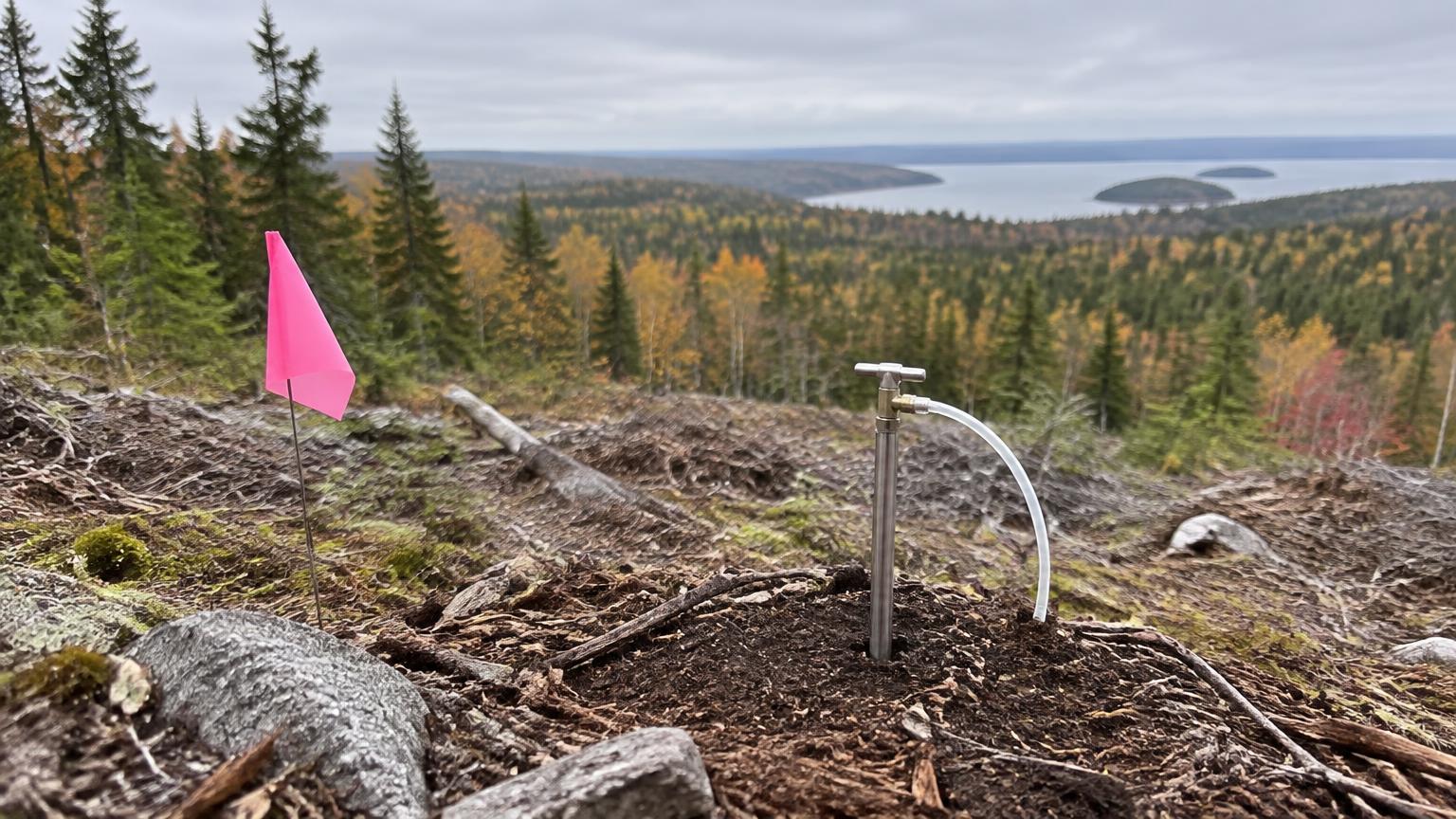
Peak helium, Zone C
5.864 ppmv
highest of 526 soil-gas samples, against a district background of 5.40 ppmv and an anomaly threshold of 5.48 ppmv, per QIMC's release of September 22, 2026
Commercial helium cutoff
0.3 mole per cent, or 3,000 ppmv
the commonly accepted threshold for commercial helium recovery, per USGS Scientific Investigations Report 2021-5085; the peak soil-gas reading is about one five-hundredth of it
Fault association
17 per cent versus 3 per cent
share of stations anomalous within 1.5 km of a mapped fault against beyond 2 km, significance p < 10⁻⁸, per the September 22, 2026 release
Seismic programme
about 50 line-kilometres
expanded from 42 line-km committed on September 14, 2026, with 8.5 km added over the helium zones
Listing and market value
CSE: QIMC, FSE: 7FJ, WKN A3D2JV, ISIN CA7480331072
C$0.59 close and about C$92.07 million market value on 156.05 million shares, September 22, 2026 (QuoteMedia, 15-minute delayed, secondary market data)
A soil-gas survey at New Salem-Apple River in Nova Scotia returned its strongest helium reading at 5.864 parts per million by volume. Ordinary air carries about 5.2.
Québec Innovative Materials Corp. (CSE: QIMC) released that survey on September 22, 2026 and reported that its helium anomalies cluster along mapped faults in the Cumberland Basin. Every sample was analysed by an outside geochemistry laboratory, GeoFrontiers Corporation of Wichita Falls, Texas, rather than in-house. The programme collected 526 samples across 28 lines and lifted the district database to 554.
The headline figure has already been read in two incompatible ways, and the arithmetic settles which one is available.
5.864 parts per million is a tracer value, not a grade
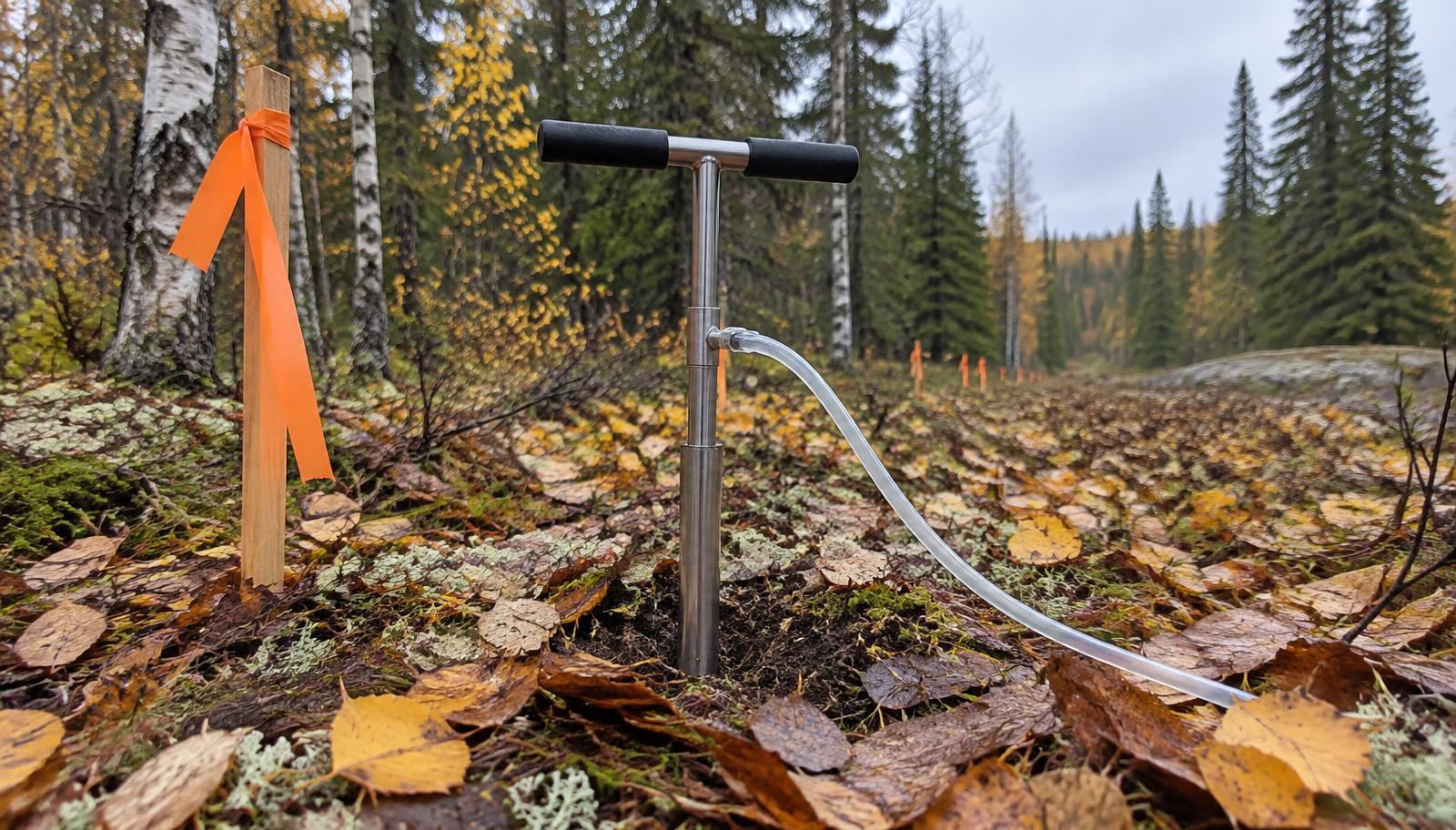
Soil-gas surveying works by measuring the tiny quantity of gas held in the ground a metre or so below surface and looking for places where it differs from the surrounding area. Helium is used for this because it is chemically inert, very light and does not get consumed on the way up, so it tends to mark the route rather than the destination.
The numbers in the release describe that kind of measurement, and they are close together by design. The company set a district background of 5.40 ppmv and an anomaly threshold of 5.48 ppmv, both as reported on September 22, 2026. The strongest result, 5.864 ppmv in Zone C, sits 0.464 ppmv above background, about 8.6 per cent higher. Of the 526 samples, 463 were classed as background, 63 as anomalous and 18 as strongly anomalous above 5.57 ppmv. That is 12.0 per cent anomalous and 3.4 per cent strongly anomalous.
Two outside benchmarks put the scale in order. Air carries helium at about 5.2 parts per million, which is why extracting it from the atmosphere is not economic, according to the U.S. National Academies' study of the federal helium reserve. Every reading in this survey, background and peak alike, therefore sits within roughly 13 per cent of the concentration of ordinary air. Separately, the U.S. Geological Survey's national assessment of helium resources states that "the commonly accepted cutoff for commercial viability of helium recovery and processing is a gas containing 0.3 mole percent helium." That is 3,000 ppmv. The peak soil-gas figure is close to one five-hundredth of it.
None of that is a criticism of the survey. No operator proposes to produce helium from soil. The point of the arithmetic is that 5.864 ppmv cannot be compared with a reservoir concentration, and anyone treating the peak as a grade has the wrong instrument in hand.
The fault statistic is the result that carries weight
The finding that does real work is statistical. QIMC reported that anomalous stations occur roughly five times more frequently within 1.5 kilometres of a mapped fault than beyond two kilometres, 17 per cent against three per cent, and put the significance at p less than 10⁻⁸. A p-value is the probability of seeing a pattern that strong if the samples were actually scattered at random; at 10⁻⁸ the random explanation is not a live option for this dataset.
That matters because it converts a cloud of near-background readings into a geometry. If the anomalies sat anywhere, the survey would have told the company nothing about where to point a drill. Clustering along structures says the opposite: whatever is producing the helium is using the faults to get to surface, and the faults are mappable and seismically imageable.
The zone descriptions carry the same information in a different form. Zone C, on line 5002, returned 17 anomalous stations out of 25 and an unbroken 800-metre run of them, per the September 22, 2026 release. Zone B, four kilometres west on the same east-west structure the company labels F-III, gave a 1.5-kilometre anomalous segment on line 5000 peaking at 5.690 ppmv. Zone A takes in the November 2025 New Salem traverse, which reached 5.722 ppmv with thermogenic hydrocarbons present, and now sits on a second fault, F-I, three to seven kilometres to the southwest. The release also flags a further target with a 5.831 ppmv peak on line 6002.
An 800-metre continuous anomaly is a different object from a single high sample. One station can be a bad jar, a damp hole or a patch of disturbed ground. Seventeen in a row along a line, on a structure that was mapped before the sampling, is a pattern that has to be explained geologically.
Expanding a committed seismic programme in eight days is the loudest thing in the release
QIMC engaged Echo Seismic and Strum Consulting on September 14, 2026 for a 42-kilometre 2D seismic programme in Nova Scotia. Eight days later the programme is about 50 line-kilometres, with the additional 8.5 kilometres pointed directly at the helium zones. Seismic is the method that images the faults and any structural traps beneath them, and it is considerably more expensive per kilometre than walking a soil-gas line.
Expanding a committed programme within a week of getting the data is a stronger statement about the company's own confidence than any adjective in the release. It is also the step that makes the survey testable rather than decorative: seismic either shows faults and traps under those anomalies or it does not.
That sequence is the one Maple has been following all month. QIMC reported a pressurised free-gas intersection at Bennett Hill in Quebec with hydrogen readings up to 30.0 per cent on September 1, engaged Echo Seismic and Strum Consulting for a 42-kilometre 2D seismic programme on September 14, and put 823 new soil-gas stations into Ontario on September 17. Nova Scotia is the third province in four weeks to get the same treatment: sample densely, publish the raw counts, then pay to image whatever the counts point at. A company that repeats a method in public can be held to it, which is the rarer thing at this end of the market.
The densification work now under way is the same discipline. QIMC is resampling Zones B and C at 50-metre spacing and running six north-south cross-lines through the 3.5-kilometre gap between lines 5000 and 5002. That gap is currently unsampled, and until it is filled, the two zones are two separate anomalies on one fault rather than one continuous feature.
Nothing in the release reports gas at depth
The company's own language is careful here, and it is the right place to stop. QIMC states that soil-gas anomalies do not by themselves establish the presence, composition or economic viability of gas in the subsurface, and that further geochemical, geophysical and drilling work would be required to evaluate any of it. Nothing in the September 22 release reports a helium accumulation, a reservoir, a flow rate or a concentration measured at depth. The C1 to C4 hydrocarbon results from the same samples have not yet been released.
The sequence that would have to follow is long and each step is separately uncertain: seismic imaging, then a hole that intersects the structure, then a measured gas composition at depth, then pressure and flow. Helium exploration in Nova Scotia has produced none of those yet, at this property or anywhere near it.
The company also states that it does not use hydraulic fracturing or any other form of reservoir stimulation in Nova Scotia, and that its model is conventional migration along faults into shallow traps. That is a permitting-relevant fact in a province whose subsurface framework is still being rebuilt, and it is one of the few commitments in the release that can be checked against future filings.
The money and the listing
QIMC trades on the Canadian Securities Exchange as QIMC, on the OTCQB as QIMCF and on the Frankfurt Stock Exchange as 7FJ, the symbol carried in the company's own release boilerplate. The German line is identified by WKN A3D2JV and ISIN CA7480331072, per the Frankfurt Stock Exchange listing record. Pricing on the Canadian line is where the volume is.
Shares closed at C$0.59 on September 22, up one cent or 1.7 per cent, on 257,352 shares against a 653,360-share 30-day average, about 0.4 times normal, for a market value of about C$92.07 million on 156,054,801 shares (exchange closing data, 15-minute delayed). The 52-week range to September 22, 2026 is C$0.29 to C$2.37. The tape barely registered the survey, which matters less than it usually would: the work the survey commits the company to is already booked and paid for, and the seismic will report whether or not anyone traded the news.
Market data carried cash of C$14.84 million against liabilities of C$1.92 million as at June 30, 2026. SEDAR+ was not readable when this was written, so those are the figures Maple reported on September 17 and are not verified against interim statements filed since. The company's April 2026 bought deal, reported in Maple's September 1 coverage, raised C$17,250,345 through 19,167,050 units at C$0.90, each carrying a warrant exercisable at C$1.30 until April 27, 2029. Those warrants sit far above the current price and are not a near-term funding source at C$0.59.
Where this leaves the property
QIMC has done something specific and has documented it: it sampled a district densely, sent every sample to an outside laboratory, found that its anomalies cluster on structures it had mapped in advance, and within eight days spent more money imaging those structures. On the evidence published so far this is the strongest structural case the company has made for a Nova Scotia target, and it rests on a statistic across 526 samples rather than on one lucky jar.
What the survey has not produced, and does not claim to, is gas at depth. That is what the seismic and any hole behind it are for, and the first of those is already contracted. The map is drawn and the test of it is on the calendar.
Transparency note > Transparency note. This is an independent due-diligence analysis and editorial opinion piece produced by The Maple Markets editorial desk. It is not sponsored, promoted or commissioned, and no compensation of any kind has been received from Quebec Innovative Materials Corp. (CSE: QIMC) or any party acting on their behalf. The analysis is based on public disclosure available as of the publish date; every figure is attributed to its primary source. The Maple Markets and its authors may hold positions in securities mentioned; nothing here is a recommendation to buy, sell or hold any security, and readers should not treat it as investment advice. Past disclosure does not guarantee future results. Policies: Editorial Standards · Financial Disclaimer.
Read next
Auch auf Deutsch: Fünfmal so viele Helium-Anomalien nahe einer Störung: QIMCs Survey mit 526 Proben in Nova Scotia
 Mining and ResourcesQIMC Buys the Picture: Seismic Contractors Engaged for 42 Kilometres at Bennett HillQuebec Innovative Materials Corp. (CSE: QIMC, FSE: 7FJ) engaged Echo Seismic and Strum Consulting on September 14, 2026 for 42 line-kilometres of 2D seismic across Bennett Hill and Apple River in Nova Scotia, the larger half of a 78-kilometre campaign and the biggest geophysical programme it has funded. It follows five drill holes that measured up to 30.0 per cent hydrogen at two centres about fifteen kilometres apart. The structural picture arrives this autumn; a flow test, the step that would settle deliverability, has still not been announced.Priya Sandhu · September 14, 2026 · 9 min
 EnergyThe Pressure Event Is the Result: Reading QIMC's 30.0% Hydrogen Update at Bennett HillQuébec Innovative Materials Corp. (CSE: QIMC) reported a record 30.0% H2 field reading at 413 metres in DDH-26-05 — then reported free gas reaching surface under apparent pressure between 413 and 416 metres, triggering repeated hydrogen alarms and halting the hole. Evidence for a mobile hydrogen-bearing system has strengthened. Evidence for reservoir performance has not. Benchmarked against MAX Power's completed-interval flow test at Lawson.Daniel Okoye · September 1, 2026 · 11 min
 Mining and ResourcesQIMC Takes 823 New Soil-Gas Stations Into Ontario, the Fifth Step in a Method Built in PublicQuébec Innovative Materials Corp. (CSE: QIMC) launched an expanded 2026 natural hydrogen programme on the Ontario side of the Témiscamingue Graben on September 17, 2026: 823 new soil-gas stations at 100-metre spacing over about 80 line-kilometres, taking the Ontario database to roughly 1,733 stations, alongside more than 1,100 gravimetric stations and 78 line-kilometres of 2D seismic. The shares closed at C$0.59. The company's own disclosure says none of this measures flow.Priya Sandhu · September 17, 2026 · 7 min
Follow this story
Follow QIMC.CN — the next Maple piece on this company, plus the Maple Morning Debrief before the open.
Follow and ask
Get more of our Canadian market coverage in Google Top Stories.
Opinion
This article expresses the author's personal views, is separate from news reporting and is not investment advice.
Disclosure
**Transparency note.** This is an independent due-diligence analysis and editorial opinion piece produced by The Maple Markets editorial desk. It is not sponsored, promoted or commissioned, and no compensation of any kind has been received from Quebec Innovative Materials Corp. (CSE: QIMC) or any party acting on their behalf. The analysis is based on public disclosure available as of the publish date; every figure is attributed to its primary source. The Maple Markets and its authors may hold positions in securities mentioned; nothing here is a recommendation to buy, sell or hold any security, and readers should not treat it as investment advice. Past disclosure does not guarantee future results. Policies: [Editorial Standards](https://themaplemarkets.ca/en/policies/editorial-standards) · [Financial Disclaimer](https://themaplemarkets.ca/en/policies/financial-disclaimer). See the Financial Disclaimer.
Sources and references (8)
- QIMC Identifies Three Fault-Controlled Helium Zones at New Salem-Apple River, Nova Scotia, and Expands Seismic Program to Approximately 50 Line-Kilometres (September 22, 2026)
- QIMC Engages Echo Seismic and Strum Consulting for 42-Kilometre Nova Scotia 2D Seismic Program (September 14, 2026)
- U.S. Geological Survey, National Assessment of Helium Resources Within Known Natural Gas Reservoirs (SIR 2021-5085)
- National Research Council, Selling the Nation's Helium Reserve
- Frankfurt Stock Exchange listing record, Québec Innovative Materials Corp. (WKN A3D2JV, ISIN CA7480331072)
- The Maple Markets, QIMC Takes 823 New Soil-Gas Stations Into Ontario (September 17, 2026)
- The Maple Markets, QIMC Buys the Picture: Seismic Contractors Engaged for 42 Kilometres (September 14, 2026)
- The Maple Markets, The Pressure Event Is the Result: QIMC's 30.0% Hydrogen Update at Bennett Hill (September 1, 2026)
Cite this analysis
Please attribute The Maple Markets and link to the original page.
Priya Sandhu (September 23, 2026). Five Times More Helium Anomalies Near a Fault: QIMC's 526-Sample Survey in Nova Scotia. The Maple Markets. https://themaplemarkets.ca/en/newsroom/quebec-innovative-materials-three-fault-controlled-zones-and-a-peak-ofhttps://themaplemarkets.ca/en/newsroom/quebec-innovative-materials-three-fault-controlled-zones-and-a-peak-of