
Under QIMC's Helium Zones: A Magnetic Body 10 Kilometres Long
Three separate datasets now point at one structure in Nova Scotia, and the same release states that none of them measures gas composition, pressure, flow rate or recoverable volume.
Québec Innovative Materials Corp. reported on 28 September 2026 that its 526-sample soil-gas helium survey at New Salem-Apple River in Nova Scotia, regional gravity data and aeromagnetic data all describe a single fault-bounded structure, with a magnetic body about 10 kilometres by 2 kilometres beneath two of the helium zones. The work is a reinterpretation of data the company already held. It reports no flow rate, no gas purity and no resource, and the shares closed down 3.6 per cent at C$0.54.
By Élise Galarneau7 min read
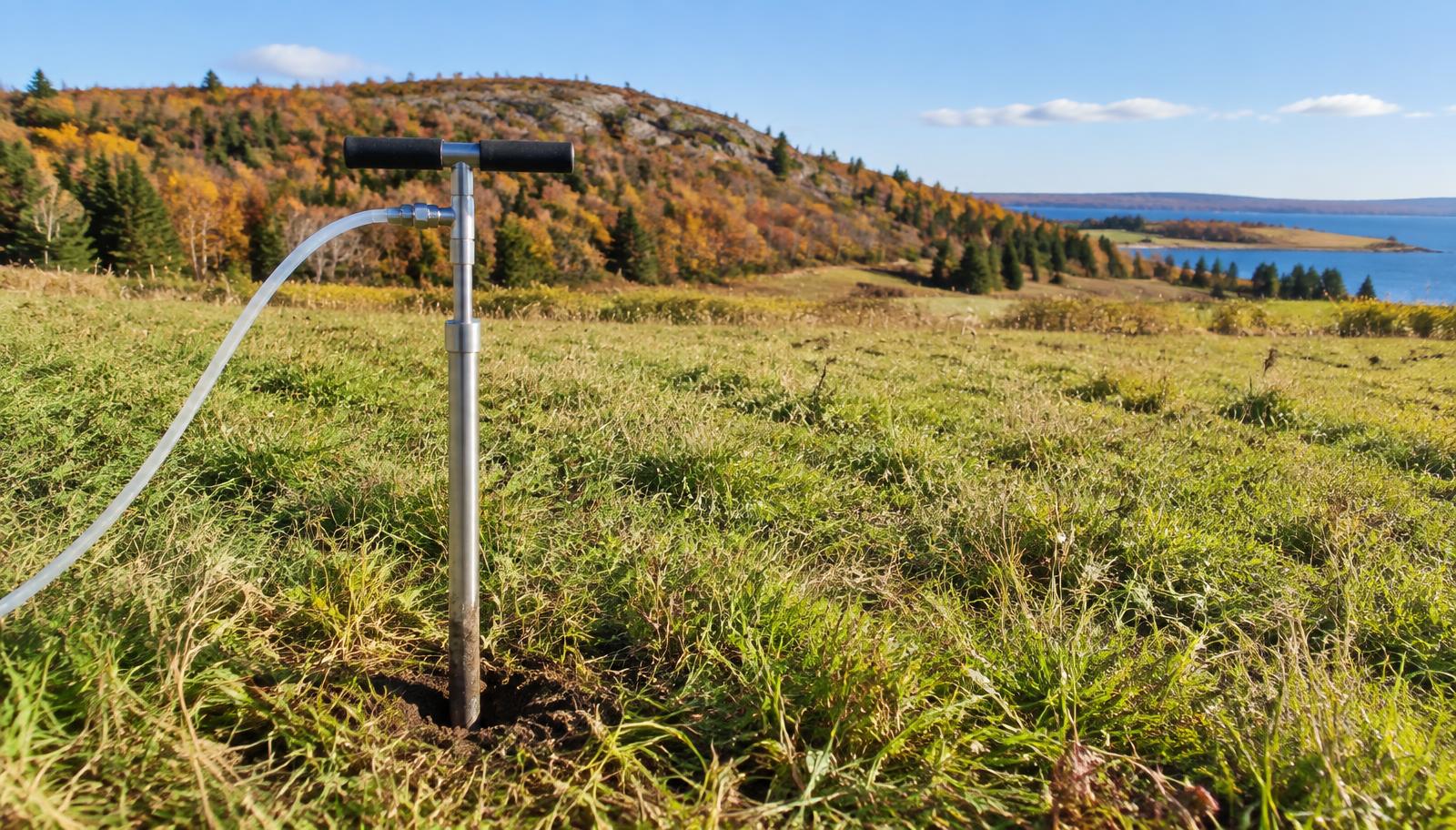
Magnetic body under Zones B and C
approximately 10 km by 2 km
interpreted from aeromagnetic data along fault F-III; company release, 28 September 2026.
Interpreted magnetic basement depth
600 to 750 m under Zone C, 900 to 1,000 m under Zone B
the release states these are not confirmed depths to gas-bearing formations.
Peak soil-gas helium
5.864 ppmv against a 5.40 ppmv background
the highest of 526 samples, 8.6% above background; survey reported 22 September 2026.
April 2026 financing
C$17,250,345 gross, 19,167,050 units at C$0.90
closed 27 April 2026; warrants at C$1.30 to 27 April 2029, 141% above the 28 September close.
Close, 28 September 2026
C$0.54, down 3.6%, market value about C$84.27 million
market data read after the close, 15-minute delayed, not verified against SEDAR+ filings.
Québec Innovative Materials Corp. now has three separate kinds of evidence pointing at the same piece of ground in Nova Scotia, and on 28 September 2026 it said so. The company reported that it "has integrated the 526-sample helium survey with regional gravity and aeromagnetic data and finds that the helium zones, the mapped faults and the buried basement architecture describe a single structure."
That is a real step forward and it deserves to be said without qualification first. Three independent datasets agreeing on one structure is better than one dataset with a strong number in it, and QIMC has built this argument in public, release by dated release, rather than presenting it complete and unfalsifiable.
The findings are specific. Regional gravity shows a north-west-dipping ramp between the low-density sediments of the Cumberland Basin and dense older basement. The helium zones, in the company's words, "lie strictly within this transition zone."
Processing of the aeromagnetic data locates a magnetic intrusive body roughly 10 kilometres by 2 kilometres beneath Zones B and C. Fault F-III runs along its south-western edge. Both zones sit where that fault bends or meets cross-structures. Depth processing of the same data puts the top of the magnetic basement at roughly 600 to 750 metres beneath Zone C and 900 to 1,000 metres beneath Zone B. The planned seismic programme has grown by about 8.5 line-kilometres to roughly 50, including a north-south line across Zone C.
The size of the helium signal, in the numbers the company published
The figures behind all of this come from the survey QIMC reported on 22 September 2026, and they are worth working through because the absolute quantities are easy to miss.
Regional background helium in the soil gas was 5.40 parts per million by volume. The threshold for calling a station anomalous was set at 5.48 parts per million, which is 1.5 per cent above background. The highest value recorded anywhere across the 526 samples was 5.864 parts per million at Zone C, which is 0.464 parts per million above background, or 8.6 per cent. Of the 526 samples, 63 were anomalous, that is 12.0 per cent, and 18 were strongly anomalous above 5.57 parts per million, which is 3.4 per cent. Helium in ordinary air runs at about 5.2 parts per million by volume.
So the entire helium signal at New Salem-Apple River sits within roughly half a part per million of the air above it. That is not a criticism of the survey. Soil-gas helium surveys are designed to detect exactly this kind of faint leakage, and the statistical case QIMC published is strong: anomalous stations were 17 per cent of those within 1.5 kilometres of a mapped fault against 3 per cent beyond 2 kilometres, a difference the company reports at a probability below one in a hundred million of arising by chance. The pattern is almost certainly real.
What the size of the numbers does mean is simpler. Nothing about the concentration at surface says anything about the concentration underground. A helium reservoir is measured in whole percentages of the gas stream, not in fractions of a part per million of soil gas. Hundreds of metres of rock separate the two.
The company says this plainly, and one sentence in its own release does not
QIMC's cautions are unusually direct for a venture-board explorer, and they are the most useful paragraph in the document. Soil-gas concentrations and geophysical interpretations, the release states, "are not measurements of reservoir gas composition, formation pressure, gas flow rate, reservoir deliverability or recoverable volumes." The work does not "establish the presence of a subsurface gas reservoir or an economically recoverable accumulation of helium, hydrogen or hydrocarbons." On the depths specifically, the release says estimates from magnetic data "refer to an interpreted magnetic source or basement feature and should not be interpreted as confirmed depths to gas-bearing formations or reservoirs."
Set that last sentence against the quote from John Karagiannidis, president and chief executive officer, in the same release: the datasets, he said, "place the target at 600 to 1,000 metres, the same depths where we intersected 24 to 30 percent clean natural hydrogen at Bennett Hill." The technical text calls those numbers depths to an interpreted magnetic feature and warns against reading them as depths to gas. The quote calls them the target depth and ties them to hydrogen concentrations measured at a different project. Both statements are in the document QIMC filed on 28 September 2026. The cautionary language is the accurate one.
There is no flow rate in the release, no well test at New Salem-Apple River, no helium purity figure and no mineral resource or reserve. A purity above 80 per cent and a commercially viable flow rate have been discussed among retail holders this week; neither figure exists in any QIMC statement, and the company has published nothing that would support either.
Money, and what the April financing costs at today's price
QIMC closed a bought-deal financing on 27 April 2026: 19,167,050 units at C$0.90 for gross proceeds of C$17,250,345, sole-underwritten by Research Capital Corporation, with a cash commission of C$1,201,224.15 and 1,334,694 broker warrants. Each unit carried one common share and one warrant exercisable at C$1.30 until 27 April 2029.
Two pieces of arithmetic follow. The shares closed on 28 September 2026 at C$0.54, which is 40 per cent below the C$0.90 that April's buyers paid. And the warrants, struck at C$1.30, sit 141 per cent above that close, which means they are not a realistic source of cash at current prices and the C$24.9 million they would raise if fully exercised should not be counted as funding.
The company has not published a cash balance in a news release since that financing, and the interim financial statements filed since were not available when this was written, so the April gross proceeds are the most recent funding figure QIMC itself has stated. A roughly 50 line-kilometre seismic programme, contracted to Echo Seismic and Strum Consulting and planned for the autumn, plus continued drilling in Nova Scotia and an expanded soil-gas programme in Ontario, is a meaningful call on whatever is left of it.
The hydrogen hole shareholders are actually waiting on
Much of the visible disappointment with this release is about what it is not. QIMC's last Bennett Hill report, on 1 September 2026, gave a company-record 30.0 per cent hydrogen reading at 413 metres in hole DDH-26-05 and described pressurized free gas reaching surface between about 413 and 416 metres, which triggered hydrogen alarms and stopped the hole twice. The company said then that it planned to continue the hole with adapted equipment and procedures, and that it was "evaluating the deployment of appropriate equipment and procedures to measure pressure and gas flow as part of the next phase of technical evaluation."
Since 1 September 2026 QIMC has published no report of that hole being completed, no measured formation pressure and no flow rate. The Maple Markets made the same point on 14 September. The position has not changed in the fortnight since. The measurement that would move Bennett Hill from a geochemical story to a reservoir one has not been taken, and the 28 September release concerns a different project on the other side of the province.
A note on one other thing circulating this week. The suggestion that a named brokerage has been accumulating ten-thousand-share lots below C$0.60 rests on broker attribution data, which shows which dealer executed a trade and not who owns the resulting shares. Dealers execute for clients, including sellers. Beneficial ownership at these levels appears in insider filings and early-warning reports, and nothing of that kind has been filed. The comparison that has also circulated, setting QIMC's market value against MAX Power Mining Corp.'s, uses figures drawn from different dates and is not repeated here.
The closing figures come from market data read after the close on 28 September 2026, 15-minute delayed and not verified against SEDAR+ filings. QIMC closed at C$0.54, down C$0.02 or 3.6 per cent, in a day range of C$0.52 to C$0.57. The volume-weighted average price was C$0.53. Volume on the Canadian Securities Exchange was 569,225 shares against a thirty-day average of 585,893, and total reported volume including alternative trading systems was about 1.17 million shares. Market value was about C$84.27 million on 156.05 million shares, against a 52-week range of C$0.29 to C$2.37.
The ticker also carried a paid "boosted" placement on a Canadian retail investor board that day. That is part of why the visible enthusiasm around it looks more one-sided than the price does.
A market that had been handed a reservoir would not have closed the stock down two cents. QIMC has been handed a map instead, and it is a better map than it had on 21 September. The well that tests it has not been drilled.
Transparency note
Transparency note. This is an independent due-diligence analysis and editorial opinion piece produced by The Maple Markets editorial desk. It is not sponsored, promoted or commissioned, and no compensation of any kind has been received from Québec Innovative Materials Corp. (CSE: QIMC), MAX Power Mining Corp. (CSE: MAXX) or any party acting on their behalf. The analysis is based on public disclosure available as of the publish date; every figure is attributed to its primary source. The Maple Markets and its authors may hold positions in securities mentioned; nothing here is a recommendation to buy, sell or hold any security, and readers should not treat it as investment advice. Past disclosure does not guarantee future results. Policies: Editorial Standards · Financial Disclaimer.
Read next
 Mining and ResourcesFive Times More Helium Anomalies Near a Fault: QIMC's 526-Sample Survey in Nova ScotiaQuébec Innovative Materials Corp. (CSE: QIMC) reported on September 22, 2026 that a 526-sample helium soil-gas survey across 28 lines at New Salem-Apple River, Nova Scotia, identified fault-associated helium zones, with a peak of 5.864 parts per million by volume against a district background of 5.40 ppmv. The survey's load-bearing number is not the peak. It is the finding that anomalous stations occur roughly five times more often within 1.5 kilometres of a mapped fault than beyond two kilometres, which is why the 2D seismic programme grew from 42 to about 50 line-kilometres.Priya Sandhu · September 23, 2026 · 8 min
 Mining and ResourcesQIMC Takes 823 New Soil-Gas Stations Into Ontario, the Fifth Step in a Method Built in PublicQuébec Innovative Materials Corp. (CSE: QIMC) launched an expanded 2026 natural hydrogen programme on the Ontario side of the Témiscamingue Graben on September 17, 2026: 823 new soil-gas stations at 100-metre spacing over about 80 line-kilometres, taking the Ontario database to roughly 1,733 stations, alongside more than 1,100 gravimetric stations and 78 line-kilometres of 2D seismic. The shares closed at C$0.59. The company's own disclosure says none of this measures flow.Priya Sandhu · September 17, 2026 · 7 min
 EnergyThe Pressure Event Is the Result: Reading QIMC's 30.0% Hydrogen Update at Bennett HillQuébec Innovative Materials Corp. (CSE: QIMC) reported a record 30.0% H2 field reading at 413 metres in DDH-26-05 — then reported free gas reaching surface under apparent pressure between 413 and 416 metres, triggering repeated hydrogen alarms and halting the hole. Evidence for a mobile hydrogen-bearing system has strengthened. Evidence for reservoir performance has not. Benchmarked against MAX Power's completed-interval flow test at Lawson.Daniel Okoye · September 1, 2026 · 11 min
Follow this story
Follow QIMC.CN — the next Maple piece on this company, plus the Maple Morning Debrief before the open.
Follow and ask
Get more of our Canadian market coverage in Google Top Stories.
Opinion
This article expresses the author's personal views, is separate from news reporting and is not investment advice.
Disclosure
**Transparency note.** This is an independent due-diligence analysis and editorial opinion piece produced by The Maple Markets editorial desk. It is not sponsored, promoted or commissioned, and no compensation of any kind has been received from Québec Innovative Materials Corp. (CSE: QIMC), MAX Power Mining Corp. (CSE: MAXX) or any party acting on their behalf. The analysis is based on public disclosure available as of the publish date; every figure is attributed to its primary source. The Maple Markets and its authors may hold positions in securities mentioned; nothing here is a recommendation to buy, sell or hold any security, and readers should not treat it as investment advice. Past disclosure does not guarantee future results. Policies: [Editorial Standards](https://themaplemarkets.ca/en/policies/editorial-standards) · [Financial Disclaimer](https://themaplemarkets.ca/en/policies/financial-disclaimer). See the Financial Disclaimer.
Sources and references (6)
- QIMC Ties New Salem-Apple River Helium Zones to a Buried Basement Structure, 28 September 2026
- QIMC Identifies Three Fault-Controlled Helium Zones at New Salem-Apple River and Expands Seismic Program, 22 September 2026
- QIMC reports record 30.0% clean natural hydrogen at Bennett Hill, 1 September 2026
- QIMC engages Echo Seismic and Strum Consulting for Nova Scotia 2D seismic program, 14 September 2026
- QIMC announces closing of C$17.3 million bought deal offering, 27 April 2026
- The Maple Markets, Five Holes, No Flow Test: Quebec Innovative Materials Turns to Seismic at Bennett Hill, 14 September 2026
Cite this analysis
Please attribute The Maple Markets and link to the original page.
Élise Galarneau (September 28, 2026). Under QIMC's Helium Zones: A Magnetic Body 10 Kilometres Long. The Maple Markets. https://themaplemarkets.ca/en/newsroom/quebec-innovative-materials-the-board-did-not-want-this-release-qimc-shttps://themaplemarkets.ca/en/newsroom/quebec-innovative-materials-the-board-did-not-want-this-release-qimc-s