
Cameco and Westinghouse: The Vertical Integration Bet
Cameco's Westinghouse stake turned a cyclical uranium miner into a fuel-cycle business with recurring services revenue. This piece unpacks what integration adds, what it costs in leverage and reporting complexity, and how to read the segments separately.
By Marc Belzile3 min readTranslation: human
Cet article n'est offert qu'en anglais pour le moment.
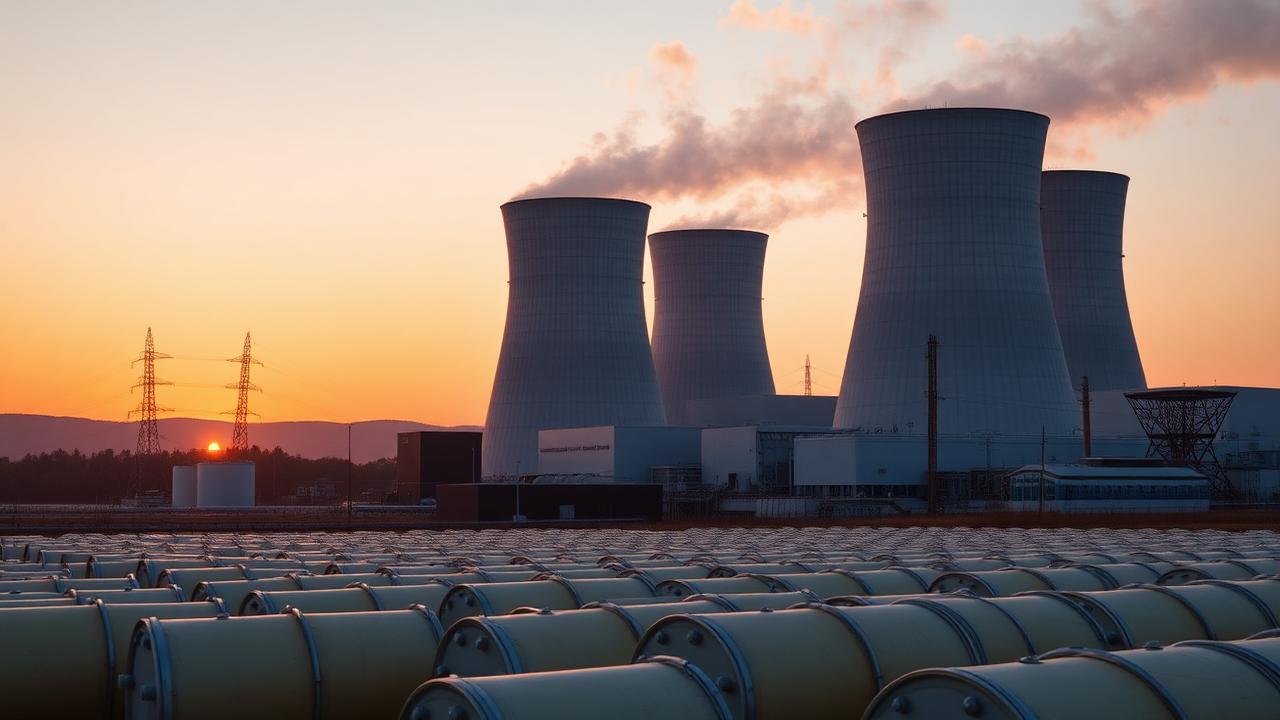
Segments
Mining plus services
Fuel cycle
Services revenue
Contractual
Installed-base driven
Reporting
Equity accounting
Harder to read
Cameco's investment in Westinghouse converted it from a uranium producer with cyclical earnings tied to a single commodity price into a business with exposure across mining, conversion, fabrication and reactor services. That shift changes not just the growth profile of the company but the entire framework an investor should use to value it, because a mining company and a services business do not trade on the same multiple, do not carry the same risk, and do not respond to the same catalysts.
What integration adds
Reactor servicing revenue is contractual and recurring, tied to the installed base of operating reactors rather than to the spot or long-term uranium price. Utilities operating a nuclear reactor need ongoing fuel fabrication, maintenance and engineering services for the operating life of that reactor, which can span decades, and that need does not disappear when uranium prices fall. That dampens the earnings volatility that historically defined Cameco as a pure-play miner, whose results swung with a commodity price driven by a relatively small and illiquid global uranium market. A services-heavy earnings mix supports a steadier valuation approach, closer to how an investor would think about an industrial services company than a mining company, even though the mining segment remains a large part of the overall business.
What it costs
The stake in Westinghouse was funded with a combination of debt and equity, which means the integration was not free and left the balance sheet more levered than the standalone mining business would otherwise be. Westinghouse's earnings are reported through equity accounting rather than full consolidation, which makes the contribution to Cameco's own income statement harder to read at a glance; a headline earnings number can move for reasons that have nothing to do with the mining segment's performance, and vice versa. Investors now effectively need to model two quite different businesses separately, using different assumptions for each, and then reconcile them through an equity-accounting adjustment that is less transparent than a straightforward consolidated segment report would be.
Balance sheet and financing considerations
Any acquisition funded partly with debt introduces a variable that a pure commodity investor did not previously have to consider: interest expense and covenant sensitivity that exist independent of the uranium price cycle. In a period of higher uranium prices, the mining segment's cash flow comfortably services that debt and the leverage looks like a sensible use of a strong balance sheet. In a period of weaker uranium prices, the same debt load becomes a more material consideration, because the servicing segment's earnings, while more stable, are not typically large enough on their own to fully offset a prolonged downturn in mining profitability. The integration reduces overall volatility but does not eliminate the underlying cyclicality of the largest segment.
The upside case
New reactor construction and life-extension programs for existing reactors benefit both segments simultaneously: new builds eventually need fuel supplied by the mining and conversion business, and every operating reactor, new or extended, needs the services Westinghouse provides for as long as it runs. If the nuclear build cycle materialises at the pace that current policy commitments in multiple countries imply, integration allows Cameco to capture value at multiple points in the fuel cycle rather than at the single point of mine-mouth uranium sales, which is the central thesis behind the acquisition.
Reading the disclosures
Because the two businesses are reported differently, an investor comparing Cameco to a pure uranium miner needs to separate the segments explicitly rather than relying on a single blended multiple. The uranium mining and conversion segments can reasonably be benchmarked against other producers, while the equity-accounted Westinghouse contribution needs to be assessed against services and engineering comparables, with an understanding that the underlying detail available on Westinghouse's own operations is less granular than what a fully consolidated segment would provide.
What to watch
Track segment-level disclosure on uranium production, conversion and fabrication volumes separately from the equity-accounted Westinghouse contribution; the trend in net debt and interest coverage as the combined entity services acquisition-related financing; the order backlog and contracted revenue disclosed for reactor servicing; and the pace of announced new reactor construction and life-extension approvals globally, which is the leading indicator for demand across both segments of the combined business.
Divulgation
Information only. Not investment advice. The Maple Markets does not hold positions in securities discussed.
À lire ensuite
Aussi en anglais: Cameco and Westinghouse: The Vertical Integration Bet
 Mining & EnergyCameco resserre sa prévision d'uranium pour 2026 après un arrêt prolongé à Key LakeCameco a publié ses résultats du troisième trimestre 2026 le 30 octobre. Un arrêt d'entretien planifié plus long à l'usine de Key Lake a réduit la production trimestrielle d'uranium à 3.5 millions de livres, la fourchette de production 2026 a été resserrée à 19.5 à 20.5 millions de livres, la prévision de coût unitaire a augmenté et Westinghouse a affiché une perte trimestrielle, moins importante qu'un an plus tôt. Les prix obtenus ont progressé, le dividende annuel de C$0.24 a été déclaré et l'action a clôturé à C$107.60, en baisse de 7.7 pour cent.Élise Galarneau · 30 octobre 2026 · 8 min
 Mining & EnergyPrêts de redémarrage américains d'environ US$4.4 milliards; l'action de Cameco glisse vers son plus basLe département de l'Énergie des États-Unis s'est engagé à verser jusqu'à US$4.4 milliards, au moyen de trois engagements de prêt fédéraux, pour redémarrer les réacteurs de Palisades, Crane et Duane Arnold. Cameco, le producteur d'uranium de Saskatoon, n'a rien publié qui le relie à ces centrales. Ses résultats de juillet font état de contrats de plus de 28 millions de livres par année en moyenne sur cinq ans, de C$1.1 milliard de trésorerie et de prévisions de production inchangées; son action a clôturé à C$113.88 le 19 octobre.Élise Galarneau · 20 octobre 2026 · 8 min
 MacroComment le prix de l'uranium canadien est fixé des années avant son extractionLe Canada produit environ le quart de l'uranium mondial et en exporte les neuf dixièmes, presque entièrement sous des contrats à long terme. Le troisième trimestre de 2026 de Cameco montre comment ces contrats fonctionnent : un prix réalisé bien inférieur au cours au comptant, une prévision resserrée après un arrêt prolongé à Key Lake, et un carnet de contrats qui lie les prix futurs au marché à l'intérieur de planchers et de plafonds.Daniel Okoye · 31 octobre 2026 · 8 min
Follow this story
Follow CCO — the next Maple piece on this company, plus the Maple Morning Debrief before the open.
Follow and ask
Get more of our Canadian market coverage in Google Top Stories.
Sources et références (2)
Citer cette analyse
Please attribute The Maple Markets and link to the original page.
Marc Belzile (June 15, 2026). Cameco and Westinghouse: The Vertical Integration Bet. The Maple Markets. https://themaplemarkets.ca/fr/newsroom/cameco-and-westinghouse-the-vertical-integration-bethttps://themaplemarkets.ca/fr/newsroom/cameco-and-westinghouse-the-vertical-integration-bet