
Kinross Raised Its Cost Per Ounce Eight Per Cent, and the Arithmetic Points at the Denominator
All-in sustaining cost is a ratio, and the September revision moved the bottom of that ratio at least as much as the top.
Kinross Gold cut its 2026 production outlook and raised its all-in sustaining cost outlook in one release on September 23, 2026. The cost figure went from about US$1,730 per ounce to US$1,850 to US$1,900 per ounce. Holding February's implied total cost dollars constant and dividing by the new ounce count gives US$1,870 per ounce, inside the new band. That is what a per-ounce cost measure does when the ounces go missing, and it is the single most useful thing to understand about a gold producer's headline cost number.
By Marc Belzile8 min read
2026 all-in sustaining cost guidance
US$1,850 to US$1,900 per Au eq. oz. sold
revised September 23, 2026 from approximately US$1,730 plus or minus 5 per cent set February 18, 2026, an increase of about 8.4 per cent at the midpoint (Kinross releases via GlobeNewswire).
2026 production guidance
1.84 to 1.86 million Au eq. oz.
revised September 23, 2026; the company describes this as 2 to 3 per cent below the low end of the prior 2.0 million plus or minus 5 per cent range, and it is 7.5 per cent below that range's midpoint.
The denominator identity
US$1,870 per oz
February's implied total of about US$3.46 billion of all-in sustaining cost dollars divided by 1.85 million ounces; inside the new band. Maple Markets arithmetic on Kinross guidance figures, not a company disclosure.
Q2 2026 realised price less all-in sustaining cost
US$2,666 per oz
US$4,487 realised against US$1,821 of cost, per the July 29, 2026 release; the same difference was US$1,852 per oz for full-year 2025.
Canadian gold output
about 200 tonnes, C$16.9 billion
2024, fourth largest in the world at 6.1 per cent of global mine production; Ontario 79.9 t and Quebec 55.5 t (Natural Resources Canada).
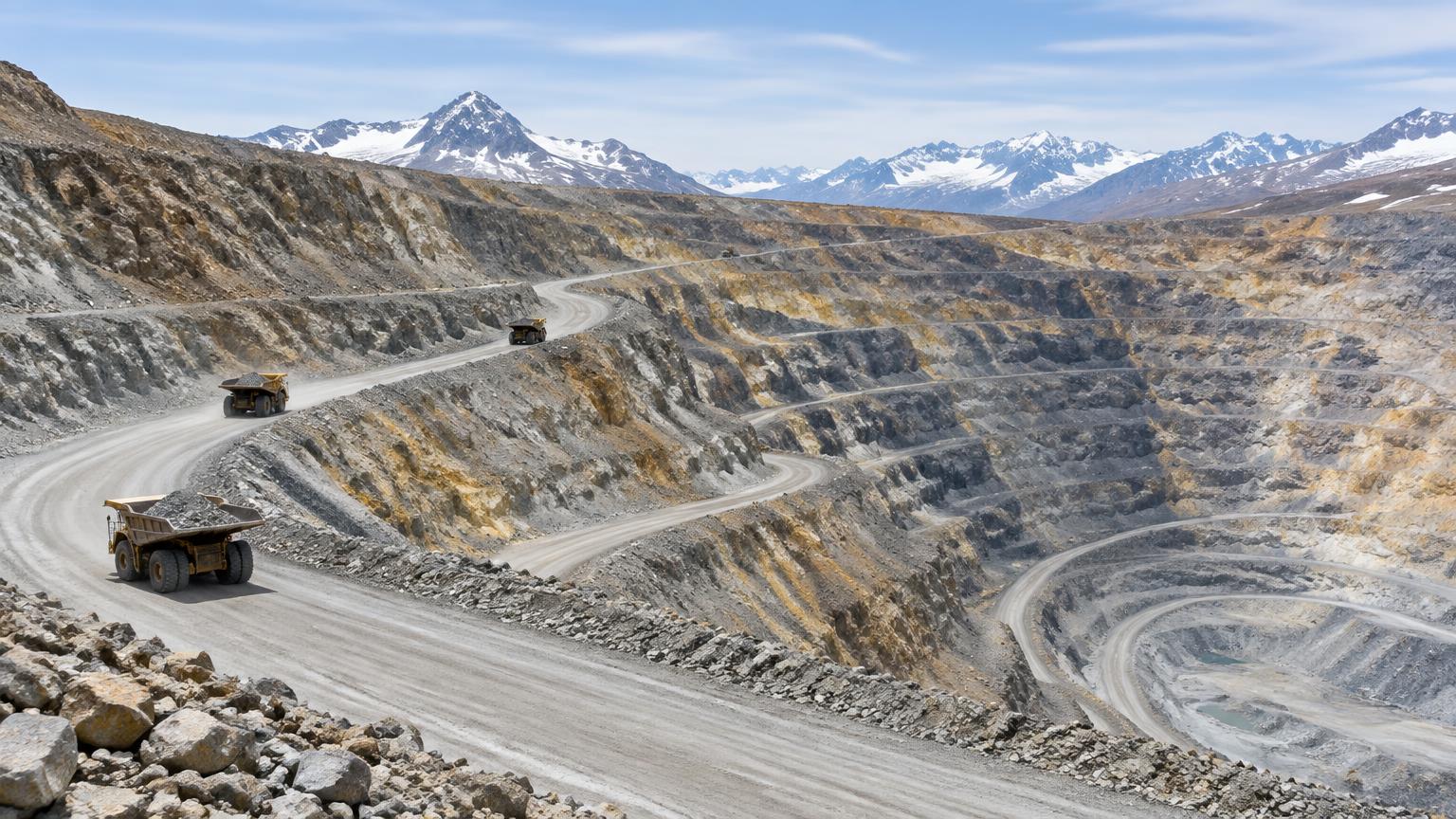
The Chilean winter is in Kinross Gold's cost guidance now. On September 23, 2026 the company told the market that unprecedented winter weather events at its La Coipa mine had disrupted mining and milling through the third quarter, and in the same release it lowered how much gold it expects to produce and raised how much each ounce will cost.
The two revisions arrived together, and most of the attention went to the second one. Kinross now expects all-in sustaining cost of approximately US$1,850 to US$1,900 per gold equivalent ounce sold in 2026, against approximately US$1,730 per ounce, plus or minus five per cent, in the guidance it published on February 18, 2026. Against the midpoint of the new band that is an increase of about 8.4 per cent.
Maple's report on the release, published September 24, 2026 under Élise Galarneau's byline, put the production cut at three per cent and the cost increase at eight per cent, and both figures hold up against the company's own documents. The cost number, though, is not a price. It is a fraction, and the company lowered its denominator in the same sentence.
The cost figure most people quote is a ratio, and it is not an accounting measure
All-in sustaining cost is the cash a producer spends to mine, process and sell an ounce of gold and to keep the mine it came from running, divided by the ounces it sold. Kinross calculates it on guidance published by the World Gold Council, and its own quarterly release states that the measure has no standardised meaning under International Financial Reporting Standards and is not necessarily indicative of results prepared under those standards. That is not a criticism of the company. It is the status of the number. Every senior gold producer reports it, none of them is audited on it, and the comparability across producers that makes it popular is a convention rather than a rule.
Two things sit outside it. The first is growth capital: money spent building something that does not yet produce. Kinross guided to total capital expenditures of approximately US$1.5 billion, plus or minus five per cent, for 2026 in its February release, and all-in sustaining cost captures only the sustaining portion of that. The second is everything below the operating line: taxes, interest and working capital. A producer can therefore report a rising cost per ounce and a rising cash balance in the same quarter without either figure being wrong.
The company also reports a narrower measure, production cost of sales per ounce, which is the mining and processing cost without sustaining capital. It moved in the same direction and by a similar proportion: the company guided to approximately US$1,360 per ounce, plus or minus five per cent, on February 18, 2026, and to approximately US$1,420 to US$1,460 per ounce on September 23, 2026. The gap between the two measures, roughly US$430 per ounce at the new midpoints, is what sustaining capital and the other included items cost.
Three data points from the company's own filings
| Basis | Attributable production, Au eq. oz. | All-in sustaining cost, US$/oz sold | Gold price |
|---|---|---|---|
| 2025 actual (results release, February 18, 2026) | 2,012,106 | 1,571 | 3,423 realised |
| 2026 guidance (February 18, 2026) | 2,000,000 plus or minus 5% | about 1,730 plus or minus 5% | 4,500 assumption |
| 2026 revised (September 23, 2026) | 1,840,000 to 1,860,000 | 1,850 to 1,900 | 4,350 assumption, rest of 2026 |
Take February's two point estimates and multiply them. Two million ounces at US$1,730 per ounce implies about US$3.46 billion of all-in sustaining cost dollars for the year. Divide that same total by 1.85 million ounces, the midpoint of the new range, and the result is US$1,870 per ounce. The new guidance band is US$1,850 to US$1,900.
That arithmetic is an identity, not a disclosure. Kinross did not publish a revised total cost figure and has not said that its total spending is unchanged. What the identity establishes is narrower and still useful: the entire eight per cent increase in the headline cost per ounce is arithmetically consistent with the same dollars spread over fewer ounces.
The reasons the company gave for the revision were operational rather than financial, and they were specific. At La Coipa, alongside the weather, it cited higher than expected copper grades and lower than expected recoveries in some of the sulphide ore. At Round Mountain it cited lower mining rates and lower than expected grades and recoveries. None of those is a cost-inflation story. All of them are ounce stories.
The three per cent and the seven and a half per cent are both correct
The production revision deserves its own paragraph because the percentage attached to it depends entirely on what it is measured against. Kinross described the new range as two to three per cent below the low end of the previously disclosed guidance. The low end of 2.0 million ounces, plus or minus five per cent, is 1.90 million ounces, and 1.84 to 1.86 million ounces is indeed two to three per cent below that. Measured against the midpoint of the old range rather than its floor, 1.85 million against 2.00 million is 7.5 per cent lower.
Neither framing is misleading and both are in the documents. They simply answer different questions, and a cost-per-ounce figure responds to the second one.
The half-year split makes the same point in a different currency. Kinross reported attributable production of 984,889 gold equivalent ounces for the first half of 2026 in its release dated July 29, 2026, of which 492,326 ounces came in the second quarter. Against a full-year midpoint of 1.85 million, that leaves about 865,000 ounces for the second half, roughly 12 per cent below the first. The company guided to approximately 425,000 ounces in the third quarter, which implies about 440,000 in the fourth. The ounces are not coming back this year.
The margin per ounce went up while the cost per ounce went up
A rising cost per ounce does not by itself mean a shrinking margin, and here it did not. Kinross reported an average realised gold price of US$3,423 per ounce for full-year 2025 against all-in sustaining cost of US$1,571 per ounce, in its results release dated February 18, 2026, a difference of US$1,852 per ounce. According to the quarterly release dated July 29, 2026, it realised US$4,487 per ounce in the second quarter of 2026 against all-in sustaining cost of US$1,821 per ounce, a difference of US$2,666 per ounce. The cost per ounce rose 15.9 per cent between those two periods. The difference between price and cost rose 44 per cent.
A producer whose cost per ounce is climbing can be earning substantially more per ounce than it did a year earlier, and in this case it was. That is the honest arithmetic on the company's own figures, and it is also the entire extent of what those figures show. A difference between a realised price and a non-standardised cost ratio is not profit. It excludes the taxes, the interest and the growth capital that all-in sustaining cost is defined to leave out.
At the guidance level, the direction reverses once the ounce count is included. February's assumptions, US$4,500 per ounce against US$1,730 of cost across 2.0 million ounces, imply about US$5.54 billion of gross margin at that measure. September's, US$4,350 per ounce against US$1,875 across 1.85 million ounces, imply about US$4.58 billion. That is about 17 per cent less at the same measure, on a price assumption that fell only 3.3 per cent. Fewer ounces did most of that work, and the cost ratio is where it became visible.
In the same release of September 23, 2026, Kinross said it was raising the share of free cash flow it intends to return for 2026 from 40 to 50 per cent, and that it expects to return approximately US$800 million to shareholders this year including approximately US$655 million of share repurchases.
The company reported that it has returned more than US$1.5 billion to shareholders since the first quarter of 2025 and repurchased more than four per cent of its outstanding shares over that period. At June 30, 2026 it held US$2,656.4 million of cash and cash equivalents against US$738.8 million of long-term debt, and generated US$1,564.3 million of attributable free cash flow in the first half. Those figures match the ones in Maple's September 24, 2026 report and come from the same quarterly release.
What this changes for a Canadian holder
Canada produced close to 200 tonnes of gold in 2024, with a production value of C$16.9 billion, and ranked fourth in the world at 6.1 per cent of global mine production, according to Natural Resources Canada's gold facts page, read on September 26, 2026. Ontario accounted for 79.9 tonnes and Quebec for 55.5 tonnes, together 68 per cent of national output. Gold producers are correspondingly heavy in Canadian resource funds, and a cost-per-ounce revision at a large producer is read across the group within hours.
There is a currency layer that the cost ratio hides entirely. Kinross reports in US dollars while its shares trade in Canadian dollars in Toronto, and its February guidance named 1.38 Canadian dollars to the US dollar among its key exchange rate assumptions. The Bank of Canada's daily exchange rate on September 25, 2026 was 1.4145. A Canadian dollar weaker than the assumption raises the Canadian-dollar value of US-dollar revenue and of US-dollar costs alike; only the portion of costs actually incurred in Canadian dollars gets cheaper in US-dollar terms. The company does not break out that portion in the guidance release, so the size of the effect is not something the release supports a figure for.
The Toronto close on September 24, 2026 was C$34.50, down C$4.41 or 11.3 per cent, as Maple reported that day. Whether an eleven per cent move is the right response to a guidance revision of this shape is not something the filings answer. What they do answer is which number moved.
All-in sustaining cost is a fraction. Only one of its two numbers made the headline.
Transparency note
Transparency note. This is an independent due-diligence analysis and editorial opinion piece produced by The Maple Markets editorial desk. It is not sponsored, promoted or commissioned, and no compensation of any kind has been received from any issuer, government body or organisation named in this article or any party acting on their behalf. The analysis is based on public disclosure available as of the publish date; every figure is attributed to its primary source. The Maple Markets and its authors may hold positions in securities mentioned; nothing here is a recommendation to buy, sell or hold any security, and readers should not treat it as investment advice. Past disclosure does not guarantee future results. Policies: Editorial Standards · Financial Disclaimer.
Read next
Auch auf Deutsch: Kinross hebt die Kosten je Unze um acht Prozent an, und die Rechnung zeigt auf den Nenner
 Mining and ResourcesKinross Cut 2026 Production Three Per Cent and Raised All-In Cost Guidance EightKinross Gold cut 2026 and 2027 production guidance to about 1.84 to 1.86 million gold equivalent ounces, two to three per cent below the low end of its previous range, and lifted its 2026 return of capital target from 40 to 50 per cent of free cash flow. The cost revision in the same release was proportionally larger. Shares closed at C$34.50 on 24 September, down 11.3 per cent.Élise Galarneau · September 24, 2026 · 7 min
 Mining and ResourcesAya Gold and Silver Has Drilled 3,501 g/t Silver at Zgounder and Sold Nothing From It YetAya Gold & Silver Inc. (TSX: AYA) reported high-grade silver intercepts near the Zgounder pit and at depth on September 16, 2026, eight days after doubling the paper value of its Boumadine project and fifteen days after agreeing to buy a copper-silver land package. The shares closed at C$40.24 on 17 September. The company holds US$182.8 million of cash, and about 80 per cent of the metal in the Boumadine study is in the most speculative resource category there is.Élise Galarneau · September 18, 2026 · 8 min
 Mining and ResourcesOne 0.65-Metre Sample Supplies Three Quarters of the Gold in Ashley Gold's 60-Metre IntervalAshley Gold Corp. (CSE: ASHL) closed at C$0.11 on September 25, 2026, up 69.2 per cent on roughly 48 times its 30-day average volume, after reporting 3.333 g/t gold over 60.00 metres downhole at the Tak Patents in northwestern Ontario. Three quarters of the metal in that average comes from one 0.65-metre sample assaying 229 g/t. The company capped that sample at 40 g/t in its own release and said true thickness is unknown. Ashley Gold has no mineral resource on the property.Élise Galarneau · September 25, 2026 · 7 min
Follow this story
Follow XGD.TO — the next Maple piece on this company, plus the Maple Morning Debrief before the open.
Follow and ask
Get more of our Canadian market coverage in Google Top Stories.
Opinion
This article expresses the author's personal views, is separate from news reporting and is not investment advice.
Disclosure
## Transparency note **Transparency note.** This is an independent due-diligence analysis and editorial opinion piece produced by The Maple Markets editorial desk. It is not sponsored, promoted or commissioned, and no compensation of any kind has been received from any issuer, government body or organisation named in this article or any party acting on their behalf. The analysis is based on public disclosure available as of the publish date; every figure is attributed to its primary source. The Maple Markets and its authors may hold positions in securities mentioned; nothing here is a recommendation to buy, sell or hold any security, and readers should not treat it as investment advice. Past disclosure does not guarantee future results. Policies: [Editorial Standards](https://themaplemarkets.ca/en/policies/editorial-standards) · [Financial Disclaimer](https://themaplemarkets.ca/en/policies/financial-disclaimer). See the Financial Disclaimer.
Sources and references (7)
- Kinross provides operational and return of capital update, September 23, 2026
- Kinross reports 2025 fourth-quarter and full-year results, including 2026 guidance, February 18, 2026
- Kinross reports strong 2026 second-quarter results, July 29, 2026
- Kinross Gold news releases
- Natural Resources Canada, Gold facts
- Bank of Canada, daily exchange rates
- The Maple Markets, Kinross Cut 2026 Production Three Per Cent and Raised All-In Cost Guidance Eight, September 24, 2026
Cite this analysis
Please attribute The Maple Markets and link to the original page.
Marc Belzile (September 26, 2026). Kinross Raised Its Cost Per Ounce Eight Per Cent, and the Arithmetic Points at the Denominator. The Maple Markets. https://themaplemarkets.ca/en/newsroom/all-in-sustaining-cost-why-a-record-gold-price-is-not-a-record-marginhttps://themaplemarkets.ca/en/newsroom/all-in-sustaining-cost-why-a-record-gold-price-is-not-a-record-margin