
Cameco Narrows Its 2026 Uranium Forecast After a Longer Key Lake Shutdown
Third-quarter output fell to 3.5 million pounds while the price Cameco realized rose, and the shares ended lower on October 30.
Cameco reported third-quarter 2026 results on October 30. A longer planned maintenance stop at the Key Lake mill cut quarterly uranium output to 3.5 million pounds, the 2026 production range narrowed to 19.5 to 20.5 million pounds, unit cost guidance rose and Westinghouse posted a quarterly loss, smaller than a year earlier. Realized prices rose, the C$0.24 annual dividend was declared and the shares closed at C$107.60, down 7.7 per cent.
By Élise Galarneau7 min read
Q3 2026 uranium production
3.5 million lb
down from 4.4 million lb in Q3 2025; Cameco Q3 release, October 30, 2026.
2026 production guidance
19.5 to 20.5 million lb
narrowed from 19.5 to 21.5 million lb; Q3 2026 MD&A, October 30, 2026.
Average realized uranium price
US$65.78/lb
Q3 2026, against US$62.12 in Q3 2025; Cameco Q3 release.
Cash and total debt
C$860 million cash; C$1.0 billion debt
at September 30, 2026; Q3 2026 MD&A.
Close on October 30
C$107.60, down 7.7 per cent from C$116.63
3,498,369 shares on the TSX; end-of-day data on TMX Money (QuoteMedia) read at 13:58 PT.
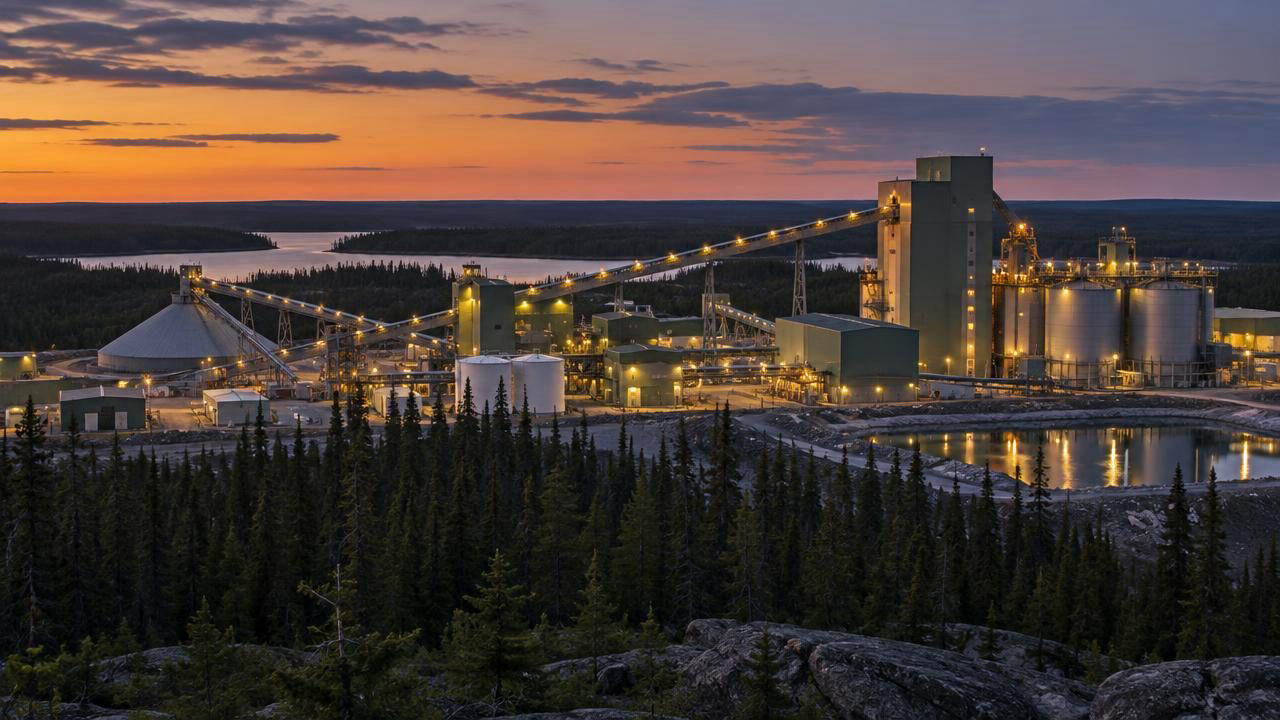
The Key Lake mill in northern Saskatchewan is where ore from the McArthur River mine is turned into the yellow powder utilities eventually buy. This summer Cameco kept it shut for longer than in any recent year, to install new equipment and repair old equipment, and on October 30 the company's third-quarter results showed what that pause cost.
Cameco called its year-to-date performance "as expected" in the headline of its release. The quarter itself was quieter than a year ago on almost every volume line, and the company tightened its production forecast for the year.
The mill stop explains most of the quarter
Cameco mines uranium in Saskatchewan at McArthur River and Cigar Lake, buys a share of the output of the JV Inkai joint venture in Kazakhstan, converts uranium into reactor feed at its fuel services plants in Ontario, and owns 49% of Westinghouse, the reactor designer and fuel supplier. Uranium is the largest piece of the business.
Uranium production was 3.5 million pounds in the third quarter, down from 4.4 million a year earlier, according to the October 30 release. The MD&A for the quarter says the Key Lake shutdown "included the installation of new infrastructure and repairs to major existing infrastructure" and was "planned to be longer than in previous years." Commissioning of the new equipment is underway.
The company lists a plain risk beside that work: the installations and repairs "may not proceed as scheduled, or may encounter unforeseen delays." The production forecast for the year was narrowed in the same MD&A.
Cameco narrowed its forecasts for production and for deliveries; for production it lowered the top of the range by 1 million pounds and kept the bottom. The working for the fourth quarter is a subtraction: the new range for the year, less what was done by September 30, 2026.
| 2026, million lb U3O8 | Guidance (Oct 30) | Previous guidance | Nine months to Sept 30 | Left for Q4 |
|---|---|---|---|---|
| Production | 19.5 to 20.5 | 19.5 to 21.5 | 13.6 | 5.9 to 6.9 |
| Sales and deliveries | 29.5 to 30.5 | 29 to 32 | 20.5 | 9.0 to 10.0 |
Fewer pounds sold, at a better price
Sales followed production down. Cameco sold 5.6 million pounds in the quarter, against 6.1 million a year earlier. The average price it realized rose to US$65.78 a pound from US$62.12.
That realized price sits well below the market quotes in the same MD&A, which put spot uranium at US$89.63 a pound and the long-term price at US$96.50 at September 30. The spot price is what a pound costs for delivery now; the long-term price is the benchmark for contracts that deliver years out. Cameco sells mostly under long-term contracts signed in earlier years, so its realized price moves more slowly than the market, up or down.
The company says it has contracts in place for average deliveries of more than 28 million pounds a year over the next five years, with commitments above that average in 2026 to 2028 and below it in 2029 and 2030.
Costs moved the other way. Cameco raised its 2026 guidance for the average unit cost of sales, which is what each pound sold costs the company including depreciation, to C$67.00 to C$70.00 a pound from C$63.00 to C$67.50. A mill with largely fixed running costs usually costs more per pound when fewer pounds come through it.
On the other side, the company cut its 2026 capital spending guidance to C$440 million to C$490 million, from C$490 million to C$540 million, which the MD&A attributes primarily to the timing of certain mine development activities at its northern operations.
Adjusted earnings fell on higher uranium costs
Cameco reported revenue of C$619 million for the three months ended September 30, 2026, against C$615 million a year earlier. Net earnings were C$43 million, or C$0.10 a share, up from nil, according to the MD&A.
Cameco also reports adjusted net earnings, which strip out items such as gains and losses on currency hedges so the operating result is easier to follow. On that measure the quarter was a loss of C$2 million, against earnings of C$32 million a year earlier. The company's summary attributes the results for the quarter and the first nine months to lower equity earnings from Westinghouse, lower sales volumes and the higher unit cost, partly offset by the better realized price. For the third quarter alone, the adjusted earnings bridge in the October 30 release shows higher uranium costs reducing earnings by C$71 million, while earnings from equity-accounted investees, which include Westinghouse, added C$19 million.
Westinghouse contributed a net loss of C$24 million as Cameco's share, smaller than the C$32 million loss of the third quarter of 2025. Its adjusted EBITDA attributable to Cameco, a measure of operating earnings before interest, taxes, depreciation and amortization, was C$143 million in the quarter, against C$124 million in the third quarter of 2025. For the nine months it fell to C$427 million from C$569 million.
For the nine months, when earnings from equity-accounted investees were C$70 million lower, the MD&A attributes the decline to Westinghouse's participation in the Dukovany new-build project in the Czech Republic, which added about US$170 million to Cameco's share of Westinghouse's revenue in the second quarter of 2025. The Dukovany effect explains the nine-month comparison; the third quarter alone shows a smaller Westinghouse loss and higher adjusted EBITDA than a year earlier.
The reactor pipeline is the longer-term part of the Westinghouse story. In September the US Department of Commerce and the Republic of Korea announced a non-binding framework anticipating up to US$120 billion of Korean investment to help build up to eight large US reactors, six of them Westinghouse AP1000s. Cameco describes it as building on the 2025 strategic partnership between Cameco, Brookfield and the US government, and as "subject to definitive agreements and other conditions."
Operating cash fell to C$3 million in the quarter
Cash provided by operations was C$3 million in the three months ended September 30, 2026, against C$156 million a year earlier, the MD&A reported. The MD&A says the line moves with the timing of deliveries and of product purchases.
At September 30, 2026, Cameco reported cash and cash equivalents of C$860 million and total debt of C$1.0 billion, with a C$1.0 billion revolving credit facility undrawn. A revolving facility works like a corporate line of credit: the company can draw and repay it as needed.
The board declared the 2026 annual dividend of C$0.24 a share, payable on December 15, 2026, to shareholders of record on November 30.
Management sets out its case for patience
Chief executive Tim Gitzel framed the quarter around discipline. "We will not advance production, commit capital or pursue growth simply in response to headlines," he said in the release, adding that "our investment thesis does not depend on any single demand driver" and that, in the company's view, "the fundamentals supporting nuclear energy remain stronger than ever."
The MD&A gives market figures on each side of that position. Citing the industry consultant UxC, it puts long-term contracting at about 42 million pounds in the first nine months of 2026, slightly below about 45 million a year earlier, and spot volume at about 9 million pounds in the third quarter against 15 million. It also describes utilities issuing more requests for proposals and negotiating more contracts directly, away from the published market.
The finance team changes at the turn of the year. Leah Hipperson becomes senior vice-president and chief financial officer on January 1, 2027, and Heidi Shockey becomes executive director, finance, until her planned retirement on March 31, 2027, according to the October 30 release.
The shares ended the day 7.7 per cent lower
The shares closed at C$107.60 on the Toronto Stock Exchange on October 30, 2026, down 7.742 per cent on 3,498,369 shares traded on the exchange itself, per end-of-day data read at 13:58 Pacific on TMX Money. The session ran from a low of C$103.285 to a high of C$107.90, against a previous close of C$116.63. At the day's low the shares were down about 11.4 per cent from the previous close, so part of the fall was recovered before the bell.
The next steps Cameco has dated
Three dated items follow. The final 2026 shipment from JV Inkai is in transit and expected at the Blind River refinery in Ontario before year-end; Inkai is on track for 10.4 million pounds on a 100% basis, of which Cameco expects 4.2 million. The dividend is paid on December 15. And the Key Lake commissioning has to finish in time for the fourth quarter to produce close to twice what the third did.
Disclosure
Transparency note. This is an independent due-diligence analysis and editorial opinion piece produced by The Maple Markets editorial desk. It is not sponsored, promoted or commissioned, and no compensation of any kind has been received from Cameco Corporation (TSX: CCO), Westinghouse Electric Company, Brookfield or any party acting on their behalf. The analysis is based on public disclosure available as of the publish date; every figure is attributed to its primary source. The Maple Markets and its authors may hold positions in securities mentioned; nothing here is a recommendation to buy, sell or hold any security, and readers should not treat it as investment advice. Past disclosure does not guarantee future results. Policies: Editorial Standards · Financial Disclaimer.
Read next
 Mining & EnergyUS Restart Loans Total About US$4.4 Billion, and Cameco Shares Slip Toward Their LowThe US Department of Energy has committed up to US$4.4 billion across three federal loan commitments to restart the Palisades, Crane and Duane Arnold reactors. Cameco, the Saskatoon uranium producer, has published nothing that ties it to those plants. Its July results show contracts averaging more than 28 million pounds a year for five years, C$1.1 billion in cash, and unchanged production guidance, while its shares closed at C$113.88 on October 19.Élise Galarneau · October 20, 2026 · 6 min
 Mining & EnergyCameco's Korean Nuclear Framework: An Intention, Not an OrderThe United States and the Republic of Korea announced a framework on 30 September 2026 under which Korea would invest US$120 billion toward building Westinghouse reactor technology in the United States. Cameco acknowledged it, owns 49 per cent of Westinghouse, and is not a party to it. The terms are non-binding. What Cameco sells is uranium under contracts already signed, and those are the numbers that decide the year.Élise Galarneau · October 7, 2026 · 7 min
 Mining & EnergyF3 Uranium's Strongest Exploration Hole: 4,400 cps Outside JR and TetraF3 Uranium reported on 21 October that hole PLN26-232, drilled about a kilometre east of its Tetra Zone discovery in Saskatchewan's western Athabasca Basin, returned 4,400 counts per second on a handheld spectrometer, its strongest reading in an exploration hole away from its known zones. A second drill rig is following it up. F3 ended its fiscal year on 30 June 2026 with C$22.7 million in cash and term deposits. That leaves the follow-up drilling funded. Assays are pending, and this week's option and RSU grants are routine compensation filings.Daniel Okoye · October 30, 2026 · 7 min
Follow this story
Follow CCO.TO — the next Maple piece on this company, plus the Maple Morning Debrief before the open.
Follow and ask
Get more of our Canadian market coverage in Google Top Stories.
Sources and references (3)
- Cameco Q3 2026 news release, October 30, 2026 (Form 6-K, Exhibit 99.1)
- Cameco Q3 2026 management's discussion and analysis, October 30, 2026 (Form 6-K, Exhibit 99.2)
- TMX Money quote page, Cameco (TSX: CCO)
Cite this analysis
Please attribute The Maple Markets and link to the original page.
Élise Galarneau (October 30, 2026). Cameco Narrows Its 2026 Uranium Forecast After a Longer Key Lake Shutdown. The Maple Markets. https://themaplemarkets.ca/en/newsroom/cameco-reported-its-third-quarter-2026-results-on-30-october-statinghttps://themaplemarkets.ca/en/newsroom/cameco-reported-its-third-quarter-2026-results-on-30-october-stating