
Dakota Gold Picks a Half-Inch Crush and One Heap for Richmond Hill
The South Dakota developer has fixed the main design choices for its Pre-Feasibility Study, due this quarter, on a resource that now draws on 333 holes drilled in 2025 and 2026.
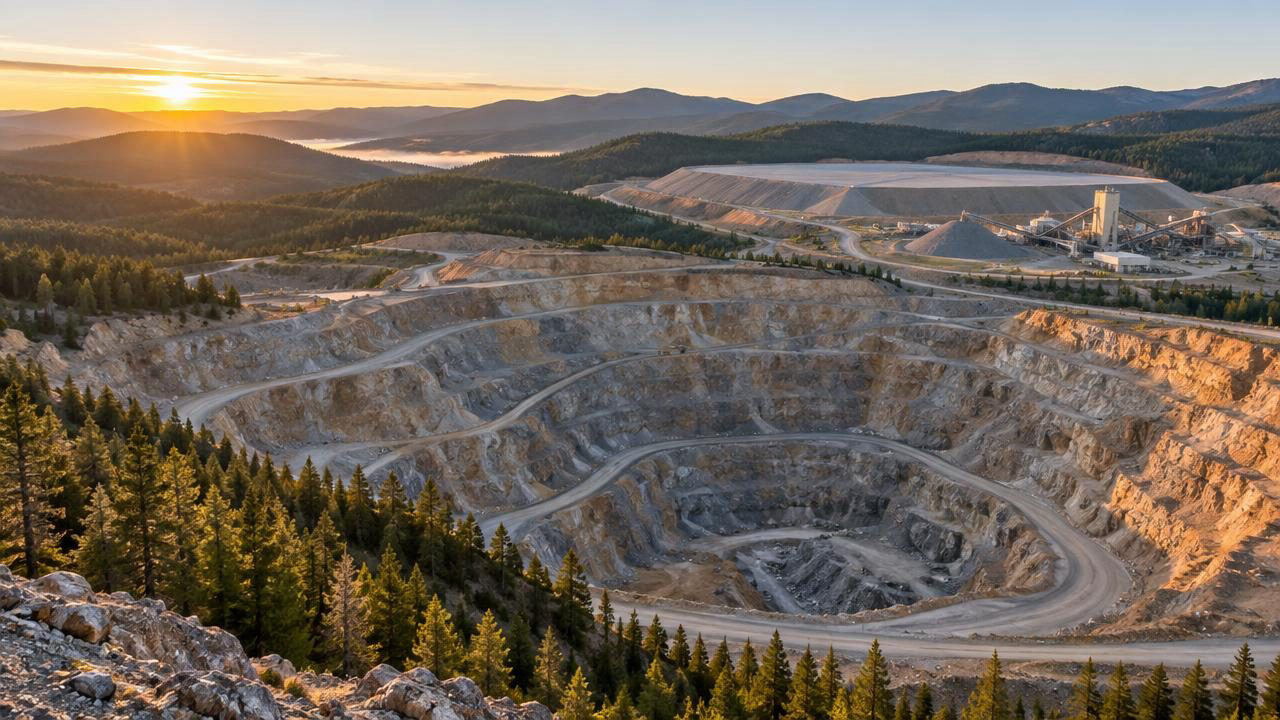
Dakota Gold Corp. has chosen a 0.5-inch crush and a single heap leach facility for Richmond Hill, its open-pit gold project in the Homestake district of South Dakota, and will base the coming Pre-Feasibility Study on an oxide-only resource. The company expects the updated resource and the study in the fourth quarter of 2026, with a Feasibility Study in mid-2027, and held about US$99.3 million in cash at June 30, 2026.
By Daniel Okoye8 min read
Cash
US$99.3 million
cash and cash equivalents at June 30, 2026, per the 10-Q for that quarter
Drilling in the new resource
42,791 metres
333 holes from 2025 and 2026, per the release of September 28, 2026
Oxide recovery at 0.5-inch crush
80.4 per cent
modelled ultimate gold recovery, unweighted mean of domains, per the release of September 10, 2026
2025 assessment, after-tax NPV at 5 per cent
US$1,662 million
measured and indicated plan at US$2,350 gold, Initial Assessment of July 7, 2025
Next step
Q4 2026
updated resource and Pre-Feasibility Study expected, per the company; Feasibility Study expected mid-2027
Richmond Hill has its design. Having completed its pre-feasibility drilling and metallurgical tests, Dakota Gold Corp. said on September 28, 2026 that the study for its South Dakota gold project will assume ore crushed to half an inch and stacked on a single heap leach facility, over a resource limited to oxide material.
Those choices matter because they are the first ones the company has had to make in hard numbers. The July 2025 assessment that put Richmond Hill on the map described a concept with several possible leach areas. The study now being finished describes one operation, and the next one after it, a Feasibility Study the company expects in mid-2027, is the kind of document construction lenders work from.
A developer on private ground in the Homestake district
Dakota Gold is based in Lead, South Dakota, the town that grew up around the Homestake mine, which produced gold for well over a century before it closed. The company describes itself as an exploration and development company with two projects, both on private land in the district: Richmond Hill, an open-pit heap leach project it is advancing toward production, and Maitland, where it is exploring for higher-grade gold that could be mined underground. Its shares trade only on NYSE American, under DC, and it files with the US Securities and Exchange Commission.
The tenure behind Richmond Hill runs through Barrick.
Dakota Gold signed an option on October 14, 2021 to acquire 100 per cent of Barrick's interest in the property. A second option, signed on September 7, 2021, covers 4,261 acres of surface rights in the district along with facilities and data. On February 6, 2025, Barrick extended both options to December 31, 2028, in return for annual cash payments that the company's 10-Q for the period ended June 30, 2026 says were made for 2026. Exercising the options gives Dakota Gold full ownership of the ground.
A heap leach mine is the simplest way to recover gold from low-grade rock. Crushed ore is stacked on a lined pad and irrigated with a dilute cyanide solution that dissolves the gold as it trickles through. The solution is collected and the gold recovered from it. Low capital cost is the attraction. The size of the crushed rock and the type of ore decide how much of the gold comes out.
The numbers the 2025 assessment set
The benchmark for everything since is the Initial Assessment with Cash Flow released on July 7, 2025. An initial assessment is the earliest economic study US rules allow a company to publish; it can include inferred resources, the least certain category, and it carries less engineering than a pre-feasibility study.
| Item (Initial Assessment, July 7, 2025) | Measured and indicated plan |
|---|---|
| Gold resource, measured and indicated | 3.65 million ounces |
| Initial capital, including contingency | US$384.1 million |
| After-tax net present value at 5 per cent | US$1,662 million |
| After-tax internal rate of return | 55 per cent |
| Base gold price | US$2,350 per ounce |
| Average annual payable gold | 153,000 ounces over 17 years |
Those figures are the company's, from a study it described as an initial assessment, and they are forward-looking. They are the yardstick the Pre-Feasibility Study will be measured against when it is published.
The US$2,350 base price sits well below what gold has been fetching. Agnico Eagle Mines, a large Canadian producer, reported a realised gold price of US$4,264 per ounce for the third quarter of 2026 in its results release of October 28, 2026, which is one producer's sale price for one quarter and not a forecast for Richmond Hill.
Two tests, two decisions
The design announced on September 28 came out of a metallurgical program the company reported on September 10. Forte Dynamics, now part of SLR International Corporation, ran column tests on master composites of oxide and transition material at two crush sizes. A column test is a tall tube of crushed ore leached for weeks to imitate a heap.
The result that drove the decision is simple to state. At half an inch, the modelled ultimate gold recovery for oxide averaged 80.4 per cent across domains. At one inch it averaged 75.9 per cent. Finer crushing costs more in power and equipment, and the company said those trade-offs would be reconciled in the study. It chose the finer crush.
The best material in the program was breccia oxide, which returned gold extractions of 90.7 to 92.0 per cent in the laboratory. Transition material, rock partly altered from oxide toward the sulphide ore beneath it, recovered less, with a modelled mean of 74.4 per cent at half an inch.
The company was precise about what those figures are. The means are unweighted averages across domains, laboratory extractions rather than a commercial recovery forecast, and the planned production-weighted recovery will be set in the study. The 2025 assessment carried an 85.1 per cent gold recovery in its measured and indicated plan, so the recovery the study adopts is one of the figures that will move its economics.
The second decision followed from the first. Transition material, about 18 per cent of the heap leach material in the prior resource, is excluded from the Pre-Feasibility Study. The resource now counts oxide only, which the company defines by a cyanide-to-fire-assay ratio of at least 0.82 and total sulphur of no more than 0.5 per cent. In plain terms, the study is built on the rock that leaches best.
One heap instead of several
The 2025 concept spread leaching across multiple areas. The September 28 release replaces them with a single facility, located generally within the first phase of the 2025 plan. Jack Henris, the chief executive, said the decisions support a simpler operating configuration and reduce geotechnical complexity.
A single pad means one liner system and one solution-collection circuit to engineer and permit. Fewer moving parts is the usual route by which a heap leach study gets cheaper to build and easier to finance. The Pre-Feasibility Study will put the capital and operating costs on that configuration.
More drilling under the resource
The updated resource takes in 333 holes drilled in 2025 and 2026, totalling 42,791 metres, which the company says is about 30 per cent more drilling data than the prior estimate. A further 3,002 metres of geotechnical drilling followed the main program, and Phase 2 definition drilling at Chism Gulch is intended to convert remaining inferred blocks for the Feasibility Study. Two drills are working now to convert inferred resources into the categories a feasibility study can use as reserves.
The final assays released on September 28 included 18.3 metres grading 1.81 grams of gold per tonne, the largest interval in the batch by gram-metres.
For scale, the company's own table gives the measured and indicated average grade from the 2025 assessment as 0.566 g/t. Four geotechnical holes in the batch (RH26C-456, RH26C-458, RH26C-461 and RH26C-471) returned no significant gold mineralization.
At Maitland, initial results from the first 791 metres of a planned 5,578-metre campaign on the Unionville zone included 15.3 metres at 1.47 g/t. The company moved drilling capacity to Richmond Hill and said that does not change its long-term view of Maitland; it expects the maiden resource program there to finish in the first half of 2027.
The money and the people
Dakota Gold had cash and cash equivalents of US$99,296,041 at June 30, 2026, according to its 10-Q for the quarter, up from US$29,686,451 at December 31, 2025. Total liabilities were US$4,001,932 at June 30, 2026.
Most of the increase in cash came from a February 2026 offering of 12,561,000 shares at US$6.08, which raised net proceeds of about US$71.7 million through a syndicate led by BMO Capital Markets and Scotiabank.
The spending goes mostly into the ground. Exploration expense for the six months to June 30, 2026 was US$13,022,804, or 77 per cent of the half's US$16,812,249 net loss.
Its note on the basis of preparation says management believes it has sufficient resources to meet its obligations for at least the next year. It had 134,172,991 shares outstanding at August 12, 2026, per the cover of the same filing. The cash on hand funds the study work now under way; a mine built to the 2025 assessment's capital estimate would need more than that, and the company has put a named executive in charge of lining up construction financing.
That executive is Shawn Campbell. In a release dated July 29, 2026, the company said Dr. Robert Quartermain would retire as chief executive on August 18, 2026 and remain co-chair; the company described him as its largest shareholder. Jack Henris, who joined as president and chief operating officer a year earlier, became chief executive; Mr. Campbell took on development, shareholder engagement and construction financing; Amy Koenig, chief legal officer, added the permitting processes to her role. The September 28 release, the latest on the company's wire, lists Mr. Henris as chief executive, president and director.
The shares closed at US$5.71 on NYSE American on November 4, 2026, up 10.02 per cent on 1,308,366 shares, per end-of-day data read at 16:59 ET on November 4, 2026 from the exchange's delayed quote page. The company issued no release that day.
What the fourth quarter brings
The company's timetable is explicit. It expects the updated resource and the Pre-Feasibility Study in the fourth quarter of 2026, the Feasibility Study in mid-2027, and has described production at Richmond Hill as possible as soon as 2029. Those are its projections, and its releases tie them to the usual risks set out in its 10-K. The design is fixed and the drilling is in, and the cash at June 30, 2026 covers the study work under way.
The Pre-Feasibility Study, due before the year ends, will set the life-of-mine recovery and cost for a single oxide heap crushed to half an inch, and the Feasibility Study the company expects in mid-2027 follows it.
Disclosure
Transparency note. This is an independent due-diligence analysis produced by The Maple Markets editorial desk. It is not sponsored, promoted or commissioned, and no compensation of any kind has been received from Dakota Gold Corp. (DC), Barrick Mining Corporation or Agnico Eagle Mines Limited (TSX: AEM), or any party acting on their behalf. The analysis is based on public disclosure available as of the publish date; every figure is attributed to its primary source. The Maple Markets and its authors may hold positions in securities mentioned; nothing here is a recommendation to buy, sell or hold any security, and readers should not treat it as investment advice. Past disclosure does not guarantee future results. Policies: Editorial Standards · Financial Disclaimer.
Read next
 Mining & EnergyKinross Gold's Third Quarter: 425,000 Ounces After a Lower 2026 ForecastKinross Gold produced 424,693 attributable gold equivalent ounces in the third quarter of 2026, in line with the figure it gave on September 23 when it lowered its 2026 forecast to 1.84 to 1.86 million ounces. Net earnings were US$583.2 million and net cash US$1.9 billion at September 30. Great Bear's declines passed 500 metres and Round Mountain Phase X stays on track for 2028. Two contractor employees died after separate September incidents at Bald Mountain.Daniel Okoye · November 2, 2026 · 7 min
 Mining & EnergyEldorado Gold Lowers Its 2026 Forecast as Skouries Starts Up in GreeceEldorado Gold's third-quarter report, released on 28 October 2026, records first concentrate at Skouries in northern Greece, permanent grid power on site and commercial production expected late in the fourth quarter. The company lowered its 2026 gold forecast to 425,000 to 475,000 ounces from 495,000 to 600,000, raised the Skouries capital estimate to about US$1.425 billion and ended September with US$396.8 million of cash, which it says leaves the project fully funded.Priya Sandhu · October 30, 2026 · 7 min
 Mining & EnergyIsland Gold Sets a Record, and Alamos Gold Makes 119,000 OuncesAlamos Gold reported 119,000 ounces of gold for the third quarter of 2026 on 28 October, down 16% from a year earlier. Island Gold set a quarterly record while Young-Davidson and Mulatos produced less, and all-in sustaining costs rose to US$1,956 an ounce. The company kept its revised 2026 guidance, moved the Island Gold shaft to mid-2027 and held US$597.4 million of cash at 30 September.Élise Galarneau · October 29, 2026 · 6 min
Follow this story
Follow DC — the next Maple piece on this company, plus the Maple Morning Debrief before the open.
Follow and ask
Get more of our Canadian market coverage in Google Top Stories.
Sources and references (8)
- Dakota Gold: Richmond Hill assay results and key design decisions for upcoming Pre-Feasibility Study (Newsfile, September 28, 2026)
- Dakota Gold: positive metallurgical test program results informing the Richmond Hill Pre-Feasibility Study (Newsfile, September 10, 2026)
- Dakota Gold Form 10-Q for the quarter ended June 30, 2026 (SEC EDGAR)
- Initial Assessment with Cash Flow for Richmond Hill, Exhibit 99.1 to Form 8-K (SEC EDGAR, July 7, 2025)
- Dakota Gold: leadership changes as it advances Richmond Hill (Newsfile, July 29, 2026)
- Dakota Gold: offering of common stock (Newsfile, February 9, 2026)
- Agnico Eagle Mines: third-quarter 2026 results (October 28, 2026)
- Dakota Gold Corp. (DC) quote, NYSE American (NYSE, delayed quote, as of 16:00 ET November 4, 2026)
Cite this analysis
Please attribute The Maple Markets and link to the original page.
Daniel Okoye (November 4, 2026). Dakota Gold Picks a Half-Inch Crush and One Heap for Richmond Hill. The Maple Markets. https://themaplemarkets.ca/en/newsroom/dakota-gold-release-of-28-september-2026-puts-a-pre-feasibility-designhttps://themaplemarkets.ca/en/newsroom/dakota-gold-release-of-28-september-2026-puts-a-pre-feasibility-design