
Four Things a Canadian Miner Can Say About a Hole in the Ground, and What Each Is Worth
In one week the Canadian venture market paid up for rock nobody had measured and marked down two companies that published measurements, which is easier to follow once the four stages of mining proof are separated.
A Canadian explorer with no laboratory numbers rose 93.8 per cent on September 9, 2026. A company that published laboratory numbers fell 35 per cent the next day. Canadian mining disclosure runs on four separate stages of proof, and most of the confusion in a drill-results week comes from treating them as one.
By Priya Sandhu8 min read
Perseverance Metals' one-day gain, to C$0.93 from C$0.48
93.8 per cent
September 9, 2026 session, QuoteMedia 15-minute delayed data; the release reported four holes, three intrusion intercepts and no assays.
Juggernaut Exploration's one-day fall, to C$0.63 from C$0.97
35.0 per cent
September 10, 2026, per market data read after the Toronto close, the day laboratory assays replaced two visual-mineralisation headlines from August 2026.
Hemlo Mining's September 10, 2026 true-width conversion factor at South Rim, revised from 30 to 70 per cent in its May 14, 2026 release on the same zone, with no explanation given.
65 to 90 per cent
Talon Metals' proven and probable reserves at the Eagle mine, Michigan
3,486 kilotonnes at 1.06 per cent nickel
technical report released April 30, 2026; mining scheduled into the second half of 2030.
share of the world's public mining companies listed on TSX and TSXV
About 40 per cent
TMX Group mining sector page, data as of December 31, 2025.
On September 9, 2026, a Canadian explorer that has never published an estimate of how much metal sits under its ground closed 93.8 per cent higher. The next day a company that did publish laboratory numbers fell 35 per cent.
Neither move was irrational, and neither company did anything wrong. They were being priced at different stages of the same process. Canadian mining disclosure separates what a company can say about a hole in the ground into four stages, each with a different standard of proof behind it, and the gap between the first stage and the last one is the distance between a photograph and a mine plan. A week like the one that just ended is much easier to follow once the four are pulled apart.
Rock you can see, and the number nobody has taken yet
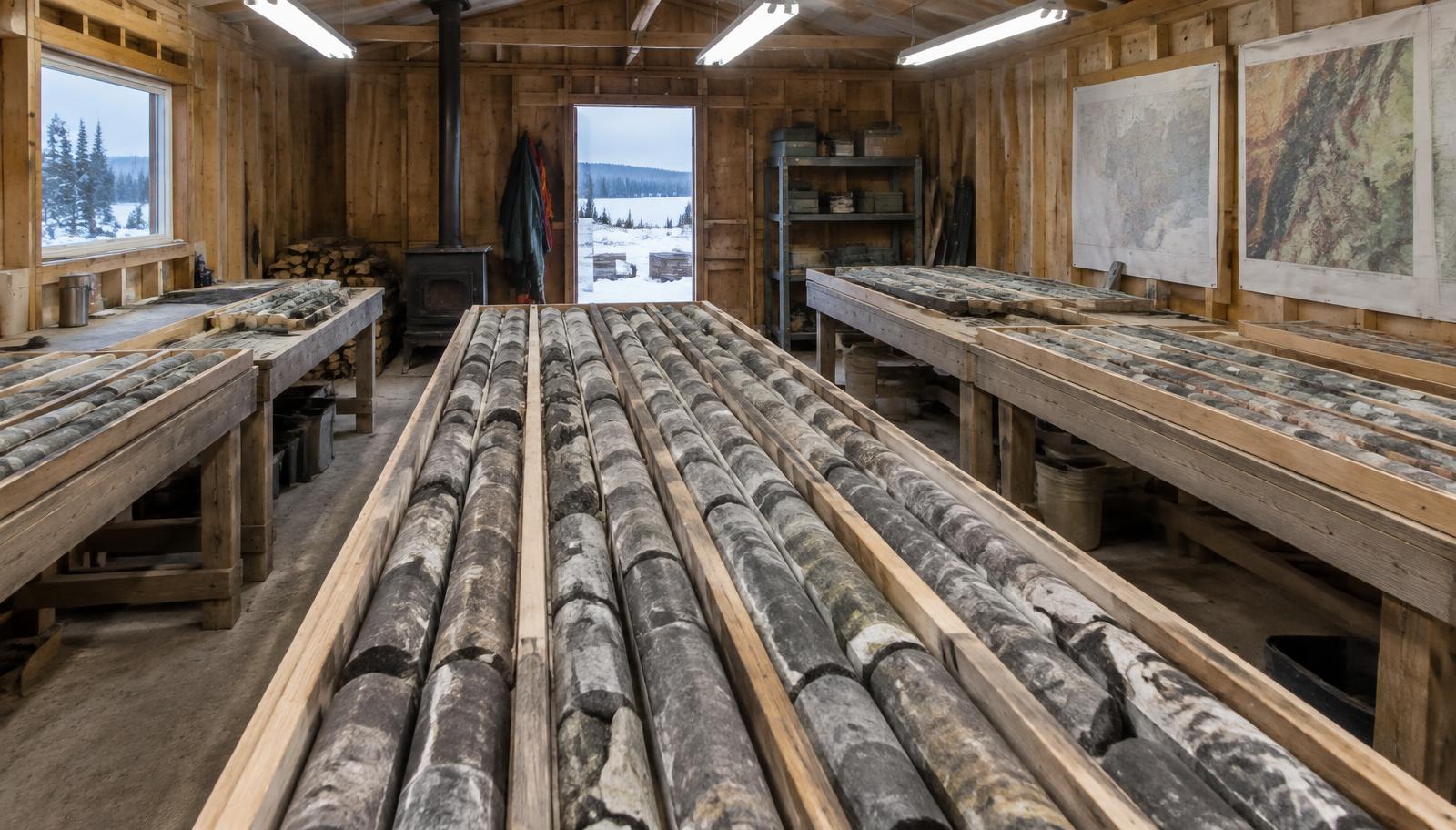
Perseverance Metals reported on September 9, 2026 that it had completed four diamond drill holes at its Osprey target, that three of the four had cut a mafic-ultramafic intrusion up to 50 metres thick, and that the intrusion carried 3 to 8 per cent magmatic sulphides. Assays were pending. The shares closed at C$0.93, up C$0.45 or 93.8 per cent from C$0.48, on 1.29 million shares on the TSX Venture Exchange plus 92,426 on alternative venues, according to QuoteMedia's 15-minute delayed feed read for that session. The Maple Markets covered the day in Four Holes, Three Intrusions and No Assays.
Everything in that release is a geologist's observation. Sulphide is a mineral group; some sulphides carry nickel and copper, some carry almost nothing, and the eye cannot tell the difference at the percentages that make a deposit. The company said the intrusion was fertile, which in geology means capable of hosting metal, not proven to contain it. No grade was reported because no grade had been measured.
This is the first stage, and it is worth exactly one thing: it tells you where to drill next. A company at this stage has spent money and found a reason to spend more. Perseverance held roughly C$7.53 million in cash against about C$2.85 million in liabilities as of its most recent disclosure, so it can pay for the next holes. That is a real fact about a real business. It is not a statement about tonnes.
The laboratory is where a headline gets tested
Juggernaut Exploration ran the same sequence in reverse, and in public. On August 19, 2026 it headlined 30.11 metres of quartz-sulphide mineralisation in hole BO-26-14 at its Big One property, with assays pending. On August 27, 2026 it headlined up to 20.24 metres of the same in BO-26-17, assays again pending.
On September 10, 2026 the assays arrived. BO-26-14 returned no reported gold interval at all. BO-26-17 returned 0.47 grams per tonne of gold over 1.16 metres. The best result in the release came from a third hole, BO-26-11: 3.08 grams per tonne over 5.03 metres of core length. The shares fell 35.0 per cent that day to C$0.63 from C$0.97, on volume several times the recent average, per market data read after the Toronto close. Maple's read of it is A One Third Markdown on Six Times Volume.
An assay is a laboratory measurement of how much metal a crushed sample contains, reported in grams per tonne for gold and silver or in per cent for base metals. It is the first number in the whole sequence that someone outside the company has produced, and it is the first one that can contradict a press release. Nothing about Juggernaut's August disclosures was false. They described visible mineralisation, said so, and said the assays were not in. The market chose to read visible sulphide as gold, and the laboratory disagreed.
The lesson transfers to every release of this kind. Between the photograph and the assay, the only honest position is that the metal content is unknown, and the company saying so in its own release is a point in its favour rather than a caveat to skip.
A true width is an estimate, and Hemlo revised its own
Even an assay comes wrapped in an interpretation. Drill core is measured along the hole, which almost never runs perpendicular to the mineralised zone, so a 3.0-metre core length may represent a narrower true thickness. Companies publish a conversion factor, and that factor is judgement.
Hemlo Mining reported on September 10, 2026 an intercept of 89.89 grams per tonne of gold over 3.0 metres of core length in hole 6702608, between 175.0 and 178.0 metres downhole, at its South Rim zone. The release estimated true width at 65 to 90 per cent of downhole length, which puts the true thickness between roughly 2.0 and 2.7 metres. In a May 14, 2026 release on the same zone, the company had estimated true thickness at 30 to 70 per cent of downhole length, and it gave no explanation for the change. As Maple set out in Grade Beside a Working Mine, a revision of that size moves every width in the file. South Rim itself carries no resource, no reserve and no economics.
A resource carries a named person's signature
The third stage is where a number stops being a measurement of one hole and becomes an estimate of a deposit. A mineral resource is a quantity of mineralised rock, with a grade, estimated by a qualified person to have reasonable prospects for eventual economic extraction. Canada's rule book for that estimate is National Instrument 43-101, which requires the technical report behind it to be prepared under the supervision of a qualified person and filed publicly on SEDAR+. The definitions the instrument uses are the CIM Definition Standards, adopted by the Canadian Institute of Mining, Metallurgy and Petroleum's council on May 10, 2014.
Resources come in three confidence classes. Inferred is estimated from limited sampling and geological inference. Indicated is drilled closely enough to support mine planning. Measured is the tightest of the three. The classes matter because an inferred tonne cannot be converted into a reserve without more drilling, whatever the headline total says.
What a resource is not is any number a company has ever put in print. Myriad Uranium's Copper Mountain property in Wyoming carries a 1979 estimate by Rocky Mountain Energy of 26.63 million pounds of equivalent uranium oxide within 48.95 million tonnes grading 269 parts per million, from a programme of roughly 2,000 boreholes drilled by Union Pacific in the late 1970s.
Under Canadian rules that is a historical estimate, not a current mineral resource, and the company's March 31, 2026 technical report contains no mineral resource estimate at all. Maple worked through the gap in A Forever Explorer or a Data Advantage, including the detail that the 1979 tonnage and grade multiply to about 29.0 million pounds rather than the 26.63 million quoted. Converting an archive into an asset means new holes, laboratory assays and a qualified person willing to sign.
Only a reserve has survived the mine plan
The fourth stage is the one almost no exploration company reaches. A mineral reserve is the part of a measured or indicated resource that a study has shown can be mined and sold at a profit after applying what the standards call modifying factors: mining method, metallurgy, infrastructure, permitting, environmental and social requirements, costs and metal prices.
The United States adopted the same architecture in 2018, when the Securities and Exchange Commission modernised its mining rules and began requiring registrants to disclose resources alongside reserves, with a dated and signed technical report summary from a qualified person, effective for fiscal years beginning on or after January 1, 2021. The SEC said the change brought its requirements closer to the framework used by the Committee for Mineral Reserves International Reporting Standards, which is the family Canada's rules belong to.
Talon Metals shows the two top stages side by side. Its Eagle mine in Michigan carries proven and probable reserves of 3,486 kilotonnes grading 1.06 per cent nickel and 0.82 per cent copper, per the technical report released April 30, 2026, with mining scheduled into the second half of 2030. Its Tamarack project in Minnesota entered environmental impact statement scoping on July 14, 2026, a step that decides what an eventual statement will study rather than assessing the project. One asset sells nickel this year. The other has a permitting calendar. Maple's A Nickel Developer Is Not a Nickel Supply works the distinction through in detail.
| Stage | What has actually been done | Who stands behind it |
|---|---|---|
| Visual mineralisation | Rock logged and photographed; no metal measured | The company's geologists |
| Assay | A sample crushed and measured by a laboratory | An accredited lab, then the company's width interpretation |
| Mineral resource | A deposit estimated with grade and confidence class | A qualified person, in a report filed on SEDAR+ |
| Mineral reserve | A study applying mining, cost and permitting factors | A qualified person, in a study the mine plan rests on |
Why this ladder is a Canadian export
None of this is academic housekeeping for a Canadian investor. TMX Group's mining sector page puts about 40 per cent of the world's public mining companies on the Toronto Stock Exchange and the TSX Venture Exchange, with 54 new mining listings in 2025 and more than 300 companies graduating from TSXV to TSX between 2000 and 2025. A person holding a Canadian dividend fund and a person holding a single venture explorer are reading releases written to the same instrument, and that instrument is one of Canada's more successful regulatory exports.
It also sets the terms of a fair complaint. When a company reports visible sulphide and says the assays are pending, it has met the standard. When the share price triples on that release, the standard has not failed; the interpretation has. The week's three pieces of evidence, a first-stage release that rose, a second-stage release that fell and a third-stage revision on a producing mine, are all the system behaving exactly as written.
The four stages are not a scale of company quality either. A good explorer at stage one and a struggling producer at stage four can both be honest about where they are. What the stages fix is the question: before asking whether a number is big, ask which of the four things it is.
Transparency note. This is an independent due-diligence analysis and editorial opinion piece produced by The Maple Markets editorial desk. It is not sponsored, promoted or commissioned, and no compensation of any kind has been received from any issuer, government body or organisation named in this article, or any party acting on their behalf. The analysis is based on public disclosure available as of the publish date; every figure is attributed to its primary source. The Maple Markets and its authors may hold positions in securities mentioned; nothing here is a recommendation to buy, sell or hold any security, and readers should not treat it as investment advice. Past disclosure does not guarantee future results. Policies: Editorial Standards · Financial Disclaimer.
Read next
Auch auf Deutsch: Vier Dinge, die ein kanadischer Bergbaukonzern über ein Bohrloch sagen kann, und was jedes davon wert ist
 BusinessNI 43-101 Versus the Press Release: Detecting Selective DisclosureCanada's mining disclosure standard is among the strictest in the world. It constrains the technical report — and press releases are where the pressure escapes.Daniel Okoye · August 29, 2026 · 8 min
 Mining and ResourcesA Kilometre From Its Nearest Hole, FireFox Gold Drilled 21 Metres of 4.13 g/t in LaplandFireFox Gold Corp. (TSXV: FFOX) reported on 16 September 2026 that hole 26MJ032 cut 21.0 metres averaging 4.13 g/t gold more than 650 metres from any previous drilling at Mustajarvi in Finnish Lapland. The shares closed at C$0.63, up 26.0 per cent on thirteen times average volume. Two earlier holes this month carried higher grades and moved nothing. What changed was the distance, and a paid listing that ran the same day.Priya Sandhu · September 17, 2026 · 7 min
 Mining and ResourcesBanyan Gold Joins the GDXJ With 8.6 Million Ounces and No Economic Study of ThemBanyan Gold Corp. (TSXV: BYN) said on 14 September 2026 that it joins the index behind the VanEck Junior Gold Miners ETF on 21 September. Its AurMac project in the Yukon holds 3.639 million indicated ounces and 4.985 million inferred ounces of gold. There is no preliminary economic assessment yet. At Tuesday's close the market valued the company at about C$98 for every ounce in the ground, or C$233 for each indicated ounce.Élise Galarneau · September 15, 2026 · 6 min
Get the Maple Morning Debrief
Yesterday's close, overnight, and what to watch before the open — in your inbox by 6 a.m. ET. Free, and one click to unsubscribe.
Follow and ask
Get more of our Canadian market coverage in Google Top Stories.
Opinion
This article expresses the author's personal views, is separate from news reporting and is not investment advice.
Disclosure
**Transparency note.** This is an independent due-diligence analysis and editorial opinion piece produced by The Maple Markets editorial desk. It is not sponsored, promoted or commissioned, and no compensation of any kind has been received from any issuer, government body or organisation named in this article, or any party acting on their behalf. The analysis is based on public disclosure available as of the publish date; every figure is attributed to its primary source. The Maple Markets and its authors may hold positions in securities mentioned; nothing here is a recommendation to buy, sell or hold any security, and readers should not treat it as investment advice. Past disclosure does not guarantee future results. Policies: [Editorial Standards](https://themaplemarkets.ca/en/policies/editorial-standards) · [Financial Disclaimer](https://themaplemarkets.ca/en/policies/financial-disclaimer). See the Financial Disclaimer.
Sources and references (9)
- Perseverance Metals Inc., news releases (Newsfile)
- Juggernaut Exploration, Big One assay release, September 10, 2026 (The Newswire)
- Hemlo Mining Corp., 89.9 g/t Au over 3.0 metres at South Rim, September 10, 2026 (PR Newswire)
- Myriad Uranium, Copper Mountain technical report filing (Newsfile)
- SEC adopts rules to modernize property disclosures for mining registrants, October 31, 2018
- TMX Group, mining sector profile
- SEDAR+, the filing system for Canadian technical reports
- CIM Definition Standards for Mineral Resources and Mineral Reserves, adopted May 10, 2014
- Talon Metals, Eagle mine NI 43-101 technical report results, April 30, 2026
Cite this analysis
Please attribute The Maple Markets and link to the original page.
Priya Sandhu (September 13, 2026). Four Things a Canadian Miner Can Say About a Hole in the Ground, and What Each Is Worth. The Maple Markets. https://themaplemarkets.ca/en/newsroom/four-stages-of-mineral-proof-what-a-canadian-drill-release-is-worthhttps://themaplemarkets.ca/en/newsroom/four-stages-of-mineral-proof-what-a-canadian-drill-release-is-worth