
First Phosphate's Quebec Deposit Reaches 204.7 Million Tonnes
The resource update filed in August put 204.7 million tonnes of measured and indicated rock behind the Bégin-Lamarche project, and the company's own schedule sets a feasibility study for the first quarter of 2027.
First Phosphate Corp. (CSE: PHOS) carries 204.7 million tonnes at 6.05 per cent P2O5 in the measured and indicated categories at Bégin-Lamarche in Quebec, effective 1 May 2026, with the supporting NI 43-101 technical report filed to SEDAR+ on 24 August 2026. Its test work points to a concentrate of 40.4 per cent P2O5 at 88 per cent recovery, and two export credit agencies have written letters covering most of the projected equipment bill. The next dated step is a feasibility study the company schedules for the first quarter of 2027.
By Priya Sandhu7 min read
Measured and indicated resource, Bégin-Lamarche
204.7 Mt at 6.05% P2O5
effective 1 May 2026, 2.5% P2O5 cut-off inside a pit shell; 12.38 Mt contained P2O5; QP Antoine Yassa, P.Geo., P&E Mining Consultants (company release 26 May 2026; NI 43-101 report filed to SEDAR+ 24 August 2026).
Anticipated concentrate grade and recovery
40.4% P2O5 at 88% recovery
company test-work figure, not an operating result (First Phosphate corporate presentation, October 2026).
Swiss export credit support
up to US$212.5 million
letter of support dated 16 September 2026, equal to 85% of an assumed US$250 million Swiss export contract; conditional on Swiss sourcing and SERV due diligence, no definitive agreement (company release).
Shares outstanding
190,419,664
as at 29 September 2026; 203,563,639 fully diluted (First Phosphate corporate presentation, October 2026).
Frankfurt listing
FSE KD0, WKN A3DQCH, ISIN CA33611D1033
no turnover or price fixings shown on the Frankfurt page read 15 October 2026 (Deutsche Börse master data).
Almost all of the world's phosphate comes out of ancient seabeds. The United States Geological Survey puts it plainly in its 2026 commodity summary: phosphate rock resources occur principally as sedimentary marine phosphorites, and Morocco alone holds roughly 68.5 per cent of the world's reserves. Igneous phosphate, the kind formed in cooling rock rather than settled on a sea floor, is the small exception. The survey names five countries where it occurs in any size, and Canada is one of them.
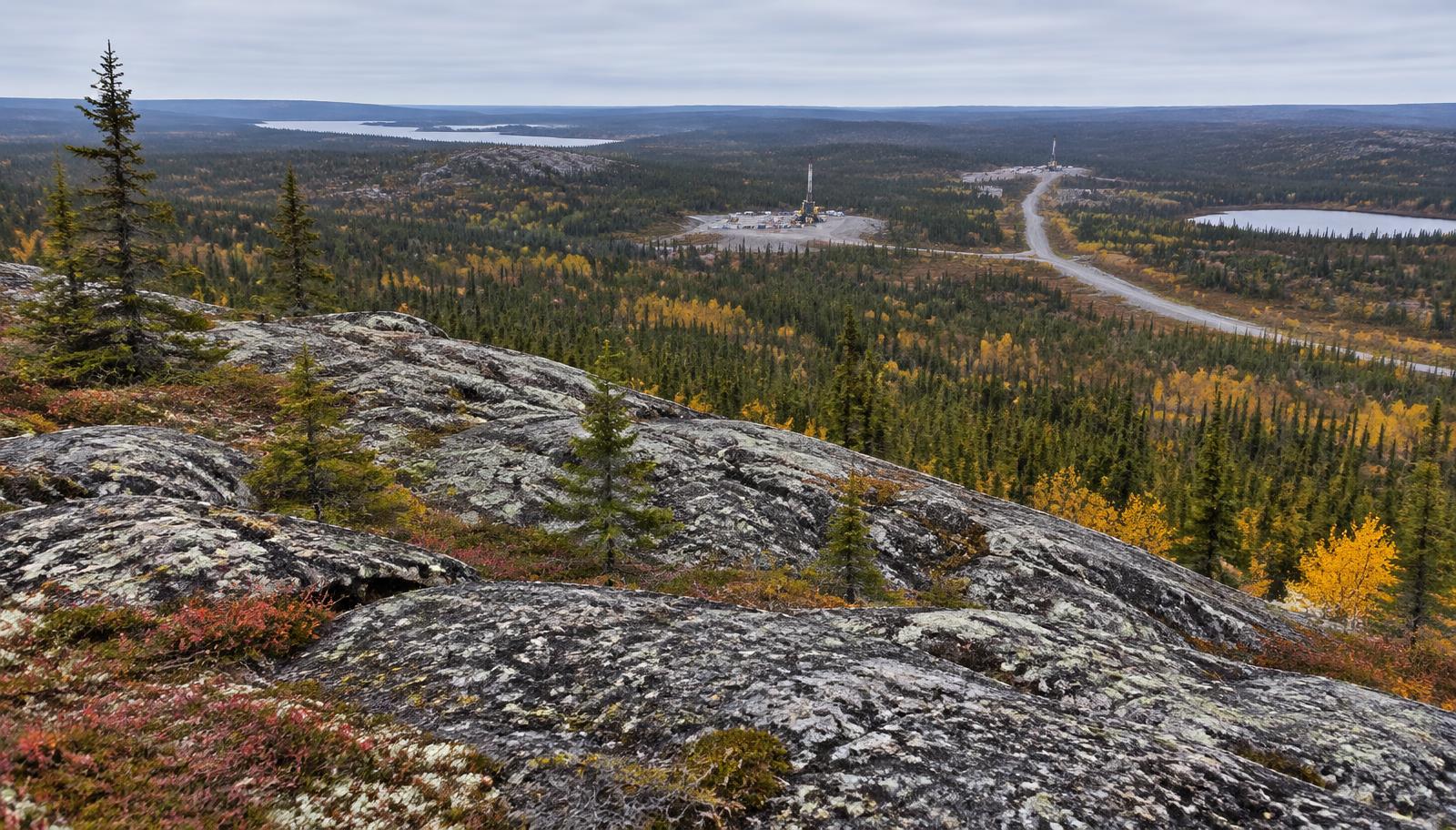
First Phosphate Corp. (CSE: PHOS) is trying to build a mine on that exception, in the Saguenay-Lac-Saint-Jean region of Quebec. On 26 May 2026 the company reported an updated mineral resource estimate for its Bégin-Lamarche property, and on 24 August 2026 it filed the NI 43-101 technical report behind it to SEDAR+. Those two documents are now the floor under everything else the company says.
The tonnage, and which category it sits in
A mineral resource estimate sorts rock into confidence classes. Measured is the best drilled, indicated is next, and inferred is the class a company may not use in an economic study. The distinction decides what a feasibility study is allowed to count.
First Phosphate's updated estimate carries an effective date of 1 May 2026.
| Category | Tonnes | P2O5 grade | Contained P2O5 |
|---|---|---|---|
| Measured | 6.2 Mt | 7.70% | 0.47 Mt |
| Indicated | 198.5 Mt | 6.00% | 11.91 Mt |
| Measured and indicated | 204.7 Mt | 6.05% | 12.38 Mt |
| Inferred | 89.5 Mt | 6.16% | 5.50 Mt |
The indicated line is the one that moved. Against the initial estimate dated 9 September 2024, the company reported a 378 per cent increase in indicated resources. Antoine Yassa, P.Geo., of P&E Mining Consultants Inc. is the independent qualified person responsible for the estimate; Steeve Lavoie, P.Geo., the company's chief geologist, reviewed and approved the disclosure.
The constraining assumptions are published and they are ordinary, which matters more than it sounds. The estimate sits inside a pit shell drawn at a 2.5 per cent P2O5 cut-off, using an exchange rate of US$0.72 to the Canadian dollar and a long-run price deck anchored on roughly five years of trailing averages. Change the price deck and the pit shell changes with it. That is true of every pit-constrained resource on the exchange, and it is why the cut-off is printed beside the tonnes.
Igneous apatite starts poorer and finishes cleaner
Six per cent phosphate in rock would be unremarkable in Morocco. It is the wrong comparison. Sedimentary ore arrives at the plant richer and leaves it carrying the impurities the seabed left behind, principally cadmium and other heavy metals. The rock at Bégin-Lamarche starts leaner and comes out clean.
What a buyer pays for is the concentrate. First Phosphate's October 2026 corporate presentation puts the anticipated concentrate at 40.4 per cent P2O5, using what the company describes as solventless beneficiation. Recovery of the contained phosphate through that process is put at 88 per cent, and conversion of the concentrate into purified phosphoric acid for lithium iron phosphate cathode material at 91.1 per cent. Purified phosphoric acid is the input that battery chemistry needs. Fertiliser-grade acid will not do, because the trace elements a crop tolerates will poison a cell.
On 21 September 2026 the company reported that a study of the Mountain, North and South zones of the deposit had been published in the journal Ore Geology Reviews, written by scientists at Queen's University and the Université du Québec à Chicoutimi. The release says the phosphate layers are low in chlorine and other trace elements, and that test work indicates concentrate levels around 40 per cent P2O5. Lavoie reviewed that disclosure as well.
Peer review in a geology journal establishes that the geological description holds up. It is not a metallurgical certification, and the company's own release keeps the open-pit conclusion subject to further engineering and mine planning. Both of those statements are in the release. Taken together they describe a deposit whose character is now documented in the literature and whose economics are not yet settled.
The money is arranged in letters, and letters carry conditions
Two export credit agencies have written to First Phosphate about the equipment bill, and the terms of both are worth reading closely because the headline numbers are large.
The more recent is Swiss. On 16 September 2026 the company reported a letter of support from Swiss Export Risk Insurance, the Swiss federal export credit agency, covering a financed amount of approximately US$212.5 million. That figure is 85 per cent of an assumed eligible Swiss export contract value of US$250 million, and SERV's own language in the release is that it "is prepared to consider insurance/guarantees in support of a buyer credit financing." SERV would cover up to 95 per cent of the eligible financed amount, in line with OECD guidelines. Eligibility requires that a sufficient portion of the project be sourced from Switzerland. No definitive agreement exists, and the release lists SERV's due diligence among its forward-looking assumptions.
So the instrument is real and the money is not drawn. An export credit agency guarantee covers a lender against a borrower's default on a loan raised to buy that country's exports; it is not itself a loan, and it exists to make a bank comfortable rather than to replace one. The practical effect, if it converts, is that a large slice of the capital budget gets financed against Swiss equipment orders rather than against share issuance. That is a materially better outcome for existing holders than the alternative, and it depends on orders the company has not yet placed.
Maple reported on 7 October 2026 that a Danish export credit agency, EIFO, signed a letter of intent in April 2026 for up to EUR 170 million, and that the Government of Canada committed C$4.84 million in non-repayable contributions on 5 August 2026. The pattern across all three is the same: capacity arranged ahead of the spending it would fund.
Four tickers, one security
The shares trade on the Canadian Securities Exchange as PHOS, on Nasdaq as PHOS following an uplisting in August 2026, and over the counter in the United States as FRSPF. The Frankfurt line is KD0, with WKN A3DQCH and ISIN CA33611D1033, as Deutsche Börse's own master data records it.
That German line is an identifier rather than a market. Read on 15 October 2026, the Frankfurt page for the security showed no turnover, no price fixings and no bid or ask. Anyone working from the WKN is looking at a venue where the shares are listed and not traded, and the price discovery is happening on the CSE and on Nasdaq. The CSE close on 15 October 2026 was C$1.91, down 0.52 per cent on volume 1.12 times the 30-day average, per 15-minute delayed market data from QuoteMedia, which is secondary market data and not verified against SEDAR+ filings.
The same presentation reports 190,419,664 shares outstanding as at 29 September 2026, against a market value of about C$419 million on that date. Maple's 7 October 2026 piece derived a count of about 189.14 million shares from market data; the company's own figure, struck a week earlier, is the better one, and the gap between them is about 1.3 million shares. The presentation gives no cash balance. It describes the company as debt free and puts total invested capital to date at C$80 million. The interim financial statements for the period ended 30 June 2026 were filed to SEDAR+ on 30 July 2026.
The schedule, not the newsflow, is what to measure the work against
Nothing operational has been filed since 21 September 2026. The company's SEDAR+ filing history and its own news archive agree on that date. What has appeared since is promotional: an investor conference hosted by an investor relations firm, set for 22 October 2026, and a series of flash reports from Emerging Growth Research, which the company's own materials disclose was paid US$1,500 for its work. Neither carries information about the deposit.
A quiet month at a development-stage mining company is ordinary. The work between a resource estimate and a feasibility study is drilling data, metallurgical test work and engineering, and almost none of it generates a release. Timing is the thing you can actually hold the company to.
On that the company is explicit. Its October 2026 presentation sets completion of the feasibility study for the first quarter of 2027, with environmental studies and the Quebec public hearing process in the quarter after, permit applications in early 2028 and commercial production in 2030. Maple noted on 7 October 2026 that no release then on file gave a feasibility date. The October presentation now does, and it is the first dated milestone the company has put in front of its shareholders since the resource estimate landed in May.
Fourteen months separate that study from today. Everything in this file turns on it.
Disclosure
Transparency note. This is an independent due-diligence analysis and editorial opinion piece produced by The Maple Markets editorial desk. It is not sponsored, promoted or commissioned, and no compensation of any kind has been received from First Phosphate Corp. (CSE: PHOS) or any party acting on their behalf. The analysis is based on public disclosure available as of the publish date; every figure is attributed to its primary source. The Maple Markets and its authors may hold positions in securities mentioned; nothing here is a recommendation to buy, sell or hold any security, and readers should not treat it as investment advice. Past disclosure does not guarantee future results. Policies: Editorial Standards · Financial Disclaimer.
Read next
Auch auf Deutsch: First Phosphates Lagerstätte in Quebec erreicht 204.7 Millionen Tonnen
 Mining and ResourcesFirst Phosphate Has Two Binding Offtakes and Ottawa's Money; the Economic Study Is NextFirst Phosphate Corp. (CSE: PHOS, FSE: KD0) has signed two definitive offtake agreements covering 200,000 tonnes a year of phosphate concentrate and 60,000 tonnes a year of phosphoric acid, both confirmed independently in a Government of Canada backgrounder, and has C$21.54 million of non-repayable federal funding under contract. The indicated resource at Bégin-Lamarche has grown nearly fivefold since 2024. What is still missing is the economic study that would price the mine, and neither buyer is named.Daniel Okoye · September 15, 2026 · 9 min
 Mining and ResourcesDoes a Draft EU Minerals Pact Change Anything for First Phosphate?A draft joint statement circulating among EU member states before an October 2026 summit in Montreal would open European Investment Bank financing to Canadian critical-minerals projects, according to reporting on September 30, 2026. First Phosphate Corp. (CSE: PHOS, FSE: KD0) sits inside that perimeter. Its Bégin-Lamarche deposit in Saguenay grew to 204.7 million tonnes of measured and indicated resource this year, and it has no mineral reserve and no completed economic study.Priya Sandhu · October 2, 2026 · 6 min
 Mining & EnergyQuebec's New Government Inherits First Phosphate's Fast-Track StatusFirst Phosphate Corp. (CSE: PHOS) holds Filon fast-track status from Quebec's Ministry of Natural Resources and Forests, granted 27 July 2026, and letters from two European export credit agencies covering up to US$212.5 million and EUR 170 million. None of those is a permit or a drawn loan. After the Parti Québécois won a minority on 5 October 2026, this is what the documents actually support and what they do not.Priya Sandhu · October 7, 2026 · 7 min
Follow this story
Follow PHOS.CN — the next Maple piece on this company, plus the Maple Morning Debrief before the open.
Follow and ask
Get more of our Canadian market coverage in Google Top Stories.
Opinion
This article expresses the author's personal views, is separate from news reporting and is not investment advice.
Sources and references (8)
- First Phosphate Corp., Updated Mineral Resource Estimate for Bégin-Lamarche, 26 May 2026
- First Phosphate Corp., SERV letter of support, 16 September 2026
- First Phosphate Corp., peer-reviewed study of the Bégin-Lamarche deposit, 21 September 2026
- First Phosphate Corp., corporate presentation, October 2026
- SEDAR+ filing record, First Phosphate Corp. (profile 000027739)
- Deutsche Börse master data, First Phosphate Corp.
- United States Geological Survey, Mineral Commodity Summaries 2026, Phosphate Rock
- The Maple Markets, Quebec's New Government Inherits First Phosphate's Fast-Track Status, 7 October 2026
Cite this analysis
Please attribute The Maple Markets and link to the original page.
Priya Sandhu (October 16, 2026). First Phosphate's Quebec Deposit Reaches 204.7 Million Tonnes. The Maple Markets. https://themaplemarkets.ca/en/newsroom/first-phosphate-added-three-releases-to-this-week-on-its-quebechttps://themaplemarkets.ca/en/newsroom/first-phosphate-added-three-releases-to-this-week-on-its-quebec