
A Weaker Loonie Lowers the Cost of Mining Gold in Canada
The Canadian dollar ended the week weaker than the rates Agnico Eagle and Equinox Gold had built into their 2026 cost guidance, which lowers the US-dollar cost of an ounce mined in Canada without a single change at the mine.
Gold is priced in US dollars, but a mine in Ontario, Quebec or Nunavut pays much of its bill in Canadian dollars. With the Bank of Canada's rate at 1.4154 Canadian dollars per US dollar on October 16, against the 1.36 Agnico Eagle and the 1.34 Equinox Gold assumed in their 2026 guidance, each Canadian dollar of cost converts into about 4 to 5 per cent fewer US dollars. Hedges, royalties and diesel absorb part of the effect, and mines outside Canada get none of it.
By Marc Belzile6 min read
C$ per US$, October 16, 2026
1.4154
Bank of Canada daily exchange rate; the loonie's strongest 2026 reading was 1.3515 on January 29 and its weakest 1.4271 on October 9.
Agnico Eagle 2026 cost guidance rate
1.36 C$ per US$
release of July 29, 2026; about 60 per cent of remaining 2026 Canadian-dollar exposure hedged between roughly 1.38 and 1.42.
Equinox Gold 2026 cost guidance rate
1.34 C$ per US$
MD&A dated August 5, 2026; updated 2026 AISC guidance US$1,900 to US$2,000 an ounce.
Currency effect on a Canadian-dollar cost
3.9 to 5.3 per cent lower in US dollars
desk calculation, October 16 rate against the two guidance assumptions.
Canadian share of production
about 85.4 per cent at Agnico Eagle (Q2 2026), about 59.5 per cent at Equinox Gold (Q3 2026)
desk calculation from the companies' releases.
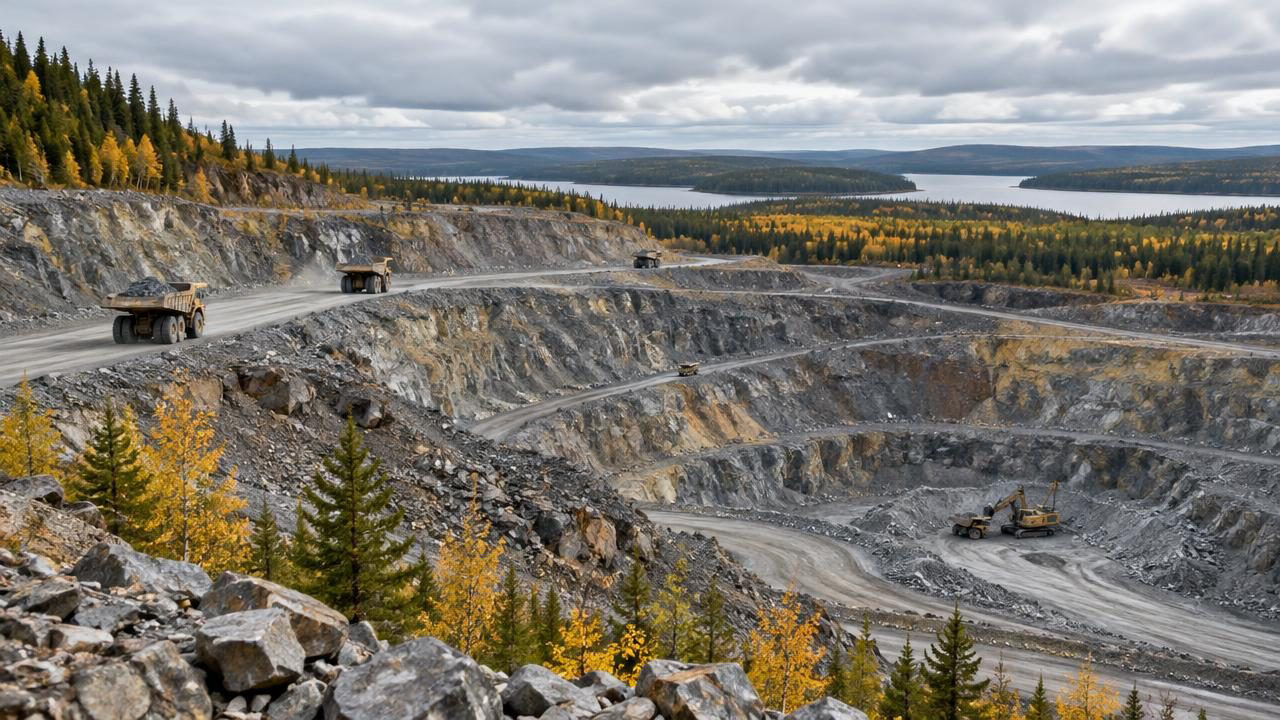
Greenstone, Equinox Gold's open-pit mine in northern Ontario, sells its gold in US dollars and reports its costs to shareholders in US dollars. Much of what it takes to run the mine, from payroll to contractors, is paid in Canadian dollars.
That mismatch makes the exchange rate a cost line. On October 16, 2026, the Bank of Canada's daily rate was 1.4154 Canadian dollars per US dollar.
Two of the largest gold producers with mines in Canada planned for a stronger loonie. Agnico Eagle Mines built its 2026 cost guidance on 1.36, according to its second-quarter release, and Equinox Gold built its guidance on 1.34, according to its most recent MD&A.
When the loonie weakens, a Canadian dollar spent at the mine converts into fewer US dollars on the cost report. The trucks move the same tonnes. The reported cost per ounce falls anyway.
The gold producers dominated Maple's coverage this week, from Equinox Gold's largest quarter of the year on October 13 to Aya Gold & Silver's record quarter and the ounces B2Gold needs in the second half. Production comes first. The cost figures arrive with the full results, starting October 28, and part of what they show this time will be the currency.
Two separate forces set a cost per ounce
All-in sustaining cost, usually shortened to AISC, is the number the industry uses for what it takes to keep a mine producing an ounce: the cash spent mining and processing, the royalties, the capital needed to sustain the operation and a share of head-office cost. It is a non-IFRS measure, meaning the accounting standards do not define it, so each company explains its own calculation in its MD&A.
Two quite different things move it. One happens at the mine: the grade of the ore, the tonnes processed, the recovery in the mill, the price of labour and consumables. The other happens in the currency market, and it changes the US-dollar value of every Canadian-dollar invoice without touching the operation.
The companies separate the two themselves when the currency explains a change. In February, Agnico Eagle said the midpoint of its 2026 cost guidance sat about 12 per cent above 2025, and put about 60 per cent of that increase down to higher royalty costs and a strong Canadian dollar.
Its second-quarter release made the same point about results. Production costs per ounce in the first half of the year rose partly because the Canadian dollar had strengthened against the US dollar.
The loonie has since turned. The Bank of Canada's daily series shows its strongest 2026 reading at 1.3515 on January 29 and its weakest at 1.4271 on October 9. The quarterly averages in the table below are the desk's calculation from the Bank's daily figures.
What C$1,000 of mine cost is worth in US dollars
The mechanism fits in a single division. A bill of C$1,000 paid at a Canadian mine is reported as C$1,000 divided by the exchange rate.
| Rate (C$ per US$) | Where the rate comes from | C$1,000 of cost, reported in US$ |
|---|---|---|
| 1.34 | Equinox Gold 2026 cost guidance assumption (MD&A, August 5, 2026) | US$746 |
| 1.36 | Agnico Eagle 2026 cost guidance assumption (release, July 29, 2026) | US$735 |
| 1.3843 | Bank of Canada daily rates, April to June 2026 average | US$722 |
| 1.3993 | Bank of Canada daily rates, July to September 2026 average | US$715 |
| 1.4154 | Bank of Canada daily rate, October 16, 2026 | US$707 |
Against Agnico's assumption, the October 16 rate takes 3.9 per cent off the US-dollar value of a Canadian-dollar cost. Against Equinox's, it takes off 5.3 per cent. Between the second-quarter average and the third-quarter average, the change was 1.1 per cent, which is the part already inside the results due this autumn.
Greenstone shows the scale at one mine. Equinox reported its second-quarter AISC there at US$2,207 an ounce sold, which is about C$3,055 at that quarter's average rate.
Reported at 1.4154, the same Canadian-dollar cost would come to about US$2,158, roughly US$49 lower.
That figure is a ceiling, and a generous one. It assumes every dollar Greenstone spends is a Canadian dollar, and Equinox does not publish the split. Fuel and a good deal of equipment are typically priced off US-dollar benchmarks wherever the mine sits.
Why the full effect never reaches the cost report
The exchange rate passes through to the reported number only in part.
Hedges come first. Agnico Eagle's July release said it had hedged about 60 per cent of its estimated remaining 2026 Canadian-dollar exposure, up from about 40 per cent in February. The contracts protect it against rates below 1.38 on average and let it benefit from a falling loonie up to an average of 1.42.
A hedge of that shape limited the damage while the loonie was strong, and it caps how much of any further decline the company keeps. The October 16 rate sits inside that band.
Royalties follow the gold price, not the currency. Agnico's guidance assumes US$4,500 an ounce for its Nunavut royalty payment, and its second-quarter cost increase came partly from royalties linked to the gold price.
Diesel is the third buffer. Agnico estimates that a 10 per cent change in diesel prices moves its total cash costs by about US$4 an ounce for the second half of 2026, and the Bank of Canada said on September 2 that elevated refined-energy margins were keeping fuel prices high.
Proportion matters too. Agnico reported a second-quarter AISC of US$1,459 an ounce against an average realized gold price of US$4,483. If every dollar of that cost were Canadian, a 3.9 per cent currency effect would come to about US$57 an ounce, a small fraction of the price it realized. The currency is a real line in the margin. The gold price is the margin.
Only the mines in Canada get the benefit
A Canadian listing does not mean Canadian costs. Maple's October 12 piece on Canadian miners' foreign assets set out how much of what Toronto-listed miners own sits abroad. A producer whose mines are in Mexico, Nicaragua or West Africa pays its bills in pesos, córdobas or CFA francs, and the loonie does nothing for those costs.
The two producers in the table sit at different points on that spectrum. Equinox's October 13 production release put 140,931 of its 237,019 third-quarter ounces at Greenstone, Musselwhite and Valentine, its three Canadian mines. Musselwhite counted for August and September only, because the Orla Mining combination that brought it in closed on July 31.
Agnico leans further toward Canada. Its seven Canadian mines produced about 85.4 per cent of its 855,816 second-quarter ounces, with the rest from Australia, Finland and Mexico.
There is a second effect for anyone who owns these shares in Toronto. A company that earns and reports in US dollars translates into more Canadian dollars when the loonie weakens, so the Canadian-dollar value of its profit rises alongside the US-dollar cost falling. The two effects run in the same direction for a Canadian holder, and neither has anything to do with how the mine performed.
October 28 starts the cost season
Agnico Eagle releases its third-quarter results after the close on October 28, with a conference call the next morning. Equinox Gold follows on November 9. Agnico has already named the Canadian dollar as a cost driver twice this year, in February and in July.
Some of this cannot be known from the outside. Neither company publishes the share of its costs paid in Canadian dollars, so the size of the currency effect at any single mine is an estimate with an upper bound.
The third-quarter average captured only part of the move to 1.4154. And the rate swung about 5.6 per cent between the loonie's strongest and weakest 2026 readings, so a cost improvement that rests on it can reverse without any change at the mine.
The ounce mined in Ontario this autumn is cheaper partly because the loonie is, and the companies' own cost bridges will say how much.
Disclosure
Transparency note. This is an independent due-diligence analysis and editorial opinion piece produced by The Maple Markets editorial desk. It is not sponsored, promoted or commissioned, and no compensation of any kind has been received from any issuer, government body or organisation named in this article, including Agnico Eagle Mines Limited, Equinox Gold Corp., Aya Gold & Silver Inc., B2Gold Corp. and Orla Mining Ltd., or any party acting on their behalf. The analysis is based on public disclosure available as of the publish date; every figure is attributed to its primary source. The Maple Markets and its authors may hold positions in securities mentioned; nothing here is a recommendation to buy, sell or hold any security, and readers should not treat it as investment advice. Past disclosure does not guarantee future results. Policies: Editorial Standards · Financial Disclaimer.
Read next
Auch auf Deutsch: Ein schwächerer Loonie senkt die Kosten der Goldförderung in Kanada
 macroCanadian Miners Made More Metal Than They Sold Last QuarterMining and metals names took 26 of the 47 places on this week's Canadian mover lists, and two of the quarter's production releases carried the same quiet feature: more metal came out of the ground than went off the books. DPM Metals produced about 97,000 gold-equivalent ounces in the September quarter and sold about 77,000. Ivanhoe Mines finished the quarter holding roughly 43,000 tonnes of unsold copper, up from about 40,000. Neither gap is a demand problem, and only one of them closes on its own.Marc Belzile · October 10, 2026 · 9 min
 Mining & EnergyWhy DPM Metals' Own Outlook Stops Short of a Million OuncesDPM Metals Inc. (TSX: DPM) guides to 305,000 to 365,000 gold-equivalent ounces in 2026 and publishes an outlook averaging about 350,000 a year through 2028. Adding Čoka Rakita at its feasibility-study rate gets to roughly 530,000. The chief executive's own public figure is about 600,000. The million-ounce target circulating among shareholders is an inference drawn from an interview, not guidance, and the two assets that could close the gap have no published resource estimate.Daniel Okoye · October 7, 2026 · 8 min
 Mining and ResourcesColombia Shortens the Restriction Over Aris Mining's Soto NorteAris Mining Corporation (TSX: ARIS) said on September 30, 2026 that it has finished preparing the environmental and social impact assessment for Soto Norte in Colombia and will take it to three towns in October before filing it. The same release disclosed that Colombia's environment ministry revoked an extension of the temporary reserve area covering the project, so the restriction on new environmental licences there now lapses on March 4, 2027. Nothing can be built until a licence is granted, and the licence is the gate everything else waits behind.Élise Galarneau · October 2, 2026 · 6 min
Get the Maple Morning Debrief
Yesterday's close, overnight, and what to watch before the open — in your inbox by 6 a.m. ET. Free, and one click to unsubscribe.
Follow and ask
Get more of our Canadian market coverage in Google Top Stories.
Sources and references (9)
- Bank of Canada: daily exchange rates (USD/CAD), October 12 to 16, 2026
- Bank of Canada: USD/CAD daily observations, 2026 (Valet series FXUSDCAD)
- Agnico Eagle Mines: second quarter 2026 results, July 29, 2026 (Form 6-K, Exhibit 99.1)
- Agnico Eagle Mines: fourth quarter and full year 2025 results and 2026 guidance, February 12, 2026 (Form 6-K, Exhibit 99.1)
- Agnico Eagle Mines: notice of third quarter 2026 results and conference call, September 28, 2026 (Form 6-K, Exhibit 99.1)
- Equinox Gold: MD&A for the three and six months ended June 30, 2026, dated August 5, 2026
- Equinox Gold: Q3 2026 production results, October 13, 2026 (GlobeNewswire)
- The Maple Markets: Equinox Gold Fell 5% on Its Largest Quarter of Production, October 13, 2026
- The Maple Markets: Canada's Public Miners Hold C$241 Billion Abroad, October 12, 2026
Cite this analysis
Please attribute The Maple Markets and link to the original page.
Marc Belzile (October 17, 2026). A Weaker Loonie Lowers the Cost of Mining Gold in Canada. The Maple Markets. https://themaplemarkets.ca/en/newsroom/weaker-loonie-lowers-cost-of-mining-gold-in-canadahttps://themaplemarkets.ca/en/newsroom/weaker-loonie-lowers-cost-of-mining-gold-in-canada