
US Midterms and Canada's Economy: What Congress Can Change Before 2036
Democrats take both chambers on January 3, 2027, while the tariffs on Canadian goods rest on presidential statutes and the trade agreement now faces a review every year until it expires in July 2036.
Democrats won control of both chambers of the US Congress in the November 3, 2026 midterm elections and take their seats on January 3, 2027. The tariffs on Canadian goods rest on statutes a president can use on his own authority, so changing them takes a law that survives a veto or a negotiated deal. For Canada's economy over the next decade, the larger force is the yearly review of CUSMA, which now runs to July 1, 2036, and how businesses invest while those reviews continue.
By Hannah Kuan13 min read
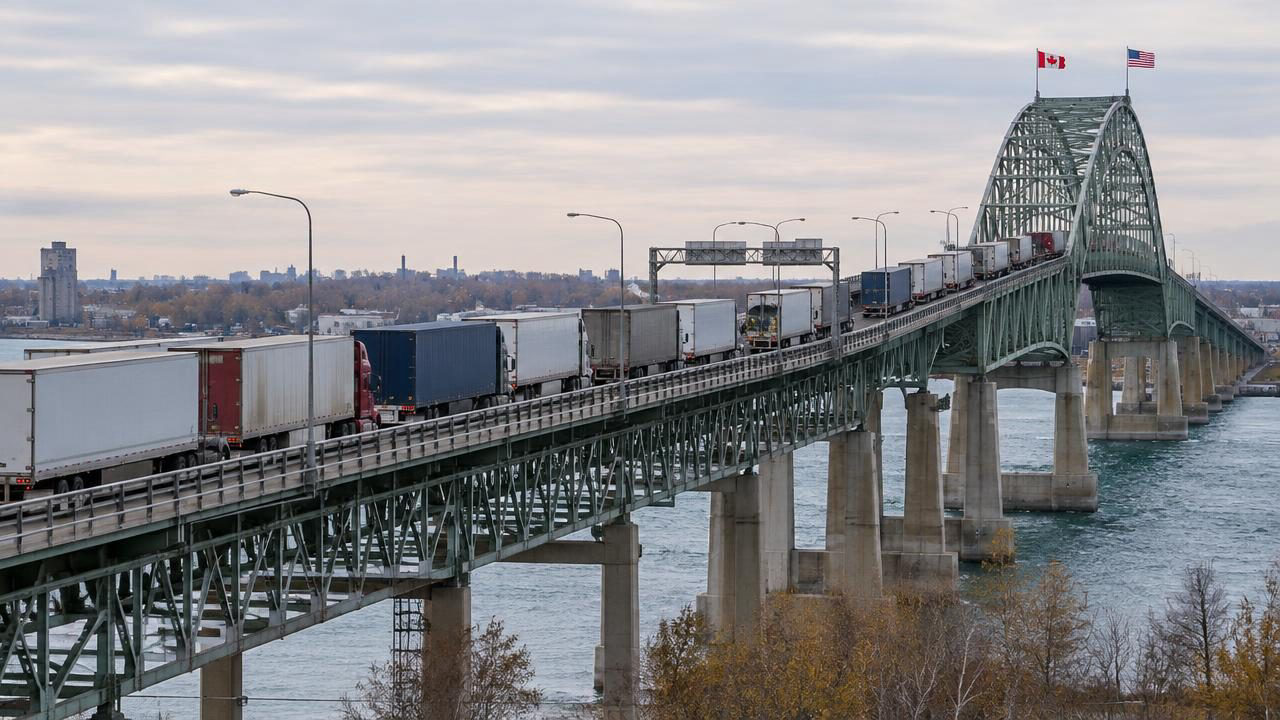
Average US tariff on Canadian goods
7.5 per cent
as of October 22, 2026, up from 5.0 per cent in July (Bank of Canada, October 2026 Monetary Policy Report).
Canadian exports to the US crossing tariff-free
about 80 per cent
as of October 22, 2026 (Bank of Canada).
Trade-policy uncertainty cost to GDP
0.4 per cent of the level of GDP in 2027, 0.2 per cent in 2028
Bank of Canada projection published October 28, 2026.
New Congress sworn in
January 3, 2027
two days after the announced 50 per cent rate on Canadian autos and steel (US Constitution, Twentieth Amendment; announced rate per CBS News, August 24, 2026).
CUSMA expiry without renewal
July 1, 2036
with a joint review every year until then (CUSMA Article 34.7; USTR statement, July 1, 2026).
Democrats won control of both the US House of Representatives and the Senate in the midterm elections of November 3, 2026, according to network projections reported on November 4 and 5, and the new Congress takes its seats on January 3, 2027. The tariffs now charged on Canadian goods rest on statutes that let a president act on his own authority, so changing them takes either a law that survives a presidential veto or a negotiated deal. Over the next decade, the bigger force on Canada's economy is the trade agreement's new calendar: the Canada-United States-Mexico Agreement now faces a review every year until it expires on July 1, 2036, unless the three countries extend it.
Canadian companies and households, along with the Bank of Canada, are left planning around a border whose rules can be reopened each summer. A Congress in different hands changes who can amend those rules. It does not change how often they come up for review.
What do US tariffs on Canada rest on today?
The tariffs that remain on Canadian goods come from three US trade laws: Section 232, Section 338 and, since July 24, 2026, a 10 per cent Section 301 duty from which goods qualifying under the trade agreement are exempt. The US Supreme Court ruled out a fourth law in February, and a fifth lapsed in July.
On February 20, 2026, the Supreme Court decided Learning Resources, Inc. v. Trump and held that the International Emergency Economic Powers Act (IEEPA), a 1977 sanctions law, "does not authorize the President to impose tariffs." The fentanyl and border tariffs on Canada had been imposed under that act and fell with it. Six justices joined the core of the ruling and three dissented.
The administration moved the same week. A proclamation signed on February 20 used Section 122 of the Trade Act of 1974, which allows a temporary surcharge to deal with balance-of-payments problems, to put a 10 per cent duty on most imports from February 24. Goods entering duty-free as Canadian under the trade agreement were excluded. The law caps that surcharge at 150 days unless Congress extends it, and it lapsed on July 24, 2026, without an extension.
On July 20, 2026, three proclamations invoked Section 338 of the Tariff Act of 1930 to add a 50 per cent duty on certain Canadian products, citing how Canada treats US alcohol and dairy products as well as US motor vehicles. The proclamations set the start for August 19; a further proclamation signed August 18 suspended the duties for three days, and they took effect on August 22. The Bank of Canada describes the goods covered as including machinery and equipment, plastics, furniture as well as wood and paper products, applied regardless of their treatment under the trade agreement.
The oldest layer is Section 232 of the Trade Expansion Act of 1962, which lets the president restrict imports on national-security grounds. It carries the sector tariffs on steel and aluminum, both at 50 per cent, and on autos, at 25 per cent on non-US content. On August 24, according to CBS News, President Donald Trump posted that tariffs on Canadian vehicles and parts, and on steel, would rise to 50 per cent on January 1, 2027.
The Bank of Canada's own tally, as of October 22, 2026, puts the average US tariff on Canadian goods at 7.5 per cent, up from 5.0 per cent in its July report, while about 80 per cent of Canadian goods exports to the United States still cross tariff-free.
Most trade still qualifies for the agreement's exemptions. Crude oil and other energy products are exempt from the Section 338 duties, as are potash and critical minerals, the Bank notes. Canada answered with counter-tariffs on about C$28 billion of US goods, and the Bank estimates Canada's average tariff on US imports at 3.9 per cent.
What can the new Congress actually change, and when?
The new Congress can change the laws behind the tariffs, but each change needs either a presidential signature or a two-thirds vote in both chambers to override a veto.
The calendar matters first. The Congress elected in 2024 serves until January 3, 2027, a lame-duck session that keeps the current majorities. The announced 50 per cent rate on autos and steel is dated January 1, 2027, two days before the new members are sworn in. A law aimed at that rate could not pass the new Congress before the rate starts, if it starts as announced.
After January 3, Congress has three kinds of tool. It can repeal or amend a statute, for example removing Section 338 or requiring its approval for new Section 232 tariffs. It can attach a trade provision to a bill that must pass, such as the annual spending bills or the defence authorization act. It can also hold hearings and question the US trade representative, the official who runs the negotiations.
The vote count is the constraint. Peter Harrell wrote on his Substack on November 6 that a bill limiting tariff powers would need roughly a dozen Republican votes in the Senate and about thirty in the House to override a veto. He also wrote that the president "is not going to sign any legislation that substantially constrains his tariff powers." That is his analysis, and the votes have not been counted on any such bill.
There is a precedent for the effort. On April 8, 2025, Senators Ron Wyden and Rand Paul introduced, with Chuck Schumer and Tim Kaine, a resolution to end the national emergency the global tariffs then rested on. Paul is a Republican; the other three are Democrats.
For Canada the consequence is timing. A change that survives a veto, or one folded into a spending bill the president signs, would alter what Canadian exporters pay. Neither has a date yet.
Why the CUSMA review calendar matters more than any single vote
The trade agreement's own review clause sets the rhythm for the decade, whoever controls Congress.
The Canada-United States-Mexico Agreement (CUSMA, called USMCA in the United States and ACEUM in French) took effect on July 1, 2020, with a term of 16 years. Article 34.7 required a joint review at the sixth anniversary, July 1, 2026, at which each government could confirm in writing that it wanted a new 16-year term. Canada wrote on June 1 that it supported renewal, and Mexico confirmed its support in a July 1 statement, according to the law firm White & Case.
The United States did not. "The United States did not agree to renew the USMCA in its current form," Ambassador Jamieson Greer, the US trade representative, said on July 1. His statement added that the agreement "remains in force pending resolution of these issues or until the Agreement's termination."
Under Article 34.7, that outcome triggers a joint review every year for the rest of the term. The agreement terminates on July 1, 2036, unless all three heads of government confirm a new term in writing at any of those reviews. Separately, Article 34.6 lets any party withdraw on six months' written notice.
A Congress cannot extend the agreement on its own; the confirmation is the president's. What Congress can do is weigh on the negotiation, through hearings, through the trade representative's reporting, and through the votes any amended agreement would need.
How a trade regime reopened every year shapes Canadian investment
The cost of annual reviews shows up less in tariff bills than in the investment that waits for clarity.
A company deciding whether to build a plant in Ontario to serve the US market is making a 20- or 30-year bet. When the terms of access can change at any July review, the rational move is often to delay, build smaller, or build on the US side. The Bank of Canada puts a number on that hesitation: in its October 2026 Monetary Policy Report, trade-policy uncertainty removes 0.4 per cent from the level of Canadian GDP in 2027 and 0.2 per cent in 2028.
The Bank's projection, published October 28, has GDP growth of 1 per cent in 2026 and about 2 per cent in 2027 and 2028, with business investment growing by about 4 per cent a year on average in 2027 and 2028. Export growth slows to around 1¼ per cent in 2027 as US tariffs restrain non-commodity exports, then picks up in 2028 as the tariff drag diminishes. The Bank holds current tariffs constant in that projection, so a higher rate in January, or a lower one later, would move those numbers in the next report.
A household feels this at one remove, through fewer new jobs in the towns that depend on those plants. Statistics Canada reported on November 4 that motor vehicle exports fell in September, with passenger cars and light trucks down 7.0 per cent from August.
The loonie and interest rates under a tariff regime
Tariffs pull on the Canadian dollar and on interest rates in opposite directions, which is why the Bank of Canada treats them carefully.
A tariff makes Canadian goods dearer in the US market. Fewer sales south of the border mean less demand for Canadian dollars, which tends to weaken the loonie. At the same time, Canada's counter-tariffs and a weaker currency raise the price of imports, which pushes up inflation at home. Slower growth argues for lower rates; higher prices argue for higher ones.
In October the Bank leaned toward the price side, for reasons that had more to do with oil than with trade. It raised its policy rate by a quarter point to 2.5 per cent on October 28, its first increase since 2023, citing the risk that high energy prices linked to the Middle East conflict spread to other prices, as Maple reported in its account of the decision. The Bank expects consumer price inflation to stay above 3 per cent through much of 2027.
For the currency, the Bank assumes the loonie averages 71 US cents over its projection, unchanged from July. On November 6, 2026, the Bank's daily rate was C$1.4113 per US dollar, or about 70.9 US cents, after C$1.3989 a day earlier. Maple's review of the August GDP figures covered the flat August economy and the currency's October.
A Congress that eventually narrowed the tariff tools would ease one of those pressures.
Which sectors are exposed and which are exempt
The exposure is concentrated in manufacturing and metals, while the resource exports that make up much of Canada's trade surplus are largely outside the tariffs.
| Sector | US measure | Rate on Canadian goods | Status as of November 7, 2026 |
|---|---|---|---|
| Steel | Section 232 | 50 per cent | In force; Trump post of August 24 names steel among goods going to 50 per cent on January 1, 2027 |
| Aluminum | Section 232 | 50 per cent | In force since June 4, 2025 |
| Autos and parts | Section 232 | 25 per cent on non-US content | Announced rise to 50 per cent on January 1, 2027 |
| Machinery; plastics; furniture; wood and paper products (among others) | Section 338 | 50 per cent | In force since August 22, 2026 |
| Crude oil, other energy, potash, critical minerals | Exempt from Section 338 | 0 per cent under the new duties | Exempt, per the Bank of Canada |
| Most CUSMA-qualifying goods | Agreement exemptions | 0 per cent | About 80 per cent of exports tariff-free |
Energy is the clearest case. Statistics Canada reported that energy exports rose 8.2 per cent in September, a second monthly gain, and the Bank of Canada's oil assumptions, from futures prices as of October 15, put Brent crude near US$100 a barrel on average in the fourth quarter of 2026. Potash and critical minerals share that exemption, so Saskatchewan's potash and the metals that the United States classes as critical cross without the new duties.
The exposed sectors are where diversification is being tested.
Is Canada finding other buyers? Aluminum is the measured case
Some diversification is visible in the data, and aluminum shows how much it takes.
Canada produces about 3.3 million tonnes of aluminum a year and exports about 90 per cent of it, Jean Simard, who heads the Aluminium Association of Canada, told BNN Bloomberg on November 4. Since the United States put a 25 per cent tariff on Canadian aluminum in March 2025 and doubled it on June 4, 2025, Canadian producers have shipped roughly 800,000 tonnes to Europe, he said, against about 100,000 tonnes in a normal period of the same length.
That is a large shift for one product, to a market farther away than the US Midwest. Andreas Schotter of Western University's Ivey Business School told the same outlet he does not expect a quick return to full tariff-free trade, noting that Democrats also lean toward protecting US industry.
Across all goods, the shift is slower. Statistics Canada reported that exports to countries other than the United States made up 29.8 per cent of Canada's merchandise exports in September 2026, down from 30.1 per cent in August. About seven dollars in ten still go south.
What does this do to Canada's long-run growth?
The longer-run cost of a trade regime that can change each year shows up in productivity, the output each worker produces, and in the economy's speed limit.
The Bank of Canada estimates potential output, the pace the economy can grow without stoking inflation, at just under 1½ per cent in 2026, about 1½ per cent in 2027 and about 1¾ per cent in 2028. It links the 2026 slowdown to slower population growth and the effects of US trade policy, including a drag on productivity that eases over the projection. Productivity suffers when plants run below the scale they were built for, when supply chains are rerouted, and when investment in new equipment is postponed.
A year of uncertainty can be absorbed. A decade of it compounds, because a postponed plant is capacity missing when demand recovers.
Three ways the decade could unfold
Each path below is tied to a named mechanism and a dated trigger. None is a forecast of how any vote will go.
The statutes stay as they are, through 2028. In this path no tariff law changes, either because no bill passes or because a veto holds. The trigger is January 1, 2027, when the announced 50 per cent rate on autos and steel is due, and the next joint review on July 1, 2027. The Bank of Canada's projection, with tariffs held constant, is the starting point; a higher auto rate would add to the drag on exports and investment the Bank already expects in 2027.
Congress narrows the tools. In this path Congress repeals Section 338 or requires its approval for new Section 232 tariffs, either with enough Republican votes to override a veto or inside a spending or defence bill the president signs. The triggers are the annual appropriations deadline, the start of the US federal fiscal year on October 1, and the yearly defence authorization. The Bank's July estimate of a 5.0 per cent average tariff, made before the Section 338 duties began, gives a rough sense of what removing them would change, with the Section 232 sector tariffs still in place.
A negotiated renewal resets the clock. In this path the three governments confirm a new 16-year term at one of the annual joint reviews, which would end the yearly cycle and move the agreement's expiry well beyond 2036. The trigger is any July 1 review between 2027 and 2035, and the mechanism is a written confirmation by each head of government. The Section 232 sector tariffs can apply even to goods that meet the agreement's rules of origin, which leaves steel and aluminum particularly exposed in those talks, according to the law firm Cain Lamarre.
If none of these happens by July 1, 2036, the agreement terminates and trade reverts to the rules each country applies to partners without a deal.
What the election leaves alone
Several forces on Canada's economy sit outside Congress's reach. The oil price is the main force on Canadian inflation this year, which is why the Bank of Canada cited energy prices, not tariffs, when it raised its rate on October 28. The review calendar was fixed in 2020.
Canadian ministers have framed their approach around that calendar. "Our job is to focus on what we can control, and that's to work with the people that Americans have elected," Dominic LeBlanc, the minister responsible for Canada-US trade, said on November 4, as reported by Global News. Ontario Premier Doug Ford said the same day that "the January tariffs are still on the table."
Two other Maple pieces this weekend cover the parts of this story that need their own space: an explainer on who in Washington can put a tariff on Canadian goods and take it off, statute by statute, and on Sunday, a walk-through of Ottawa's November 5 budget and what it assumes about US trade.
The midterms moved the votes in Washington. The dates that bind Canada's next decade, January 1, each July 1, and July 1, 2036, were already on the calendar.
Disclosure
Transparency note. This is an independent due-diligence analysis and editorial opinion piece produced by The Maple Markets editorial desk. It is not sponsored, promoted or commissioned, and no compensation of any kind has been received from any issuer, government body or organisation named in this article, or any party acting on their behalf. The analysis is based on public disclosure available as of the publish date; every figure is attributed to its primary source. The Maple Markets and its authors may hold positions in securities mentioned; nothing here is a recommendation to buy, sell or hold any security, and readers should not treat it as investment advice. Past disclosure does not guarantee future results. Policies: Editorial Standards · Financial Disclaimer.
Read next
Auch auf Deutsch: US-Zwischenwahlen und Kanadas Wirtschaft: Was der Kongress bis 2036 ändern kann
 MacroCan the New Congress End US Tariffs on Canada? Three Laws DecideA Democratic Congress can repeal or rewrite the laws behind US tariffs on Canada, but it cannot end them alone: the President must sign the bill or two-thirds of both chambers must override a veto. As of November 7, 2026, the duties rest on three statutes, Section 232, Section 338 and Section 301, and the new Congress sits on January 3, 2027.Priya Sandhu · November 7, 2026 · 9 min
 MacroCanada's Economy Was Flat in August, and the Loonie Ended October FirmerReal gross domestic product was essentially unchanged in August 2026, Statistics Canada said on October 30, 2026, the second flat month in a row, and was 1.5 per cent higher than in August 2025. An advance estimate shows a 0.1 per cent decline in September, which the agency said leaves third-quarter growth at 0.3 per cent. The Canadian dollar was worth US$0.7163 on October 30 by the Bank of Canada's daily average, up from its 2026 low of US$0.7007 on October 9, and the 2-year and 10-year Government of Canada benchmark yields were 3.36 and 3.84 per cent on October 29.Marc Belzile · October 31, 2026 · 8 min
 MacroA Quarter-Point Rate Rise Meets Canada's Last Big Mortgage RenewalsThe Bank of Canada raised its policy rate to 2.5% on October 28, its first increase since 2023. For mortgage holders the change arrives through two different doors: prime-linked variable loans adjust at once, and fixed-rate renewals follow the five-year bond yield. The Bank estimates the last large group of pandemic-era renewals, about 12% of all mortgages, faces payments about 15% higher, and that nearly all of it will have renewed by the second half of 2027.Marc Belzile · October 31, 2026 · 6 min
Get the Maple Morning Debrief
Yesterday's close, overnight, and what to watch before the open — in your inbox by 6 a.m. ET. Free, and one click to unsubscribe.
Follow and ask
Get more of our Canadian market coverage in Google Top Stories.
Sources and references (22)
- Bank of Canada, Monetary Policy Report, October 2026: tariff assumptions
- Bank of Canada, Monetary Policy Report, October 2026: Canadian outlook
- Supreme Court of the United States, Learning Resources, Inc. v. Trump, No. 24-1287, decided February 20, 2026
- Federal Register, Proclamation 11012, temporary import surcharge under Section 122, February 25, 2026
- Federal Register, Proclamation 11046, Section 338 duties, alcoholic beverages, July 23, 2026
- Federal Register, Proclamation 11047, Section 338 duties, dairy, July 23, 2026
- Federal Register, Proclamation 11048, Section 338 duties on certain products of Canada, motor vehicles, July 23, 2026
- Federal Register, Proclamation 11056, effective date of the Section 338 duties moved to August 22, 2026
- Office of the US Trade Representative, Ambassador Greer statement on the USMCA joint review, July 1, 2026
- Global Affairs Canada, CUSMA Chapter 34, Final Provisions (Articles 34.6 and 34.7)
- Statistics Canada, Canadian international merchandise trade, September 2026, released November 4, 2026
- Bank of Canada, daily USD/CAD exchange rate
- Bank of Canada, target for the overnight rate
- US Senate Finance Committee, Wyden, Paul, Schumer and Kaine resolution to repeal global tariffs (via)
- White & Case, USMCA 2026 joint review (via)
- Cain Lamarre, the USMCA after the July 1, 2026 review (via)
- Peter Harrell, What should the new Democratic Congress do on trade, November 6, 2026 (via)
- CBS News, Trump says tariffs on Canadian autos and steel will rise to 50% on January 1, 2027, August 24, 2026 (via)
- BNN Bloomberg, Canadian aluminum industry and the midterms, November 4, 2026 (via)
- Global News, US-Canada trade after the midterms, November 4, 2026 (via)
- Office of the US Trade Representative, Section 301 forced labor action, July 2026
- GHY International, CBP guidance on the Section 301 forced labor duties (via)
Cite this analysis
Please attribute The Maple Markets and link to the original page.
Hannah Kuan (November 7, 2026). US Midterms and Canada's Economy: What Congress Can Change Before 2036. The Maple Markets. https://themaplemarkets.ca/en/newsroom/what-the-us-midterm-results-mean-for-the-canadian-economy-over-the-nexthttps://themaplemarkets.ca/en/newsroom/what-the-us-midterm-results-mean-for-the-canadian-economy-over-the-next